

Table of Contents
- What the Skilled Immigration Act actually is
- Change 1: The Blue Card became much easier
- Change 2: The Opportunity Card (Chancenkarte)
- Change 3: Students got more freedom
- Change 4: Experience can replace paper recognition
- Change 5: Family and settlement got friendlier
- The honest caveats
- What this means in practice: three Indian profiles
- Frequently asked questions
🕑 7 min read
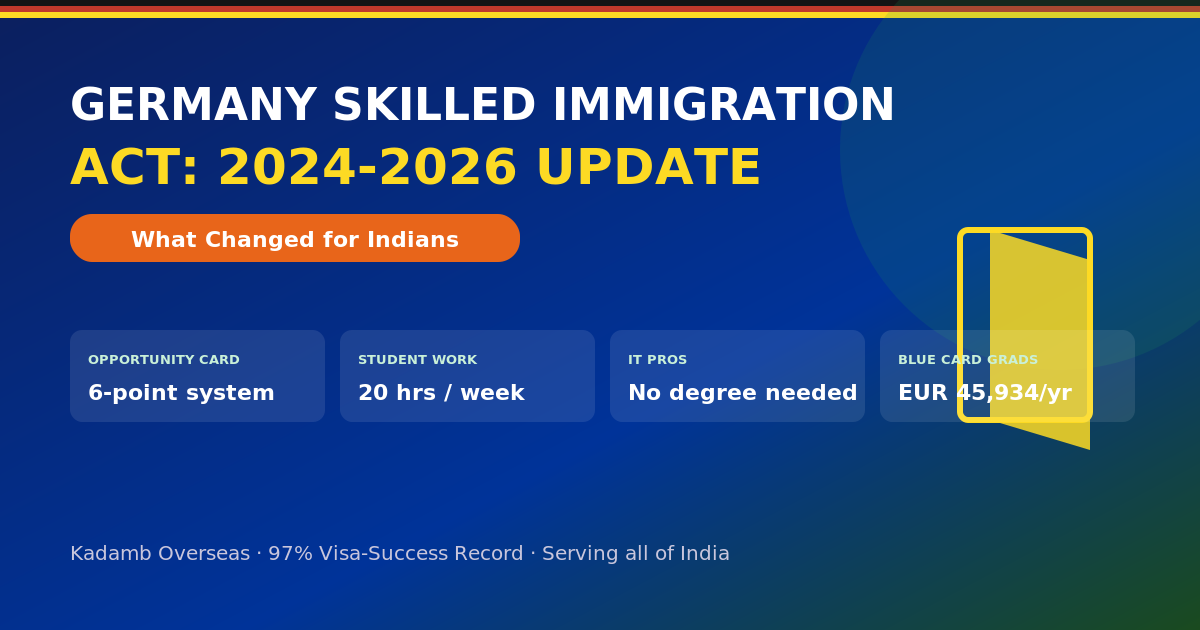
Quick answer: Germany’s Skilled Immigration Act (Fachkräfteeinwanderungsgesetz) reform, rolled out in stages from November 2023 to June 2024 and fully in force through 2026, is the biggest opening of the German labour market in decades. For Indians it changed five things: the EU Blue Card salary bars dropped and now sit at €50,700 / €45,934 for 2026; the Opportunity Card (Chancenkarte) lets you move to Germany for up to a year without a job offer on a 6-point system with proof of ~€1,091/month in funds; students may now work 20 hours a week (up from the old limits); IT professionals can qualify without a university degree; and work experience can substitute formal recognition in many hiring situations. Together they make Germany the most accessible major economy for Indian graduates in 2026.
What the Skilled Immigration Act actually is
Germany faces a shortfall of several hundred thousand skilled workers a year, and the Fachkräfteeinwanderungsgesetz 2.0 is the country’s legislative answer. Rather than one dramatic change, it is a bundle of amendments phased in across three dates — November 2023 (Blue Card easing), March 2024 (recognition and experience rules), and June 2024 (the Opportunity Card) — all fully operational through 2025–2026. The philosophy shifted from “prove your degree matches a German one before you come” to “come, work, and prove yourself”. For Indian students and professionals, that shift shows up at every stage: entry, study, job search and settlement.
Change 1: The Blue Card became much easier
The reform cut Blue Card salary thresholds sharply and widened who qualifies. For 2026 the numbers are €50,700 (standard) and €45,934.20 (shortage occupations and anyone within three years of graduation). IT specialists with three years of proven experience qualify with no degree at all. Since typical German starting salaries for engineers and developers land at or above the reduced bar, most Indian master’s graduates walk straight into Blue Card eligibility — and its 21–27-month PR track. We break the numbers down country-by-country in our EU Blue Card 2026 thresholds guide.
Change 2: The Opportunity Card (Chancenkarte)
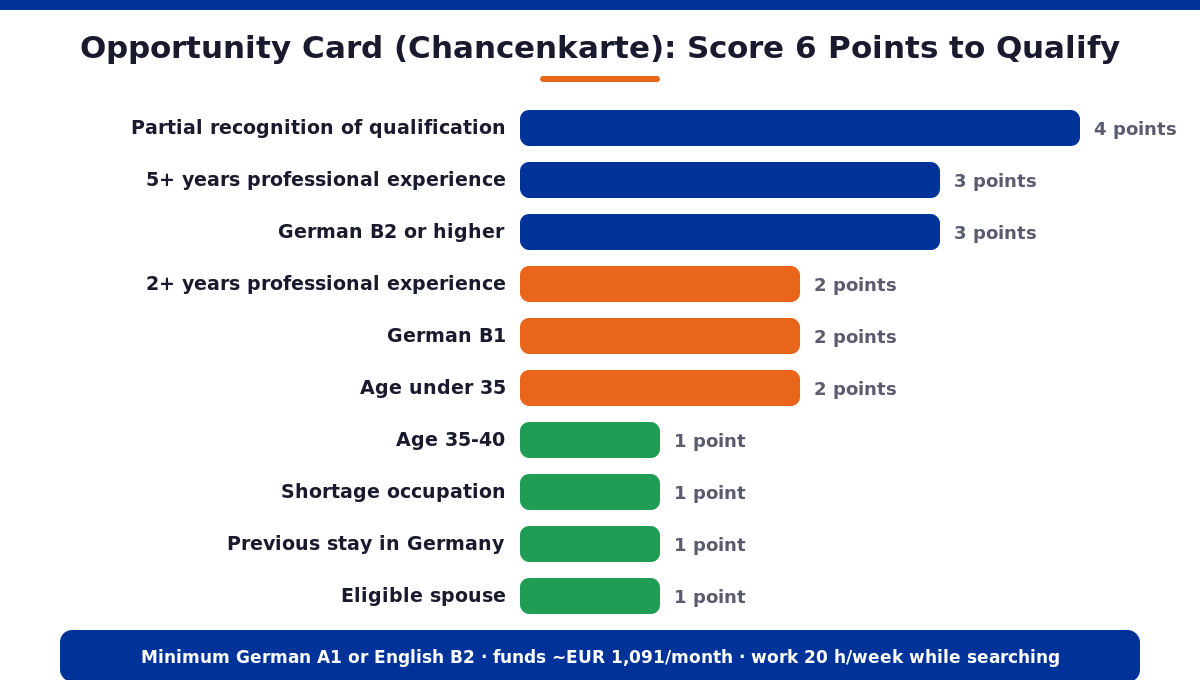
The headline innovation: a points-based job-seeker visa that requires no German job offer. You qualify automatically if your degree is fully recognised in Germany — or by scoring at least 6 points:
| Criterion | Points |
|---|---|
| Partial recognition of your qualification | 4 |
| 5+ years professional experience | 3 |
| German B2 or higher | 3 |
| 2+ years professional experience | 2 |
| German B1 | 2 |
| Under 35 years old | 2 |
| Age 35–40 | 1 |
| Shortage occupation (IT, engineering, health…) | 1 |
| Previous legal stay in Germany (6+ months) | 1 |
| Spouse also eligible for the card | 1 |
Language floor: German A1 or English B2. Funds: about €1,091 per month (≈€13,092/year for 2026), shown via blocked account or a part-time employment contract. While searching you may work 20 hours a week plus two-week job trials. A typical 27-year-old Indian engineer with a B.E., three years at an IT company and IELTS-level English scores 2 (age) + 2 (experience) + 1 (shortage occupation) — and reaches 6 with B1 German or partial recognition, which is exactly why we tell serious candidates to start German early.
Change 3: Students got more freedom
The reform raised the student work allowance to 20 hours per week during the semester (previously 120 full days a year), matching what students in the UK or Netherlands may work. Prospective students can even enter on an applicant visa and work restricted hours while finalising admission. Working-student (Werkstudent) roles at €13–17/hour now realistically cover living costs beyond rent — and, more importantly, they are the single best pipeline into a post-graduation job: German employers overwhelmingly hire graduates they already know. Combine this with the 18-month post-study job-seeker permit and the reduced graduate Blue Card bar, and the study route remains the highest-probability path — our complete Study in Germany guide maps it end to end, starting with the blocked account.
Change 4: Experience can replace paper recognition
Before the reform, most non-EU hires needed their degree formally recognised as equivalent to a German one — a months-long paperwork hurdle. Now, for non-regulated professions (most of IT, much of engineering and business), you can be hired with a degree + two years of relevant experience, skipping full recognition, provided the salary clears roughly €43,470 (2026 level, lower for under-45s with pension arrangements). Regulated professions — medicine, nursing, teaching, law — still require recognition, but the new “recognition partnership” lets you start working in Germany while the recognition completes, a major win for Indian nurses and doctors.
Change 5: Family and settlement got friendlier
The reform smoothed the parts of migration that decide whether people stay. Spouses of skilled workers and Blue Card holders arrive with immediate, unrestricted work rights and — for Blue Card families — no pre-arrival German test. New skilled workers under 45 must merely meet a modest salary floor or show retirement provision, closing an old trap that hit career-switchers. Settlement accelerated too: Blue Card holders reach PR in 21–27 months, other skilled workers in three years, and time spent studying in Germany counts at half rate. Parents of skilled workers who arrive from March 2024 onward even gained a (narrow) family-reunification pathway — a first in German law and a detail many Indian families ask us about.
The honest caveats
Two realities temper the headlines. First, the Opportunity Card is a search visa, not a job guarantee: candidates without German language skills or in-demand profiles do return home unplaced, which is why we screen profiles honestly before recommending it. Second, bureaucratic capacity lags the law — embassy appointment queues in India and Ausländerbehörde backlogs in big German cities can add weeks at every step. Build buffers into your timeline, prepare documents to embassy standard the first time, and treat B1 German as the single highest-return investment in your file whichever route you choose.
What this means in practice: three Indian profiles
Final-year B.Tech student: the master’s route is still your strongest play — German degree, 20 h/week work rights, 18-month job-seeker permit, graduate Blue Card bar. The Act made every step of that ladder easier.
Working IT professional, 3–5 years’ experience: two live options — Opportunity Card to search on the ground (start German now to hit 6 points), or direct Blue Card if you can land a remote-interviewed offer above €45,934–50,700.
Healthcare professional: the recognition partnership route: contract first, recognition alongside work. Demand for Indian nurses in Germany is at a record high.
Frequently asked questions
What did Germany’s Skilled Immigration Act change for Indian students?
Three things directly: work rights rose to 20 hours per week during the semester, the post-study path into the EU Blue Card got easier (graduates need only €45,934 in 2026), and family members of skilled workers gained smoother entry. The study-then-work route to German PR is now the most predictable in Europe.
How many points do I need for Germany Opportunity Card?
Six points — unless your degree is fully recognised in Germany, in which case you qualify without any points. Points come from experience (2–3), German language (2–3), age under 35 (2), shortage occupation (1), prior stay in Germany (1) and an eligible spouse (1), with a minimum of German A1 or English B2.
How much money do I need to show for the Chancenkarte in 2026?
About €1,091 per month of your stay — roughly €13,092 for a full year — via a blocked account, or a part-time job contract in Germany. You may work 20 hours per week while searching, which most Indians use to cover costs from month one.
Can IT professionals move to Germany without a degree?
Yes. Since the reform, IT specialists with at least three years of relevant professional experience can obtain an EU Blue Card without a university degree, if the offer meets the reduced salary threshold (€45,934.20 in 2026). This is one of the Act’s most-used provisions by Indian developers.
Is the Opportunity Card better than a student visa for Indians?
They serve different profiles. With under two years of work experience and no German, you likely won’t reach 6 points — and even if you do, employers prefer local credentials; the master’s route fixes both. With 3+ years of experience and B1 German, the Opportunity Card is faster and cheaper. Many of our clients run the two in parallel and take whichever lands first.
Does time on the Opportunity Card count toward German PR?
The search year itself does not, but the moment you convert to a Blue Card or skilled-worker permit, your PR clock starts — 21–27 months on the Blue Card track. Time as a student counts at half rate toward settlement, which shortens the total for the study route too.
Which German route fits your profile — study, Opportunity Card or Blue Card?
Kadamb Overseas evaluates your degree, experience and language level against all three pathways and manages the one that gets you to Germany fastest — for students and professionals from every state of India, with a 97% visa-success record.
Saumitra Rajput
Saumitra Rajput is the founder of Kadamb Overseas Pvt. Ltd., India's leading Europe-focused study abroad consultancy based in Ahmedabad. With 14+ years of expertise in European education, he has personally counselled 2,500+ Indian families and helped 500+ students secure admission to top European universities including TU Munich, ETH Zurich, EPFL, KU Leuven, HEC Paris, Sapienza Rome, TU Wien, and Warsaw University of Technology. He has visited 25+ European universities, partners with 250+ EU institutions, and maintains a 500+ students placed.
Planning to Study Abroad?
Get free expert guidance from our experienced counselors

Saumitra Rajput
Saumitra Rajput is the founder and lead counsellor at Kadamb Overseas, India's trusted Europe education consultancy based in Ahmedabad. With 14+ years of hands-on experience, he has personally guided 500+ students to universities across Germany, Switzerland, France, Italy, Austria, and Spain. Saumitra has visited partner universities across Europe, holds deep expertise in European visa processes, scholarships, and student life, and has achieved a 97% visa success rate for his clients. He is the host of the YouTube channel "Europe with Saumitra", where he shares first-hand insights on studying and living in Europe. His mission: make Europe accessible to every Indian student, with zero consultancy fees.