

Table of Contents
🕑 7 min read
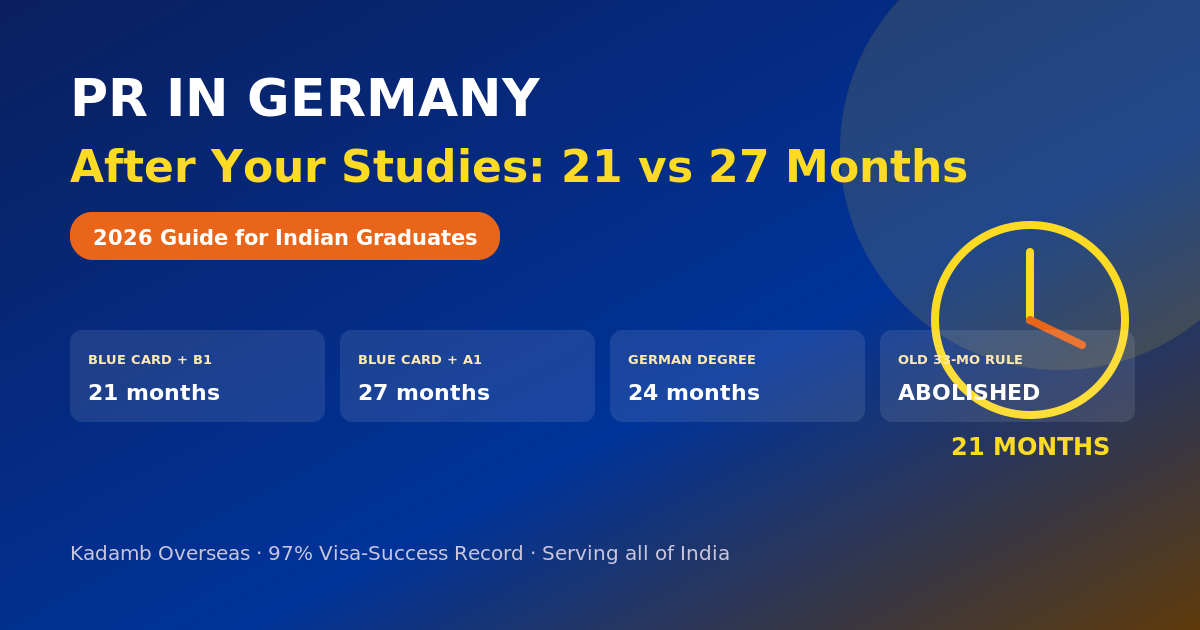
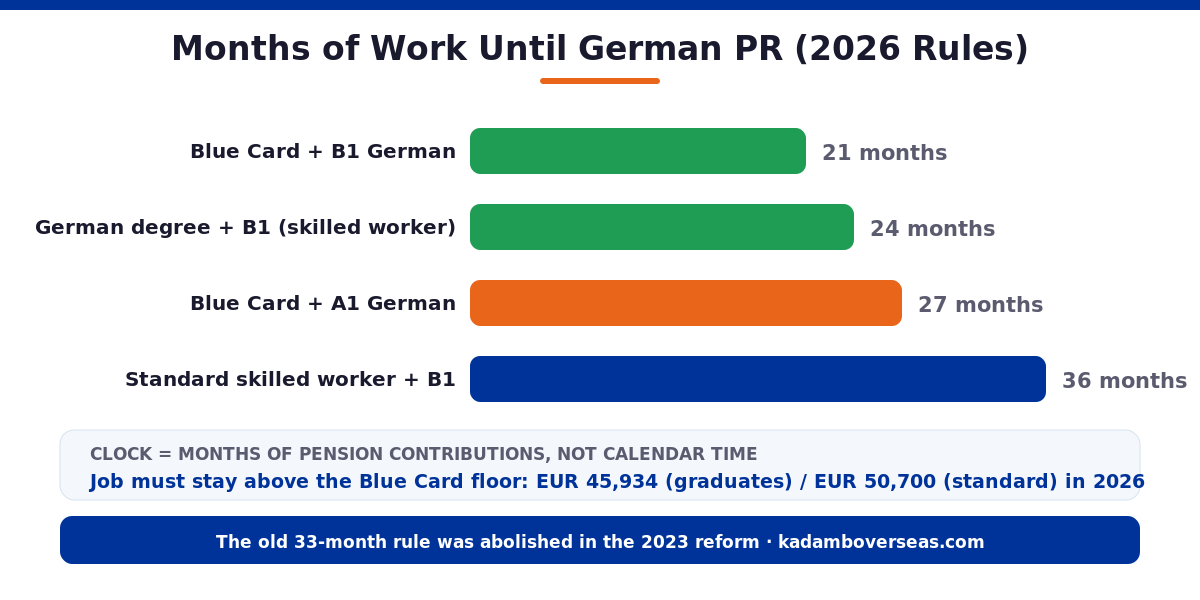
Quick answer: An Indian graduate of a German university can reach permanent residency (Niederlassungserlaubnis) in as little as 21 months after starting work. The fast lane runs through the EU Blue Card: 27 months of contributions, or just 21 months with B1 German (the old 33-month rule was scrapped in the 2023 reform). Without a Blue Card, skilled workers qualify after 36 months — and German-degree holders get a special track at 24 months. Half of your study time in Germany also counts toward some residence calculations. In practice: land a job above €45,934 (the 2026 graduate Blue Card floor), keep paying pension contributions, learn B1 German — and you can hold PR before your third work anniversary.
What German PR actually gives you
The Niederlassungserlaubnis (settlement permit) is unlimited residence: no more visa renewals, no employer dependence, freedom to change jobs, become self-employed, or take career breaks — plus easier mortgages and, for many, the psychological end of “visa life”. It is a separate thing from citizenship, which since the 2024 nationality reform is possible after 5 years of residence (3 in exceptional integration cases) with dual citizenship now permitted — a game-changer for Indians who previously refused to surrender their Indian passport (note: India itself does not allow dual citizenship, so taking German citizenship still means OCI status rather than an Indian passport). Most of our students aim for PR first and decide about citizenship later.
The four PR tracks, compared
| Track | Time to PR | Key conditions |
|---|---|---|
| Blue Card + B1 German | 21 months | 21 pension contributions, B1 certificate, job above threshold |
| Blue Card + A1 German | 27 months | 27 pension contributions, basic German (A1) |
| German-degree skilled worker | 24 months | Degree from a German university + skilled job + B1 + 24 contributions |
| Standard skilled worker | 36 months | Skilled-worker permit (§18a/b), B1, 36 contributions |
Two clarifications that save readers confusion. First, the widely-quoted “33 months” is outdated — the November 2023 Skilled Immigration Act reform cut the Blue Card’s standard track from 33 to 27 months. Second, the clock counts months of pension contributions, not calendar time in Germany: unpaid gaps pause it; your student years don’t count toward these specific tracks (though they count at 50% toward other residence-based rights and citizenship).
The graduate’s optimal timeline, step by step
Semester 1–4: study; work as a Werkstudent (20 h/week) — these months build German, savings and the network that produces your job offer (our Study in Germany guide covers this stage).
Month 0 (graduation): switch to the 18-month job-seeker permit — or straight to a Blue Card if you already hold a qualifying offer.
Month 0–4: sign a contract above €45,934 base (the 2026 reduced threshold for recent graduates); convert to the EU Blue Card. Your PR clock starts with the first payroll pension contribution.
Month 4–18: work; finish B1 German (one evening class per week is enough at this timescale); keep every payslip and contribution record.
Month 21–25 (of employment): file the Niederlassungserlaubnis application at the Ausländerbehörde with passport, Blue Card, employment contract, payslips, pension record (Rentenversicherungsverlauf), B1 certificate, health insurance proof, rental contract and the €113 fee. Processing typically takes 4–12 weeks depending on the city.
Total: PR roughly two years after your first paycheck — for many students, before their 27th birthday.
What can pause or break your PR clock
Job loss: the clock pauses (contributions stop) but doesn’t reset; the Blue Card’s grace periods let you find a new role.
Switching employers: harmless, as long as the new job still meets Blue Card conditions.
Freelancing: months without compulsory pension contributions usually don’t count — plan any switch to self-employment for after PR.
Long stays outside Germany: more than 6 continuous months abroad can cost you the permit; count sabbaticals carefully.
Late B1: nothing is lost — you simply file at 27 months instead of 21. But six months of PR earlier is worth one evening class a week; B1 also halves the citizenship residence requirement’s practical difficulty later.
PR vs citizenship: the 2026 decision landscape
With the 2024 nationality law, German citizenship needs 5 years of legal residence (your full study years count here), B1 German, financial self-sufficiency and a naturalisation test — and you may keep other citizenships Germany permits. For Indian nationals the practical trade-off is that India does not permit dual citizenship: naturalising in Germany means exchanging the Indian passport for OCI (lifelong visa-free access to India, most rights except voting, government office and agricultural land). Many of our alumni therefore hold PR indefinitely and revisit citizenship when family plans settle. PR needs no such trade — you remain fully Indian, permanently resident in Germany, with the EU long-term residence upgrade available after 5 years if you want mobility across Europe.
After PR: the EU long-term residence upgrade
PR holders often stop reading here, but one more status matters for ambitious careers: EU long-term residence (Daueraufenthalt-EU), available after five years of legal residence in Germany — and your student years count at 50% toward it. Unlike the national settlement permit, it travels: it gives simplified access to living and working in most other EU countries, so a Berlin data engineer can later take a role in Amsterdam or Vienna without restarting immigration from zero. Blue Card holders have an even smoother version of this mobility built in. The paperwork is nearly identical to the Niederlassungserlaubnis application plus a basic income-security check, and many Ausländerbehörden let you request both in one appointment. If there is any chance your career crosses borders, ask for the EU variant — same effort, strictly more freedom. One caution: unlike the national permit, EU long-term residence can lapse after extended absences from the EU, so frequent long stints in India argue for holding the national Niederlassungserlaubnis alongside it — German law allows you to hold both statuses simultaneously, and seasoned applicants routinely do exactly that for maximum flexibility.
Five mistakes that delay German PR
1. Taking a first job below the Blue Card bar. A €44,000 offer puts you on the 36-month track instead of 21–27. Negotiate the base above €45,934 — even at the cost of bonus — or keep interviewing.
2. Postponing German. B1 at month 21 is the whole difference between the fast and standard lane; starting classes only after two years wastes the advantage.
3. Gaps in pension contributions. Mini-jobs and freelance interludes often don’t contribute; check every contract’s pension status.
4. Missing paperwork hygiene. The application wants a contribution history — order your Rentenversicherungsverlauf annually so errors surface early.
5. Applying in the wrong city rhythm. Big-city Ausländerbehörden book out months ahead; request the PR appointment at month 18–19, not the week you become eligible.
Frequently asked questions
How long does it take to get PR in Germany after a master’s degree?
As little as 21 months of employment with an EU Blue Card and B1 German, or 27 months with basic German. Holders of a German degree on a normal skilled-worker permit qualify in 24 months with B1. In total, a typical student holds PR about 4–4.5 years after first arriving in Germany.
Is it 21, 27 or 33 months for Blue Card PR in Germany?
21 months with B1 German, 27 months with A1 — the 33-month figure is the pre-2024 rule, abolished by the Skilled Immigration Act reform. Any source still quoting 33 months is out of date.
Does study time in Germany count toward PR?
Not toward the 21/27-month Blue Card contribution counts — those need employment. But your study years count at 50% toward other residence-based calculations and count in full toward the 5-year citizenship requirement, so time as a student is never wasted.
What salary do I need for the fastest PR route in Germany?
Any job qualifying for the EU Blue Card: in 2026 that means €45,934.20 gross base for recent graduates and shortage occupations (IT, engineering, medicine), or €50,700 otherwise. Typical German starting salaries for master’s-level engineers clear the reduced bar.
Can my spouse get PR in Germany too?
Spouses of Blue Card holders work unrestricted from day one and can obtain their own settlement permit, generally after 3–5 years depending on their permit and language level; the family’s citizenship eligibility runs on the same 5-year residence clock. Children born in Germany to a parent with PR-track residence can acquire German citizenship at birth.
What documents are needed for the German PR application?
Passport, current residence permit, employment contract and recent payslips, pension insurance history (Rentenversicherungsverlauf), B1 (or A1) certificate, health-insurance confirmation, rental contract with Anmeldung, biometric photo and the fee (~€113). Cities vary slightly — check your Ausländerbehörde’s checklist when booking.
Plan your degree with PR as the destination
Kadamb Overseas maps the full India → German degree → Blue Card → PR timeline for students from Mumbai, Delhi, Bengaluru, Hyderabad, Pune, Ahmedabad and every state of India — program choice, budget and language plan aligned to the 21-month track, with a 97% visa-success record.
Saumitra Rajput
Saumitra Rajput is the founder of Kadamb Overseas Pvt. Ltd., India's leading Europe-focused study abroad consultancy based in Ahmedabad. With 14+ years of expertise in European education, he has personally counselled 2,500+ Indian families and helped 500+ students secure admission to top European universities including TU Munich, ETH Zurich, EPFL, KU Leuven, HEC Paris, Sapienza Rome, TU Wien, and Warsaw University of Technology. He has visited 25+ European universities, partners with 250+ EU institutions, and maintains a 500+ students placed.
Planning to Study Abroad?
Get free expert guidance from our experienced counselors

Saumitra Rajput
Saumitra Rajput is the founder and lead counsellor at Kadamb Overseas, India's trusted Europe education consultancy based in Ahmedabad. With 14+ years of hands-on experience, he has personally guided 500+ students to universities across Germany, Switzerland, France, Italy, Austria, and Spain. Saumitra has visited partner universities across Europe, holds deep expertise in European visa processes, scholarships, and student life, and has achieved a 97% visa success rate for his clients. He is the host of the YouTube channel "Europe with Saumitra", where he shares first-hand insights on studying and living in Europe. His mission: make Europe accessible to every Indian student, with zero consultancy fees.