

Table of Contents
💰 Europe Cost Calculator 2026 Updated
Country 1
Country 2
- What Indian graduates actually earn in Germany: 2026 benchmarks by role and city
- The Blue Card floor: the one number you cannot negotiate below
- When and how the salary conversation happens in Germany
- Beyond base: what else is negotiable (and what isn’t)
- Gross vs net: set your expectations in rupees correctly
- Scripts for the three moments that decide the number
- Five negotiation mistakes Indian graduates make in Germany
- Frequently asked questions
🕑 7 min read
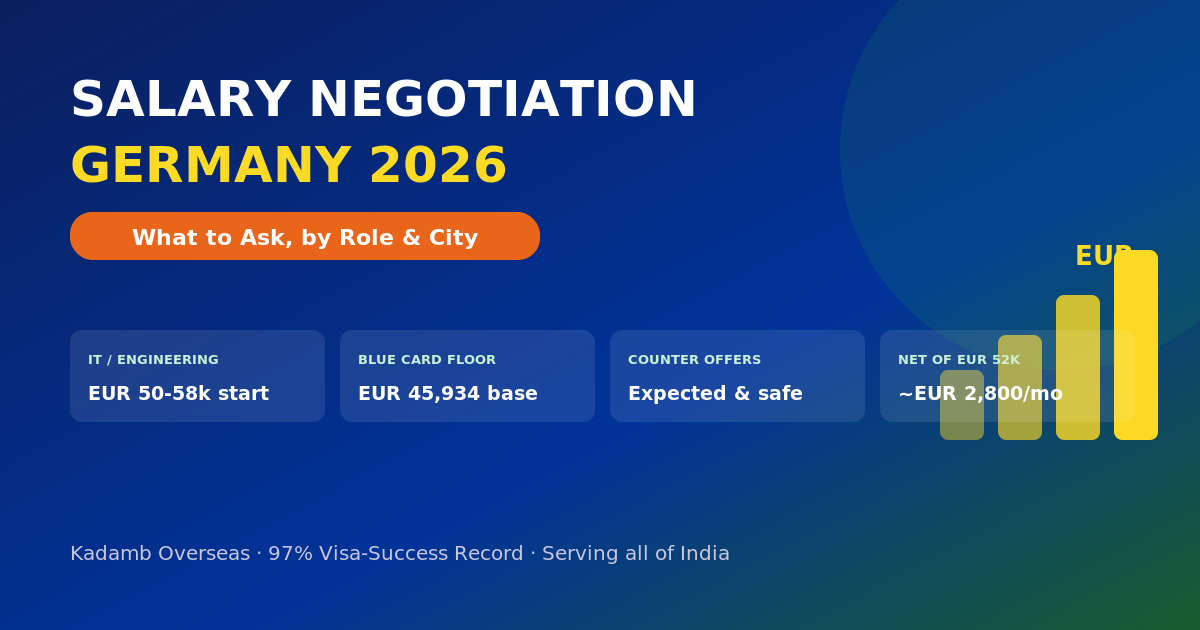
Quick answer: Fresh master’s graduates in Germany should ask for €50,000–58,000 in IT and engineering (Munich/Stuttgart top of range), €45,000–52,000 in business and analytics roles, and never accept a base below €45,934 if they want the fast EU Blue Card → PR track — the threshold counts base salary only, so trading base for bonus is the one negotiation mistake with immigration consequences. German salary talk is data-driven and unemotional: one well-researched number range, quoted gross per year, backed by StepStone/Kununu benchmarks, beats every bargaining tactic. Employers expect a counter — polite negotiation is normal and does not cost offers in Germany.
What Indian graduates actually earn in Germany: 2026 benchmarks by role and city
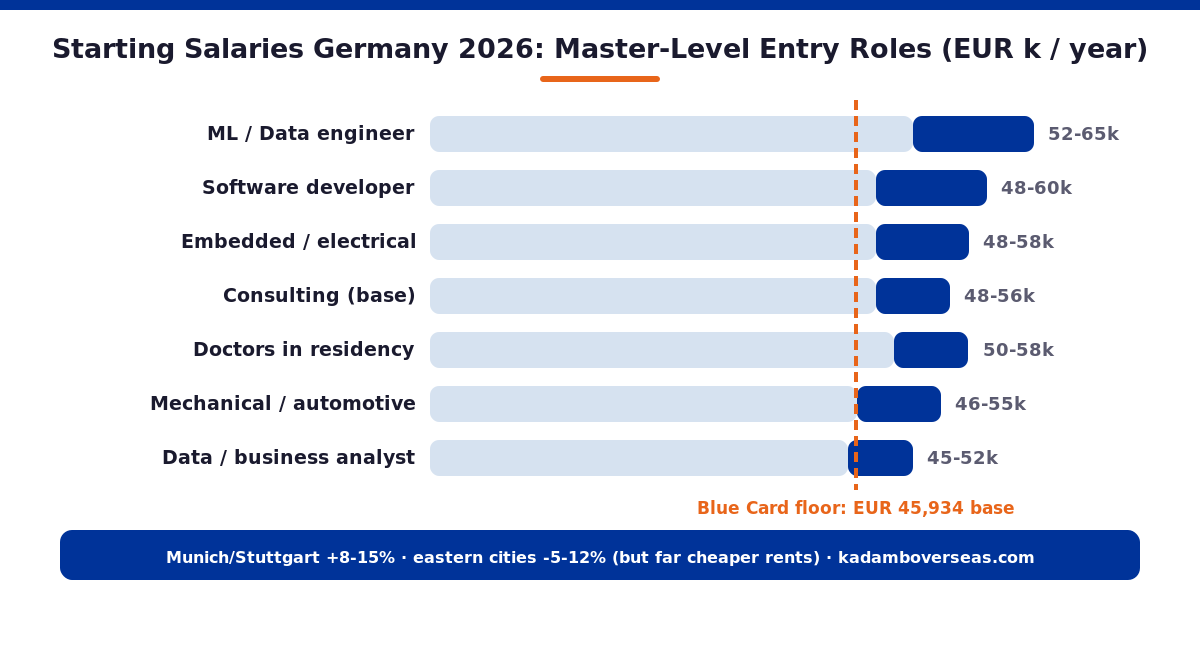
Anchor your ask in published data, not hope or fear. Realistic gross starting corridors for master’s-level entry roles in 2026 (1–3 years’ experience adds €5,000–12,000):
| Role | Typical start (gross/yr) | Notes |
|---|---|---|
| ML / Data engineer | €52,000–65,000 | Highest demand; Munich tops range |
| Software developer | €48,000–60,000 | Stack matters: cloud/SAP premium |
| Mechanical / automotive engineer | €46,000–55,000 | IG Metall tariff firms pay above market |
| Electrical / embedded engineer | €48,000–58,000 | Chip hubs (Dresden) rising fast |
| Data / business analyst | €45,000–52,000 | Watch the Blue Card floor here |
| Consulting (Big 4 / IT) | €48,000–56,000 + bonus | Bonus-heavy: verify the base |
| Doctors in residency | €50,000–58,000 | Tariff-regulated (TV-Ärzte) |
City adjustment: Munich and Stuttgart pay 8–15% above the national mid; Berlin startups pay slightly less cash (sometimes with equity); the eastern cities pay 5–12% less but rents are 30–50% lower — a €50,000 offer in Dresden usually nets more disposable income than €58,000 in Munich. Sources German recruiters themselves respect: the StepStone Gehaltsreport, Kununu company salary pages, Glassdoor, and for tariff companies the published IG Metall / ver.di tables.
The Blue Card floor: the one number you cannot negotiate below
Before any conversation, memorise the 2026 thresholds from our EU Blue Card guide: €45,934.20 base for recent graduates and shortage occupations, €50,700 otherwise. Two consequences follow. First, bonuses, stock and sign-on payments do not count — if an employer offers “€48k package: €43k base + €5k bonus”, that package fails the Blue Card test; ask to rebalance toward base and explain why in one sentence (“the residence-permit threshold counts base only”) — German HR departments know this rule and routinely accommodate it. Second, a below-floor offer puts you on the 36-month PR track instead of 21–27 months (see our PR in Germany guide) — six to fifteen months of your life is worth more than shyness in one meeting.
When and how the salary conversation happens in Germany
In the application: many German job ads ask for your Gehaltsvorstellung (salary expectation) in the cover letter. Give a single researched figure or tight range in gross annual terms (“Meine Gehaltsvorstellung liegt bei 52.000–56.000 € brutto jährlich”) — leaving it out when asked reads as evasive.
In the first interview: HR often re-confirms the number early to check budget fit. Repeat your range calmly; do not negotiate yet.
At offer stage: this is the real conversation. Thank them, ask for the offer in writing, take 2–3 days (“Ich melde mich bis Freitag” is perfectly normal), then counter once, in writing or on a call: a specific number, two sentences of justification anchored to benchmarks and your strongest proof points, and one non-salary ask as fallback.
A counter that works: “Thank you — I’m excited about the role. Based on StepStone’s benchmark for this position in Bavaria and my thesis work in exactly this domain, I was expecting €54,000. Is there room to move toward that?” Short, factual, collaborative. German counterparts respond to evidence and directness; they respond poorly to haggling theatre, invented competing offers, or emotional appeals.
Beyond base: what else is negotiable (and what isn’t)
Germany’s benefit landscape is more standardised than India’s — health insurance, ~20–30 vacation days, pension contributions and sick pay are set by law or policy, not negotiation. What does move: start date, remote/hybrid days, a guaranteed salary review at 6 or 12 months (the classic compromise when budget is truly capped — get it in the contract, not verbally), training budget, relocation support (€1,000–5,000 is common), job title (matters for your next move), and in startups equity/VSOP. In tariff-bound companies (much of automotive, machine building, public sector), base pay follows the published grade table — there you negotiate the grade placement and experience step, not the number itself; knowing which grade your role maps to is the entire game.
Gross vs net: set your expectations in rupees correctly
German taxes and social contributions take 35–42% of a single person’s gross at these levels. Roughly: €52,000 gross ≈ €2,750–2,850 net per month (tax class I, no church tax) — about ₹2.6–2.7 lakh per month at 2026 rates, in a country where a good one-bedroom outside Munich runs €700–1,100. Use a Brutto-Netto calculator before you anchor a number, so you negotiate the figure that actually matters to your life — and so you don’t mistake a €3,000 gross difference (worth ~€130/month net) for a life-changing gap while giving up something that matters more, like remote days or the review clause.
Scripts for the three moments that decide the number
When the ad demands a Gehaltsvorstellung and you fear pricing yourself out: give the benchmark mid-point, not your minimum — “Based on current market data for this role and region, my expectation is around €53,000 gross annually, with flexibility depending on the overall package.” The flexibility clause keeps doors open without surrendering the anchor.
When HR asks “What did you earn in your last job?”: redirect without refusing — “My previous compensation was in a different market with a different cost structure; for this role I’m benchmarking against German market data, which puts it at €52,000–56,000.” Calm, factual, closed.
When the offer is fair but the base sits just under the Blue Card line: name the constraint plainly — “I’d like to accept. One structural point: for my residence permit, base salary must be at least €45,934. Could we move €2,000 from the variable component into base? The total cost to you stays the same.” This ask succeeds far more often than candidates expect, because it costs the employer nothing and saves them paperwork later.
Practise each script aloud once. The words matter less than the fact that you have a prepared, unhurried answer — hesitation, not modest asks, is what lowers outcomes.
Five negotiation mistakes Indian graduates make in Germany
1. Accepting on the call out of gratitude. Enthusiasm is good; instant acceptance leaves money and the review clause on the table. Sleeping on any offer is expected.
2. Trading base for package. The Blue Card counts base only. Never let the base fall below €45,934 — whatever the package total says.
3. Anchoring on Indian salary history. Your Bengaluru CTC is irrelevant and quoting it invites lowballing. Anchor on German market data for the German role.
4. Inventing competing offers. Germany is a small, well-networked market and HR teams compare notes. Real leverage: keep interviewing until a contract is signed — a genuine second process changes the tone without a word of bluff.
5. Not negotiating at all. Surveys consistently show a majority of German employers leave room in the first offer and respect a well-founded counter. One polite, evidence-based ask is free; over a career it compounds into six figures.
Frequently asked questions
What salary should I ask for as a fresh graduate in Germany?
For master’s-level entry roles in 2026: €50,000–58,000 in IT/engineering, €45,000–52,000 in business/analytics, adjusted up ~10% for Munich/Stuttgart and down ~10% for smaller eastern cities. Quote a researched range in gross annual terms and keep the base above €45,934 for Blue Card eligibility.
Is salary negotiable in Germany for entry-level jobs?
Yes — a single well-founded counter is normal and expected, and does not endanger offers when framed politely with benchmark data. The exceptions are tariff-bound companies, where the table sets the pay and you negotiate grade placement and experience step instead.
What is a good salary in Germany for an Indian student after MS?
€50,000–55,000 gross is a strong start: roughly €2,700–2,900 net per month (₹2.5–2.75 lakh), comfortably above the Blue Card graduate threshold, and typically growing €5,000–12,000 within the first two to three years.
Do German employers ask for salary expectations upfront?
Frequently, yes — the Gehaltsvorstellung is a standard cover-letter element and an early interview question. Answer with one researched gross-annual figure or a tight range; refusing to name a number is read as unprepared, not as savvy.
Does bonus count toward the EU Blue Card salary threshold?
No. Only guaranteed gross base salary counts toward the €45,934/€50,700 thresholds (2026). If an offer relies on bonus to reach the number, ask to rebalance toward base — German HR knows the rule and usually can.
How much of my German gross salary is deducted as tax?
For a single person at €45,000–60,000 gross, expect 35–42% in income tax and social contributions (health, pension, unemployment, care), leaving roughly €2,500–3,100 net per month. Married couples and parents pay materially less via tax classes and allowances.
Negotiate from data, not guesswork
Kadamb Overseas prepares students from Mumbai, Delhi, Bengaluru, Hyderabad, Pune, Ahmedabad and all of India for the full German career path — role benchmarks, offer review and Blue Card–safe negotiation — with a 97% visa-success record behind every plan.
Saumitra Rajput
Saumitra Rajput is the founder of Kadamb Overseas Pvt. Ltd., India's leading Europe-focused study abroad consultancy based in Ahmedabad. With 14+ years of expertise in European education, he has personally counselled 2,500+ Indian families and helped 500+ students secure admission to top European universities including TU Munich, ETH Zurich, EPFL, KU Leuven, HEC Paris, Sapienza Rome, TU Wien, and Warsaw University of Technology. He has visited 25+ European universities, partners with 250+ EU institutions, and maintains a 500+ students placed.
Planning to Study Abroad?
Get free expert guidance from our experienced counselors

Saumitra Rajput
Saumitra Rajput is the founder and lead counsellor at Kadamb Overseas, India's trusted Europe education consultancy based in Ahmedabad. With 14+ years of hands-on experience, he has personally guided 500+ students to universities across Germany, Switzerland, France, Italy, Austria, and Spain. Saumitra has visited partner universities across Europe, holds deep expertise in European visa processes, scholarships, and student life, and has achieved a 97% visa success rate for his clients. He is the host of the YouTube channel "Europe with Saumitra", where he shares first-hand insights on studying and living in Europe. His mission: make Europe accessible to every Indian student, with zero consultancy fees.