World-class universities and grandes écoles, low public tuition, a two-year post-study work visa, and two of Europe’s most generous scholarships for Indian students. This is every cost, step and deadline you need.
✍️ Reviewed by Saumitra Rajput, Founder, Kadamb Overseas · 14+ years counselling Indian students to Europe · Updated September 2026France combines world-class institutions with low public tuition and a two-year post-study work visa (APS). Non-EU students pay a capped rate of €2,895/year (Bachelor’s) and €3,941/year (Master’s) at public universities — and many still charge the far lower EU rate by exemption. The Charpak (India-specific) and Eiffel scholarships are among the most generous in Europe, and 1,600+ programmes are taught in English. Your realistic all-in budget at a public university is ₹89–12.5 lakh a year.
For a generation of Indian families, studying abroad meant the UK, the US, Canada or Australia — and a loan the size of a house. France quietly changed that equation. At a public university, an Indian student can earn a globally respected degree for a capped tuition of a few thousand euros a year (and often far less, at the exempted EU rate), in a country that is home to Airbus, LVMH, L’Oréal, TotalEnergies, Dassault and a fast-growing Paris tech scene. Set that against £20,000–38,000 a year in the UK, and the maths becomes hard to argue with.
But cost is only half the story. France pairs two distinct systems: public universities, which are affordable and research-strong (Paris-Saclay is ranked number one in the world for mathematics), and the famous grandes écoles — small, elite, fiercely selective institutions like École Polytechnique, CentraleSupélec and HEC that produce much of France’s leadership. As an Indian student you can target either, and the right strategy usually blends both: an ambitious grande école as a reach, and an affordable public university as a strong, fundable match.
And France plans for you to stay. The two-year APS permit, the Talent Passport, and a job market hungry for engineers, data specialists and business graduates mean France is a career decision, not a two-year trip — provided you plan the whole ladder from the start, which is exactly what we help you do.
Not sure if France fits your profile?Get a free, honest assessment of your marks, budget and best-fit universities.
Book a Free Review →The headline is simple: public university tuition in France is a fraction of the UK or US, and your real budget is living costs. All figures verified for 2026 (≈ ₹90/€).
| Cost item | Amount | ≈ INR |
|---|---|---|
| Public university tuition — Bachelor’s (non-EU) | €2,895/yr | ₹2.6 lakh/yr |
| Public university tuition — Master’s (non-EU) | €3,941/yr | ₹3.5 lakh/yr |
| EU-rate exemption (many public unis) | ~€250/yr | ₹22,500/yr |
| CVEC student-life fee | €103/yr | ₹89,300 |
| Living — outside Paris | €615–900/mo | ₹55,000–81,000/mo |
| Living — Paris | €1,000–1,300/mo | ₹90,000–1.17 lakh/mo |
| Campus France processing fee | €70–250 | ₹6,300–22,500 |
Where you study matters. Paris is expensive; France’s excellent regional cities are far kinder to your budget.
| City | Monthly living cost | Notes |
|---|---|---|
| Paris | €1,000–1,300/mo | Most expensive; best jobs, grandes écoles |
| Lyon | €750–1,000/mo | Second city, strong engineering & business |
| Toulouse | €700–950/mo | Aerospace hub (Airbus), affordable |
| Grenoble | €650–900/mo | Tech & research, Alpine setting |
| Smaller cities (Rennes, Lille, Montpellier) | €600–850/mo | Cheapest, growing student life |
France’s system splits into research universities (low tuition) and grandes écoles (elite, selective, often pricier but funded). Each badge below is a monogram crest — your team can swap these for official logos where licensing allows.
Paris Sciences & Lettres is a collegiate powerhouse that groups some of France’s most storied institutions — Dauphine, Mines Paris, ENS, Chimie ParisTech and the Observatoire de Paris — under one roof. It is exceptional across the sciences, engineering, economics, mathematics and the humanities, with a research and Nobel pedigree that rivals anywhere in the world. For Indian students, PSL combines a globally recognised name with a growing catalogue of English-taught Master’s and, as a public group, tuition far below what its reputation would suggest. Admission to its selective programmes is competitive, so a strong academic record and a sharp application matter.
If your goal is elite engineering, the Institut Polytechnique de Paris belongs at the top of your list. It groups France’s most famous engineering school, École Polytechnique (“l’X”), with ENSTA, Télécom Paris, ENSAE and others on a single campus south of Paris. Its strength is deep in engineering, applied mathematics, data science, physics and artificial intelligence, and it runs a growing set of selective English-taught Master’s tightly linked to French industry and research. Graduates are among the most sought-after in Europe, and admission is genuinely rigorous.
One of Europe’s largest and most powerful research clusters, Université Paris-Saclay is ranked number one in the world for mathematics and sits among the global elite for physics and the sciences. It brings together universities, grandes écoles and national research bodies (CNRS, CEA) on a vast campus, giving students access to world-leading labs. For strong science, mathematics and engineering students, Paris-Saclay offers a rare combination — genuinely top-tier research at low public tuition — and a widening range of English-taught Master’s.
Heir to the historic University of Paris, Sorbonne University is one of France’s most prestigious institutions, strong across the arts, humanities, medicine, law and the natural sciences. It pairs a globally respected name with the resources of a large research university, and its growing English-taught graduate offer makes it increasingly accessible to Indian students in the sciences, data and the humanities. Sorbonne sits in the heart of Paris, with all the opportunity — and cost — that the capital brings.
A leading engineering grande école on the Paris-Saclay research cluster, CentraleSupélec is strong in energy, systems engineering, computing, signal processing and industrial engineering, with exceptionally deep partnerships across French industry — think EDF, Thales, Safran and Renault. Its programmes are selective and rigorous, and many are English-taught at Master’s level. For students aiming at a high-calibre engineering career in Europe, it is one of France’s finest, most industry-connected options.
France’s premier school for political science, international affairs, economics and public policy, Sciences Po is intensely international and English-friendly, with a global alumni network spanning heads of state, diplomats and business leaders. Its Master’s in international affairs, public policy, economics and management attract students from across the world, and its campuses blend rigorous academics with real-world engagement. For Indian students eyeing careers in policy, diplomacy, development or international business, few institutions open more doors.
Consistently ranked among the very best business schools in the world, HEC Paris is the pinnacle of French management education. Its Master in Management and MBA are elite, globally recruited and expensive, opening doors across international finance, consulting, luxury and technology. HEC is private and selective, and scholarships are limited, but for the right student the return on investment — in network, brand and career trajectory — is exceptional. It anchors a French business-school ecosystem that also includes INSEAD, ESSEC and ESCP.
One of France’s leading public engineering schools, INSA Lyon is strong in mechanical, civil, electrical, computer and materials engineering, with a five-year integrated model and strong ties to Lyon’s dense industrial base. Lyon itself is France’s affordable second city — a genuine student hub with far lower living costs than Paris and a strong graduate job market. For engineering students who want quality at low public tuition without the Paris price tag, INSA Lyon is a superb, often-overlooked choice.
A top technology and engineering group within Université Grenoble Alpes, Grenoble INP is excellent in electronics, energy, computing, and micro- and nanotechnology, sitting beside one of Europe’s most important research and semiconductor clusters (CEA-Leti, STMicroelectronics). Grenoble is an affordable, spectacularly located student city in the Alps, and the university’s deep industry and research links make it a strong route into deep-tech and R&D careers.
A large, broad research university formed from the merger of Paris Descartes and Paris Diderot, Université Paris Cité is strong in medicine, the health sciences, the natural sciences, data and the humanities. It offers the breadth and research depth of a major Paris institution at affordable public tuition, with a widening English-taught offer. For students who want a globally recognised Paris degree across the sciences or health fields without a grande-école price tag, it is an excellent option.
Tell us your degree, marks and target field. We’ll build a strategic list you can realistically get into — free.
France rewards students who study its strengths. These fields line up with its biggest industries and the best job prospects after graduation.
Toulouse is the global home of Airbus, and France leads Europe in aerospace, defence and advanced manufacturing. Schools like ISAE-SUPAERO, INSA, CentraleSupélec and the Polytechnique group feed directly into Airbus, Safran, Thales and Dassault, often with paid internships built into the degree. For students in aeronautics, propulsion, materials and mechanical design, France is one of the strongest destinations on earth.
A fast-growing field with excellent English-taught Master’s at Paris-Saclay, IPP, PSL and Grenoble, and a booming Paris tech and startup scene anchored by Station F — the world’s largest startup campus. France has invested heavily in AI research, and demand for data engineers, machine-learning specialists and software developers is high across finance, industry and the public sector.
France hosts several of the world’s best business schools — HEC, INSEAD, ESSEC and ESCP — while public universities and IAE business schools offer strong, affordable management and economics programmes. Whether you want an elite MBA or a value-for-money Master in Management, France has a route, and Paris’s growing corporate and finance sector is on your doorstep.
This is uniquely French. LVMH, Hermès, Chanel, Kering and L’Oréal anchor a global luxury and beauty industry headquartered in Paris, and specialist Master’s in luxury management, fashion, cosmetics and design open doors that exist nowhere else. For students drawn to this sector, France is not just an option — it is the source.
France is a world leader in nuclear and low-carbon energy, with TotalEnergies, EDF and a national push toward sustainability creating sustained demand for engineers and scientists. Programmes in energy systems, environmental engineering, hydrogen and nuclear technology sit in a policy-backed, future-proof job market.
Paris has grown into a major post-Brexit European finance hub, with global banks relocating operations from London. France’s grandes écoles and Paris-Saclay offer world-class quantitative finance, economics and financial engineering programmes, feeding a fast-growing Paris finance job market.
France has a deep tradition in architecture and design, with strong écoles d’architecture and design schools, and a culture that prizes the built environment. Affordable public options sit alongside prestigious specialist schools.
As the world’s most-visited country and the home of fine dining, France offers globally-respected hospitality, tourism and culinary programmes (including the famous institut Paul Bocuse and Ferrandi), leading to careers in a genuinely international industry.
France’s long-stay student visa (VLS-TS) is document-driven and predictable. Here is the sequence.
Apply and pre-enrol through the “Études en France” portal, and attend the Campus France interview — part of the process for most Indian students.
Receive your acceptance from a recognised French institution.
Show roughly €615/month (about €7,380/year) of financial resources for the visa.
Submit your long-stay student visa (VLS-TS) application at VFS Global with your full document set.
Once in France, validate your VLS-TS online within three months — it then acts as your residence permit for the year.
Students in France may work up to 964 hours per year — roughly 20 hours a week — alongside their studies, rising to full-time during holidays. France’s minimum wage (SMIC) is among the higher in Europe, so part-time work can meaningfully offset living costs, and campus jobs, tutoring and hospitality roles are common. Even more valuable are paid internships (stages), which are a formal, well-compensated part of most French Master’s programmes and frequently convert into a full-time job offer — the single most reliable route from student to employee. As everywhere in Europe, though, French language ability markedly improves both your part-time earnings and your post-study job search: many of the best-paid student roles, and nearly all customer-facing ones, need conversational French, which is why we push students to start learning it before they arrive. Part-time work should offset living costs — it should not be relied on to fund tuition, and students who over-work early often hurt the grades and the thesis that matter most for their careers.
Housing is your biggest expense and biggest challenge, especially in Paris. Options range from subsidised CROUS student residences (cheapest, but with waitlists) to private studios and shared flats (colocation). The government CAF housing allowance can refund a meaningful share of your rent — a genuinely useful benefit most students do not know to claim. Start your search the moment you are admitted; in Paris and Lyon especially, demand outstrips supply.
France offers an extraordinary quality of life — world-class food, art, history and café culture — and a superb, subsidised public-transport network, with student discounts on trains and city passes. There is a large, well-established Indian community in Paris, Lyon and Toulouse, with Indian grocery stores, restaurants and student associations that make settling in far smoother than families fear.
As an international student you register with France’s national health insurance (Sécurité Sociale étudiante), which covers most medical costs for free or at very low rates. Everyday costs are moderate outside Paris, and student life comes with a web of discounts — meals at CROUS canteens for a few euros, cheaper cinema, museums and transport.
You can study and initially live in English, but France rewards those who learn the language. Even A2–B1 French transforms your daily life, your part-time work options and how quickly you land a job after graduation. We strongly encourage students to start French before departure — it is one of the highest-return things you can do for your French future.
The most important award to know as an Indian student — it is designed specifically for you. Run by the French Embassy in India, Charpak offers monthly living stipends, tuition-fee waivers and visa-fee exemptions across several tracks (Master’s, exchange, research and short programmes). Because it is India-specific, it offers some of the strongest odds any Indian applicant will find, and it is the first award we help most students target.
France’s flagship government award for the very best international Master’s and PhD candidates. It funds a monthly allowance of up to ~€1,181, plus tuition, travel and health insurance. There is one catch that trips students up: you cannot apply directly — your host institution nominates you, so you must be admitted and have the university put you forward before the deadline. We plan for this from the start so the window is never missed.
Prestigious, EU-funded Master’s programmes delivered across two or more European countries, usually including a French institution. They typically cover full tuition, travel and a generous monthly living allowance — among the most complete funding packages anywhere, and an outstanding CV line. Ideal if you are open to studying in more than one country.
Many French universities and grandes écoles, along with some regions and foundations, run their own scholarships and fee reductions for international students. These are less famous and often under-applied for — which is exactly why they can be winnable. We check every award your profile qualifies for, not just the headline ones.
See our full scholarships guide for every European award and how we help you win them.
Master’s graduates can apply for the APS (Autorisation Provisoire de Séjour) — valid 12 months and renewable once, giving up to two years to find work or start a business, with full work rights during the search. Crucially, you can take any job while you look, so you are never left without income while hunting for a role in your field.
Convert your APS into a salaried work permit once you find a qualifying job. France actively retains skilled international graduates, and demand is strong in engineering, IT, data, finance, energy and the luxury sector. Starting salaries for engineering and business graduates typically run €35,000–48,000 a year, higher in finance, consulting and tech in Paris.
The multi-year “Passeport Talent” serves qualifying graduates, researchers, entrepreneurs and high earners, offering a longer, more stable permit and a clear route toward long-term residence and, eventually, permanent settlement. Plan the whole ladder — degree, APS, work permit, Talent Passport — from the start, and France becomes a career and a home, not just a two-year degree.
Every destination has a trade-off. Here is the honest side-by-side for an Indian student.
| Factor | France | Germany | UK |
|---|---|---|---|
| Public tuition/yr | €250–3,941 | €0 | £20–38k |
| Living /month | €615–1,300 | €850–1,100 | £1,200–1,600 |
| Post-study stay | 2 years (APS) | 18 months | 24 months |
| Language to study | English OK | English OK | English |
| Best for | Business, aero, luxury | STEM, free tuition | Speed, English |
The “Études en France” portal gates your visa. Begin it early — a late application is the most common reason a strong candidate loses an intake.
You can study in English, but skipping French limits your part-time work, your internships and your job search. Start at A1 before you fly.
Elite schools are fiercely selective and pricey. A smart mix of a public university (near-free) plus one or two grandes écoles is how ambition actually succeeds.
France’s best scholarships have fixed deadlines and Eiffel is applied for by the university. Miss the window and you miss the funding — we track every date.
French admissions read for fit. A recycled SOP is a fast route to rejection from a competitive programme.
Adjust the dates for your target intake, but keep the order — it protects you from losing a year.
Free consultation and profile assessment. Start French (A1) and book IELTS/TOEFL. Shortlist universities and grandes écoles.
Sit IELTS/TOEFL. Finalise your list. Draft your SOP and request LORs. Prepare Charpak/Eiffel applications.
Open and complete the Campus France “Études en France” application. Submit to universities.
Attend the Campus France interview. Receive offers and accept. Confirm scholarships.
Apply for the VLS-TS at VFS with proof of funds and admission. Begin the housing search.
Fly, validate your VLS-TS online, enrol, and start your studies — and your French life.
We are a Europe-focused consultancy in Ahmedabad, and France is one of our core destinations. We map your universities and grandes écoles, run the Campus France process on the right timeline, craft your SOP, target the Charpak and Eiffel scholarships, prepare your visa file, and plan the APS and career that come after — 500+ students placed, 97% visa success, 14+ years. Learn more about us.
Compare France with the rest of Europe — every guide is current for 2026.
Get a free profile assessment from Saumitra’s team — the right universities for your marks, your timeline, and a realistic budget in writing.
📞 +91 99131 42345 · ✉️ support@kadamboverseas.com · Mon–Sat, 10 AM–7 PM IST
Get free expert guidance from Kadamb Overseas. Trusted by thousands of Indian students since 2014.
Book Free Consultation WhatsApp UsFrance has over 3,500 higher education institutions and 350,000+ international students. Here are the top universities for Indian students:
| University | QS Rank | Annual Tuition (INR) | English Programs | Specialty |
|---|---|---|---|---|
| PSL University (Paris) | #24 | ₹1,500–₹4,000 | Yes | Sciences, Humanities, Business |
| Sorbonne University | #56 | ₹1,200–₹2,500 | Partial | Arts, Sciences, Medicine |
| École Polytechnique | #63 | ₹1,800–₹4,500 | Yes | Engineering, Science |
| HEC Paris (MBA) | Top 3 Biz | ₹12,000–₹45,000 | Yes | Business, Management |
| INSEAD | Top 1 MBA | ₹60,000–₹80,000 | Yes | Global MBA, Finance |
| Université Grenoble Alpes | Top 200 | ₹800–₹2,000 | Yes | Engineering, Computer Science |
| Sciences Po Paris | Top 250 | ₹1,000–₹3,000 | Yes | Political Science, International Relations |
| Université de Lyon | Top 200 | ₹500–₹1,500 | Partial | Engineering, Business |
| Toulouse Business School | Top 50 Biz | ₹6,000–₹12,000 | Yes | Business, Aviation Management |
| Mines Paris - PSL | Top 200 | ₹1,200–₹3,000 | Yes | Engineering, Energy |
Not sure which French university is right for you? Book a free consultation with our France education expert →
Jul 11, 2026
⚡ Quick Facts â Studying in 🇫🇷 France🏫 Tuition FeesFrom â¹170/year at public universities (grandes écoles: â¹1â3L)🏠 Living...
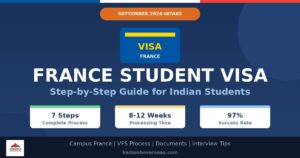
Jul 11, 2026
Overview of the French visa process for students The French visa process for students can be a bit...
Jul 11, 2026
⚡ Quick Facts â Studying in 🇫🇷 France🏫 Tuition FeesFrom â¹170/year at public universities (grandes écoles: â¹1â3L)🏠 Living...
Jul 11, 2026
⚡ Quick Facts â Studying in 🇫🇷 France🏫 Tuition FeesFrom â¹170/year at public universities (grandes écoles: â¹1â3L)🏠 Living...

601 MV House, Near Namaste Circle, Shahabad, Ahmedabad, Gujarat 380006
Copyright All Right Reserved 2026, Kadamb Overseas Pvt. Ltd. - Top Overseas Education Consultants
Australia Immigration: MARA Registered Agent — MARN: 1577771 (Feng Chen) | Partner: Kadamb Immigration & AICLA Global Pty Ltd, Perth, WA