
Table of Contents
- How the interview really works (and what officers score)
- Category 1: Purpose of travel (Q1–Q8)
- Category 2: University & academics (Q9–Q16)
- Category 3: Finances (Q17–Q24)
- Category 4: Accommodation & travel plan (Q25–Q30)
- Category 5: Career plans & return intent (Q31–Q38)
- Categories 6–7: Personal, family & curveballs (Q39–Q50)
- Five interview-day rules our 97% success rate is built on
- Frequently asked questions
🕑 7 min read
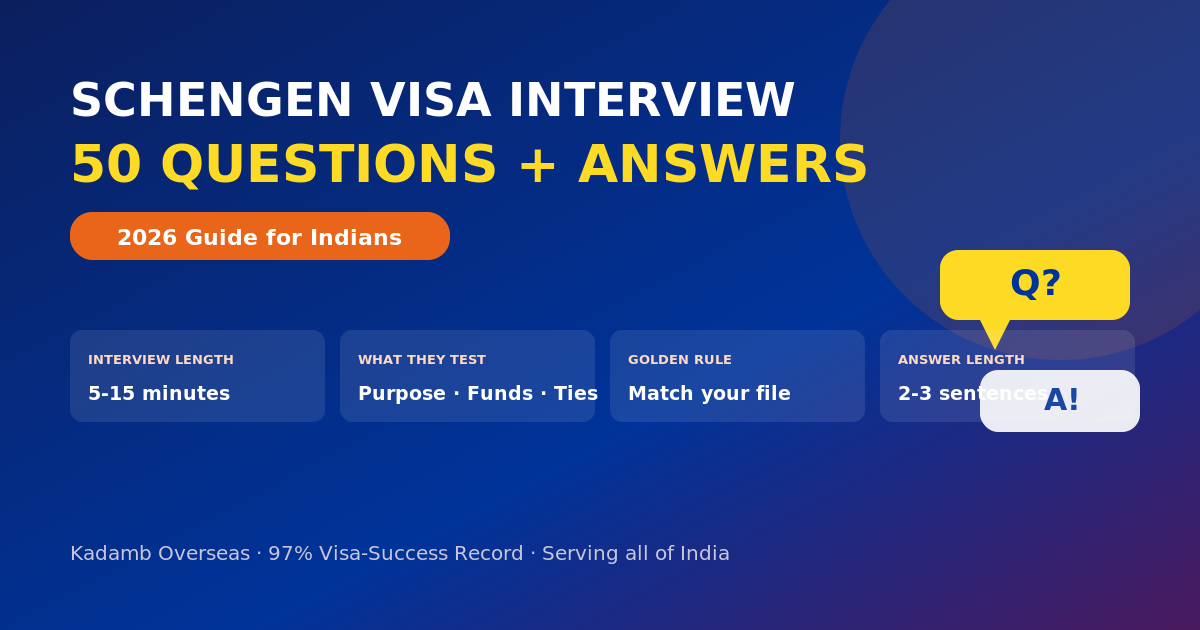
Quick answer: Schengen visa interviews — whether for a student long-stay (Type D) visa at the embassy or a short-stay visit at VFS — test three things: your real purpose of travel, your funds, and your ties to India (i.e., proof you will return or comply with your visa). Officers decide most files in under ten minutes, so answers must be short, specific and consistent with your documents. Below are the 50 questions Indian applicants actually get in 2026, grouped into seven categories, each with the ideal way to answer — drawn from the interview preparation we run for students across India before their France, Germany, Italy and Belgium appointments.
How the interview really works (and what officers score)
There is no trick psychology: the officer cross-checks what you say against what you submitted. Every answer should match your admission letter, bank statements, blocked account or sponsor file, itinerary and insurance to the digit and the date. Three silent scores decide the outcome: credibility (does your story hold together?), solvency (can you afford this trip or degree without illegal work?), and return/compliance intent (career logic for students; home ties for visitors). Rehearse out loud, keep answers to two or three sentences, and never volunteer information that wasn’t asked. The Schengen short-stay fee is €90 for adults; student Type D fees vary by country (Germany €75, France €50–99, Belgium €250 — see our Belgium Type D guide).
Category 1: Purpose of travel (Q1–Q8)
1. Why do you want to go to [country]? Name the university/program or the specific trip purpose — one concrete sentence, no speeches.
2. Why this country and not another? Give 2 program- or itinerary-specific reasons (ranking, specialisation, language, cost) — never “I love Europe”.
3. Why this university? Name the exact course, one lab/module/professor, and how it fits your background.
4. Why not study this in India? Point to curriculum, research infrastructure or global exposure — respectfully, without criticising Indian education.
5. How did you find this university/course? Honest answer: research portals, counsellor, alumni — consultants are perfectly acceptable to mention.
6. What is your course start date and duration? Exact dates from the admission letter — memorise them.
7. What will you study? Explain your course. A 3-sentence summary of the core modules and the degree awarded.
8. Have you been to Europe before? Yes/no plus dates and compliance (“returned within the visa validity”) if yes.
Category 2: University & academics (Q9–Q16)
9. Which other universities did you apply to? Name 2–3; it shows a genuine application season. Explain why you chose this one.
10. What was your previous academic performance? State percentage/CGPA plainly; if low, add one sentence on the upward trend or compensating strengths.
11. What is the medium of instruction? English (or German/French if applicable) — and your test score (IELTS/TOEFL/language certificate).
12. Do you speak the local language? Honest level; mention enrolled A1/A2 classes — effort counts.
13. What is your university’s ranking? Know one credible figure (QS/THE or national rank) — approximate is fine.
14. Who is your course coordinator / where is the campus? Know the city, campus name and faculty — it proves genuine research.
15. What are your tuition fees? Exact annual figure and what you have already paid, matching receipts.
16. Why is there a gap in your education? One-line truthful reason (work, exam preparation, family) with evidence if documentable.
Category 3: Finances (Q17–Q24)
17. Who is sponsoring your education? Name the sponsor and relationship; their occupation and annual income in one sentence.
18. What does your father/mother/sponsor do? Precise designation and employer/business — match the ITR papers.
19. How much does your entire program cost? Tuition + living for the full duration — show you’ve budgeted realistically.
20. Show/explain your proof of funds. Know your blocked account figure (Germany: €11,904/year), FD amounts and bank balances cold — our blocked account guide explains the German version.
21. What if your funds run out? Sponsor backup plus legal part-time work within permitted hours — named as a supplement, never the plan.
22. Will you work while studying? “My focus is the degree; I may take permitted part-time work (20 h/week) for experience.”
23. Have you taken an education loan? If yes: bank, amount, sanction letter details. Loans are a positive — they show committed financing.
24. Why is there a large recent deposit in your account? Explain the source honestly (FD maturity, property sale, loan disbursal) with the matching document.
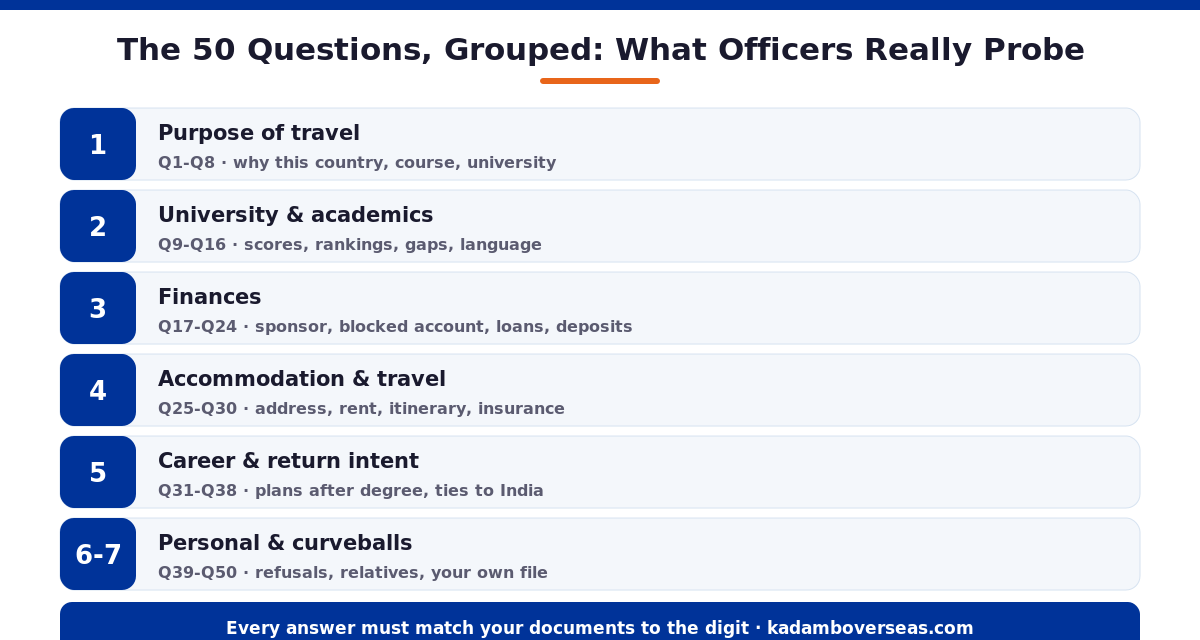
Category 4: Accommodation & travel plan (Q25–Q30)
25. Where will you stay? Exact address or dorm name; booking confirmation in file.
26. How much is your rent? The figure on your contract, plus utilities estimate.
27. When do you plan to travel? A date consistent with course start and visa processing.
28. Do you know anyone in [country]? Be truthful — relatives concealed and later discovered are a refusal classic.
29. What is your travel itinerary? (Visit visas) Day-wise outline matching hotel bookings.
30. Do you have travel insurance? Yes — provider, coverage (≥€30,000 for short stay) and validity dates.
Category 5: Career plans & return intent (Q31–Q38)
31. What will you do after your degree? A concrete career path: target roles, industries, and how the degree enables them.
32. Will you come back to India? For short-stay: an unambiguous yes with ties. For students: honest and legal — “I’ll follow the visa rules; my long-term goal is [career], whether in India’s growing [sector] or wherever my legal options allow.”
33. Why should we give you this visa? Summarise in three points: genuine admission/purpose, full funding, clean documented profile.
34. What are your ties to India? Family, property, family business, job letter of resumption — whatever genuinely applies.
35. What salary do you expect after graduating? A realistic researched range for the field — wild numbers damage credibility.
36. Do you plan to settle abroad? Never promise or deny emphatically; anchor to the legal pathway: “My decisions will follow the rules of my visa; right now my focus is the degree.”
37. What is your backup if the visa is refused? Reapply after addressing the reason — shows planning, not desperation.
38. How does this course fit your past studies/work? One clean narrative line from B.Tech/B.Com/work experience to this program.
Categories 6–7: Personal, family & curveballs (Q39–Q50)
39. Are you married? Will your spouse join you? Truthful; if yes, mention the dependent-visa plan and funding.
40. What do your parents think about this? Supportive one-liner.
41. Have you ever been refused a visa? Never lie — refusals are on record. State the reason and what changed since.
42. Do you have relatives in any Schengen country? Same rule: full honesty.
43. What is your father’s/sponsor’s annual income? The ITR figure, in INR and roughly in euros.
44. Tell me about your city/state. Rapport question — relax, answer briefly.
45. Why is your IELTS score low? Own it, note the university accepted it, and mention stronger academic indicators.
46. What will you do on weekends / outside class? Light, genuine answer — sports, exploring, student clubs.
47. Who packed your documents / prepared your file? “I prepared it with guidance from my consultant” is fine; know every paper in it.
48. Can you explain this document? The killer test — be able to explain every single page you submitted.
49. What is your blood relation with your sponsor? Plain answer with the affidavit reference if a non-parent sponsors you.
50. Is there anything you want to add? One closing sentence: purpose + funding + confidence. Then thank the officer.
Five interview-day rules our 97% success rate is built on
Match the file: every number you say must equal the number on paper. Short answers win: 2–3 sentences; silence after an answer is fine. Never lie: refusals for misrepresentation (and Article 34 revocations) haunt future applications for years. Dress and arrive like it matters: business casual, 30 minutes early, phone off. Practise aloud twice: once with a friend, once recorded — hearing yourself removes 80% of the stumbles. For country-specific document checklists, start from our Germany and France guides.
Frequently asked questions
Is an interview mandatory for a Schengen visa from India?
Short-stay applications via VFS often need only biometrics, but consulates can call any applicant for an interview. Student long-stay (Type D) visas for countries like France (Campus France interview), Belgium and Italy routinely include one. Prepare as if the interview is certain.
How long does a Schengen visa interview last?
Typically 5–15 minutes. Officers form an impression in the first two or three answers, so your purpose-of-travel and funding answers must be word-perfect.
What is the most common reason for Schengen visa rejection for Indians?
Doubt about purpose or return — usually triggered by inconsistent answers, unexplained bank deposits, or weak ties to India. Consistency between your spoken answers and your documents prevents most refusals.
Can I answer the Schengen interview in Hindi or my regional language?
Interviews for student visas are generally in English (or the destination language if you claimed proficiency). Some consulates offer interpreters for visit visas, but answering confidently in English strengthens a student application.
What should I wear to a visa interview?
Business casual — neat, simple, comfortable. You are presenting yourself as a serious student or traveller; no formal suit required, but avoid casual streetwear.
What happens if my Schengen visa is refused after the interview?
You receive the refusal ground(s) in writing and may appeal or reapply once you fix the underlying issue — better funds documentation, clearer purpose, corrected inconsistencies. A refusal is not a ban; well-corrected reapplications succeed regularly.
Walk into your visa interview fully rehearsed
Kadamb Overseas runs mock visa interviews with country-specific question banks for students from Mumbai, Delhi, Bengaluru, Hyderabad, Pune, Ahmedabad and every corner of India — part of the process behind our 97% visa-success record.
Saumitra Rajput
Saumitra Rajput is the founder of Kadamb Overseas Pvt. Ltd., India's leading Europe-focused study abroad consultancy based in Ahmedabad. With 14+ years of expertise in European education, he has personally counselled 2,500+ Indian families and helped 500+ students secure admission to top European universities including TU Munich, ETH Zurich, EPFL, KU Leuven, HEC Paris, Sapienza Rome, TU Wien, and Warsaw University of Technology. He has visited 25+ European universities, partners with 250+ EU institutions, and maintains a 500+ students placed.
Planning to Study Abroad?
Get free expert guidance from our experienced counselors

Saumitra Rajput
Saumitra Rajput is the founder and lead counsellor at Kadamb Overseas, India's trusted Europe education consultancy based in Ahmedabad. With 14+ years of hands-on experience, he has personally guided 500+ students to universities across Germany, Switzerland, France, Italy, Austria, and Spain. Saumitra has visited partner universities across Europe, holds deep expertise in European visa processes, scholarships, and student life, and has achieved a 97% visa success rate for his clients. He is the host of the YouTube channel "Europe with Saumitra", where he shares first-hand insights on studying and living in Europe. His mission: make Europe accessible to every Indian student, with zero consultancy fees.