

Table of Contents
💰 Europe Cost Calculator 2026 Updated
Country 1
Country 2
- What is the EU Blue Card, in plain words?
- EU Blue Card salary thresholds 2026, country by country
- Who qualifies: the 2026 requirements
- From Indian student to Blue Card holder: the proven pathway
- Blue Card benefits Indians care about most
- Blue Card vs Germany’s Opportunity Card vs national work permits
- Which Indian professionals clear the threshold most easily?
- Common mistakes that get Blue Card applications refused
- Frequently asked questions
🕑 7 min read
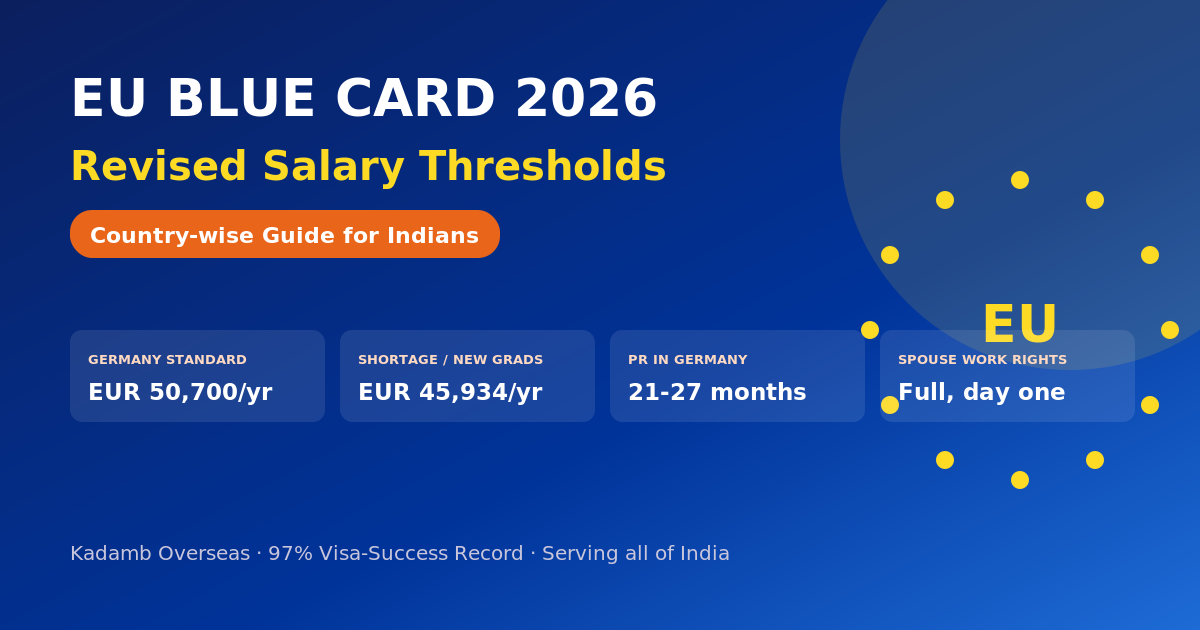
Quick answer: From 1 January 2026, the EU Blue Card in Germany requires a gross salary of €50,700 per year for standard occupations, or €45,934.20 for shortage occupations, IT specialists and graduates within three years of their degree. The Netherlands requires about €5,942 gross per month (€4,754 for recent graduates), Austria €55,678 per year, and France around €59,373 per year. For Indian students and engineers, the Blue Card remains the fastest, most predictable route to living, working and getting permanent residency in Europe — and typical tech, engineering and healthcare salaries clear these thresholds comfortably.
What is the EU Blue Card, in plain words?
The EU Blue Card is a residence-and-work permit for university-educated professionals from outside the EU, valid in 25 EU countries (Ireland and Denmark run their own systems). Think of it as Europe’s answer to the US H-1B — but with three decisive differences for Indians: there is no lottery and no quota, your spouse gets full work rights immediately, and it leads to permanent residency on a fixed, published timeline. If you meet the salary threshold and hold a recognised degree, the card is effectively yours; approval is a legal entitlement, not an employer’s sponsorship gamble.
Since the reformed Blue Card directive took effect, holders can also move between EU countries after 12 months — start in Germany, switch to the Netherlands later — while keeping the residency clock running toward EU long-term residence.
EU Blue Card salary thresholds 2026, country by country
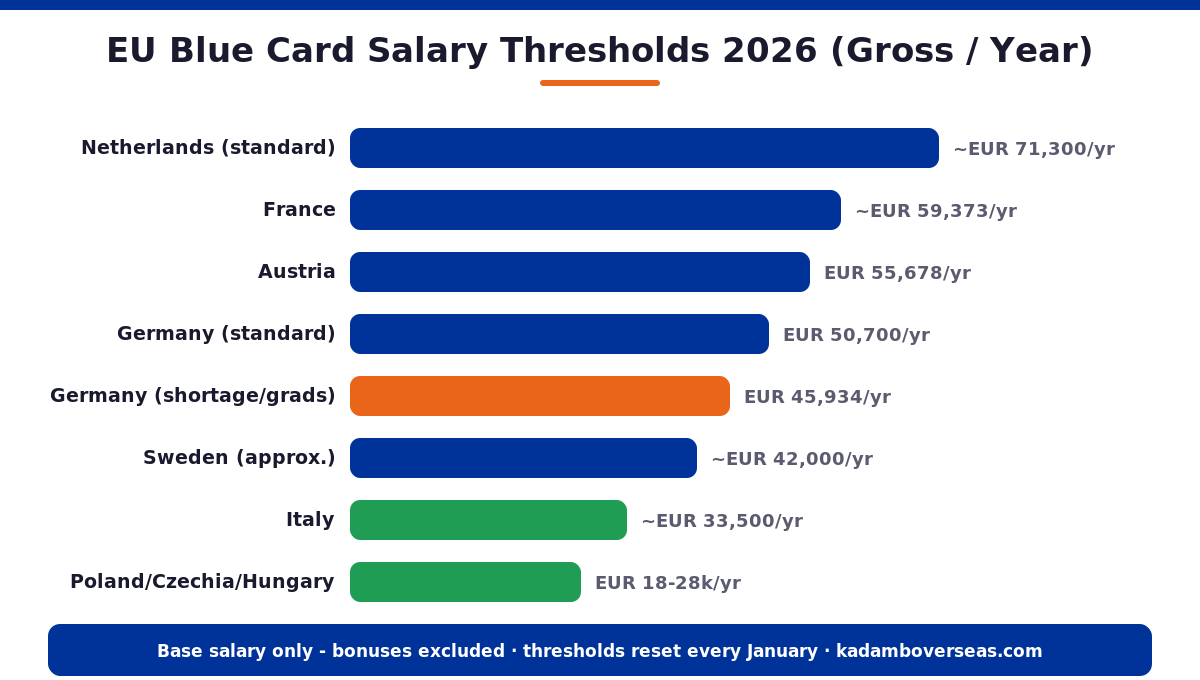
Thresholds are updated every January and count guaranteed gross base salary only — bonuses, stock and sign-on payments are excluded. These are the figures Indian applicants need for 2026:
| Country | Standard threshold (2026) | Reduced (shortage / new graduates) |
|---|---|---|
| Germany | €50,700 / year | €45,934.20 / year |
| Netherlands | ~€5,942 / month | ~€4,754 / month (under 30 / recent grads) |
| Austria | €55,678 / year | RWR Card alternative from ~€3,465 / month |
| France | ~€59,373 / year (1.5× avg salary) | — |
| Sweden | ~SEK 34,470 / month (from June 2026) | — |
| Italy | ~€33,500 / year | one of Europe’s lowest bars |
| Poland / Czechia / Hungary | €18,000–28,000 / year (local formulas) | easiest thresholds in the EU |
Figures effective January 2026 (Sweden from 1 June 2026); always confirm with the national immigration authority before signing a contract, as thresholds are revised annually.
Who qualifies: the 2026 requirements
- A recognised university degree — your Indian B.Tech/B.E., MBBS or master’s counts if the university is listed in the anabin database (most Indian universities are). For Germany, IT professionals can qualify without a degree with 3+ years of proven experience.
- A job offer or contract of at least 6 months in the country of application, meeting the salary threshold.
- The job must match your qualification — a computer-science graduate hired as a data engineer qualifies; the same graduate hired as a café manager does not.
The reduced German threshold of €45,934.20 covers what most Indian applicants actually are: engineers, IT and communications specialists, scientists, mathematicians, doctors and pharmacists — plus every graduate within three years of finishing their degree. A fresh master’s graduate from a German university therefore only needs €45,934 — roughly the median starting salary for engineering roles.
From Indian student to Blue Card holder: the proven pathway
This is the route our students follow, and why we recommend studying in Europe rather than applying for the Blue Card directly from India:
Step 1 — Master’s in Europe (2 years). Pick a program in a shortage field — AI/ML, data science, mechanical or electrical engineering, life sciences. Our guide to the top 20 AI & ML master’s programs in Europe is the natural starting point.
Step 2 — Post-study job-seeker permit. Germany grants 18 months, the Netherlands a 12-month orientation year, Belgium and Ireland up to 24 months. You are legally resident while you interview.
Step 3 — First job above the reduced threshold. As a recent graduate you need only the lower bar (€45,934 in Germany). Average German starting salaries for master’s-level engineers are €48,000–55,000, so most offers qualify automatically.
Step 4 — Permanent residency. Blue Card holders in Germany reach PR in 27 months, or just 21 months with B1 German. Compare that with a decade-plus of H-1B uncertainty in the US.
Local employers treat a European degree as proof your qualification needs no recognition procedure — one more reason the study-first route beats direct application for most profiles. Start with our complete Study in Germany guide to plan the first step, including the blocked account you will need for the student visa.
Blue Card benefits Indians care about most
- Family: your spouse receives a residence permit with unrestricted work rights from day one — no separate application, no salary requirement, no German/Dutch language test before arrival.
- PR clock: 21–27 months in Germany; five years to EU long-term residence counted across member states.
- Mobility: after 12 months in the first country, you can take a job in another Blue Card country under simplified rules.
- Unemployment buffer: losing your job no longer cancels the card immediately — you get three months (or more, after two years of holding it) to find a new role.
- Trips home: the card tolerates longer absences than a normal permit — up to 12 months outside the EU without losing status.
Blue Card vs Germany’s Opportunity Card vs national work permits
Indians researching German immigration in 2026 meet three different permits, and mixing them up causes costly mistakes. The EU Blue Card requires a job offer above the threshold and gives the fastest PR (21–27 months) plus the strongest family rights. The Opportunity Card (Chancenkarte) is a points-based job-seeker visa — it lets you enter Germany without a job offer and search for up to a year, but it is not a work-and-settle permit in itself; you convert it into a Blue Card once you sign a qualifying contract. The national skilled-worker permit (§18a/18b) covers jobs below the Blue Card salary bar: you can still work and settle, but PR takes longer and spouse rules are stricter.
The practical hierarchy for an Indian graduate is simple: take the Blue Card whenever your offer clears the threshold; fall back to the skilled-worker permit if the salary is slightly below; and use the Opportunity Card only as an entry ticket when you have no offer yet. Whichever you start on, time spent in Germany counts toward permanent residency.
Which Indian professionals clear the threshold most easily?
Based on current German market salaries, these master’s-level roles typically start at or above the reduced €45,934 threshold: machine-learning and data engineers (€52,000–65,000), software developers (€48,000–60,000), embedded and automotive engineers (€48,000–58,000), SAP and cloud consultants (€50,000–62,000), and doctors in residency (€50,000+). Mechanical and civil engineers usually start €44,000–52,000 — most offers clear the reduced bar, and the rest qualify for the national skilled-worker permit while salaries catch up. Non-shortage business roles (marketing, HR, finance analysts) must clear the full €50,700, which usually takes 1–3 years of experience — another argument for choosing a STEM or health-sciences master’s if a fast Blue Card matters to you. For business students, an MBA in Europe aimed at consulting or tech-adjacent roles is the reliable way over the higher bar.
Common mistakes that get Blue Card applications refused
Counting the wrong salary. The threshold applies to guaranteed gross base pay. A €44,000 base with a €6,000 bonus does not clear Germany’s €45,934 reduced bar.
Degree–job mismatch. Authorities check that the role genuinely requires your qualification. Career-switchers should apply under national work permits instead, or first complete a European master’s in the new field.
Unverified university. If your Indian university has no anabin entry, request a Statement of Comparability from ZAB (takes 2–3 months) before the job hunt, not after the offer.
Missing the annual reset. Thresholds change every 1 January. An offer signed in November at the old threshold but with a start date in the new year is judged against the new figure.
Frequently asked questions
What is the EU Blue Card salary requirement in Germany for 2026?
€50,700 gross per year for standard occupations, and €45,934.20 for shortage occupations (IT, engineering, science, medicine), IT specialists without a degree, and graduates within three years of completing their degree. Both figures took effect on 1 January 2026.
Can I get an EU Blue Card directly from India?
Yes — if you already hold a recognised degree and a European job offer above the threshold, you can apply from India through the embassy. In practice, most Indians land the qualifying offer far more easily after completing a master’s in Europe, because employers prefer local degrees and the reduced graduate threshold applies.
Which EU country has the easiest Blue Card threshold?
Among major economies, Italy (~€33,500) and the Central European countries — Poland, Czechia, Hungary (roughly €18,000–28,000) — have the lowest bars. Germany, however, offers the best combination of high salaries, the large reduced-threshold category and the fastest PR timeline (21–27 months).
Does the EU Blue Card lead to permanent residency?
Yes. In Germany you qualify for a settlement permit after 27 months, or 21 months with B1 German. Across the EU, five years of combined Blue Card residence leads to EU long-term resident status, which is portable between member states.
Can my spouse work on an EU Blue Card dependent visa?
Yes — fully and immediately. Spouses of Blue Card holders receive residence permits with unrestricted labour-market access in Germany, the Netherlands, Austria and most other Blue Card states, with no pre-arrival language requirement.
Do fresh graduates get a lower Blue Card salary threshold?
In Germany, yes: anyone whose degree is less than three years old qualifies at €45,934.20 instead of €50,700. The Netherlands similarly reduces its highly-skilled-migrant threshold to about €4,754/month for recent graduates. This is precisely why the study-in-Europe-first route works so well.
Plan your route from India to an EU Blue Card
Kadamb Overseas has guided students from Mumbai, Delhi, Bengaluru, Hyderabad, Chennai, Pune, Ahmedabad and across India into European master’s programs that lead straight to Blue Card careers — with a 97% visa-success record. We map your degree, budget and target country to the fastest PR pathway.
Saumitra Rajput
Saumitra Rajput is the founder of Kadamb Overseas Pvt. Ltd., India's leading Europe-focused study abroad consultancy based in Ahmedabad. With 14+ years of expertise in European education, he has personally counselled 2,500+ Indian families and helped 500+ students secure admission to top European universities including TU Munich, ETH Zurich, EPFL, KU Leuven, HEC Paris, Sapienza Rome, TU Wien, and Warsaw University of Technology. He has visited 25+ European universities, partners with 250+ EU institutions, and maintains a 500+ students placed.
Planning to Study Abroad?
Get free expert guidance from our experienced counselors

Saumitra Rajput
Saumitra Rajput is the founder and lead counsellor at Kadamb Overseas, India's trusted Europe education consultancy based in Ahmedabad. With 14+ years of hands-on experience, he has personally guided 500+ students to universities across Germany, Switzerland, France, Italy, Austria, and Spain. Saumitra has visited partner universities across Europe, holds deep expertise in European visa processes, scholarships, and student life, and has achieved a 97% visa success rate for his clients. He is the host of the YouTube channel "Europe with Saumitra", where he shares first-hand insights on studying and living in Europe. His mission: make Europe accessible to every Indian student, with zero consultancy fees.
Related Articles
- French Student Visa from India – Documents, Process & Timeline 2026
- Best Cities in France for Indian Students – Safety, Cost & Community
- UK Graduate Route Cut to 18 Months: Should Indian Students Choose UK or Europe in 2026–27?
- Master in Data Science at University of Basel
- Study in Czech Republic for Indian Students 2026 — Complete Guide