
Table of Contents
- Why your Indian resume fails in Germany (through a recruiter’s eyes)
- The Lebenslauf structure, section by section
- Writing achievement bullets Germans respond to
- The Anschreiben: the cover letter Germany still reads
- Documents Germans expect alongside the CV
- A worked example: one bullet, transformed
- Student-specific advice: the CV with little experience
- Formatting rules that quietly decide the first cut
- Frequently asked questions
🕑 7 min read
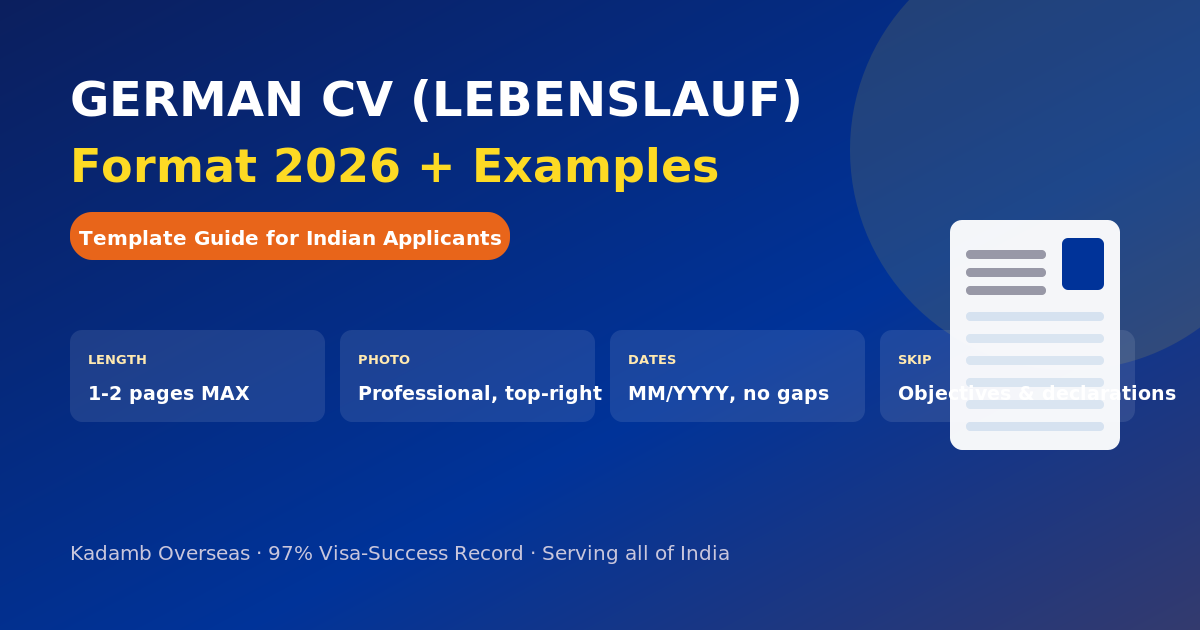
Quick answer: A German CV (Lebenslauf) is 1–2 pages, reverse-chronological and tabular — a clean two-column layout with dates on the left and content on the right. It includes a professional photo (still customary, though legally optional), a personal-details block, precise month/year dates with no unexplained gaps, quantified achievements instead of duty lists, a skills section with honest language levels (CEFR: A1–C2), and — unlike Indian resumes — no career objective, no declarations, no signatures of truthfulness, and no references on the CV itself. Recruiters spend under 60 seconds on the first pass; the Indian-style 4-page resume is the single most common reason strong candidates from India never reach a German interview.
Why your Indian resume fails in Germany (through a recruiter’s eyes)
German hiring culture prizes Übersichtlichkeit — scannability. An HR screener at a Mittelstand firm reads dozens of applications between meetings and expects to locate your degree, your last role and your German level in seconds, in the places convention says they should be. A four-page narrative resume with paragraph-style “roles and responsibilities”, decorative borders, a quote from APJ Abdul Kalam and “marital status: single, hobbies: cricket” scattered across it doesn’t read as rich detail — it reads as someone who hasn’t researched the market they’re applying into. The fix costs one focused evening. Here is the exact structure.
The Lebenslauf structure, section by section
| Section (in order) | What goes in it |
|---|---|
| Persönliche Daten | Name, phone, professional email, city (full address optional), LinkedIn/Xing/GitHub, nationality + visa status in one line (“Indian; 18-month German job-seeker permit — no sponsorship needed”) |
| Photo | Professional headshot, business attire, neutral background, top-right. Optional by law (AGG), but ~80% of German CVs still carry one; a good photo helps, a selfie hurts more than none |
| Berufserfahrung (experience) | Reverse-chronological; MM/YYYY–MM/YYYY, job title, company + city; 3–5 bullet achievements with numbers |
| Ausbildung (education) | Degrees with grades converted (German scale or percentage + “equivalent to German 1.7” if assessed); thesis title if relevant |
| Kenntnisse (skills) | Technical stack grouped by proficiency; languages with CEFR levels (“English C1, German B1 — in progress, Hindi native”) |
| Optional blocks | Certifications, publications, volunteer roles; 1–2 genuinely held interests (no filler) |
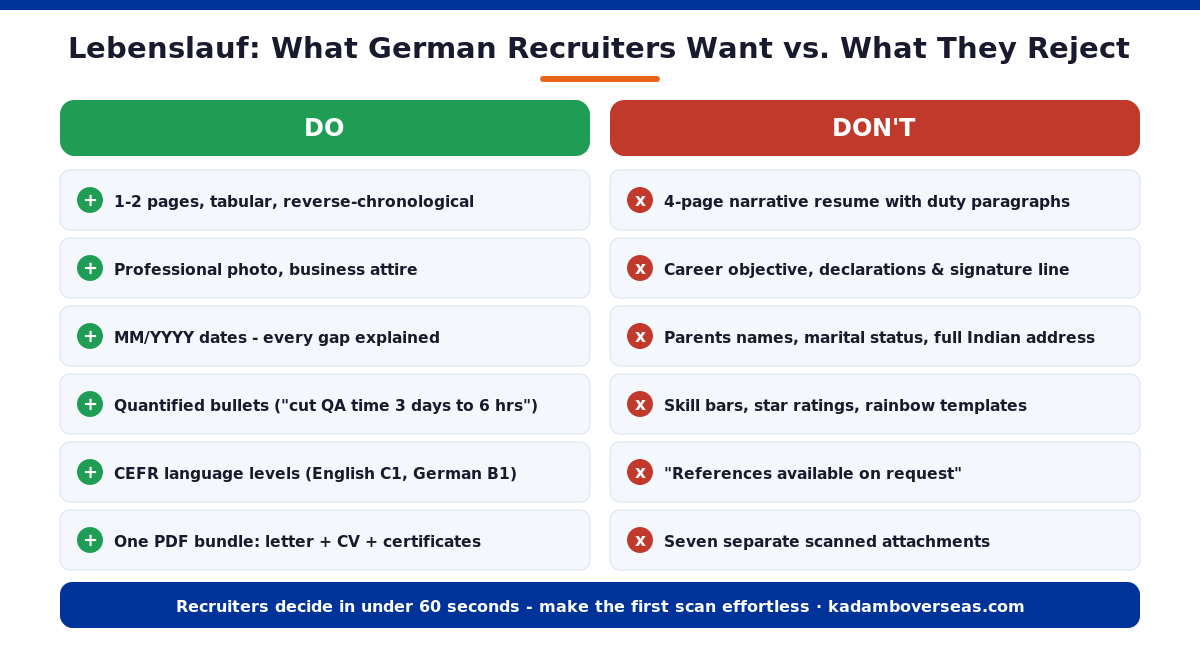
What stays out: career objective paragraphs, “declaration that the above is true” + signature (an Indian convention Germans find odd on a CV — though a signature under the Lebenslauf itself is a traditional German touch some older firms still like), parents’ names, date of birth (optional now), full home address in India, and references (“References available on request” is assumed).
Writing achievement bullets Germans respond to
German recruiters distrust adjectives and trust numbers. Convert every duty into a measured outcome: not “responsible for testing”, but “automated regression suite covering 240 test cases, cutting release QA from 3 days to 6 hours”. Not “worked on sales”, but “managed 40-account territory; grew quarterly revenue 18% YoY”. Three to five such bullets per role beat ten vague ones. Where an Indian project’s scale won’t be understood, translate it: “university with 8,000 students”, “India’s third-largest private bank”. And mirror the job ad’s own keywords — many German firms run ATS filters just like everyone else, and the ad tells you exactly which terms they filter for.
The Anschreiben: the cover letter Germany still reads
Germany is one of the last markets where the cover letter (Anschreiben) genuinely matters, especially outside startups. One page, formal German business layout (your address, their address, date, subject line “Bewerbung als [role], Referenz [job ID]”), and four short paragraphs: why this company specifically (one researched sentence beats three generic ones), what you bring (two proof points from the CV, expanded), the practicalities (start date, visa status, salary expectation only if the ad asks), and a confident closing. In English-speaking tech roles an English letter is fine; for anything else, have a German-speaking friend or your counsellor review a German version — a machine-translated Anschreiben with wrong formality (du/Sie) does active damage.
Documents Germans expect alongside the CV
A German application (Bewerbungsunterlagen) is traditionally a bundle: Anschreiben + Lebenslauf + Zeugnisse — degree certificates, transcripts, and employer reference letters (Arbeitszeugnisse). Indian applicants rarely have German-style Arbeitszeugnisse; substitute experience letters and, where possible, request short reference letters from past managers. Merge everything into one PDF, in this order, under 5 MB, filename “Bewerbung_Vorname_Nachname.pdf”. Uploading seven separately-named scans is a small negative signal before anyone reads a word. If your degree has a German recognition statement (ZAB Statement of Comparability or anabin listing), include it — it answers the qualification question before it’s asked; our Study in Germany guide explains recognition, and the Blue Card guide shows why it matters for the visa that follows the offer.
A worked example: one bullet, transformed
Take a typical line from an Indian resume: “Responsible for development and maintenance of company web application and coordinating with team members for timely delivery of modules.” A German recruiter learns almost nothing — which application, what scale, what result? The Lebenslauf version reads: “Developed customer-portal features (React/Node) used by 45,000 monthly users; led 4-person module team; delivered 6 releases with zero missed deadlines.” Same job, same person — but now there is a stack, a scale, a leadership signal and a reliability metric. Do this transformation for every bullet on your CV: name the technology or method, attach one number for scale and one for outcome, and cut everything that describes the job rather than your effect on it. If a bullet has no honest number, either find one (users, records, revenue, hours saved, marks improved) or ask whether the bullet deserves its line at all.
Student-specific advice: the CV with little experience
Fresh graduates worry they have nothing to fill a page with — the German format actually favours you. Lead with Ausbildung before experience, include your thesis title and grade, and treat substantial coursework projects, hackathons and Werkstudent or internship roles as full experience entries with the same quantified bullets (“final-year project: CNN-based crop-disease classifier, 94% accuracy on 12k-image dataset”). German employers value Praktika highly; even a six-week internship earns its dated entry. What you must not do is inflate — a “Java expert” claim gets tested in round two, and German interviewers calibrate trust across the whole CV based on the first claim that fails.
Formatting rules that quietly decide the first cut
One clean sans-serif or serif font (Calibri, Helvetica, Garamond), 10.5–12 pt, generous white space, dates in a fixed left column, consistent MM/YYYY everywhere. No skill bars or star ratings (Germans read them as imprecise), no rainbow templates, no icons for their own sake. Name the German level truthfully — interviews frequently open with a German sentence to check. Explain every gap of 2+ months in one neutral line (“03/2024–06/2024: exam preparation and relocation”). Export to PDF, check it renders on a phone screen, and have one German-market person proofread it — that single review catches the du/Sie errors, the , /. decimal mix-ups and the false friends (“actual” ≠ “aktuell”) that mark a CV as unreviewed. For where to send it once it’s ready, follow our 90-day German job search plan.
Frequently asked questions
Do I need a photo on a German CV in 2026?
It is optional under German anti-discrimination law (AGG), but the majority of applicants still include a professional headshot and most recruiters expect one. Rule of thumb: a good professional photo helps, no photo is neutral, a casual photo hurts. Never use a selfie or a cropped group picture.
How long should a German Lebenslauf be?
One page for students and early careers, two pages maximum for experienced professionals. German recruiters treat concision as competence; a third page signals inability to prioritise, not extra qualification.
Should my CV for Germany be in German or English?
Match the job advertisement’s language. English ads (most tech, research and international-team roles) take an English CV; German ads need a German Lebenslauf plus a German Anschreiben. Ambitious applicants keep both versions current.
What is an Arbeitszeugnis and do Indian applicants need one?
It is the formal graded reference letter German employers issue when staff leave — German recruiters expect them from German work history. From India, substitute experience letters and manager reference letters; after your first German job (including Werkstudent roles), always request an Arbeitszeugnis when leaving.
Should I mention my visa status on the CV?
Yes — one factual line in the personal-details block, framed positively: “18-month German job-seeker permit; Blue Card eligible, no sponsorship required.” It preempts the recruiter’s first doubt and converts a perceived risk into a selling point.
How do I convert my Indian grades for a German CV?
State your CGPA or percentage and, where helpful, the German-scale equivalent using the modified Bavarian formula (e.g. “CGPA 8.2/10 ≈ German grade 1.8”). If you hold a ZAB Statement of Comparability or your university is anabin-listed H+, say so — it settles equivalence questions instantly.
Get your Lebenslauf reviewed before it costs you interviews
Kadamb Overseas converts Indian resumes into German-standard applications — CV, Anschreiben and document bundle — for students and graduates from Mumbai, Delhi, Bengaluru, Hyderabad, Pune, Ahmedabad and all of India, backed by our 97% visa-success record.
Saumitra Rajput
Saumitra Rajput is the founder of Kadamb Overseas Pvt. Ltd., India's leading Europe-focused study abroad consultancy based in Ahmedabad. With 14+ years of expertise in European education, he has personally counselled 2,500+ Indian families and helped 500+ students secure admission to top European universities including TU Munich, ETH Zurich, EPFL, KU Leuven, HEC Paris, Sapienza Rome, TU Wien, and Warsaw University of Technology. He has visited 25+ European universities, partners with 250+ EU institutions, and maintains a 500+ students placed.
Planning to Study Abroad?
Get free expert guidance from our experienced counselors

Saumitra Rajput
Saumitra Rajput is the founder and lead counsellor at Kadamb Overseas, India's trusted Europe education consultancy based in Ahmedabad. With 14+ years of hands-on experience, he has personally guided 500+ students to universities across Germany, Switzerland, France, Italy, Austria, and Spain. Saumitra has visited partner universities across Europe, holds deep expertise in European visa processes, scholarships, and student life, and has achieved a 97% visa success rate for his clients. He is the host of the YouTube channel "Europe with Saumitra", where he shares first-hand insights on studying and living in Europe. His mission: make Europe accessible to every Indian student, with zero consultancy fees.