


Last Updated: September 7, 2026
Table of Contents
🕑 9 min read
The Anmeldung appointment takes 10-15 minutes, but getting one can take weeks. German bureaucracy moves at its own pace, and international students who don’t understand the system waste months navigating processes that should take days. In 2026, with stricter visa rules and eliminated appeal options, getting things right the first time isn’t optional—it’s essential. This comprehensive guide walks you through every bureaucratic step of your study journey to Germany, from city registration to residence permits, with exact timelines, costs, and insider tips from 500+ students we’ve helped.
⚡ German Bureaucracy 2026: Quick Facts
- Anmeldung Deadline: 14 days after moving in
- Late Registration Fine: Up to €1,000
- Blocked Account: €11,904/year (€992/month)
- Residence Permit Fee: €110-150
- Processing Time: 6-8 weeks
- Rundfunkbeitrag: €18.36/month (BAföG students exempt)
📋 What You’ll Learn in This Guide
🏠 City Registration (Anmeldung) – Your First Priority
The Anmeldung (city registration) is the foundation of your legal existence in Germany. Without it, you cannot open a bank account, get health insurance, sign phone contracts, or apply for your residence permit. German law requires everyone—citizens and foreigners alike—to register their address within 14 days of moving in.
What is Anmeldung?
Anmeldung is the process of officially declaring your residential address with the local Citizens’ Office (Bürgeramt or Einwohnermeldeamt). After registration, you receive a Meldebescheinigung (registration certificate)—one of the most important documents during your stay. Within 2-3 weeks, the tax office automatically sends your Steueridentifikationsnummer (tax ID) by mail.
Documents Required for Anmeldung
Step-by-Step Registration Process
- Book an appointment online through your city’s official website (termin.de in many cities)
- Get the Wohnungsgeberbestätigung from your landlord—they must provide this by law
- Gather all documents including passport, visa, and rental agreement
- Attend your appointment at the Bürgeramt (arrive 10-15 minutes early)
- Receive your Meldebescheinigung immediately at the appointment
- Wait for tax ID which arrives by mail within 2-3 weeks
💡 EXPERT INSIGHT
“The biggest mistake students make is waiting for the ‘perfect’ permanent address. If you’re staying in temporary accommodation, register there first—you can always do an Ummeldung (change of address) later. What matters is having SOME registration to start other processes.”
— Saumitra Rajput, Founder, Kadamb Overseas (15+ years experience)
City-Specific Tips for Getting Appointments
Large cities like Berlin, Munich, and Hamburg often have waiting times of 2-4 weeks for Anmeldung appointments. Here’s how to beat the system:
- Check multiple Bürgerämter: You can register at ANY office in your city, not just your district
- Refresh appointment portals early morning: New slots typically appear at midnight or 6 AM
- Try walk-in hours: Many offices offer limited walk-in appointments—arrive 30 minutes before opening
- Book suburban offices: Offices in outer districts often have shorter wait times
- Use appointment bot services: Websites like termine.staemme.de can alert you when slots open
Overwhelmed by German Paperwork?
Get a personalized bureaucracy checklist based on your city and situation. Our experts have guided 500+ students through German administrative processes.
✓ No spam. Response within 24 hours.
📋 Student Residence Permit (Aufenthaltstitel)
Your student visa is only valid for entry—to stay beyond 90 days, you need a student residence permit (Aufenthaltstitel) from the Ausländerbehörde (Foreigners’ Authority). This is arguably the most important bureaucratic process, as without it, you cannot legally remain in Germany.
When to Apply
- Apply within first 90 days of arrival (before your visa expires)
- Book appointment immediately after Anmeldung—wait times can be 4-8 weeks
- Processing takes 6-8 weeks after submission
- If your visa expires during processing, you’ll receive a Fiktionsbescheinigung (temporary permit)
Documents Required for Residence Permit
Residence Permit Costs 2026
- First-time application: €110-150 (varies by city)
- Extension: €96-110
- Electronic residence card (eAT): Included in fee
- Fiktionsbescheinigung: Usually free if permit is pending
🎓 STUDENT SUCCESS STORY
Priya Shah from Ahmedabad arrived in Munich with her student visa in September 2024. She followed our bureaucracy timeline exactly—did Anmeldung on Day 3, booked Ausländerbehörde appointment on Day 4, and had her residence permit within 7 weeks. “Having a checklist made everything so much easier. I saw classmates still struggling with paperwork in December!”
Now studying Data Science at TU Munich 🎓
🏦 Blocked Account Requirements 2026
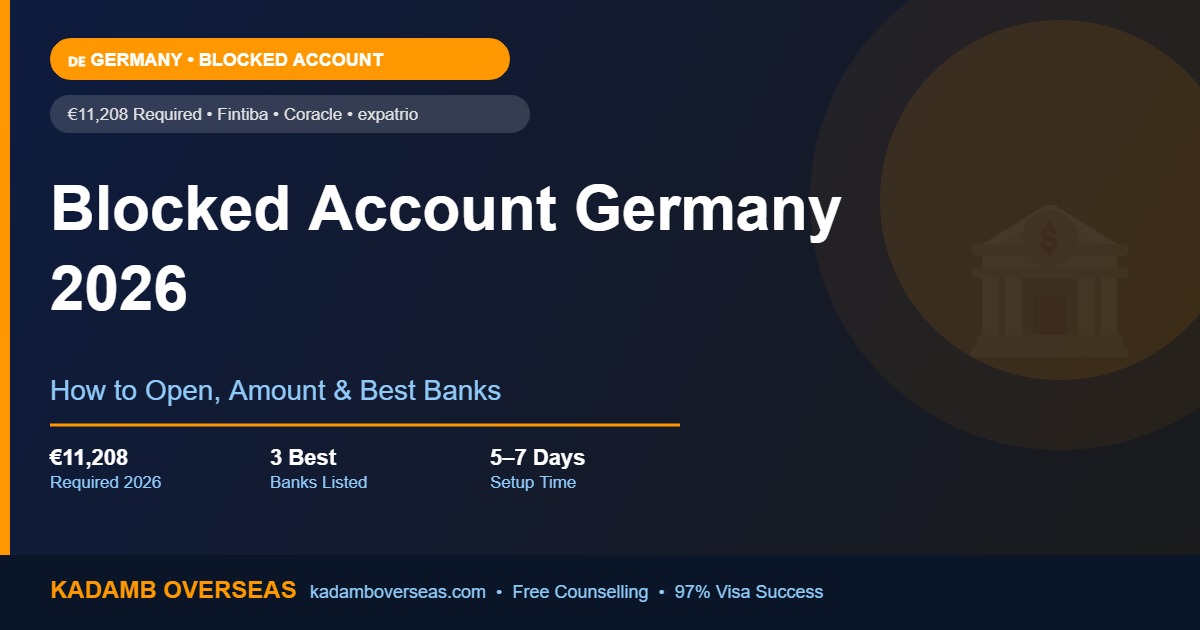
A blocked account (Sperrkonto) is a special bank account that proves you have sufficient funds for your stay. You deposit the required amount before arriving, then can only withdraw €992 per month to cover living expenses. This is mandatory for visa applications and residence permits.
2026 Blocked Account Amount
Required Deposit 2026
€11,904 (₹10.7 lakh)
= €992/month × 12 months
Top Blocked Account Providers Compared
📱 Scroll horizontally on mobile | ⚠️ Deutsche Bank no longer offers blocked accounts (since July 2022)
📚 Related Reading
Cost of Living in Germany for Indian Students 2026
Complete breakdown of monthly expenses in major German cities—rent, food, transport, and hidden costs.
💳 Opening a German Bank Account
You need a regular German bank account (Girokonto) to receive your monthly blocked account allowance, pay rent, and handle everyday transactions. Many landlords and employers will only accept German bank details.
Requirements for Opening a Bank Account
- Valid passport
- Meldebescheinigung (from Anmeldung)
- Student ID or enrollment certificate
- Tax ID (Steueridentifikationsnummer) – some banks require this
Best Banks for Students 2026
Pro Tip: Open an N26 account before arriving in Germany (no Anmeldung required), then open a traditional bank account later for better ATM access and building credit history.
📺 Broadcasting Fee (Rundfunkbeitrag)
Shortly after completing your Anmeldung, you’ll receive a letter about the Rundfunkbeitrag—Germany’s mandatory broadcasting fee that funds public TV and radio (ARD, ZDF, Deutschlandfunk). Every household must pay, regardless of whether you actually watch German TV.
Rundfunkbeitrag Facts 2026
- Amount: €18.36/month (€55.08/quarter or €220.32/year)
- Payment: Per household, not per person (share with roommates!)
- In a WG? Only one person registers and pays—split costs among yourselves
- Dorm room? You still pay if you have a private room (even without kitchen/bathroom)
Who Can Get Exemption?
✅ Students Exempt from Rundfunkbeitrag (from October 2025):
- Students receiving BAföG who don’t live with their parents
- Recipients of unemployment benefits (Bürgergeld)
- Asylum seekers
- People with vision/hearing impairments (reduced fee: €73.44/year)
⚠️ Important: International students generally do NOT qualify for exemption unless they receive a study support benefit from their home country comparable to BAföG. If you’re not exempt, don’t ignore the letters—unpaid fees accumulate and can hurt your Schufa credit score.
📅 Complete First Month Timeline
Here’s the exact order and timeline for completing all bureaucratic tasks in your first month:
❓ Frequently Asked Questions
Technically, you can be fined up to €1,000 for late registration. In practice, fines are rarely imposed for first-time offenders, especially if you register within a few weeks. However, delays in Anmeldung cause cascading delays in everything else—bank accounts, health insurance, and most importantly, your residence permit application. Register as soon as you have a fixed address.
Generally, no. Your student visa allows entry but not work. You can only start working once you have your residence permit with explicit work authorization (120 full days or 240 half days per year). If you receive a Fiktionsbescheinigung while your permit is processing, check if it includes work permission—this varies by city. For more on Germany visa requirements, see our detailed guide.
Officially, German is the only language used at Bürgeramt and Ausländerbehörde. In larger cities like Berlin, Munich, and Frankfurt, some staff speak English, but don’t count on it. Bring a German-speaking friend if possible, or use a translation app. All forms are in German—have them pre-filled with help if needed. University international offices often provide support for these appointments.
A Fiktionsbescheinigung (“fictional certificate”) is a temporary document that allows you to stay legally in Germany while your residence permit application is being processed. It’s issued if your visa expires before your permit is ready. It typically extends your legal stay for 3-6 months and maintains your current status. Most employers and landlords accept it as valid proof of legal residence.
For 2026, the required amount is €11,904 (€992/month × 12 months), equivalent to approximately ₹10.7 lakh. This amount is set by German authorities based on the BAföG rate and is updated periodically. Some embassies may require you to deposit slightly more (€100-200 buffer) to cover transfer fees. See our guide on Germany scholarships to reduce your financial burden.
Only if you receive BAföG (German student financial aid) and don’t live with your parents—in which case you can apply for exemption from October 2025. International students typically don’t qualify for BAföG and must pay the €18.36/month fee. However, the fee is per household, so if you live in a WG (shared apartment), you can split the cost among roommates. Never ignore the letters—unpaid fees can damage your credit score.
Contact the Ausländerbehörde by email or their online contact form explaining your situation. Most offices will either prioritize your case or issue a Fiktionsbescheinigung to cover the waiting period. Document everything—keep proof that you attempted to book early. The key is applying (even online) before your visa expires. From July 2025, Germany eliminated free visa appeals, making it crucial to get everything right the first time.
📝 Conclusion
German bureaucracy has a reputation for being complex, but it’s actually quite logical once you understand the sequence. The key is starting early—book appointments immediately, don’t wait for “perfect” circumstances, and always have your documents ready. With the elimination of free visa appeals from July 2025, getting things right the first time is more important than ever.
Remember: Anmeldung is Day 1 priority, Ausländerbehörde appointment should be booked within your first week, and everything else flows from there. Follow the timeline in this guide, and you’ll have all your paperwork sorted within 2-3 months of arrival—leaving you free to focus on what you came for: your studies in Germany.
Ready to Study in Germany?
September 2026 applications are now open. Get a personalized pre-departure checklist and expert guidance for navigating German bureaucracy.
📋 In Your Consultation:
- Complete bureaucracy timeline for your city
- Document checklist with templates
- Blocked account setup guidance
- University-specific enrollment tips
- First month survival guide
📞 +91-9913333239 |
💬 WhatsApp Us
📍 Kadamb Overseas, Ahmedabad, Gujarat | ⏰ Mon-Sat: 10AM – 7PM IST
Saumitra Rajput
Founder & European Education Expert
With 15+ years of experience in overseas education consulting, Saumitra has helped 500+ Indian students navigate European study journeys. His expertise spans Germany, Switzerland, Austria, France, and other European destinations, with a remarkable 97% visa success rate.
📚 Related Articles You’ll Find Helpful
Saumitra Rajput
Saumitra Rajput is the founder of Kadamb Overseas Pvt. Ltd., India's leading Europe-focused study abroad consultancy based in Ahmedabad. With 14+ years of expertise in European education, he has personally counselled 2,500+ Indian families and helped 500+ students secure admission to top European universities including TU Munich, ETH Zurich, EPFL, KU Leuven, HEC Paris, Sapienza Rome, TU Wien, and Warsaw University of Technology. He has visited 25+ European universities, partners with 250+ EU institutions, and maintains a 500+ students placed.
Planning to Study Abroad?
Get free expert guidance from our experienced counselors

Saumitra Rajput
Saumitra Rajput is the founder and lead counsellor at Kadamb Overseas, India's trusted Europe education consultancy based in Ahmedabad. With 14+ years of hands-on experience, he has personally guided 500+ students to universities across Germany, Switzerland, France, Italy, Austria, and Spain. Saumitra has visited partner universities across Europe, holds deep expertise in European visa processes, scholarships, and student life, and has achieved a 97% visa success rate for his clients. He is the host of the YouTube channel "Europe with Saumitra", where he shares first-hand insights on studying and living in Europe. His mission: make Europe accessible to every Indian student, with zero consultancy fees.