
Table of Contents
🕑 7 min read
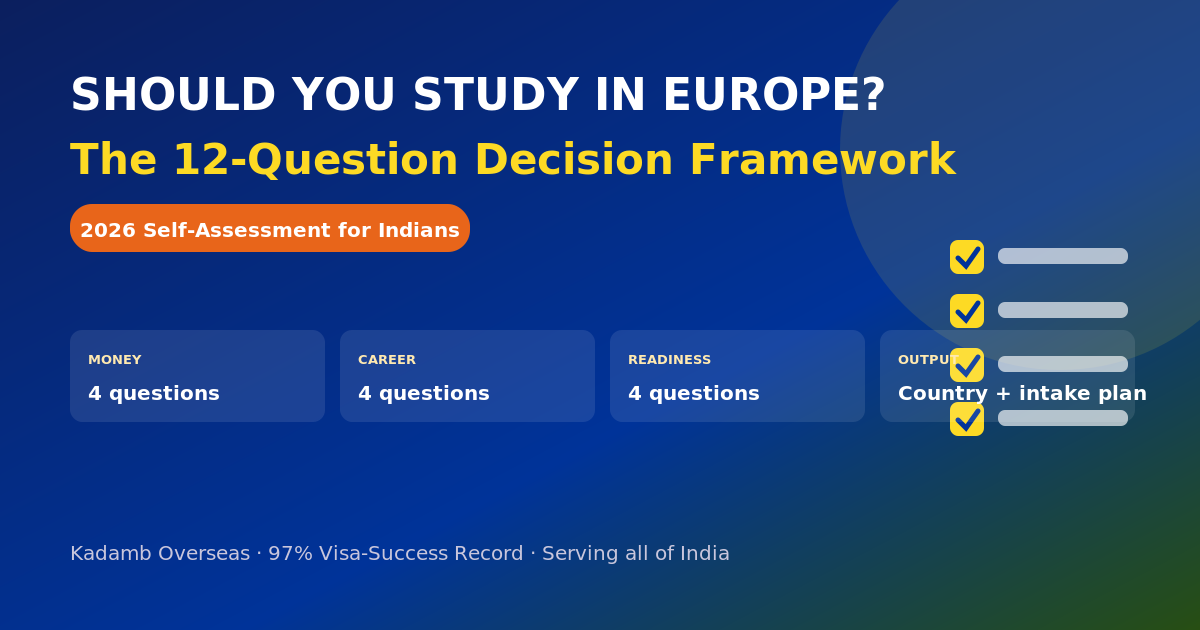
Quick answer: Before you spend a rupee on applications, answer twelve questions honestly — four about money (true budget, funding source, loan tolerance, earning-while-studying needs), four about career (target role, industry geography, language willingness, settle-or-return plan), and four about readiness (academic profile strength, English test status, timeline runway, family alignment). Your answers eliminate 80% of options mechanically and point to a primary country, a backup, and a realistic intake. This framework is exactly what a good counsellor walks you through in a first session — here it is in full, with scoring guidance, so you arrive at that conversation (or make the decision yourself) with clarity instead of confusion.
Why a framework beats browsing
Most students research study abroad backwards: months of university videos and Reddit threads first, structure never. The result is decision fatigue and a shortlist shaped by whoever shouted loudest online. The fix is boring and effective: answer the twelve questions below in one sitting, write the answers down, and only then open a university list. Every question exists because we have watched its unasked version sink real applications — the ₹30-lakh dream built on a ₹12-lakh budget, Germany plan from a student unwilling to learn German, the September intake chased with an IELTS slot in August. Work through them with our country flowchart and five-country matrix beside you — the three tools answer different layers of the same decision.
The money four (Questions 1–4)
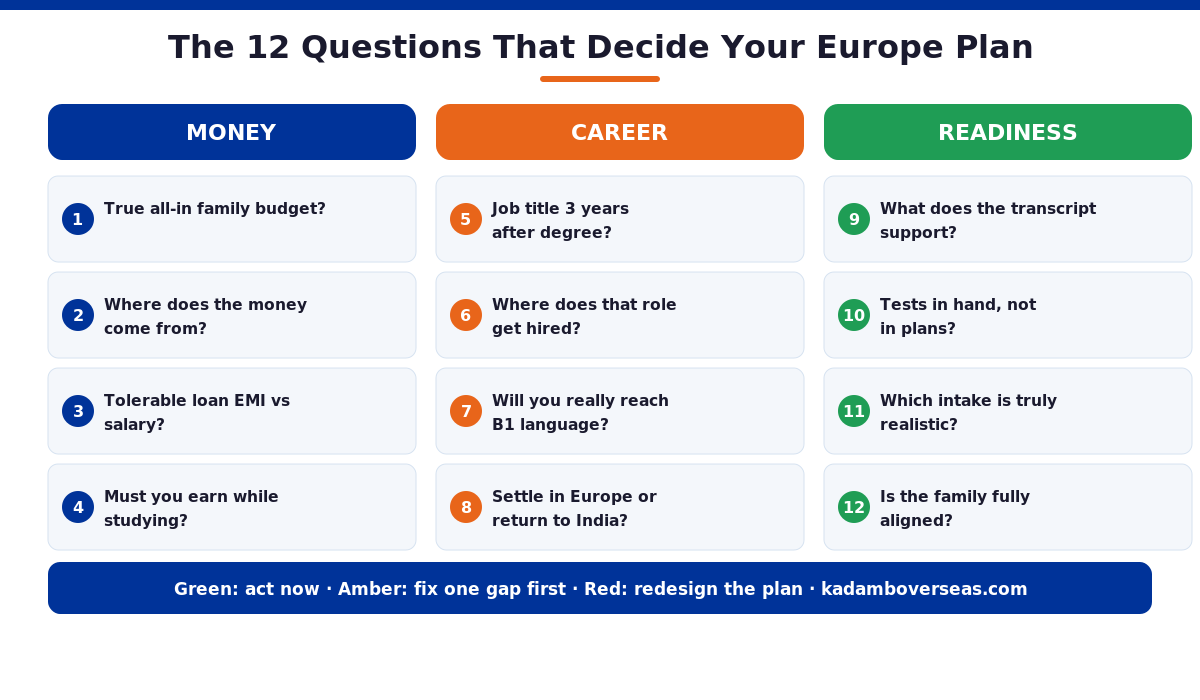
Q1. What is the family’s true all-in budget — the number nobody is embarrassed to say out loud? Not the aspirational figure: the one that survives a medical emergency at home. Under ₹18 lakh for two years points to Germany, Italy or Poland; ₹25 lakh+ opens France; ₹40 lakh+ opens the Netherlands and Ireland comfortably.
Q2. Where does the money actually come from? Savings, property-backed loan, education loan, or a sponsor’s income — each documents differently at visa time, and the wrong structure sinks files (see the seasoning rules in our blocked account guide). If the answer is “we’ll arrange it somehow,” stop and arrange it first.
Q3. How much loan burden is genuinely tolerable? Write the EMI at 11% over 10 years next to the expected starting salary from our salary guide. A ₹35-lakh loan against a €50k German salary services easily; the same loan against an uncertain home-country return does not.
Q4. Must you earn while studying? If part-time income is load-bearing (not pocket money), weight countries by real student labour markets: Germany’s Werkstudent system and Poland’s unrestricted rights are dependable; small-town Italy and Spain are not.
The career four (Questions 5–8)
Q5. What job title do you want three years after graduating? A named role (“ML engineer”, “design engineer at an automotive supplier”, “regulatory affairs associate”) makes every later choice checkable. “Something in tech” is not an answer — it is the absence of one.
Q6. Where does that role actually get hired? Map the industry: automotive and machine-building hire in southern Germany; pharma along the Rhine and in Milan; fintech in Dublin and Amsterdam; games in Warsaw and Stockholm. Study where your industry lives, not where the vlogs are pretty.
Q7. Will you genuinely learn the local language to B1? Not “would like to” — will you sit classes weekly for eighteen months? A yes multiplies Germany’s and France’s value. An honest no argues for Ireland, the Netherlands, or English-island tech roles elsewhere.
Q8. Is the plan to settle in Europe, or return to India with a premium degree? Settlement-minded profiles should weight PR mechanics heavily (Germany’s 21–27-month Blue Card track dominates). Returners should weight brand and alumni networks — a French grande école or a globally ranked one-year Irish master’s often serves the India comeback better.
The readiness four (Questions 9–12)
Q9. What does your transcript honestly support? CGPA 8.5+ with a clean record contests ETH, TU9 and Amsterdam; 7–8 fits strong mid-tier programs; below 7 or with backlogs, aim where whole-profile admissions live (Italy, Poland) and compensate with projects and a sharp SOP. Misjudging this question wastes more application fees than any other.
Q10. Where are your test scores today — not in the plan, in hand? IELTS/TOEFL booked and German/French classes started are facts; intentions are not. Count backwards from deadlines: Nordic portals close mid-January, Germany’s summer intake closes around 15 January, and APS for Germany takes 4–8 weeks before you can even file.
Q11. Which intake is actually realistic? The right intake is the one your documents, tests and funds can meet without panic. Forcing a September you are not ready for produces refusals; taking the following March/winter intake with a complete file produces admits. One semester’s patience is the cheapest insurance in this process.
Q12. Is the family aligned — on money, destination and timeline? Visa officers interview students, but families fund and sustain them. Unresolved disagreements surface as inconsistent documents and shaky interview answers. Resolve them at the kitchen table, not at the consulate.
Using the framework as a family, not alone
The framework works best answered twice: once by the student, once by the primary funder — separately, then compared. The gaps between the two sets of answers are the plan’s real risks. In our counselling rooms the classic divergences repeat: the student answers Q8 “settle in Europe” while the parent assumes a three-year return; the parent’s Q1 budget is ₹8 lakh below the student’s working assumption; the student has quietly downgraded Q7’s language commitment since the plan was first made. None of these is fatal — every one of them is fatal undiscovered, because it resurfaces as a contradictory sponsorship affidavit, a mid-degree funding crisis, or an interview answer that doesn’t match the file. Thirty minutes of comparing answers over dinner is the highest-return “application work” a family can do, and it costs nothing. Where the divergence survives discussion — genuinely different risk appetites, say — write both versions down and let a neutral third party (a counsellor, an alumnus, a family friend who has funded a student abroad) arbitrate the specific disagreement rather than the whole plan. Narrow disputes get solved; vague ones smoulder.
Scoring yourself: three profiles the answers produce
Green (act now): budget stated and sourced, role named, tests in hand, intake feasible — go straight to shortlisting; you are 4–6 weeks from applications.
Amber (build for one intake): one load-bearing gap — unfunded budget, no test, language unwillingness colliding with a Germany plan. Spend 3–6 months fixing exactly that gap; everything else waits.
Red (rethink the shape): money four and career four point in opposite directions (a ₹12-lakh budget with a Netherlands-only dream; a settle-in-Europe goal with a refusal to learn any language). The plan needs redesign, not more university research — this is where a structured counselling session earns its keep.
Frequently asked questions
How do I decide if studying in Europe is right for me?
Answer twelve structured questions across money (budget, source, loan tolerance, earning needs), career (target role, industry geography, language, settle-vs-return) and readiness (profile, tests, timeline, family alignment). If the three groups point the same direction, Europe is right and the country picks itself; if they conflict, fix the conflict before applying.
How much money do I really need to study in Europe?
Two-year all-in from ₹12–18 lakh (Germany, Italy with scholarships, Poland) to ₹40–55 lakh (Netherlands, Danish and Dutch programs). The decisive question is not the total but whether it is documented, seasoned and visa-provable — unexplained money refuses more visas than insufficient money.
When should I start planning for a September 2027 intake?
Now — roughly 12 months out. Tests by November–December 2026, APS (for Germany) started in parallel, applications from October 2026 to March 2027 depending on country, funds seasoned across the same window, visa filing from March 2027.
Should I choose my course or my country first?
Course family first (it fixes which industries and countries hire you), then country by the twelve questions, then specific universities last. Students who start from a university name usually end up rationalising backwards.
What if my family can’t decide between two very different options?
Run both through the framework separately and compare the amber flags, not the dreams: which option has fewer load-bearing gaps in money, career logic and readiness? If they tie, apply to both — a two-country strategy costs a few thousand rupees more and removes the single point of failure.
Is it too late to study in Europe if I’ve already missed this year’s intake?
No — Europe runs two intakes in many countries (September/October and January–March), and a “missed” intake used for test scores, language basics and fund seasoning consistently produces stronger admits and cleaner visas than a rushed application ever does.
Take the 12-question assessment with a counsellor
Kadamb Overseas runs this exact framework in a free first session for students from Mumbai, Delhi, Bengaluru, Hyderabad, Pune, Ahmedabad and every state of India — and hands you a written country + intake + funding plan at the end of it. 97% visa-success record.
Saumitra Rajput
Saumitra Rajput is the founder of Kadamb Overseas Pvt. Ltd., India's leading Europe-focused study abroad consultancy based in Ahmedabad. With 14+ years of expertise in European education, he has personally counselled 2,500+ Indian families and helped 500+ students secure admission to top European universities including TU Munich, ETH Zurich, EPFL, KU Leuven, HEC Paris, Sapienza Rome, TU Wien, and Warsaw University of Technology. He has visited 25+ European universities, partners with 250+ EU institutions, and maintains a 500+ students placed.
Planning to Study Abroad?
Get free expert guidance from our experienced counselors

Saumitra Rajput
Saumitra Rajput is the founder and lead counsellor at Kadamb Overseas, India's trusted Europe education consultancy based in Ahmedabad. With 14+ years of hands-on experience, he has personally guided 500+ students to universities across Germany, Switzerland, France, Italy, Austria, and Spain. Saumitra has visited partner universities across Europe, holds deep expertise in European visa processes, scholarships, and student life, and has achieved a 97% visa success rate for his clients. He is the host of the YouTube channel "Europe with Saumitra", where he shares first-hand insights on studying and living in Europe. His mission: make Europe accessible to every Indian student, with zero consultancy fees.