
Table of Contents
- Why does a BCA create a problem at all?
- Which European countries accept a 3-year BCA directly?
- How do I fix the ECTS shortfall for Germany?
- Which MS specialisations suit a BCA background best?
- What does my application need to prove?
- Mistakes BCA applicants make — and how to avoid them
- What is a realistic timeline from BCA to MS?
- Frequently asked questions
🕑 8 min read
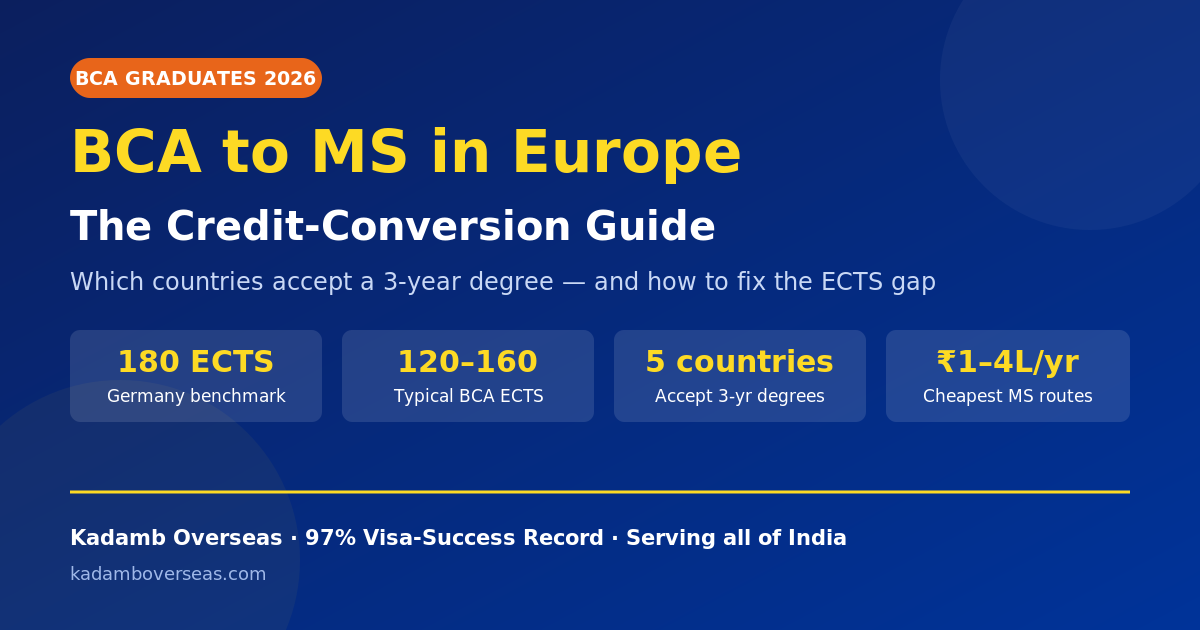
Quick answer: Yes, a 3-year BCA can get you into an MS in Europe — but not everywhere, and not in Germany by default. The blocker is credits, not your subject. A BCA typically carries 120–160 ECTS, while most German MS Computer Science programmes demand a 180-ECTS bachelor with roughly 60 ECTS in core CS and 15 ECTS in mathematics. The fastest legitimate routes are: (1) apply to countries that accept 3-year degrees outright — France, Poland, Ireland, Italy, Spain and much of the Netherlands; (2) add a 1-year pre-master or ECTS-top-up; or (3) finish an Indian MCA/M.Sc. IT and then apply to Germany, where BCA + MCA comfortably clears 180 ECTS. Budget roughly ₹12–25 lakh per year in France and Poland and ₹22–35 lakh per year in Ireland and the Netherlands (approx.; verify on the official page).
Why does a BCA create a problem at all?
Europe runs on ECTS — the European Credit Transfer System. One academic year of full-time study equals 60 ECTS. A European bachelor is therefore 180 ECTS over three years, or 240 ECTS over four.
Indian universities do not issue ECTS. When a German or Dutch admissions office evaluates your BCA marksheet, it converts your contact hours, credits and duration into an ECTS estimate. A typical Indian BCA — three years, lighter lab and project load than a B.Tech, often 120–150 credits in Indian terms — lands somewhere between 120 and 160 ECTS (approx.). That is a shortfall of 20 to 60 ECTS against the 180 benchmark.
Note what is not the problem. Your subject is fine. BCA covers programming, data structures, DBMS, operating systems and networks — exactly the core an MS in Computer Science wants to see. The issue is arithmetic, and arithmetic can be fixed.
Which European countries accept a 3-year BCA directly?
This is the single most useful table for a BCA graduate. Treat it as a shortlisting tool, then verify each programme page individually — policy varies by university, not just by country.
| Country | 3-year BCA accepted? | Typical MS tuition / year | What to watch for |
|---|---|---|---|
| France | Yes, commonly | €3,950 public (approx. ₹3.9L); €15,000–25,000 Grandes Écoles | Campus France interview; some M1 entry instead of direct M2 |
| Poland | Yes | €1,000–3,000 public (approx. ₹1–3L) | Cheapest credible route; check programme is English-taught |
| Ireland | Yes, with strong marks | €15,000–25,000 (approx. ₹15–25L) | Usually wants a first-class BCA; 2-year stay-back is the draw |
| Netherlands | Case-by-case; pre-master common | €12,000–23,000 (approx. ₹12–23L) | Research universities stricter than universities of applied sciences |
| Italy & Spain | Usually yes | €1,000–4,000 public (approx. ₹1–4L) | Declaration of Value / credential legalisation adds weeks |
| Germany | Rarely, without a top-up | €0 public + ~€300 semester fee | 180-ECTS rule; APS certificate mandatory |
If cost is your binding constraint, Poland and Italy are where a BCA graduate gets the most degree for the least money. If post-study work rights matter most, Ireland and Germany win. For the country-by-country detail, start with our Study in France guide and Study in Germany guide.
How do I fix the ECTS shortfall for Germany?
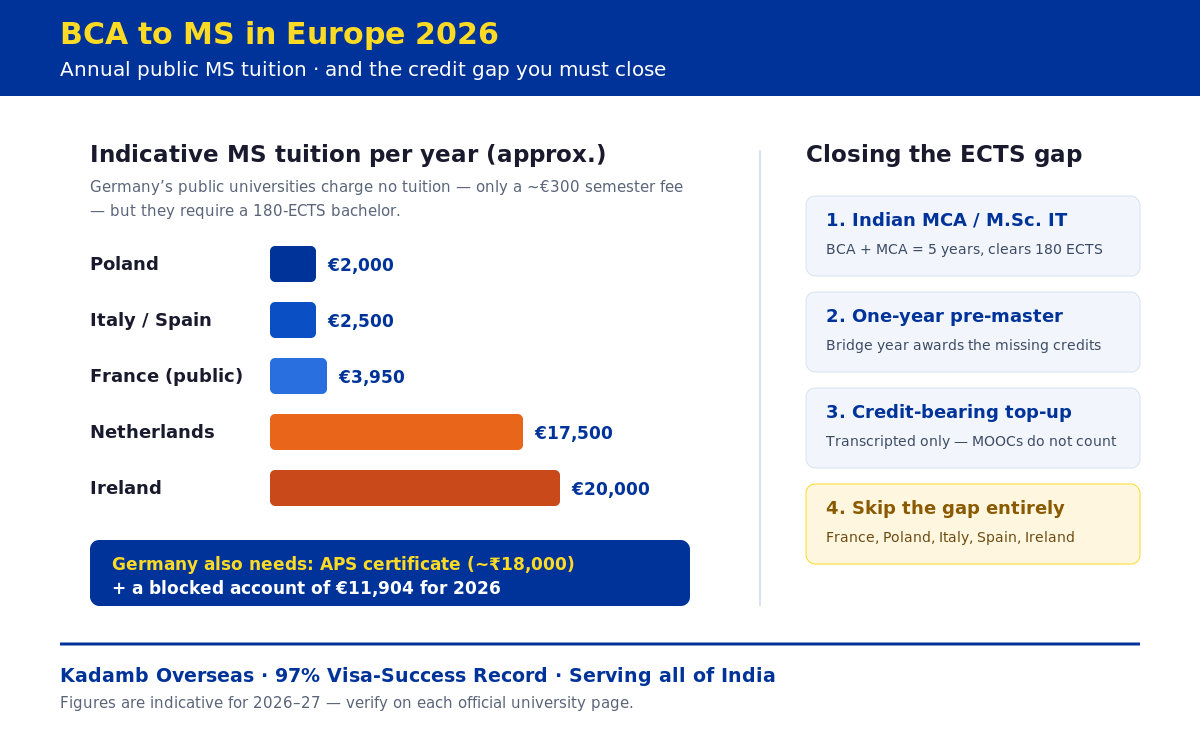
Germany is worth the extra effort: public universities charge no tuition, only a semester contribution of roughly €150–350, and the 18-month post-study job-search visa is among Europe’s most generous. Four routes actually work.
Route 1 — Finish an MCA or M.Sc. IT in India first. A 3-year BCA plus a 2-year MCA is five years of higher education. Combined, that clears 180 ECTS with room to spare, and you apply to German MS programmes as a postgraduate. Slowest on the calendar, cheapest in rupees, and the most reliably accepted.
Route 2 — A one-year pre-master or Studienkolleg-style bridge. Several German and Dutch institutions offer a preparatory or pre-master year that awards the missing credits. You pay one extra year of fees but enter the MS on schedule after that.
Route 3 — Documented ECTS top-up coursework. Some universities will accept additional credit-bearing coursework — a PG diploma, a formal university certificate programme, or credits from an open university — provided it is transcripted with credits and hours. Unaccredited online course certificates do not count. Confirm in writing with the admissions office before you pay for anything.
Route 4 — Target programmes with flexible thresholds. A minority of German universities and many Fachhochschulen (universities of applied sciences) evaluate holistically and will admit a strong 3-year graduate with relevant work experience. These are real but scarce; do not build a plan around finding one.
Whichever route you pick, the APS certificate is non-negotiable for Indian applicants to Germany — budget roughly ₹18,000 and 3–4 weeks (approx.; verify on the official APS India page). You will also need a blocked account of €11,904 for 2026, released at about €992 per month; our 2026 blocked account guide walks through provider choices and timing.
Which MS specialisations suit a BCA background best?
BCA graduates often assume they must apply for generic “MS Computer Science” and compete with B.Tech CSE applicants on pure algorithms depth. That is the hardest possible fight. Applied and interdisciplinary masters are a far better fit, because they value your software fundamentals without demanding heavy engineering mathematics.
Strong matches: Data Analytics and Business Intelligence, Information Systems / Business Informatics, Software Engineering, Cybersecurity, Cloud Computing and DevOps, Human-Computer Interaction, and Digital Transformation / IT Management.
Harder matches without extra mathematics: Artificial Intelligence and Machine Learning, Robotics, Theoretical Computer Science, Computational Science. These typically require 15–30 ECTS of linear algebra, probability and calculus, which a BCA rarely carries in sufficient depth. If AI is your goal, close that gap deliberately with credit-bearing mathematics coursework before applying — see our MS in AI and Machine Learning in Europe guide for what those programmes actually screen for.
What does my application need to prove?
Admissions committees reading a BCA transcript are asking one question: can this person survive a research-grade masters? Answer it with evidence, not adjectives.
A credit-mapped transcript summary. Build a one-page table listing every BCA subject, its Indian credits, contact hours, and the ECTS equivalent you are claiming. Total it. Show the committee the arithmetic instead of making them do it — and show them you know where you stand.
Two or three real projects with code. A public GitHub profile with a deployed web application, a data pipeline, or a security tool does more for a BCA applicant than any statement of purpose paragraph. It replaces the depth signal that a B.Tech thesis would have provided.
Work experience, framed technically. If you have 12–36 months as a developer, analyst, tester or support engineer, describe the stack, the scale and what you owned. Many universities will offset a credit shortfall against demonstrable professional competence.
Language proof that matches the programme. IELTS 6.5 overall or TOEFL 88–90 is the common English-taught baseline. For German-taught programmes you need TestDaF or DSH. Non-negotiable and slow to acquire — start early.
Mistakes BCA applicants make — and how to avoid them
Assuming Germany will make an exception. It usually will not, and you will lose a full application cycle discovering that. Verify the ECTS requirement on the programme’s own admission page before you write a single essay.
Treating an online course certificate as credits. A MOOC certificate carries no ECTS. Only accredited, transcripted, credit-bearing coursework closes a credit gap. This mistake is common and expensive.
Applying only to top-20 universities. A BCA applicant with no credit top-up applying exclusively to the most selective European CS departments will collect rejections. Build a list of 8–10 programmes across three tiers, including at least three where 3-year degrees are explicitly accepted.
Ignoring the credential-legalisation calendar. Italy’s Declaration of Value, Spain’s homologation, apostille and translation steps can each take 4–8 weeks. Start credential paperwork the same month you start shortlisting.
Under-documenting the financial file. Visa refusals for Indian students are disproportionately about incomplete or unexplained funds, not about academics. Keep a clean six-month paper trail and be ready to explain every large credit — our Schengen visa interview guide covers the questions that actually get asked.
Leaving health insurance and registration to the last week. In Germany these are prerequisites, not formalities. Sort public vs private health insurance before you fly.
What is a realistic timeline from BCA to MS?
If you accept a 3-year degree directly — France, Poland, Italy, Spain, Ireland — plan 10–14 months from decision to departure: 2 months on language tests and shortlisting, 3 months on applications, 2–3 months for offers, 2 months for visa and financials, with buffer.
If you are bridging to Germany via an MCA, the honest number is 2.5 to 3 years, most of it spent finishing the Indian masters. Via a one-year pre-master, roughly 22–26 months. Neither is wasted time if Germany’s zero-tuition, strong-labour-market combination is what you actually want — and the EU Blue Card thresholds are worth reading before you commit, because they shape what your degree is worth afterwards.
Frequently asked questions
Is a BCA equivalent to a B.Tech for European MS admission?
No. A B.Tech is four years and typically maps to 240 ECTS, clearing the 180-ECTS bar comfortably. A BCA is three years and maps to roughly 120–160 ECTS. The subject overlap is high, but the credit volume is not equivalent, and European admissions offices assess credits first.
Can I do an MS in Germany directly after a 3-year BCA?
Rarely. Most German MS Computer Science programmes require a 180-ECTS bachelor with about 60 ECTS in core computer science and 15 ECTS in mathematics. A small number of universities of applied sciences evaluate flexibly, but the dependable paths are an Indian MCA first or a one-year pre-master bridge.
Which country is cheapest for a BCA graduate to do an MS in Europe?
Poland, Italy and Spain, where public-university MS tuition commonly runs €1,000–4,000 per year (approx. ₹1–4 lakh), and all three regularly accept 3-year degrees. Germany is zero-tuition but gated behind the ECTS requirement, so it is cheapest only once you have bridged the gap.
Will an MCA from India be accepted for an MS in Europe?
Yes, and it is the strongest fix for a BCA credit shortfall. BCA plus MCA is five years of higher education, which clears 180 ECTS decisively. You may also become eligible for direct second-year (M2) entry in France and for some research-track programmes.
Do I need work experience to get into an MS in Europe after a BCA?
Not formally for most programmes, but 12–36 months of relevant IT experience materially improves a BCA application — particularly in Ireland, the Netherlands and at German universities of applied sciences, where professional competence can offset a modest credit gap.
What English score do I need for an MS in Europe after a BCA?
IELTS 6.5 overall with no band below 6.0, or TOEFL iBT 88–90, is the usual baseline for English-taught masters in Germany, Ireland, the Netherlands, France, Poland and Italy (approx.; verify on each programme page). German-taught programmes require TestDaF 4×4 or DSH-2 instead.
Your BCA is not the obstacle — your credit map is.
Kadamb Overseas has built BCA-to-MS pathways for students across India — Ahmedabad, Mumbai, Delhi, Bengaluru, Hyderabad, Pune, Chennai, Kolkata, Jaipur, Surat, Indore, Chandigarh and beyond. We map your transcript to ECTS, tell you honestly which countries will take you as you are, and build the shortlist that gets an offer. Our 97% visa-success record comes from getting this diagnosis right the first time.
Saumitra Rajput
Saumitra Rajput is the founder of Kadamb Overseas Pvt. Ltd., India's leading Europe-focused study abroad consultancy based in Ahmedabad. With 14+ years of expertise in European education, he has personally counselled 2,500+ Indian families and helped 500+ students secure admission to top European universities including TU Munich, ETH Zurich, EPFL, KU Leuven, HEC Paris, Sapienza Rome, TU Wien, and Warsaw University of Technology. He has visited 25+ European universities, partners with 250+ EU institutions, and maintains a 500+ students placed.
Planning to Study Abroad?
Get free expert guidance from our experienced counselors

Saumitra Rajput
Saumitra Rajput is the founder and lead counsellor at Kadamb Overseas, India's trusted Europe education consultancy based in Ahmedabad. With 14+ years of hands-on experience, he has personally guided 500+ students to universities across Germany, Switzerland, France, Italy, Austria, and Spain. Saumitra has visited partner universities across Europe, holds deep expertise in European visa processes, scholarships, and student life, and has achieved a 97% visa success rate for his clients. He is the host of the YouTube channel "Europe with Saumitra", where he shares first-hand insights on studying and living in Europe. His mission: make Europe accessible to every Indian student, with zero consultancy fees.