

Table of Contents
🕑 7 min read
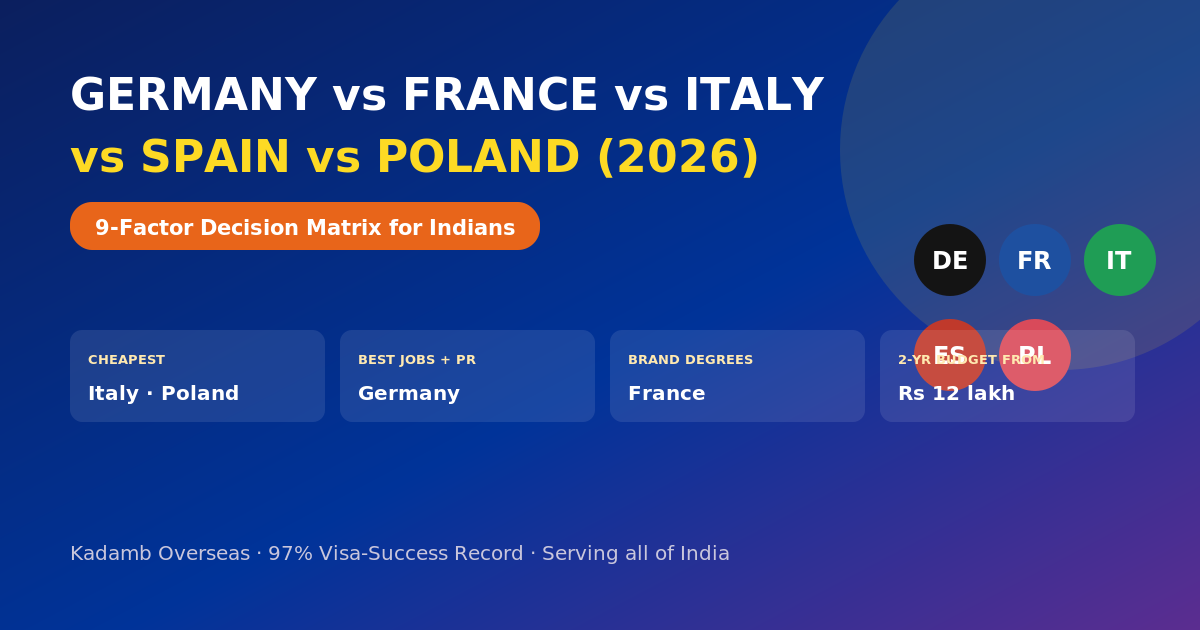
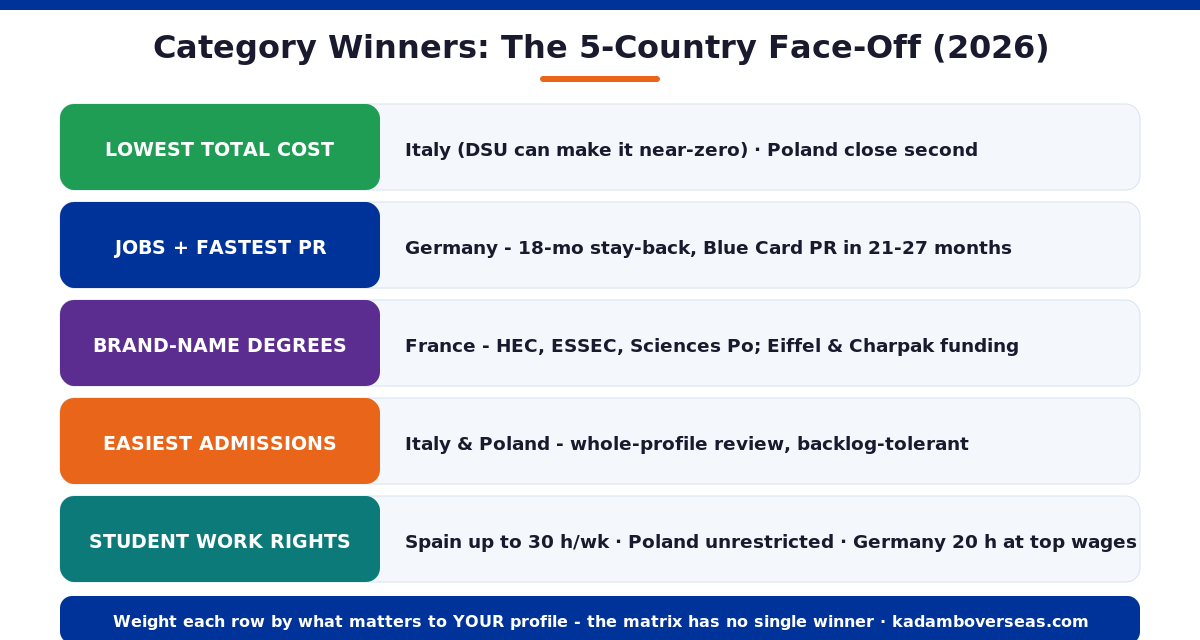
Quick answer: For Indian students comparing Europe’s five biggest study destinations in 2026: Germany wins on jobs and PR speed (zero tuition, 18-month stay-back, Blue Card PR in 21–27 months); Italy wins on total cost (€1–4k tuition, DSU scholarships that pay stipends); France wins on business schools and brand degrees; Poland wins on low costs with EU access and forgiving admissions; Spain wins on lifestyle-plus-affordability for Spanish-inclined profiles. Budget two years all-in: roughly ₹15–18 lakh Germany, ₹12–18 lakh Italy (before scholarships), ₹20–30 lakh France, ₹14–18 lakh Poland, ₹18–24 lakh Spain. The full matrix below scores all five on the nine factors that actually decide outcomes.
The 9-factor decision matrix
| Factor | Germany | France | Italy | Spain | Poland |
|---|---|---|---|---|---|
| Tuition (public, non-EU) | €0 (BW/TUM exceptions) | €3,900–€19k (grandes écoles more) | €1,000–4,000, income-based | €1,500–7,000 | €2,000–5,000 |
| Living cost/month | €950–1,200 | €900–1,400 (Paris high) | €700–1,000 | €700–1,000 | €500–750 |
| Proof of funds | €11,904/yr blocked | ~€615/month | ~€6,500/yr | ~€600/month (IPREM) | modest, ~€3,500/yr |
| Scholarships | DAAD, Deutschlandstipendium | Eiffel, Charpak | DSU (fees + stipend) | limited for non-EU | NAWA, uni waivers |
| English-taught choice | Wide (STEM) | Wide (business) | Growing (incl. MBBS) | Moderate | Wide for size |
| Part-time work | 20 h/wk, €13–17/hr | ~964 hrs/yr | 20 h/wk, fewer jobs | up to 30 h/wk | unrestricted with study |
| Post-study visa | 18 months | 12–24 mo (APS/RECE) | 12 months | 12–24 months | 9–12 months |
| Job market for internationals | Strongest (IT/engineering) | Strong w/ French | Moderate, north-centric | Improving, Spanish needed | Growing IT/BPO hubs |
| PR pathway | 21–27 mo (Blue Card) | 5 yrs | 5 yrs | 5 yrs | 5 yrs |
| 2-yr all-in (₹) | 15–18 lakh | 20–30 lakh | 12–18 lakh | 18–24 lakh | 14–18 lakh |
Approximate 2026 figures; tuition and fund thresholds change yearly — verify on official portals before applying.
Germany: the career-maximiser
Germany’s case is structural: public universities charge no tuition (Baden-Württemberg’s €1,500/semester and TUM’s new non-EU fees are the exceptions), the engineering and IT job market absorbs international graduates at scale, students work 20 hours a week at wages that meaningfully offset the €11,904 blocked account, and no other country touches the Blue Card PR timeline. The costs: competitive admissions at the TU9, the APS certificate step, and the reality that B1 German decides how wide your job market and PR lane really are. Best for: engineers, IT profiles, anyone whose end-goal is a European career or settlement.
France: the brand-degree play
France splits in two. Public universities charge the differentiated rate (~€3,900/year bachelor, similar masters) and teach much in French; the grandes écoles (HEC, ESSEC, EDHEC, Sciences Po) charge €20k+ but deliver globally traded brands with elite placement. Campus France structures the admission-visa pipeline, Eiffel and Charpak scholarships reward strong profiles, and the alumni network in Indian corporate leadership is real. The constraint: outside tech and consulting, career France runs on French. Best for: business and management ambitions, luxury/aviation/energy sector targets, strong academic profiles chasing Eiffel funding. Our Study in France guide covers the full pipeline.
Italy: the value engine
Italy is Europe’s most underrated destination for Indian families, and the numbers explain why: €1,000–4,000 tuition that falls further with family-income assessment (ISEE), regional DSU scholarships that waive fees and pay living stipends, English-taught engineering at Politecnico di Milano/Torino and medicine at €1–4k/year, and admissions culture that reads whole profiles rather than filtering on backlogs. Trade-offs: a 12-month post-study window, a job market concentrated in the industrial north, and bureaucracy that rewards patience. Best for: budget-constrained strong students, MBBS aspirants, design and architecture profiles. See our complete Italy guide.
Spain and Poland: the specialists
Spain combines moderate costs, up to 30 hours/week of student work, and a 12–24-month job-search runway — but converts into a career mainly for those who build Spanish alongside the degree; Barcelona and Madrid’s tech scenes are the English-speaking exceptions. Best for: business/hospitality/sports-management profiles and anyone already learning Spanish. Poland is the pragmatic pick: Europe’s lowest living costs (€500–750/month), tuition of €2–5k, effectively unrestricted work rights for students, booming IT/services hubs in Warsaw, Kraków and Wrocław, and admissions that accommodate gaps and backlogs. Trade-offs: thinner global brand recognition and a 9–12-month post-study window. Best for: cost-sensitive profiles, IT careers, and students rebuilding after a rejection elsewhere.
Head-to-head verdicts for common dilemmas
Germany vs Italy (the budget final): equal money after DSU; Germany wins on jobs and PR, Italy wins on admission-friendliness and MBBS. Career-first → Germany; cost-certainty-first or medicine → Italy.
France vs Germany (business vs engineering): MSc Management at a grande école beats German equivalents on brand; every engineering comparison tilts German.
Poland vs Spain (the affordable pair): Poland for IT careers and lowest cost; Spain for lifestyle fit and wider English programs at slightly higher spend.
Italy vs Poland (backlog-friendly pair): Italy if you can win DSU (net cost approaches zero); Poland if you need the fastest, simplest admission with work income from day one.
How to weight the matrix for your own profile
The matrix has no universal winner — it has your winner, found by weighting. Take five minutes and score it honestly: rate how much each of the nine factors matters to you from 1 (barely) to 3 (decisive), multiply each country’s standing in that row by your weight, and total the columns. A funding-tight family typically weights tuition, living cost and scholarships at 3 — and watches Italy and Poland pull ahead. A career-maximiser weights job market, post-study visa and PR at 3 — and Germany runs away with it. A brand-conscious commerce graduate weights English-taught choice and degree recognition — France surges. Two practical refinements: score the city you would actually live in, not the national average (Warsaw’s IT market deserves a better jobs score than rural Poland; Paris’s rents deserve a worse cost score than Lyon’s), and force yourself to keep a second-place country on file as the structural backup — the two-application strategy costs little and converts refusal risk into a routing decision rather than a lost year. And where two totals land within a few points of each other, let the visa file break the tie: the country whose funding proof your family can document most cleanly — seasoned savings for Germany’s blocked account versus monthly-income evidence for France or Spain — is the one where your approval odds are quietly highest.
Five matrix-reading mistakes to avoid
1. Comparing tuition instead of total cost of outcome — a €0-tuition degree that needs two years of German classes and a €25k one-year Irish degree can converge once salaries start.
2. Ignoring the language column’s career weight — it decides more job outcomes than the ranking column.
3. Treating post-study months as equivalent — 12 months in a thin job market is worth less than 12 in a deep one.
4. Scoring countries, not cities — Milan ≠ Calabria, Munich ≠ rural Saxony for internships and jobs.
5. Choosing solo off one YouTube comparison — run your own weights: multiply each row by how much it matters to you. The same matrix yields different winners for different profiles — which is exactly the point. For the step-before-this-step, use our 4-question country flowchart.
Frequently asked questions
Which is better for Indian students: Germany or France?
For engineering, IT and long-term settlement, Germany — zero tuition, the strongest job market and PR in 21–27 months. For business degrees with global brand value, France’s grandes écoles lead. The fields, more than the countries, decide this one.
Which country is cheapest among Germany, France, Italy, Spain and Poland?
Italy and Poland. Italy can approach net-zero education cost with a DSU scholarship (fee waiver + stipend); Poland pairs €2–5k tuition with Europe’s lowest living costs (€500–750/month). Germany’s €0 tuition makes it third despite higher living costs.
Which of these countries gives the best post-study work options?
Germany: an 18-month job-seeker permit, the deepest graduate job market of the five, and the Blue Card conversion that starts a 21–27-month PR clock. France’s 12–24-month options come second, strongest for those with working French.
Is Poland a good option for Indian students in 2026?
Yes, for the right profile: lowest total cost of the five, effectively unrestricted student work rights, growing IT hubs, and admissions that tolerate gaps and backlogs. Accept the trade-offs — less global brand weight and a shorter post-study window — and it is excellent value.
Can I study in these countries without learning the local language?
You can study in English in all five. You can build an English-only career most readily in Germany’s tech sector and parts of Poland’s IT scene; France, Italy and Spain expect the local language for most non-tech roles. Plan the language with the degree, not after it.
Which country should I pick if my grades are average or I have backlogs?
Italy and Poland evaluate complete profiles and routinely admit students with backlogs that would filter them out of TU9 Germany or numerus-fixus programs. Pair the admission-friendly country with a strong SOP and clean funding, and average-on-paper profiles enrol every intake.
Run the matrix on your own profile
Kadamb Overseas weighs these nine factors against your grades, budget and goals — for students from Mumbai, Delhi, Bengaluru, Hyderabad, Pune, Ahmedabad and every state of India — and builds a primary + backup country plan. 97% visa-success record.
Saumitra Rajput
Saumitra Rajput is the founder of Kadamb Overseas Pvt. Ltd., India's leading Europe-focused study abroad consultancy based in Ahmedabad. With 14+ years of expertise in European education, he has personally counselled 2,500+ Indian families and helped 500+ students secure admission to top European universities including TU Munich, ETH Zurich, EPFL, KU Leuven, HEC Paris, Sapienza Rome, TU Wien, and Warsaw University of Technology. He has visited 25+ European universities, partners with 250+ EU institutions, and maintains a 500+ students placed.
Planning to Study Abroad?
Get free expert guidance from our experienced counselors

Saumitra Rajput
Saumitra Rajput is the founder and lead counsellor at Kadamb Overseas, India's trusted Europe education consultancy based in Ahmedabad. With 14+ years of hands-on experience, he has personally guided 500+ students to universities across Germany, Switzerland, France, Italy, Austria, and Spain. Saumitra has visited partner universities across Europe, holds deep expertise in European visa processes, scholarships, and student life, and has achieved a 97% visa success rate for his clients. He is the host of the YouTube channel "Europe with Saumitra", where he shares first-hand insights on studying and living in Europe. His mission: make Europe accessible to every Indian student, with zero consultancy fees.