

Table of Contents
- Ask the questions in the right order
- Filter 1: What is your real total budget?
- Filter 2: How fast do you need to be earning?
- Filter 3: What are you studying?
- Filter 4: What happens after graduation?
- The seven-profile cheat sheet
- Tie-breakers: when two countries both survive the filters
- Defending your choice at the visa interview
- Five mistakes students make at this decision
- Frequently asked questions
🕑 7 min read
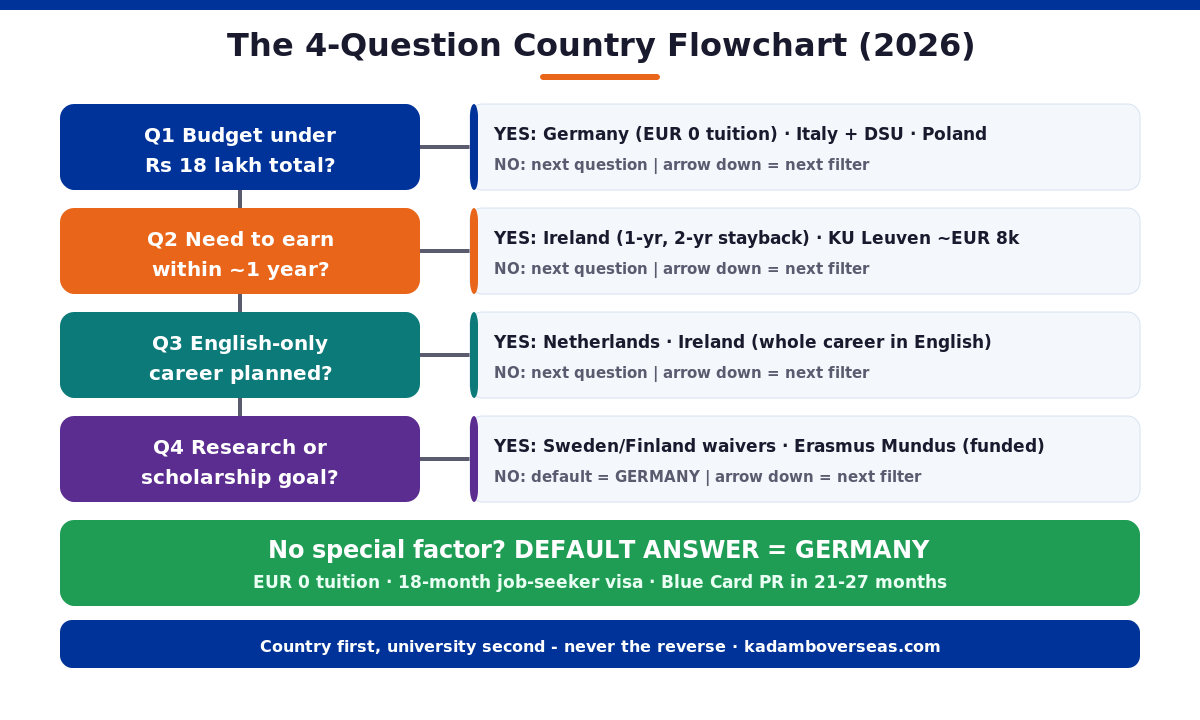
Quick answer: For most Indian students in 2026, the choice comes down to four questions. Budget under ₹15–18 lakh total? → Germany or Italy (near-zero tuition). Want a one-year master’s and fast entry to work? → Ireland or KU Leuven in Belgium. English-only, industry-focused, budget ₹40 lakh+? → Netherlands. Research career or scholarships? → Sweden/Finland (tuition waivers) or Erasmus Mundus (fully funded). Germany remains the default best answer — zero tuition, 18-month job-seeker visa, the EU’s fastest PR — unless a specific factor (timeline, budget structure, field, language) points elsewhere. The flowchart below walks the decision in order; this guide explains every branch.
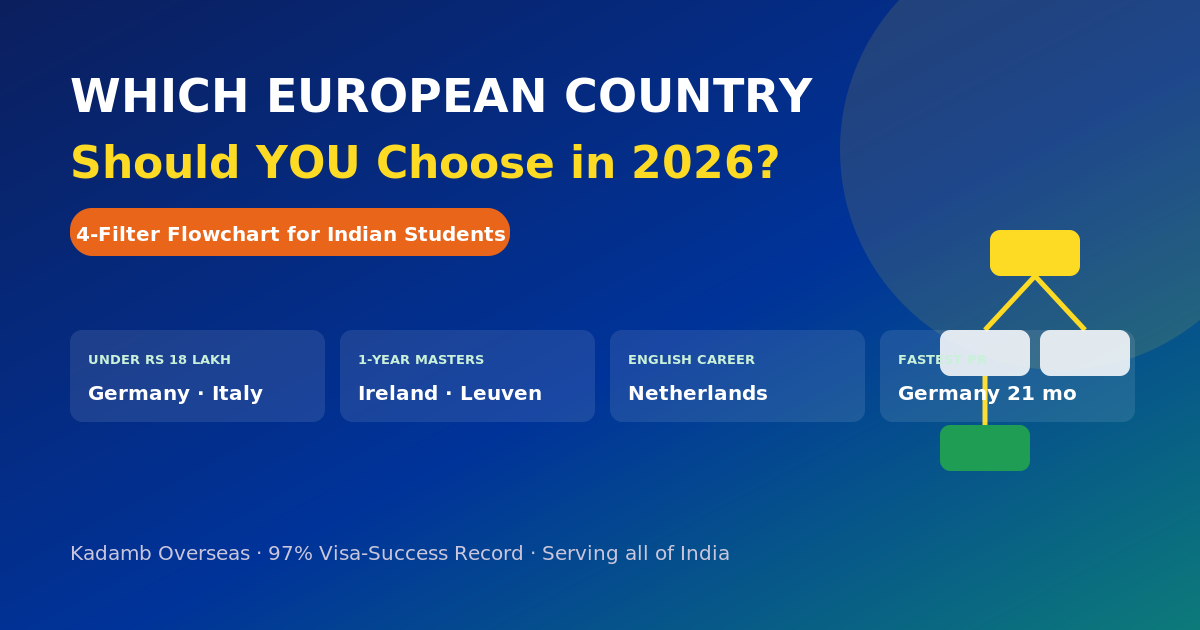
Ask the questions in the right order
Students agonise over rankings when the real decision is structural: budget shape, timeline, field, and post-study plans eliminate most countries before rankings matter at all. Work through the four filters in sequence — each one removes options for a reason you can defend at a visa interview, which is precisely what “why this country?” questions test (see our 50 interview questions guide).
Filter 1: What is your real total budget?
| Total 2-year budget (tuition + living) | Your realistic countries |
|---|---|
| ₹12–18 lakh | Germany (public), Italy (with DSU), Poland, Czechia, Hungary |
| ₹18–28 lakh | Above + Belgium (KU Leuven), Austria, France (public), Spain |
| ₹28–40 lakh | Above + Sweden/Finland (before waivers), Ireland (1-year) |
| ₹40–55 lakh+ | Everything incl. Netherlands, Denmark, French grandes écoles |
Two structural notes. Germany’s cost is almost entirely living expenses — the €11,904 blocked account per year — which means an education loan is smaller and repayment lighter. And Italy is the sleeper: public tuition of €1,000–4,000 that shrinks further with family-income assessment, plus regional DSU scholarships that can pay you a stipend — routinely making Italy cheaper than staying in an Indian private college.
Filter 2: How fast do you need to be earning?
One-year master’s: Ireland (Trinity, UCD — ~€25,000 tuition but you’re working by month 13, with a 2-year stay-back) and Belgium’s KU Leuven one-year MSc programs (~€8,000). Two-year programs everywhere else — but note the hidden compensations: Germany’s Werkstudent system (20 h/week at €13–17/hour) meaningfully offsets living costs from semester one, and two years buys a German B1 certificate, an internship and the network that one-year sprints rarely allow. If family finances need income fast, the one-year route wins; if career ceiling matters more, two years in Germany or the Netherlands usually places higher.
Filter 3: What are you studying?
Engineering & IT: Germany first (TU9 universities, the automotive/machine-building job market), Netherlands for software/design-heavy profiles, Sweden/Finland for niche research. For AI specifically, see our top-20 AI/ML programs guide.
Business & management: France’s grandes écoles (HEC, ESSEC, EDHEC) and the Netherlands (RSM) lead; Ireland for one-year MBAs feeding tech; Germany for industry-linked MSc Management.
Medicine & life sciences: Italy (English-taught MBBS at €1–4k/year), Hungary and Poland for established Indian-student pipelines; Germany/Netherlands for master’s-level biotech and public health.
Design, arts, humanities: Italy (Milan’s design schools), France, and the Dutch art academies; funding matters more here, so weight Erasmus Mundus heavily.
Research trajectory (PhD-bound): Sweden, Finland, Switzerland, Germany — funded PhD culture, ELLIS-network AI labs, and master’s theses embedded in real research groups.
Filter 4: What happens after graduation?
Post-study rules diverge more than tuition does. Job-seeker time: Germany 18 months, Ireland 24, Belgium 24, Netherlands 12 (orientation year), France 12–24 via APS/RECE, Nordics ~12. PR speed: Germany is the outlier — Blue Card to PR in 21–27 months; most others run 4–5 years. Language reality: the Netherlands and Ireland let you build a whole career in English; Germany rewards B1–B2 heavily (and the fast PR lane requires B1); France, Italy and Spain increasingly expect the local language for non-tech roles. If long-term settlement in Europe is the goal, Germany’s combination is unmatched; if a few years of English-speaking work experience then return to India is the plan, Ireland and the Netherlands fit better.
The seven-profile cheat sheet
Budget-first engineer: Germany public → fallback Italy/Poland.
Speed-first (earning by next year): Ireland → fallback KU Leuven.
English-only industry career: Netherlands → fallback Ireland.
Scholarship hunter: Erasmus Mundus (fully funded, multi-country — our complete guide) → Sweden/Finland waivers → Italian DSU.
Future PR/settlement: Germany, no serious rival in 2026.
MBBS aspirant: Italy → Hungary → Poland.
Profile with backlogs/gaps: Italy and Poland’s admissions culture evaluates the whole story, not just the transcript.
Tie-breakers: when two countries both survive the filters
Suppose Germany and the Netherlands both fit your engineering profile and budget. Break the tie on second-order factors, in this order. Total cost of the same outcome: price the full journey to first job — tuition, living, the language courses one path demands — not the tuition line alone; Germany’s €0 tuition often wins even after adding two years of German classes. Admission probability for your transcript: Dutch numerus-fixus programs and TU9 grade cut-offs behave very differently at a 7.2 CGPA than at 8.6; a country where you enter a top-tier program beats one where you scrape into a mid-tier. The specific city’s job market: a Delft admit near the Randstad tech corridor differs from an equally ranked program in a small town three hours from employers. Community and support: established Indian student communities (Berlin, Munich, Milan, Dublin, Eindhoven) measurably ease the first six months — housing leads, notes, referrals. And when the tie still won’t break: apply to both. Applications cost tens of thousands of rupees less than a wrong single bet.
Defending your choice at the visa interview
Whatever the flowchart outputs, you must be able to say it out loud in three sentences, because “why this country?” is a guaranteed interview question. The strong answer names structure, not scenery: “I chose Germany because my field is automotive engineering, the TU I’m admitted to runs a mandatory industry semester, tuition-free education keeps my family’s loan burden low, and the 18-month post-study visa fits my plan to gain work experience before deciding my long-term base.” Notice each clause maps to a filter above — field, program feature, budget, post-study rules. Build your version the same way and the question becomes the easiest one in the room.
Five mistakes students make at this decision
1. Choosing by Instagram, not structure. A country’s vlog aesthetic says nothing about your visa odds, job market or budget fit.
2. Treating rankings as the first filter. Rankings differentiate options inside a country after the structural filters — a top-200 German TU at €0 tuition beats a top-150 elsewhere at ₹35 lakh for most engineering profiles.
3. Ignoring the language trajectory. Choosing Germany while refusing to learn German wastes its biggest advantages; choosing France for business without French caps your options at consulting’s English islands.
4. Building a one-country plan. Smart applicants run a primary + one structurally different backup (e.g., Germany + Italy), sharing documents across both.
5. Deciding alone with anecdotes. Your cousin’s 2019 Canada experience is not data about 2026 Europe. Use current numbers — every figure above is verifiable on official pages.
Frequently asked questions
Which European country is best for Indian students in 2026?
Germany, for the most profiles: zero tuition at public universities, a massive engineering/IT job market, an 18-month job-seeker visa and the EU’s fastest PR (21–27 months via Blue Card). Ireland (speed), the Netherlands (English-only careers), Italy (lowest cost with scholarships) and Sweden/Finland (research) win for specific profiles.
Which European country is cheapest for Indian students?
Italy and Germany. Italian public universities charge €1,000–4,000/year with income-based reductions and DSU scholarships that can cover living costs; German public universities charge no tuition (small semester fees), leaving only living expenses of ~€11,900/year. Poland, Czechia and Hungary follow close behind.
Which country in Europe gives the best post-study work visa?
Ireland and Belgium offer 24-month stay-back periods; Germany gives 18 months plus the fastest conversion to permanent residency. The Netherlands’ 12-month orientation year is shorter but sits in a strong English-speaking job market.
Can I study in Europe without IELTS?
Some universities in Germany, Italy, Poland and Hungary accept a Medium-of-Instruction certificate instead of IELTS, but top programs and most visa officers prefer a formal test. Budget for IELTS/TOEFL — it strengthens both admission and visa files.
Which European country is easiest to get PR in for Indians?
Germany: EU Blue Card holders reach a settlement permit in 27 months, or 21 with B1 German — years faster than the 4–5-year norms elsewhere in Europe. Study time in Germany also counts at half rate toward residence calculations.
Should I choose a country or a university first?
Country first, by budget, timeline, field and post-study rules — then the best-fit universities inside the surviving countries. Reversing the order is how students end up with an admit they cannot fund or a degree in a market they cannot work in.
Get your country decision made with real numbers
Kadamb Overseas runs this exact decision framework — budget, timeline, field, post-study goals — for students from Mumbai, Delhi, Bengaluru, Hyderabad, Pune, Ahmedabad and every state of India, then builds the primary + backup country plan. 97% visa-success record.
Saumitra Rajput
Saumitra Rajput is the founder of Kadamb Overseas Pvt. Ltd., India's leading Europe-focused study abroad consultancy based in Ahmedabad. With 14+ years of expertise in European education, he has personally counselled 2,500+ Indian families and helped 500+ students secure admission to top European universities including TU Munich, ETH Zurich, EPFL, KU Leuven, HEC Paris, Sapienza Rome, TU Wien, and Warsaw University of Technology. He has visited 25+ European universities, partners with 250+ EU institutions, and maintains a 500+ students placed.
Planning to Study Abroad?
Get free expert guidance from our experienced counselors

Saumitra Rajput
Saumitra Rajput is the founder and lead counsellor at Kadamb Overseas, India's trusted Europe education consultancy based in Ahmedabad. With 14+ years of hands-on experience, he has personally guided 500+ students to universities across Germany, Switzerland, France, Italy, Austria, and Spain. Saumitra has visited partner universities across Europe, holds deep expertise in European visa processes, scholarships, and student life, and has achieved a 97% visa success rate for his clients. He is the host of the YouTube channel "Europe with Saumitra", where he shares first-hand insights on studying and living in Europe. His mission: make Europe accessible to every Indian student, with zero consultancy fees.
Related Articles
- MS Mechanical Engineering in Germany for Indian Students 2026
- Scholarships & Financial Aid for International Students – Luxembourg
- Study in Europe After Visa Rejection 2026: The Rebuild Strategy for Indian Students
- Advantages of Studying in France 2026: Data-Backed Guide
- Forex Card vs Wise vs Revolut for Indian Students in Europe 2026: The Real Cost Comparison