
Table of Contents
💰 Europe Cost Calculator 2026 Updated
Country 1
Country 2
- The three options, honestly compared
- Where students actually lose money
- The TCS rules from April 2026 — the part most blogs get wrong
- The setup that works: a two-instrument playbook
- A worked example: the ₹10-lakh year
- What about crypto, hawala-style “rate deals” and cash?
- Five money mistakes first-year students make
- Frequently asked questions
🕑 7 min read
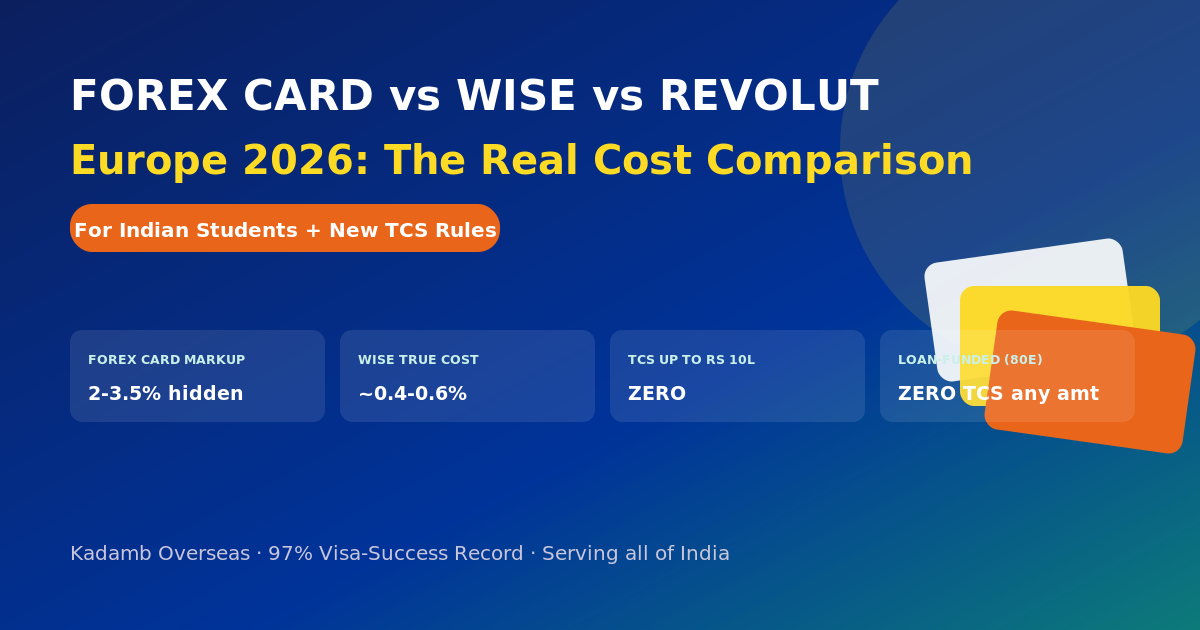
Quick answer: For Indian students in Europe in 2026, the cheapest everyday setup is usually Wise (or Revolut) for transfers and daily spending, plus one bank forex card as backup. Wise converts at the mid-market rate with fees around 0.4–0.6%; traditional forex cards look “zero fee” but hide a 2–3.5% exchange-rate markup plus reload and ATM charges; Revolut sits between, with great app features but weekend markups and plan limits. On a typical ₹10 lakh year of transfers and spending, choosing well saves ₹20,000–35,000. Tax note that changes the math from 1 April 2026: education remittances up to ₹10 lakh attract no TCS, above that just 2% — and zero TCS at any amount if funded by an education loan under Section 80E.
The three options, honestly compared
| Factor | Bank forex card | Wise | Revolut |
|---|---|---|---|
| True FX cost | 2–3.5% hidden in the rate | ~0.4–0.6% + small fixed fee, mid-market rate | ~0.5–1% (plan-dependent; weekend markup) |
| Loading / top-up from India | Parent reloads via bank; reload fee common | Parent sends INR→EUR to your account | Top-up via card/bank; INR route via transfer |
| European IBAN for rent/salary | No | Yes (Belgian IBAN) | Yes (Lithuanian/Irish IBAN) |
| ATM withdrawals | €2–3 or % per withdrawal | ~€200/mo low-fee, then ~1.75% | Plan allowance, then ~2% |
| Acceptance / reliability | Visa/MC — universal; works when phone dies | Universal card + app | Universal card + app |
| Best for | Backup card, visa-file forex proof | Big transfers (rent, fees), daily spend | Budgeting features, multi-currency travel |
Fees are indicative 2026 figures and vary by provider, plan and corridor — check the live fee breakdown before each large transfer.
Where students actually lose money
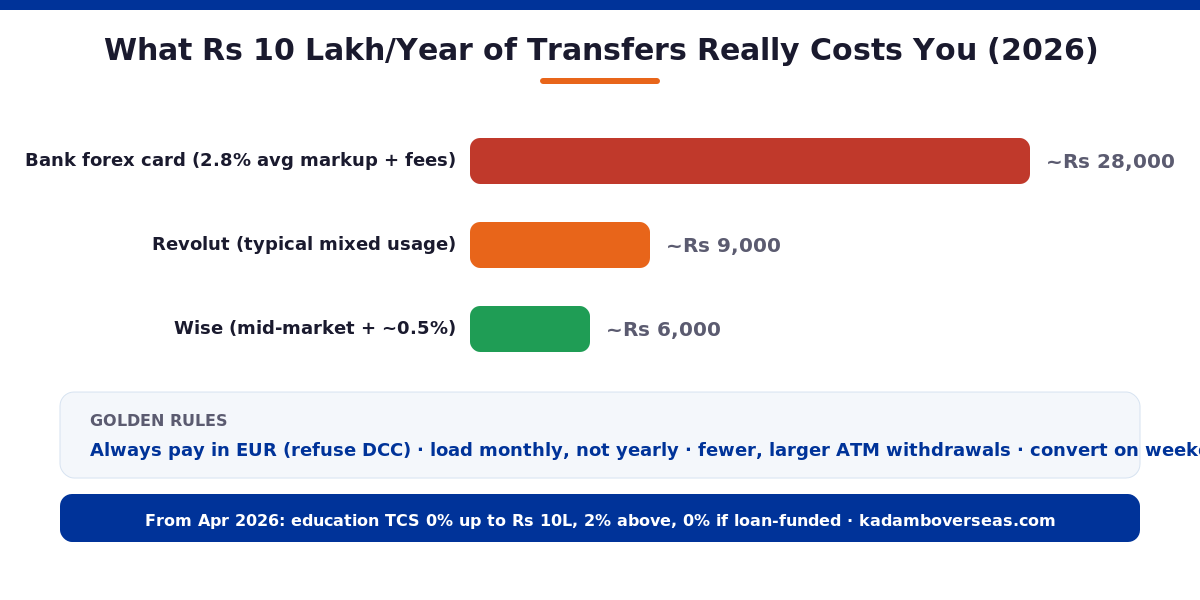
The losses hide in four places. The exchange-rate markup is the big one: a forex card “with zero issuance fee” that prices EUR at ₹2.50 above the interbank rate costs 2.6% silently — on ₹8 lakh of loading, over ₹20,000 gone before any visible fee. Dynamic currency conversion (DCC): whenever a European card machine or ATM offers to charge you “in INR”, refuse — always pay in euros; the DCC rate skims 3–6%. ATM habits: five small withdrawals a month at €2.50 each is €150/year for nothing; withdraw larger amounts, less often, within your plan’s free allowance. Weekend conversions on Revolut’s standard plan carry a markup — convert on weekdays. None of this requires financial genius; it requires knowing the four traps exist.
The TCS rules from April 2026 — the part most blogs get wrong
Tax Collected at Source applies when money leaves India under LRS, and Budget 2026 softened it substantially for students. The current structure: education remittances up to ₹10 lakh per financial year attract no TCS; above ₹10 lakh, education remittances attract just 2% (down from 5%); and — the clause every loan-funded family should memorise — remittances funded by an education loan from a specified institution (Section 80E) attract zero TCS regardless of amount. Three practical implications: route big payments as clearly-documented education remittances (tuition to the university, living costs to your own student account) rather than generic transfers; if a loan funds you, keep the sanction letter with the remitting bank so the exemption applies; and remember TCS is not a cost, it is an advance tax — reclaimable in the family’s ITR — but it still parks cash for months, so structuring to avoid it keeps money working for you.
The setup that works: a two-instrument playbook
Before you fly: open Wise (or Revolut) with your Indian KYC, and carry one bank forex card loaded with a modest €300–500 — embassies and universities occasionally want traditional forex proof, and a physical backup matters on day one.
Big payments (tuition, blocked account, deposits): compare your bank’s TT rate against Wise’s quote for the same amount including all fees — on lakhs, the difference is real money. German blocked account funding usually goes through the provider’s specified route; follow it exactly.
Monthly living money: parent sends INR→EUR via Wise to your account; you spend by card, in euros, always declining DCC.
After arrival: open a local German/Dutch bank account once Anmeldung is done — salaries (Werkstudent jobs), rent by SEPA direct debit and insurance run smoothest from a domestic IBAN; keep Wise/Revolut for the India corridor.
Emergency layer: one Indian international credit card (parent’s add-on works) that stays unused except for genuine emergencies.
A worked example: the ₹10-lakh year
Put numbers on a typical first year: ₹6 lakh in two tuition/fee transfers, ₹3 lakh in monthly living top-ups, ₹1 lakh of card spending and ATM cash. Routed through a typical bank forex card and ordinary bank TT rates, the hidden markups and per-transaction fees total roughly ₹25,000–30,000. The same year through Wise-style mid-market transfers with disciplined ATM habits costs about ₹6,000–8,000. The ₹20,000+ difference is one month’s rent in Leipzig or Kraków — recovered purely by routing, with zero risk and zero extra effort after the first setup hour. Families funding two years should double those stakes and add the TCS structuring above; the total swing between a careless and a careful money setup over a full degree comfortably exceeds ₹50,000.
What about crypto, hawala-style “rate deals” and cash?
Every year students get offered “better rates” outside official channels. Decline all of them. Informal transfer arrangements violate FEMA, create unexplainable credits that can surface at visa extension time (European banks flag irregular inflows), and offer zero recourse when money vanishes. Crypto transfers add exchange risk and a tax-reporting burden on both ends that dwarfs any spread saved. Carrying large cash is legal only within declared limits and is uninsurable in a lost bag. The official corridor — LRS remittance with clean purpose codes — is cheap now (0.5% via the right provider) and is itself part of your immigration paper trail. Boring wins. If a deal sounds better than the interbank rate, you are not the customer — you are the product, the mule, or the mark; there is no fourth option in cross-border money.
Five money mistakes first-year students make
1. Loading a full year onto a forex card at a bad rate — you pay the 3% markup on everything up front and lose flexibility. Load monthly-quarterly instead.
2. Accepting DCC “pay in INR” prompts — the single most repeated 4% donation to card machines across Europe.
3. Paying tuition through generic remittance channels — misclassified transfers can attract wrong TCS treatment and complicate refunds; always mark education purpose with the university invoice.
4. Ignoring the local bank account — some landlords and employers in Germany still insist on a German IBAN for direct debits; fintech-only setups eventually hit friction.
5. No paper trail discipline — visa extensions and tax filings both love statements. One folder, every transfer confirmation, from day one.
Frequently asked questions
Which is better for Indian students: a forex card or Wise?
For cost, Wise wins in most scenarios — mid-market rates with ~0.4–0.6% visible fees versus the 2–3.5% markup hidden in typical forex-card rates. The smart setup is both: Wise/Revolut as the primary instrument, one forex card as physical backup and for any traditional forex documentation.
Is Revolut available for Indians studying in Europe?
Yes — once you are resident in Europe you can open Revolut with your local address (and Revolut operates in India separately). Many students run Wise for the India–Europe corridor and Revolut for eurozone budgeting; both provide European IBANs and cards.
How much TCS applies when parents send money for education in 2026?
From 1 April 2026: nothing up to ₹10 lakh per financial year, 2% above ₹10 lakh for education remittances — and zero at any amount when the remittance is funded by a Section 80E education loan from a specified institution. TCS that is collected is adjustable against tax liability in the ITR.
What is DCC and why should I always pay in euros?
Dynamic Currency Conversion is the “pay in your home currency?” prompt on European terminals and ATMs. Its exchange rate typically costs 3–6% more than your own card’s conversion. Always choose to pay in the local currency (EUR) — on every terminal, every time.
Do I still need a European bank account if I use Wise?
Eventually, yes — especially in Germany, where salaries, rent direct debits and insurance run best from a domestic IBAN, and some counterparties won’t accept fintech IBANs. Open the local account after city registration; keep Wise for the India corridor where it is strongest.
How much money can parents send under LRS per year?
Up to USD 250,000 per person per financial year under RBI’s Liberalised Remittance Scheme — far above any student’s needs; the practical constraints are TCS structuring and documentation, not the ceiling itself.
Set up your money before you fly — the right way
Kadamb Overseas walks families from Mumbai, Delhi, Bengaluru, Hyderabad, Pune, Ahmedabad and all of India through the full funding stack — remittance routing, TCS structuring, blocked accounts and first-month setup — with a 97% visa-success record.
Saumitra Rajput
Saumitra Rajput is the founder of Kadamb Overseas Pvt. Ltd., India's leading Europe-focused study abroad consultancy based in Ahmedabad. With 14+ years of expertise in European education, he has personally counselled 2,500+ Indian families and helped 500+ students secure admission to top European universities including TU Munich, ETH Zurich, EPFL, KU Leuven, HEC Paris, Sapienza Rome, TU Wien, and Warsaw University of Technology. He has visited 25+ European universities, partners with 250+ EU institutions, and maintains a 500+ students placed.
Planning to Study Abroad?
Get free expert guidance from our experienced counselors

Saumitra Rajput
Saumitra Rajput is the founder and lead counsellor at Kadamb Overseas, India's trusted Europe education consultancy based in Ahmedabad. With 14+ years of hands-on experience, he has personally guided 500+ students to universities across Germany, Switzerland, France, Italy, Austria, and Spain. Saumitra has visited partner universities across Europe, holds deep expertise in European visa processes, scholarships, and student life, and has achieved a 97% visa success rate for his clients. He is the host of the YouTube channel "Europe with Saumitra", where he shares first-hand insights on studying and living in Europe. His mission: make Europe accessible to every Indian student, with zero consultancy fees.
Related Articles
- Visa application centers for Canada visas & immigration are
- Study in Austria FREE 2026: Complete Guide for Indian Students
- DSU Scholarship Italy 2026: Complete Guide for Indian Students
- DSU Scholarship Italy 2026 — Free Tuition + ₹5.8L Stipend + Dorm
- MS in Data Science & Artificial Intelligence in Europe 2026