
Table of Contents
- Why Europe is the smartest place for an AI/ML master’s in 2026
- Top 20 universities for MS in AI / Machine Learning in Europe (2026–27)
- What do you need to get admitted?
- Deadlines for the 2027 intake
- Total cost for Indian students: a realistic budget
- Jobs after an AI master’s in Europe
- How to choose: three student profiles
- Five mistakes Indian applicants make (and how to avoid them)
- Frequently asked questions
🕑 8 min read
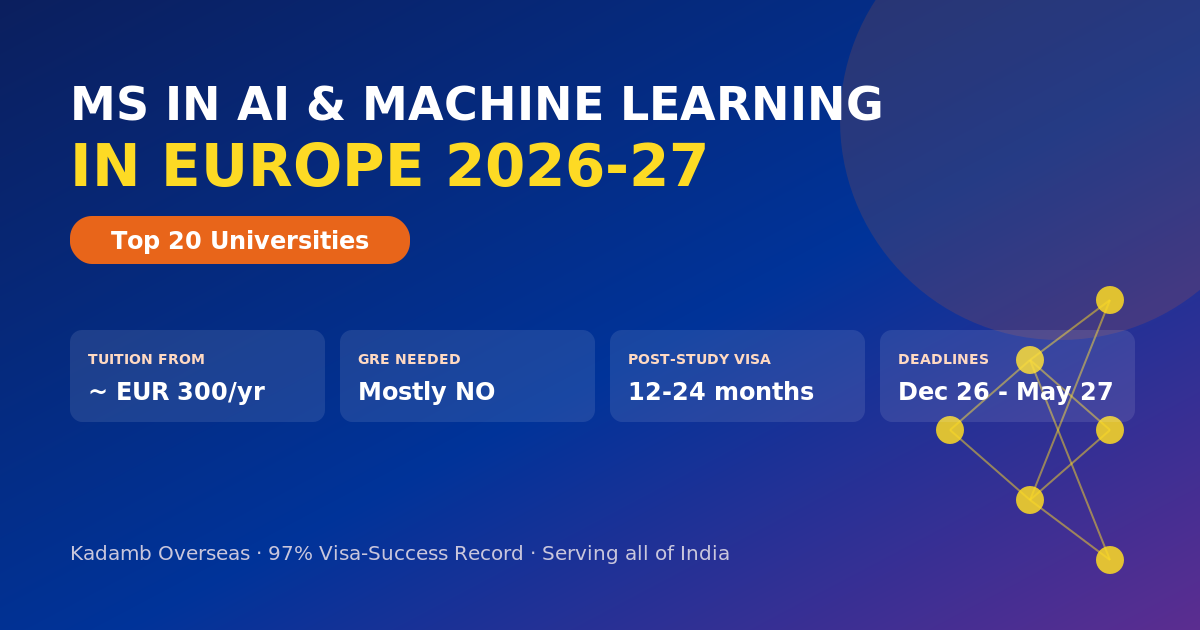
Quick answer: The best MS in Artificial Intelligence and Machine Learning programs in Europe for Indian students in 2026–27 are at ETH Zurich, EPFL, TU Munich, KU Leuven, KTH Stockholm, Aalto University, TU Delft and the University of Amsterdam. Tuition for non-EU students ranges from roughly €1,500 per year in Switzerland and public Germany to about €25,000 per year in the Netherlands. Most programs need a strong B.Tech/B.E. (CSE, IT, ECE or Maths-heavy), IELTS 6.5+, and applications close between January and May 2027 for the autumn 2027 intake. Kadamb Overseas guides students from every state of India through shortlisting, applications and visas for all of these programs.
Why Europe is the smartest place for an AI/ML master’s in 2026
Europe now hosts some of the world’s strongest AI research networks. The ELLIS network (European Laboratory for Learning and Intelligent Systems) connects 40+ top labs from Zurich to Helsinki, and the EU’s AI Act has created huge demand for engineers who understand both models and regulation. For Indian students, the practical case is simple: tuition is a fraction of US costs, post-study work visas run 12–24 months in most countries, and the EU Blue Card gives AI graduates one of the fastest routes to European PR. A typical two-year AI master’s in Germany costs less in total than a single semester at many US universities.
Top 20 universities for MS in AI / Machine Learning in Europe (2026–27)
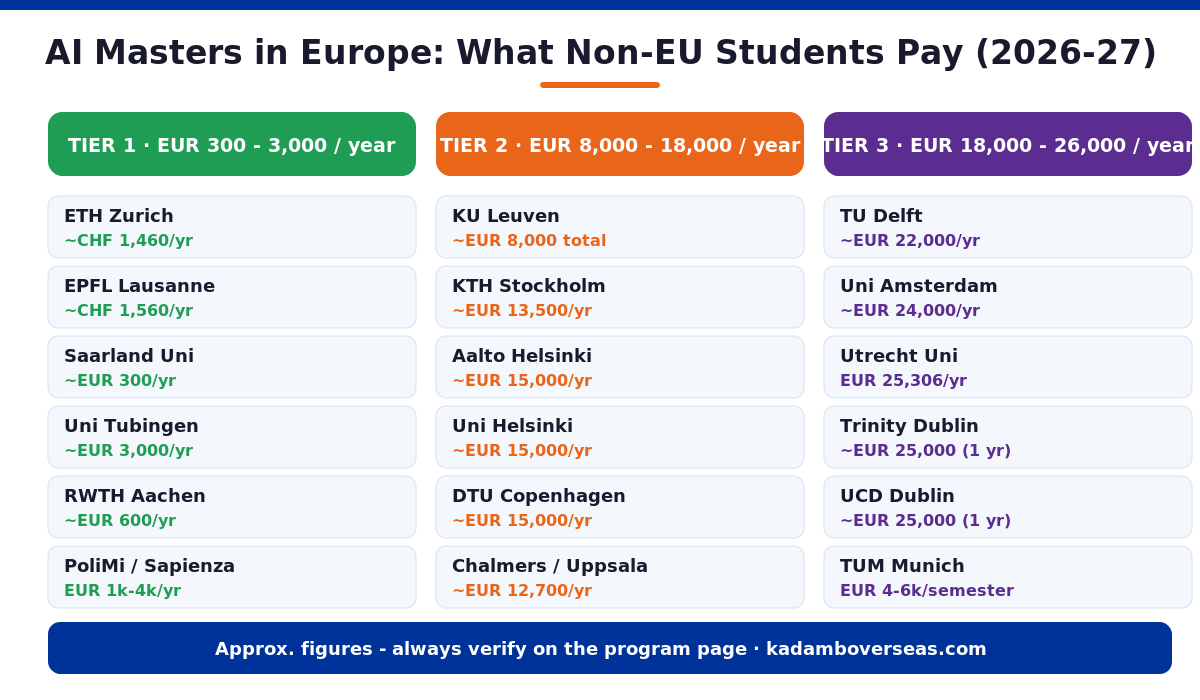
Grouped by budget tier so you can shortlist by what you will actually pay as a non-EU student. Always confirm the exact fee on the program page — several universities revise fees each academic year.
Tier 1 — World-class research, minimal tuition (€300–€3,000/year)
| University | Program | Approx. non-EU tuition |
|---|---|---|
| ETH Zurich (Switzerland) | MSc Computer Science – ML track | ~CHF 1,460/year |
| EPFL Lausanne (Switzerland) | MSc Data Science / CS | ~CHF 1,560/year |
| Saarland University (Germany) | MSc Computer Science (AI focus) | ~€300/year (semester fee only) |
| University of Tübingen (Germany) | MSc Machine Learning | ~€3,000/year (BW state fee) |
| RWTH Aachen (Germany) | MSc Data Science / CS | ~€600/year |
| Politecnico di Milano (Italy) | MSc CS Engineering – AI | ~€4,000/year (income-based) |
| Sapienza University of Rome (Italy) | MSc Artificial Intelligence & Robotics | ~€1,000–3,000/year |
Tübingen deserves a special word: it sits inside “Cyber Valley”, Europe’s largest AI research consortium, with Max Planck Institute for Intelligent Systems and Amazon/Bosch labs on the doorstep. For research-oriented students it rivals universities charging ten times more. Read our complete Study in Germany guide for how the German system works end to end.
Tier 2 — Nordic and Benelux powerhouses (€8,000–€18,000/year)
| University | Program | Approx. non-EU tuition |
|---|---|---|
| KU Leuven (Belgium) | MSc Artificial Intelligence (1 year) | ~€8,000 total |
| KTH Stockholm (Sweden) | MSc Machine Learning | ~SEK 155,000/year (≈€13,500) |
| Aalto University (Finland) | MSc Machine Learning, Data Science & AI | ~€15,000/year (big scholarships) |
| University of Helsinki (Finland) | MSc Data Science | ~€15,000/year |
| DTU Copenhagen (Denmark) | MSc Human-Centered AI | ~€15,000/year |
| Chalmers (Sweden) | MSc Data Science & AI | ~SEK 145,000/year |
| Uppsala University (Sweden) | MSc Data Science – ML | ~SEK 145,000/year |
KU Leuven’s one-year Master of AI is a standout value: a globally ranked degree, in English, for around €8,000 all-in tuition — and Belgium’s new two-year job-seeker visa afterwards. We covered the university in depth in our KU Leuven admission guide for Indian students. Sweden and Finland offer 30–100% tuition-waiver scholarships that Indian applicants win regularly; see our Sweden guide and Finland guide.
Tier 3 — Premium programs worth the price (€18,000–€26,000/year)
| University | Program | Approx. non-EU tuition |
|---|---|---|
| TU Delft (Netherlands) | MSc Computer Science – AI track | ~€22,000/year |
| University of Amsterdam (Netherlands) | MSc Artificial Intelligence | ~€24,000/year |
| Utrecht University (Netherlands) | MSc Artificial Intelligence | €25,306 (2026–27) |
| Trinity College Dublin (Ireland) | MSc Intelligent Systems | ~€25,000 total (1 year) |
| University College Dublin (Ireland) | MSc Artificial Intelligence | ~€25,000 total (1 year) |
| TUM Munich (Germany) | MSc Informatics / Mathematics in Data Science | €4,000–6,000/semester (non-EU) |
Note the TUM change: since winter 2024/25, TU Munich charges new non-EU students €4,000–€6,000 per semester on most master’s programs, though a few remain fee-free — always check the individual program page. The Netherlands and Ireland cost more but compress the degree into 12 months (Ireland) and lead into strong AI job markets with 1–2 year post-study visas.
What do you need to get admitted?
Requirements are consistent across Europe, with small local twists:
- Degree: 4-year B.Tech/B.E. in CSE, IT, ECE, or a maths-heavy B.Sc. Most Tier 1–2 programs want 70–80%+ or CGPA 7.5+; ETH, EPFL and Amsterdam effectively expect 8.5+.
- Maths and programming evidence: transcripts must show linear algebra, calculus, probability and algorithms. Aalto, KTH and TU Delft screen for this line by line.
- English: IELTS 6.5–7.0 or TOEFL 90–100. No IELTS waiver at most Tier 1 schools.
- GRE: not required by most European programs — a major advantage over the US. (EPFL recommends it for applicants from India.)
- Germany extra: APS certificate is mandatory before you apply — our APS certificate guide explains the process and timeline.
Deadlines for the 2027 intake
AI programs fill early. For autumn 2027 entry: Sweden and Finland close mid-January 2027, Switzerland (ETH/EPFL) closes in December 2026, the Netherlands closes between 15 January and 1 April 2027 (earlier for numerus-fixus AI programs like Amsterdam), Germany typically closes 15 March–31 May 2027, and KU Leuven accepts non-EU applications until around 1 March 2027. Working backwards, your IELTS, APS (for Germany) and SOP should be finished by November–December 2026.
Total cost for Indian students: a realistic budget
Add living costs to tuition: about €11,900/year in Germany (blocked account level), €9,600–€12,000 in Belgium, €12,000–€15,000 in the Netherlands and Nordics, and CHF 21,000+ in Switzerland. A Tier 1 German program can keep the entire two-year degree under ₹15–18 lakh including living costs, while a Dutch program runs ₹45–55 lakh. Scholarships that Indian AI applicants actually win include DAAD, Erasmus Mundus (fully funded — see our Erasmus Mundus guide), Aalto and KTH tuition waivers, Holland Scholarship and Irish Government IES.
Jobs after an AI master’s in Europe
AI and data roles remain the strongest hiring segment for international graduates in Europe. Entry salaries for ML engineers: roughly €55,000–€70,000 in Germany, €50,000–€65,000 in the Netherlands, SEK 45,000–55,000/month in Sweden, and CHF 100,000+ in Switzerland. Every country on this list gives you a post-study job-seeker permit — 18 months in Germany, 12 months (orientation year) in the Netherlands, 2 years in Ireland and Belgium — and AI salaries comfortably clear EU Blue Card thresholds, opening PR routes in as little as 21–27 months in Germany.
How to choose: three student profiles
Budget-first (family funds under ₹20 lakh): Saarland, Tübingen, RWTH Aachen, Politecnico di Milano, Sapienza. World-class research, near-zero tuition.
Fastest degree + job market: KU Leuven (1 year), Trinity/UCD Dublin (1 year) — you are working by 2028.
Maximum brand + research career: ETH Zurich, EPFL, TUM, Amsterdam — the strongest doors into PhD programs, DeepMind, and European AI labs.
Five mistakes Indian applicants make (and how to avoid them)
1. Applying only to famous names. Thousands of Indian applicants chase TU Delft and Amsterdam while Tübingen, Saarland and Politecnico di Milano — with equal or better AI research output — receive far fewer Indian applications and cost a tenth of the price. A balanced shortlist has two ambitious picks, three realistic ones and one safe admit.
2. Ignoring the maths audit. Nordic and Dutch universities reject otherwise strong profiles because the transcript does not clearly show linear algebra, probability and statistics credits. If your B.Tech transcript names these vaguely, attach a course-description annexure — it routinely converts rejections into admits.
3. Starting the APS too late. For Germany, the APS certificate takes 4–8 weeks and is required before uni-assist applications. Students who start APS in February miss the May deadline window.
4. A generic SOP. AI admissions teams read thousands of essays that say “AI is the future.” The SOPs that win name specific labs, professors and papers — for example, referencing Cyber Valley groups in a Tübingen application, or ELLIS units at Aalto and KTH.
5. Under-budgeting proof of funds. Visa officers verify blocked accounts and bank statements strictly. Germany requires about €11,904 in a blocked account for 2026; our blocked account guide walks through the exact setup from India.
Frequently asked questions
Which country in Europe is best for MS in AI for Indian students?
Germany offers the best overall value: top-ranked AI research at near-zero tuition, an 18-month job-seeker visa, and Europe’s largest tech job market. Switzerland is best for pure research prestige, the Netherlands for English-speaking industry roles, and Belgium (KU Leuven) for a one-year degree at moderate cost.
Can I study MS in AI in Europe without GRE?
Yes. Almost all European AI master’s programs — including TUM, KU Leuven, KTH, Aalto, TU Delft and Amsterdam — do not require the GRE. EPFL recommends (but does not mandate) it for Indian applicants.
What CGPA do I need for an AI master’s in Europe?
Tier 1 research universities (ETH, EPFL, Amsterdam, TUM) effectively expect CGPA 8.5+/75–80%+. Strong programs like Tübingen, KTH, Aalto and KU Leuven admit consistent applicants from 7.5. Below 7.0, target Italian polytechnics and East-European programs — and compensate with projects and a strong SOP.
How much does an MS in Machine Learning in Europe cost in rupees?
Total cost including living: roughly ₹15–18 lakh for two years in public German universities, ₹18–22 lakh at KU Leuven, ₹30–38 lakh in Sweden/Finland (before waivers), and ₹45–55 lakh in the Netherlands. Scholarships can cut Nordic costs by 50–100%.
Is Europe better than the USA for MS in AI?
For most Indian students in 2026, yes on cost and immigration: European tuition is 70–90% lower, no GRE, post-study visas are guaranteed by law rather than lottery-based, and the EU Blue Card offers a faster, more predictable PR route than the US H-1B system. The US retains an edge in Big-Tech salaries.
Which intake should I target for AI programs in Europe?
The autumn intake (September/October 2027) is the main one — almost every AI program admits for autumn only. Applications open September–October 2026 and close January–May 2027 depending on country, so start preparing documents now.
Get a free AI/ML university shortlist for your profile
Kadamb Overseas has placed students from every corner of India — Mumbai, Delhi, Bengaluru, Hyderabad, Pune, Ahmedabad and beyond — into Europe’s top AI programs, with a 97% visa-success record. We shortlist by your CGPA, budget and target country, then manage applications, scholarships and the visa file end to end.
Saumitra Rajput
Saumitra Rajput is the founder of Kadamb Overseas Pvt. Ltd., India's leading Europe-focused study abroad consultancy based in Ahmedabad. With 14+ years of expertise in European education, he has personally counselled 2,500+ Indian families and helped 500+ students secure admission to top European universities including TU Munich, ETH Zurich, EPFL, KU Leuven, HEC Paris, Sapienza Rome, TU Wien, and Warsaw University of Technology. He has visited 25+ European universities, partners with 250+ EU institutions, and maintains a 500+ students placed.
Planning to Study Abroad?
Get free expert guidance from our experienced counselors

Saumitra Rajput
Saumitra Rajput is the founder and lead counsellor at Kadamb Overseas, India's trusted Europe education consultancy based in Ahmedabad. With 14+ years of hands-on experience, he has personally guided 500+ students to universities across Germany, Switzerland, France, Italy, Austria, and Spain. Saumitra has visited partner universities across Europe, holds deep expertise in European visa processes, scholarships, and student life, and has achieved a 97% visa success rate for his clients. He is the host of the YouTube channel "Europe with Saumitra", where he shares first-hand insights on studying and living in Europe. His mission: make Europe accessible to every Indian student, with zero consultancy fees.