
Table of Contents
- First 72 hours: what to do (and not do) after the refusal
- Diagnose like an officer: the four real reasons students get refused
- Reapply or pivot? The honest decision framework
- Rebuilding the timeline: what a refusal really costs
- Protect the second file: consistency is everything
- A real rebuild, anonymised: from France refusal to Italy scholarship
- Five rebuild mistakes that cause second refusals
- Frequently asked questions
🕑 7 min read
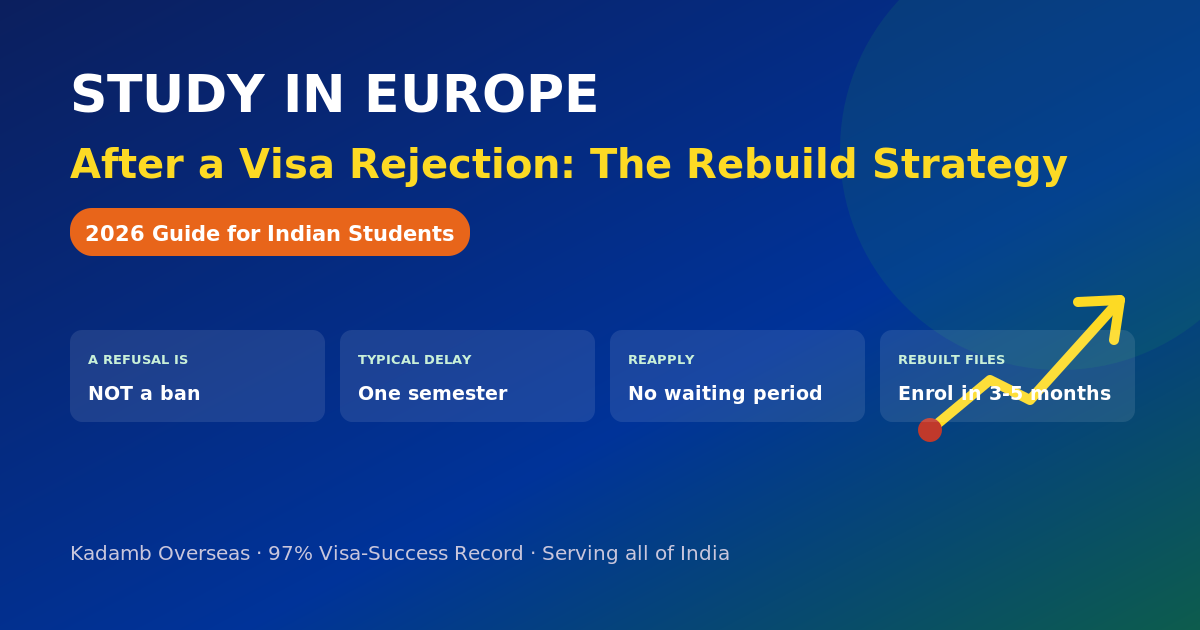
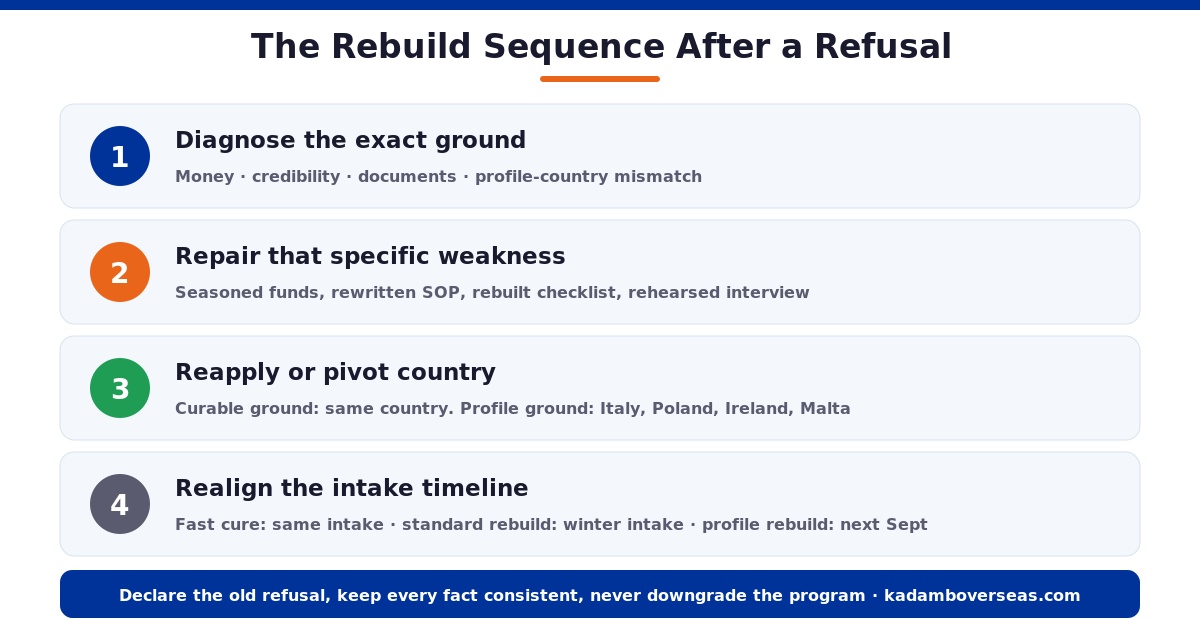
Quick answer: A visa rejection does not end your Europe plan — statistically, it barely dents it. A refusal is not a ban and not permanently disqualifying: you may reapply to the same country immediately with a corrected file, or pivot to one of several equally strong countries whose requirements fit your profile better. The rebuild that works follows a fixed sequence: diagnose the exact refusal ground → repair that specific weakness → decide same-country reapplication vs. country pivot → realign your intake timeline (most students lose one semester, not one year). Students we’ve guided through this rebuild enrol successfully every single intake — usually within 3–5 months of the refusal.
First 72 hours: what to do (and not do) after the refusal
Do not book a reapplication slot the same week, and do not fire off applications to three new countries in panic — both moves multiply refusals. Instead: read the refusal letter twice and list every cited ground; pull your entire submitted file and re-read it as a sceptical officer would; write down, honestly, what you said in the interview (memory fades fast); and check your hard deadlines — university enrolment latest date, scholarship conditions, blocked-account validity. Then take a structured file review (ours takes under an hour) before any money moves. The refusal letter is your repair manual; treat it that way. Our companion guide to the appeal and reapplication routes in Germany, France and Italy covers the legal mechanics and deadlines country by country.
Diagnose like an officer: the four real reasons students get refused
Money problems (the biggest bucket): insufficient funds, un-seasoned lump-sum deposits, sponsor income that can’t plausibly support the commitment, mismatched figures across documents. Repair: rebuild the funding story from scratch — correct blocked account or FD structure, 3–6 month bank trails, sponsor ITRs aligned with stated income, one page explaining every large credit.
Credibility gaps: the officer didn’t believe the study plan — course disconnected from your academic past, generic SOP, wobbly interview answers about the university or career logic. Repair: a rewritten SOP that closes the logic gap explicitly, plus interview rehearsal against our 50-question bank.
Documentation defects: missing apostilles, expired police certificates, non-compliant insurance, translation gaps. Repair: mechanical — rebuild the checklist to embassy standard; these files win on reapplication at very high rates.
Profile-country mismatch: long education gaps, many backlogs, or an age profile that one country’s officers view sceptically while another’s rules accommodate happily. Repair: this is the pivot case — see below.
Reapply or pivot? The honest decision framework
Reapply to the same country when the refusal ground is specific and curable (funds structure, missing document, one bad interview answer), your admission is still valid, and the timeline allows a decision before enrolment deadline. A cured same-country reapplication is the fastest route — often 4–8 weeks to a decision — and officers respect files that fixed exactly what was cited.
Pivot to another country when the ground attacks your profile rather than your paperwork. Concretely: heavy backlogs or gaps sit better with Italian and Polish admissions culture than with some northern consulates; older applicants and career-changers fare well in Ireland and Malta’s one-year master’s ecosystems; funding-constrained families find Italy’s DSU scholarships and Germany’s zero tuition change the entire financial credibility question; and if the refusal cited return-intent doubts on a short-stay logic, a long-stay student visa with a degree-length plan often reads completely differently. A pivot is not defeat — several of our strongest placements (including DSU scholars in Italy and KU Leuven admits in Belgium) came directly after a refusal elsewhere.
Run both in parallel when a deadline is close: reapplication to country A plus a fresh application to country B doubles your chances and violates no rule — just keep every file internally consistent, because Schengen consulates can see prior refusals.
Rebuilding the timeline: what a refusal really costs
Mapped against the two intake seasons, a refusal in, say, June for a September intake typically plays out one of three ways: a fast cure (documents/funds) still catches the same intake or a late-enrolment window; a standard rebuild lands the winter/spring intake (Germany’s March–April summer semester, Italy’s February courses, Ireland’s January starts) — a 4–6 month delay; and a profile rebuild (language certificate upgrade, one semester of work experience, stronger funds) targets the next September stronger than the first attempt ever was. The productive frame: the months between attempts are build time — B1 German or a better IELTS score, seasoned bank statements, and a sharper SOP convert a marginal file into an easy approval. Students who use the gap this way often end up at better universities than their original choice.
Protect the second file: consistency is everything
Consulates keep your history, and modern Schengen systems share refusal data. Three rules keep the rebuild safe. Declare the refusal everywhere it’s asked — concealment converts a curable file into a misrepresentation problem that genuinely can end the Europe plan. Never change facts between files — a father’s income that grows 40% between attempts, a new “uncle sponsor” appearing from nowhere, or a rewritten employment history all read as fabrication even when innocent; if something legitimately changed, document why. Keep the story one story — SOP, forms, funds and interview answers must tell the same narrative across both attempts; the second interview will probe precisely the deltas.
A real rebuild, anonymised: from France refusal to Italy scholarship
A B.Com graduate from Gujarat came to us after a France student-visa refusal citing insufficient and unverifiable funds — a ₹9 lakh lump sum had landed in the family account three weeks before the application, unexplained. The diagnosis took twenty minutes; the rebuild took eleven weeks. We documented the deposit’s source (a matured family FD, papers retrieved from the bank), but more importantly re-ran the country decision: with the family’s realistic budget, Italy’s regional DSU scholarship — which covers fees and pays a living stipend — changed the financial credibility question entirely rather than merely patching it. New application: Italian public university, DSU application filed in parallel, refusal declared with a one-line explanation and the FD paper trail enclosed. Visa approved in five weeks; the scholarship came through in October. The lesson generalises: the strongest rebuilds don’t just fix the cited defect — they re-ask whether the original country choice was ever the best fit for the profile.
Five rebuild mistakes that cause second refusals
1. Reapplying with the same file “for luck”. Same file, same outcome — now with a pattern forming.
2. Panic-applying to five countries at once. Five rushed files share the same defect; one corrected file beats them all.
3. Buying a “guaranteed visa” from an agent. No such product exists; fabricated documents are the one mistake with permanent consequences.
4. Switching to a visibly weaker program to “improve odds”. A credibility-refused applicant who downgrades from a ranked master’s to an obscure diploma confirms the officer’s doubt. Pivot sideways or upward, never downward.
5. Letting the blocked account lapse. German blocked accounts and FDs have validity windows; time the financial evidence to the new application date, not the old one.
Frequently asked questions
Can I study in Europe after a visa rejection?
Yes. A refusal is not a ban — you may reapply immediately with a corrected file or apply to a different country. Rebuilt applications succeed routinely; most students enrol within 3–5 months of a refusal, typically losing one semester at most.
Which country is easiest to get a student visa for after a rejection elsewhere?
There is no universally “easy” country — there is the country whose rules fit your specific weakness. Backlog-tolerant admissions: Italy, Poland; mature applicants: Ireland, Malta; funding-sensitive profiles: Italy (DSU scholarships) and Germany (zero tuition). Choose by refusal ground, not by rumour.
Do European embassies know about my previous visa rejection?
Assume yes: Schengen consulates share refusal data through the Visa Information System, and every application form asks. Declare it honestly with one line on what changed — a declared, cured refusal has minimal weight; a concealed one is treated as misrepresentation.
How long should I wait before reapplying after a student visa refusal?
There is no mandatory waiting period in Germany, France or Italy. Wait exactly as long as the cure takes — typically 3–8 weeks for document and funds repairs — and not a day less; a premature identical reapplication is the most common cause of second refusals.
Will one rejection affect my chances in other countries?
Only marginally, and only if unaddressed. Officers care whether the refusal ground still exists. A France file refused on funds, followed by an Italy application with a DSU scholarship and clean financials, is evaluated on its own strong merits.
Should I change my university or course after a visa rejection?
Only if the course logic itself was the problem (credibility ground). If funds or documents caused the refusal, keep the admission — universities routinely defer enrolment by one intake on request, and continuity strengthens the second file.
Refused once? Rebuild it right
Kadamb Overseas has rebuilt refused files into approvals for students from Mumbai, Delhi, Bengaluru, Hyderabad, Pune, Ahmedabad and every state of India — forensic diagnosis, reapply-or-pivot strategy and a corrected file, backed by our 97% visa-success record.
Saumitra Rajput
Saumitra Rajput is the founder of Kadamb Overseas Pvt. Ltd., India's leading Europe-focused study abroad consultancy based in Ahmedabad. With 14+ years of expertise in European education, he has personally counselled 2,500+ Indian families and helped 500+ students secure admission to top European universities including TU Munich, ETH Zurich, EPFL, KU Leuven, HEC Paris, Sapienza Rome, TU Wien, and Warsaw University of Technology. He has visited 25+ European universities, partners with 250+ EU institutions, and maintains a 500+ students placed.
Planning to Study Abroad?
Get free expert guidance from our experienced counselors

Saumitra Rajput
Saumitra Rajput is the founder and lead counsellor at Kadamb Overseas, India's trusted Europe education consultancy based in Ahmedabad. With 14+ years of hands-on experience, he has personally guided 500+ students to universities across Germany, Switzerland, France, Italy, Austria, and Spain. Saumitra has visited partner universities across Europe, holds deep expertise in European visa processes, scholarships, and student life, and has achieved a 97% visa success rate for his clients. He is the host of the YouTube channel "Europe with Saumitra", where he shares first-hand insights on studying and living in Europe. His mission: make Europe accessible to every Indian student, with zero consultancy fees.