

Table of Contents
- What exactly changed in the UK — and who is affected
- The numbers side by side (2026–27)
- Where the UK still genuinely wins
- Where Europe now wins on the same questions
- Decision guide: which profile goes where
- The financial modelling most families skip
- Five mistakes in the UK-vs-Europe decision
- Frequently asked questions
🕑 7 min read
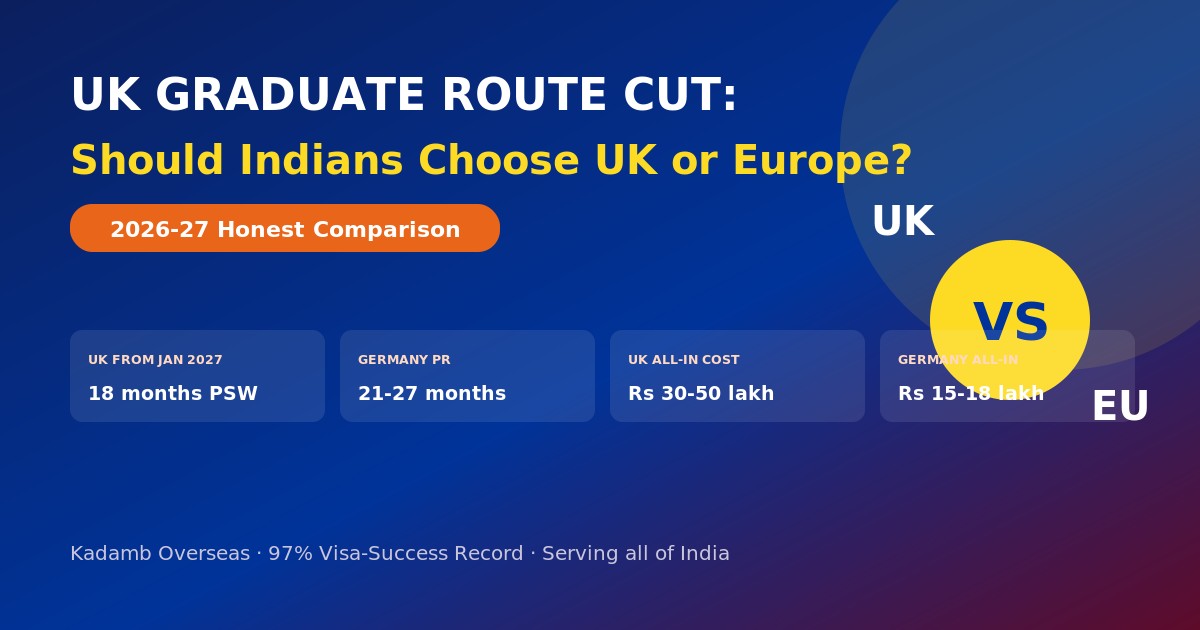
Quick answer: The UK has cut its Graduate Route: applications from 1 January 2027 get 18 months of post-study work instead of two years (PhDs keep three), following the October 2025 rule changes. That puts the UK level with Germany’s 18 months and behind Ireland’s and Belgium’s 24 — while UK master’s degrees still cost ₹30–50 lakh all-in versus ₹15–18 lakh in Germany and ₹12–18 lakh in Italy. The honest 2026 comparison: choose the UK for one-year degrees with global brand weight and an English-only life; choose Europe for cost, engineering job depth, and — decisively — the settlement math, where Germany’s Blue Card reaches PR in 21–27 months against the UK’s 5-year ILR clock (on which Graduate Route time does not count).
What exactly changed in the UK — and who is affected
The May 2025 immigration white paper became rules on 14 October 2025: Graduate Route grants move from 24 to 18 months for anyone applying from 1 January 2027. The date that matters is the application date, not graduation — so the September 2026 intake is effectively the last cohort with a realistic path to the full two years, and only if results and applications land before the deadline. Alongside this, the Immigration Skills agenda has tightened sponsor-ship economics for employers, and the ILR (settlement) qualifying period is under active political discussion. None of this makes the UK a bad option — it makes the old “UK = easy two-year work visa” shortcut obsolete, and the comparison with Europe genuinely open.
The numbers side by side (2026–27)
| Factor | UK | Germany | Ireland | Italy / Poland |
|---|---|---|---|---|
| Master’s tuition | £18,000–35,000 | €0 (public) | €15,000–28,000 | €1,000–5,000 |
| Degree length | 1 year | 2 years | 1 year | 2 years |
| All-in cost (₹) | 30–50 lakh | 15–18 lakh | 28–38 lakh | 12–18 lakh |
| Post-study window | 18 mo (from Jan 2027; PhD 3 yrs) | 18 months | 24 months | 12 / 9–12 months |
| Settlement / PR clock | 5 yrs ILR (Graduate Route time doesn’t count) | 21–27 months via Blue Card | 5 yrs | 5 yrs |
| Health surcharge/insurance | IHS £776/yr upfront | ~€141–147/mo | ~€500–1,000/yr | low |
| Language of life | English | German helps a lot | English | Local language for careers |
Approximate 2026 figures; UK fees and rules per the October 2025 Statement of Changes — verify on gov.uk before applying.
Where the UK still genuinely wins
Three cases keep the UK rational despite the cost gap. The one-year premium master’s: Oxbridge, Imperial, LSE, UCL and the top Russell Group brands carry weight in Indian and global hiring that few continental names match, and you are back in the workforce a full year earlier than a German two-year program — a real earnings offset. Finance, law and consulting: London remains Europe’s deepest market for these, and the target-school pipelines run through UK campuses. The all-English life: no language investment, family visits without translation anxiety, and a familiar system. If your plan is brand degree → London job or strong India comeback, the UK case survives the 18-month change intact — provided the budget genuinely exists without distress borrowing.

Where Europe now wins on the same questions
Total cost: a German or Italian master’s saves ₹15–35 lakh against the comparable UK program — the largest controllable variable in the whole decision. Engineering and manufacturing careers: the UK’s industrial base cannot absorb graduates the way Germany’s automotive, machine-building and energy sectors do; for core engineering, the German market is simply deeper. The settlement math: this is the decisive line for settle-minded families — a German graduate on a Blue Card can hold PR before a UK peer has even started counting ILR years (Graduate Route time does not count toward ILR; skilled-worker years do). Backup optionality: an EU degree opens 27 labour markets via Blue Card mobility; a UK degree opens one. And on pure visa risk: Europe’s student-visa regimes have been stable while the UK has now changed its headline offer twice in three years — policy volatility is itself a cost when you are planning 2027–2030 around it. Run your own numbers through our country flowchart and five-country matrix.
Decision guide: which profile goes where
Choose the UK if: the target is a top-30-brand one-year master’s, the field is finance/law/consulting/management, the ₹35–50 lakh budget exists without crippling loans, and the plan is a fast career start (London or back in India) rather than European settlement.
Choose Germany if: the field is engineering, IT or research; budget matters; or settlement is the goal — the 21–27-month PR track has no UK equivalent.
Choose Ireland if: you want the UK-style one-year English-language degree with a longer (24-month) post-study window — increasingly the rational “UK alternative” for tech profiles.
Choose Italy/Poland if: cost dominates the decision — the UK is not in this comparison at all at ₹12–18 lakh.
Split strategy: a UK brand application plus a German/Irish backup shares one document set and hedges both policy risk and admission risk — the structure we build for most dual-track students.
The financial modelling most families skip
Model three years, not one. UK path: ₹40 lakh spent by month 12; earning (say £32,000 in a graduate role) from month 14; 18 months to convert to Skilled Worker sponsorship before the window closes — and the sponsorship conversion, not the degree, is where UK plans now succeed or fail, because employer sponsorship appetite has tightened alongside the visa changes. German path: ₹16 lakh spread over 24 months, partially offset by Werkstudent income of €800–1,100/month; earning €50,000+ from month 26–30; Blue Card immediately, PR around month 50 from first landing. Net position at the three-year mark: the German graduate typically carries ₹20–30 lakh less debt and already holds or nearly holds permanent residency; the UK graduate holds a bigger-brand degree, a year’s head start on earnings, and a visa still dependent on employer sponsorship. Neither is wrong — but the ledger should be written down before the choice, not discovered after it.
Five mistakes in the UK-vs-Europe decision
1. Comparing old UK rules. Two-year Graduate Route content written before October 2025 is obsolete; plan on 18 months unless you apply before January 2027.
2. Ignoring the IHS and London rents in the budget. The £776/year health surcharge is paid upfront for the whole visa; London living costs rival tuition.
3. Treating the post-study window as the settlement plan. In both systems the window is a bridge to a skilled/sponsored role — compare the destination visas (Skilled Worker vs Blue Card), not just the bridge.
4. Buying brand where the field doesn’t pay for it. A mid-ranked UK master’s at ₹40 lakh has no career edge over a strong German TU at ₹16 lakh for engineering roles.
5. Deciding on rankings alone. Employability, cost, and immigration math are three separate columns — the UK wins one of them for some profiles, Europe wins the other two for most.
Frequently asked questions
Is the UK Graduate Route now 18 months or 2 years?
Applications made from 1 January 2027 receive 18 months (PhD graduates: 3 years). Applications made before that date still receive two years — making the September 2026 intake the last with a realistic two-year path, and the application date, not the graduation date, is what counts.
Is the UK still worth it for Indian students after the Graduate Route cut?
For top-brand one-year master’s in finance, law, consulting and management with a genuine ₹35–50 lakh budget — yes. For engineering, IT, research or any settlement-minded plan, Germany and Ireland now beat the UK on cost, job-market depth and PR timelines.
Which is cheaper: studying in the UK or Germany?
Germany, by a wide margin: ₹15–18 lakh all-in for a two-year public-university master’s versus ₹30–50 lakh for a one-year UK degree. Italy and Poland are cheaper still at ₹12–18 lakh.
Does Graduate Route time count toward UK permanent residency?
No — time on the Graduate Route does not count toward the 5-year ILR qualifying period; only subsequent Skilled Worker (and similar) years do. This is why the UK settlement clock effectively starts later than Germany’s Blue Card clock, which begins with your first qualifying paycheck.
Is Ireland a better alternative to the UK now?
For many tech and business profiles, yes: one-year English-taught master’s, a 24-month post-study window (longer than the UK’s new 18), EU labour-market context, and total costs a notch below London. The trade-off is a smaller job market than London’s — deep in tech and pharma, thinner elsewhere.
Can I apply to both the UK and Europe at the same time?
Yes, and for strong profiles we recommend it: the document sets overlap heavily, the intakes can be sequenced, and a UK-brand application with a German or Irish backup hedges both admission risk and the UK’s ongoing policy volatility.
UK or Europe? Get the answer for your profile, with numbers
Kadamb Overseas runs the full cost-career-settlement comparison for students from Mumbai, Delhi, Bengaluru, Hyderabad, Pune, Ahmedabad and every state of India — and builds dual-track applications when it’s close. 97% visa-success record.
Saumitra Rajput
Saumitra Rajput is the founder of Kadamb Overseas Pvt. Ltd., India's leading Europe-focused study abroad consultancy based in Ahmedabad. With 14+ years of expertise in European education, he has personally counselled 2,500+ Indian families and helped 500+ students secure admission to top European universities including TU Munich, ETH Zurich, EPFL, KU Leuven, HEC Paris, Sapienza Rome, TU Wien, and Warsaw University of Technology. He has visited 25+ European universities, partners with 250+ EU institutions, and maintains a 500+ students placed.
Planning to Study Abroad?
Get free expert guidance from our experienced counselors

Saumitra Rajput
Saumitra Rajput is the founder and lead counsellor at Kadamb Overseas, India's trusted Europe education consultancy based in Ahmedabad. With 14+ years of hands-on experience, he has personally guided 500+ students to universities across Germany, Switzerland, France, Italy, Austria, and Spain. Saumitra has visited partner universities across Europe, holds deep expertise in European visa processes, scholarships, and student life, and has achieved a 97% visa success rate for his clients. He is the host of the YouTube channel "Europe with Saumitra", where he shares first-hand insights on studying and living in Europe. His mission: make Europe accessible to every Indian student, with zero consultancy fees.