

Table of Contents
- How European recruiters actually use LinkedIn
- The seven-field optimisation, in priority order
- The weekly activity system (30 minutes, compounding)
- Messages that get answered (and the ones that don’t)
- Content that works for students (documentation beats punditry)
- Five LinkedIn mistakes that keep Indian profiles invisible in Europe
- Frequently asked questions
🕑 7 min read
Quick answer: European recruiters find candidates on LinkedIn through five fields — headline, location, skills, Open-to-Work settings and keywords in your About and experience sections. The optimisation that changes outcomes for Indian graduates targeting Europe: set your location to your (future) European city the moment you have a visa or admission, write a headline in the recruiter-search format (role | stack | city), state your work-rights status openly (“18-month German job-seeker permit — no sponsorship needed”), fill all 50 skill slots with the exact terms from your target job ads, and post or comment in your field weekly. Done properly, profile views from European recruiters typically multiply within 3–4 weeks — because you finally exist in the searches they actually run.
How European recruiters actually use LinkedIn
Understand the tool on the other side: LinkedIn Recruiter, where sourcers run boolean searches filtered by location, title keywords, skills and openness signals. If your location says “Pune” and the search filter says “Munich area”, you do not appear — no matter how strong the profile. If your headline says “Aspiring engineer | Dreamer | Lifelong learner”, the keyword match fails. The whole playbook below is reverse-engineering those filters honestly. One reality-setting note: LinkedIn complements the application channels in our 90-day German job search plan — it is where recruiters find you; portals remain where you find them. You need both engines running.
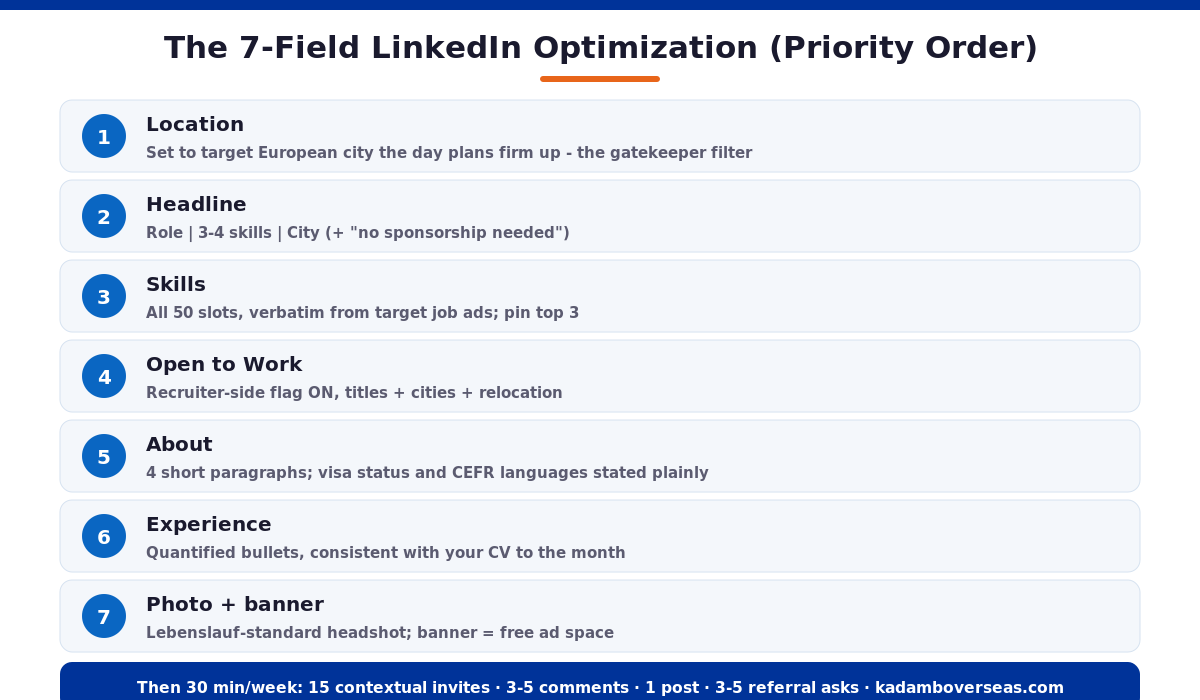
The seven-field optimisation, in priority order
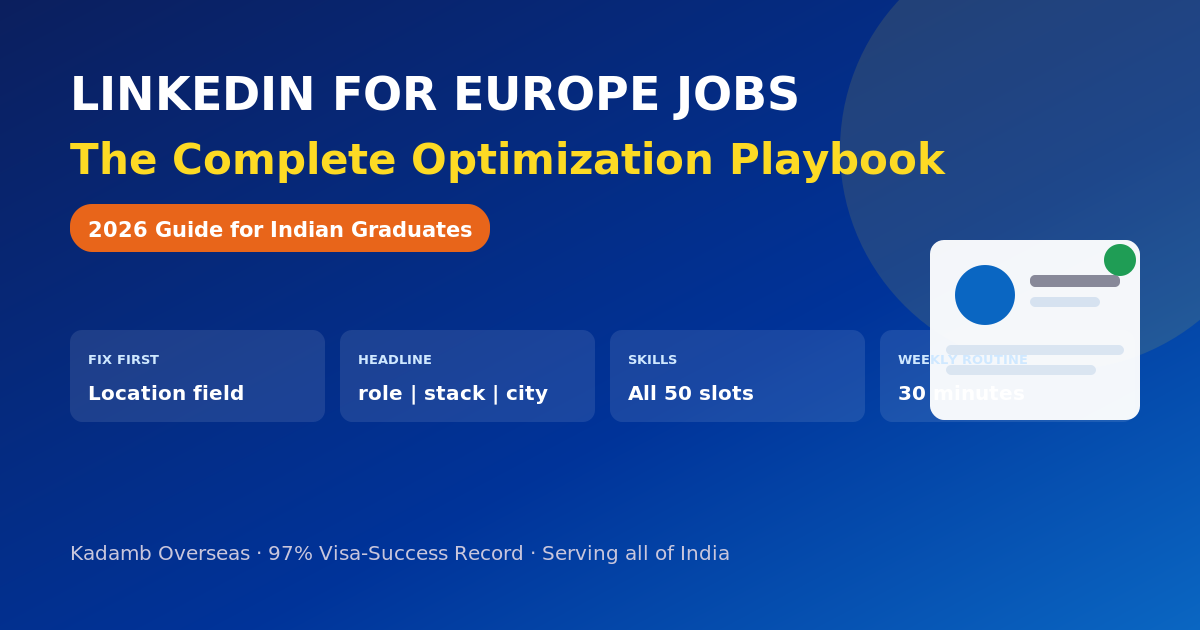
1. Location (the gatekeeper). Once you hold an admission or visa, set your location to the target city and note the arrival date in your headline or About. Recruiters filter by geography first; “relocating to Berlin, August 2027” inside a Pune-located profile is invisible to them.
2. Headline (the search string). Formula: Target role | 3–4 core skills | City — “Data Engineer | Python · Spark · Azure · SQL | Munich”. Add the work-rights clause if space allows. Never waste the field on “Student at XYZ University”.
3. Skills (the filter bank). Fill all 50, drawn verbatim from 10–15 target job ads — if ads say “PyTorch”, list “PyTorch”, not “deep learning frameworks”. Pin the top three; collect endorsements from classmates and colleagues for the pinned ones.
4. Open to Work (the beacon). Switch on for recruiters (the private setting), list target titles and the European cities, and select relocation. The green ring visible to everyone is optional; the recruiter-side flag is not.
5. About (the pitch + keyword layer). Four short paragraphs: who you are technically, two quantified proof points, your Europe situation stated plainly (visa status, arrival date, languages with CEFR levels), and what you are looking for. Write it in the first person; recruiters read hundreds of third-person clichés a day.
6. Experience (the evidence). Same quantified-achievement discipline as your German CV — numbers, stack, outcome — and keep CV and LinkedIn consistent to the month; recruiters cross-check and discrepancies read as fabrication.
7. Photo + banner (the credibility frame). Same professional headshot standard as the Lebenslauf; use the banner for a one-line value statement or your stack — free advertising space almost everyone wastes.
The weekly activity system (30 minutes, compounding)
Profiles are static; networks compound. The sustainable weekly routine: connect with 15–20 relevant people — alumni of your university in Europe, engineers at target companies, recruiters in your niche — always with a two-line personalised note (mention the shared thread; never pitch in the invite). Comment substantively on 3–5 posts in your field — a genuine technical observation on a hiring manager’s post outperforms a hundred “CFBR” comments. Post once — a project write-up, a thing you learned, a question; documentation beats thought-leadership for students. And send 3–5 referral requests for live openings to second-degree connections: short message, specific role link, CV attached, easy for them to say yes. Referred applications interview at several times the cold-application rate everywhere in Europe — this habit alone justifies the platform.
Messages that get answered (and the ones that don’t)
The template that works, 60 words or fewer: “Hi [Name], I’m an MSc student at [uni] graduating in [month], focused on [niche]. I saw [company] is hiring a [role] — I’ve built [one relevant proof point]. Would you be open to referring me, or to a 15-minute chat about the team? CV attached — happy to make it easy.” What kills responses: essays, flattery paragraphs, “any job in your esteemed organisation”, asking for a job rather than a referral or advice, and pitching inside the connection request itself. Europeans respond to brevity, specificity and low-effort asks — the same qualities their inboxes lack.
Content that works for students (documentation beats punditry)
You do not need to become an influencer; you need four posts a month that prove you build things. The formats that consistently perform for student profiles: the project walkthrough (“built X with Y; here’s what broke and what I’d change” — screenshots or a repo link, 150 words); the learning log (“three things the Kafka docs don’t tell you”); the local observation once you land (“what surprised me in my first German sprint planning” — these travel remarkably well); and the honest question to your niche, which invites senior engineers to teach you in public — the single most underrated networking mechanic on the platform. Skip motivational reposts, AI-generated carousels and hot takes on layoffs: they add noise, not evidence. One useful discipline: before posting, ask whether a hiring manager reading it learns anything checkable about your competence. If yes, post; if no, save it for WhatsApp. Language of posts: English is fine everywhere; an occasional short post in German or French after you reach B1 signals integration to exactly the recruiters who care — and the imperfections are a feature, not a bug, because effort is the message. Frequency ceiling: more than three posts a week from a student profile starts reading as procrastination; the goal is a steady evidence trail, not a broadcast channel. Consistency over months is what recruiters’ feeds reward.
Five LinkedIn mistakes that keep Indian profiles invisible in Europe
1. Indian location + Europe dreams. The single biggest filter failure — fix the location field the day your plans firm up.
2. Buzzword headlines. “Passionate innovator” matches zero recruiter searches; tools and titles match thousands.
3. Hiding the visa situation. Recruiters assume the worst when it’s absent; stating “no sponsorship required” converts your status into a selling point.
4. Connection spam without context. Blank invites to 500 strangers build a dead network; 15 contextual invites a week build a live one.
5. CV–profile mismatch. Different dates, titles or projects between LinkedIn and your CV is the fastest credibility loss in the entire process.
Frequently asked questions
Should I set my LinkedIn location to Europe before moving?
Once you hold an admission or visa with a firm arrival window, yes — set the target city and state the arrival date in your headline or About. Recruiters filter by location first; being honest about relocation while appearing in their geographic search is exactly the right balance.
What should my LinkedIn headline say as a student targeting Europe?
Use the recruiter-search formula: target role, three or four core skills, city — e.g. “ML Engineer | Python · PyTorch · MLOps | Berlin (from Aug 2027) — no sponsorship needed”. Every word should be something a recruiter might type into a search box.
Does LinkedIn Premium help students get jobs in Europe?
Marginally. InMail credits and applicant insights help active networkers, and the free month is worth using during your peak search. But an optimised free profile with weekly activity outperforms a passive Premium one every time — fix the seven fields first.
How do I ask for a referral on LinkedIn without being awkward?
Keep it under 60 words: who you are, the specific role link, one proof point, and a low-effort ask (“would you be open to referring me, or a 15-minute chat?”) with your CV attached. Ask second-degree connections and alumni first — and accept that a 20–30% response rate is success, not failure.
Is Xing still necessary for jobs in Germany, or is LinkedIn enough?
LinkedIn now dominates German tech and international-facing recruiting, but Xing retains real weight with Mittelstand HR departments and traditional industries. The efficient answer: full effort on LinkedIn, plus a complete mirror profile on Xing that costs you one hour once.
How long before an optimised profile starts producing recruiter messages?
Typically 3–6 weeks of consistent weekly activity in a hiring market like Germany or the Netherlands — location and skills fixes surface you in searches almost immediately, while network compounding and content take a few weeks to lift profile views and inbound InMails.
Get your LinkedIn and CV rebuilt as one system
Kadamb Overseas aligns profile, Lebenslauf and application strategy for students from Mumbai, Delhi, Bengaluru, Hyderabad, Pune, Ahmedabad and all of India heading to European careers — with a 97% visa-success record behind the plan.
Saumitra Rajput
Saumitra Rajput is the founder of Kadamb Overseas Pvt. Ltd., India's leading Europe-focused study abroad consultancy based in Ahmedabad. With 14+ years of expertise in European education, he has personally counselled 2,500+ Indian families and helped 500+ students secure admission to top European universities including TU Munich, ETH Zurich, EPFL, KU Leuven, HEC Paris, Sapienza Rome, TU Wien, and Warsaw University of Technology. He has visited 25+ European universities, partners with 250+ EU institutions, and maintains a 500+ students placed.
Planning to Study Abroad?
Get free expert guidance from our experienced counselors

Saumitra Rajput
Saumitra Rajput is the founder and lead counsellor at Kadamb Overseas, India's trusted Europe education consultancy based in Ahmedabad. With 14+ years of hands-on experience, he has personally guided 500+ students to universities across Germany, Switzerland, France, Italy, Austria, and Spain. Saumitra has visited partner universities across Europe, holds deep expertise in European visa processes, scholarships, and student life, and has achieved a 97% visa success rate for his clients. He is the host of the YouTube channel "Europe with Saumitra", where he shares first-hand insights on studying and living in Europe. His mission: make Europe accessible to every Indian student, with zero consultancy fees.