

Table of Contents
💰 Europe Cost Calculator 2026 Updated
Country 1
Country 2
- What changed, exactly — and why fees went up
- The full cost from India in 2026: what you’ll actually pay
- Who pays nothing: the waivers Indians overlook
- Student long-stay visas are a different fee system
- Seven legitimate ways to keep the cost down
- Where and how you actually pay
- Fee vs fine print: three traps that cost applicants money
- How India compares — and what may change next
- Frequently asked questions
🕑 7 min read
Quick answer: The standard Schengen short-stay visa fee is €90 for adults and €45 for children aged 6–11 (children under 6 free), after the 12.5% hike that took effect on 11 June 2024 and still applies through 2026. In rupees that is roughly ₹8,200–8,500 at 2026 exchange rates — but the real cost from India, once VFS service charges, appointment extras, photos, insurance and travel to the application centre are added, typically lands between ₹11,000 and ₹16,000 per person. The good news for students: most Schengen countries waive the visa fee entirely for study, training and research purposes, and long-stay student (Type D) visas use separate national fees — Germany €75, France about €50–99, Belgium €250.

What changed, exactly — and why fees went up
On 11 June 2024 the European Commission raised the harmonised Schengen visa fee from €80 to €90 (adults) and from €40 to €45 (children 6–11), citing inflation across member states — the same mechanism that had lifted it from €60 to €80 in 2020. The Visa Code requires the Commission to review the fee every three years, so the next scheduled review falls in 2027; no further increase has been announced for 2026, and the €90 rate is what every consulate and VFS centre in India charges today. One more wrinkle: the EU can impose a higher €135 rate on countries that don’t cooperate on readmission — India is not on that list, and the India–EU mobility discussions signed in early 2026 point the other way, toward possible student and researcher concessions that have not yet been implemented.
The full cost from India in 2026: what you’ll actually pay
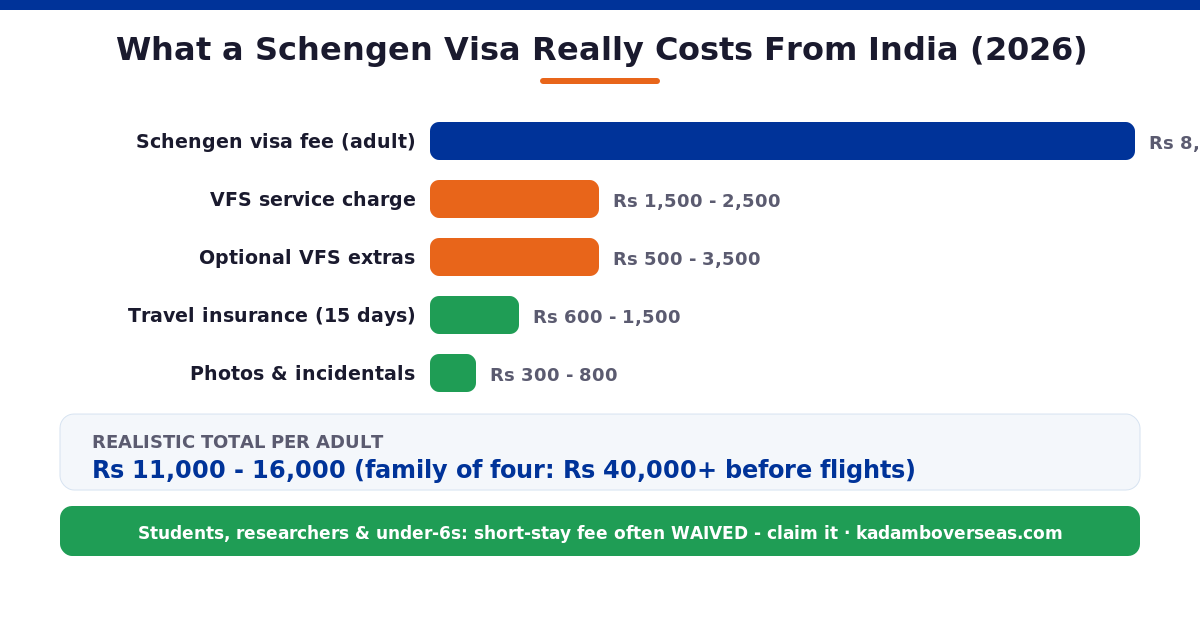
| Cost item | Typical amount (2026) |
|---|---|
| Schengen visa fee (adult) | €90 ≈ ₹8,200–8,500 |
| Child 6–11 / under 6 | €45 ≈ ₹4,100–4,300 / free |
| VFS service charge | ₹1,500–2,500 |
| Optional VFS extras (SMS, courier, premium lounge, prime-time slot) | ₹500–3,500 |
| Travel insurance (≥€30,000 cover, 15 days) | ₹600–1,500 |
| Photos, printing, notarisation odds & ends | ₹300–800 |
| Realistic total per adult | ₹11,000–16,000 |
Two notes on that table. The visa fee itself is charged in rupees at the consulate’s own exchange rate, refreshed periodically — so the INR figure moves a few hundred rupees through the year. And the fee is non-refundable even if the visa is refused, which is the financial argument for getting the file right the first time.
Who pays nothing: the waivers Indians overlook
The Visa Code obliges or allows member states to waive the short-stay fee for several groups that matter to our readers: children under six (mandatory), school pupils, students, postgraduate students and accompanying teachers travelling for study or educational training (mandatory), researchers travelling for scientific research or conferences (mandatory), and representatives of non-profits under 25 attending seminars or sports events. Spouses and children of EU citizens also apply free. In practice: a semester-exchange student attending a summer school in France, or a PhD scholar presenting at a conference in Vienna, should tick the fee-waiver category and attach the proof (enrolment letter, invitation) — thousands of eligible Indians pay €90 every year simply because they didn’t claim it.
Student long-stay visas are a different fee system
The €90 figure applies to short stays (up to 90 days). Degree-seeking students apply for national long-stay (Type D) visas, each with its own fee: Germany €75 (about ₹6,900), France roughly €50–99 depending on category plus the Campus France/EEF fee (about ₹22,000 in 2026, waived for some scholarship holders), Italy €50, Netherlands around €250 (charged as the residence-permit fee), and Belgium €250 plus a contribution fee — our Belgium Type D guide itemises it. Budget these alongside proof-of-funds requirements like Germany’s €11,904 blocked account, and always check the destination country’s current schedule before paying.
Seven legitimate ways to keep the cost down
1. Claim the student/researcher waiver whenever your travel purpose qualifies — it is a right, not a favour.
2. Skip the VFS extras. SMS alerts, lounge access and courier return are conveniences, not requirements; declining them saves ₹1,500–3,000.
3. Apply in the standard window (up to 6 months before travel, ideally 4–8 weeks out) so you never need a prime-time or urgent slot.
4. Buy insurance independently. Annual multi-trip Schengen-compliant policies from Indian insurers often cost less than the per-trip product sold alongside the appointment.
5. Ask for a multi-year multiple-entry visa if you travel often: frequent travellers with clean histories can receive 1–5-year visas under the cascade rules — one €90 fee amortised over many trips.
6. Get the file right the first time. A refusal costs the full fee plus a fresh fee to reapply; consistent documents and a prepared interview (see our 50 interview questions guide) are the cheapest insurance there is.
7. Watch the exchange-rate reset. If the rupee strengthens, consulates periodically lower the INR conversion — applying just after a reset can save a few hundred rupees per applicant on family applications.
Where and how you actually pay
For nearly all Schengen countries, Indians apply through VFS Global (a few use BLS or TLScontact), with centres in Delhi, Mumbai, Bengaluru, Chennai, Hyderabad, Kolkata, Pune, Ahmedabad, Kochi, Chandigarh and a dozen more cities — you must apply through the centre covering your state of residence. The visa fee is payable in cash or card in rupees at the counter (some centres accept online prepayment), while VFS charges appear separately on your receipt — keep it, because it is your proof if anything is disputed. Appointment demand is seasonal: April–June and September see the longest queues, so in peak months book the moment your travel dates firm up. If your nearest centre is in another city, add that travel to your real budget too — for a family, an overnight trip to the biometric appointment can cost more than the visa itself.
Fee vs fine print: three traps that cost applicants money
The double-payment trap: abandoning an application after payment (say, because a document was missing at the counter) forfeits the fee; rescheduling the appointment instead is free at most centres. The agent-markup trap: unofficial “agents” around VFS centres resell free things — appointment slots, form-filling, checklists. Everything they sell is available at zero or list price through official channels. The insurance-mismatch trap: a policy that doesn’t explicitly state €30,000 medical coverage valid across all Schengen states gets flagged, and fixing it at the counter means buying the overpriced desk product. Buy compliant insurance in advance and print the certificate.
How India compares — and what may change next
At €90, the Schengen fee sits between the UK’s standard visitor visa (£127) and the US B1/B2 fee ($185), while covering 29 countries on one sticker — per country visited, it remains the best value of the three. Looking ahead: the Visa Code’s triennial review lands in 2027, EU inflation makes another increase plausible, and the EU’s ETIAS system (for visa-exempt travellers) does not affect Indian passport holders, who will continue to need visas. Meanwhile the India–EU mobility pact conversations of early 2026 have put student and researcher fee concessions on the table — not yet law, but worth watching if you are planning a 2027 intake. We track these changes continuously for the students we counsel from every state of India.
Frequently asked questions
What is the Schengen visa fee for Indians in 2026?
€90 for adults and €45 for children aged 6–11 (under 6 free) — approximately ₹8,200–8,500 and ₹4,100–4,300 at 2026 exchange rates, paid in rupees at the consulate’s rate. VFS service charges and extras raise the realistic total to ₹11,000–16,000 per person.
Is the Schengen visa fee waived for students?
Yes — for short stays with study, training or research as the purpose, the Visa Code waives the fee for school pupils, students, postgraduates, accompanying teachers and researchers. Degree students applying for long-stay Type D visas pay national fees instead (Germany €75, Italy €50, Belgium €250).
Will the Schengen visa fee increase again in 2026?
No increase has been announced for 2026; the current €90 rate dates from 11 June 2024. The Visa Code requires a fee review every three years, so the next scheduled review is 2027 — another inflation-linked adjustment then is plausible.
Is the Schengen visa fee refundable if my visa is rejected?
No. The fee covers processing, not approval, and is not refunded on refusal or withdrawal. That makes first-time-right documentation and interview preparation the most cost-effective investment in the whole application.
How much does a Schengen visa really cost from India including all charges?
Budget ₹11,000–16,000 per adult all-in: the €90 fee, VFS service charge (₹1,500–2,500), optional extras if taken, compliant travel insurance (₹600–1,500) and incidentals. A family of four can comfortably cross ₹40,000 before flights.
Do children need to pay the Schengen visa fee?
Children under 6 apply free; children aged 6–11 pay the reduced €45; from age 12 the full €90 applies. VFS service charges, however, apply per application regardless of age.
Pay the right fee — and only once
Kadamb Overseas prepares refusal-proof Schengen and student visa files for applicants from Mumbai, Delhi, Bengaluru, Hyderabad, Pune, Ahmedabad and all of India — fee waivers claimed where eligible, documents right the first time, backed by our 97% visa-success record.
Saumitra Rajput
Saumitra Rajput is the founder of Kadamb Overseas Pvt. Ltd., India's leading Europe-focused study abroad consultancy based in Ahmedabad. With 14+ years of expertise in European education, he has personally counselled 2,500+ Indian families and helped 500+ students secure admission to top European universities including TU Munich, ETH Zurich, EPFL, KU Leuven, HEC Paris, Sapienza Rome, TU Wien, and Warsaw University of Technology. He has visited 25+ European universities, partners with 250+ EU institutions, and maintains a 500+ students placed.
Planning to Study Abroad?
Get free expert guidance from our experienced counselors

Saumitra Rajput
Saumitra Rajput is the founder and lead counsellor at Kadamb Overseas, India's trusted Europe education consultancy based in Ahmedabad. With 14+ years of hands-on experience, he has personally guided 500+ students to universities across Germany, Switzerland, France, Italy, Austria, and Spain. Saumitra has visited partner universities across Europe, holds deep expertise in European visa processes, scholarships, and student life, and has achieved a 97% visa success rate for his clients. He is the host of the YouTube channel "Europe with Saumitra", where he shares first-hand insights on studying and living in Europe. His mission: make Europe accessible to every Indian student, with zero consultancy fees.
Related Articles
- Top Universities in France 2026: Rankings, Fees & Admission Guide
- How Long Does French Student Visa Take from India in 2026
- How Much Time Required to Prepare for IELTS?
- Szechenyi Istvan University of Gyor: Fees & Programs
- Study in Europe with 5, 10, 15+ Backlogs (2026): Universities That Accept Indian Students