

AI answer summary
What IELTS score is required for European universities?
Most English-taught European programs ask for IELTS around 6.0 to 7.0 depending on country, university and level. Some programs accept TOEFL, PTE, Duolingo or MOI instead.
Book a free Kadamb counselling call for profile-specific country and visa guidance.
Last Updated: September 7, 2026
Table of Contents
- IELTS Score Required for European Universities 2026 – Country-Wise Complete Guide
- IELTS Requirements by Country – Europe 2026
- IELTS Requirements at Top European Universities
- Alternatives to IELTS Accepted by European Universities
- Can You Get IELTS Waiver for European Universities?
- IELTS Preparation Tips for European University Applications
- Indian Student Life in Europe — Comprehensive Practical Guide 2026
- Top European Employers Hiring Indian Master's Graduates 2026 — Complete List
- EU Mobility — How Indian Master's Graduates Move Between Countries
- Indian Family Visit + Long-Distance Reality
- Indian Family Visit Visa to Europe — Schengen Tourist Visa
- EU Tax + Social Security Reality for Indians Working in Europe (2026)
- India-Europe Tax Treaty (DTAA) — How to Avoid Double Taxation
- How to File Indian ITR After Moving to Europe
- EU Pension System for Indian Workers
- Quick Reference — Top 10 Questions Indian Master's Students Ask About Europe
- Final CTA — Ready to Start?
🕑 10 min read
IELTS Score Required for European Universities 2026 – Country-Wise Complete Guide
IELTS requirements for European universities are generally lower than USA or Canada — most programmes accept IELTS 6.0-6.5 compared to 6.5-7.0 for North America. Some European countries like Germany have specific language exemption rules if your bachelor degree was taught in English. This country-by-country guide covers everything you need to know about IELTS for European universities in 2026.
IELTS Requirements by Country – Europe 2026
| Country | Typical IELTS Requirement | Band Minimum | Notes |
|---|---|---|---|
| Germany | 6.0-6.5 overall | No band below 5.5 typically | English medium degree exempt at many unis |
| Switzerland (ETH/EPFL) | 7.0 (ETH Zurich) / 6.5 (EPFL) | No band below 6.0 | Very competitive programmes, high standard |
| Netherlands | 6.0-6.5 overall | No band below 5.5 | English-speaking country equivalent exempt |
| France | 6.0-6.5 overall | No band below 5.5 | Some schools accept 5.5 for MSc |
| Belgium (KU Leuven) | 6.5 overall | No band below 6.0 | Strong academic English required |
| Belgium (Ghent) | 6.5 overall | No band below 6.0 | Research programmes may require 7.0 |
| Austria | 6.0-6.5 overall | No band below 5.5 | TU Vienna and Uni Vienna most popular |
| Italy | 5.5-6.5 overall | Varies by programme | Lower requirements at many Italian unis |
| Spain | 5.5-6.5 overall | Varies | Spanish unis generally more flexible |
| Czech Republic | 5.5-6.0 overall | Varies | Lower requirements at many programmes |
| Poland | 5.5-6.0 overall | Varies | Lower requirements available |
IELTS Requirements at Top European Universities
| University | Country | IELTS Minimum | IELTS Preferred |
|---|---|---|---|
| ETH Zurich | Switzerland | 7.0 overall (6.5 each band) | 7.5+ for competitive programmes |
| TU Munich | Germany | 6.5 overall | 7.0 for research-focused MSc |
| TU Delft | Netherlands | 6.5 overall (no band <6.0) | 7.0 for Architecture/Design |
| KU Leuven | Belgium | 6.5 overall | 7.0 for medical/research |
| Ghent University | Belgium | 6.5 overall | 7.0 for competitive programmes |
| EPFL Lausanne | Switzerland | 6.5 overall | 7.0+ strongly preferred |
| University of Bologna | Italy | 5.5-6.0 | 6.5 for competitive programmes |
| Aix-Marseille University | France | 6.0 | 6.5 preferred |
Alternatives to IELTS Accepted by European Universities
| Test | Equivalent to IELTS 6.5 | Equivalent to IELTS 7.0 | Accepted Where? |
|---|---|---|---|
| TOEFL iBT | 88-92 | 100+ | Widely accepted across Europe |
| Duolingo English Test (DET) | 105-110 | 120+ | Growing acceptance, not universal |
| PTE Academic | 58-64 | 65+ | Growing acceptance at many unis |
| Cambridge C1 Advanced | B (180-192) | A (193-210) | Widely accepted |
| Cambridge C2 Proficiency | Any pass | Distinction | Widely accepted |
| Pearson PTE Academic | 58 | 65 | Some universities |
Can You Get IELTS Waiver for European Universities?
Yes, many European universities waive the IELTS requirement if one or more of these conditions apply:
- English-medium degree: If your bachelor degree was taught entirely in English and your university provides a letter confirming this — accepted by many German, Dutch, and Belgian universities
- Native English speaker country: Passports from USA, UK, Australia, Canada, Ireland, NZ often exempt
- Previous degree from English-speaking country: Degree from USA/UK/Australia usually waives IELTS
- Internal English test: Some universities (especially in Netherlands) conduct their own online English test
IELTS Preparation Tips for European University Applications
- Target IELTS 6.5: This is the sweet spot that opens doors at 90%+ of European programmes
- No single band below 6.0: Even with 7.0 overall, a 5.5 in Writing can cause rejection
- Apply for IELTS Academic: Not IELTS General — universities only accept Academic version
- Two test attempts for safety: Most European universities accept your best score in last 2 years
- Free coaching via Kadamb/Zuriko: Kadamb students get free IELTS/PTE preparation via our partner Zuriko
Kadamb Overseas includes free IELTS coaching via Zuriko for all our enrolled students. Check our visa guide for what English proof is required for your visa application too.
Ready to Study in Europe?
Get free expert counselling from Kadamb Overseas — 14+ years, 97% visa success.
Based on 340+ verified reviews from Kadamb alumni
⭐⭐⭐⭐⭐
“Saumitra personally reviewed my SOP. Got into TU Munich with DAAD scholarship. Now at BMW Munich EUR 72K.”
— Rahul K., TU Munich
⭐⭐⭐⭐⭐
“Zero tuition via DSU Italy + MAECI. Saved 40 lakh rupees vs USA. Now at Leonardo SpA Rome.”
— Aishwarya P., Sapienza Rome
⭐⭐⭐⭐⭐
“Got German PR in exactly 21 months via EU Blue Card. Bringing parents on family visa now.”
— Arjun S., TU Berlin (PR holder)
Indian Student Life in Europe — Comprehensive Practical Guide 2026
Daily Life Setup in Your First 30 Days
Your first month in Europe is critical. Here’s the standard sequence every successful Indian Master’s student follows:
Days 1-3: Arrival + Temporary Setup
- Arrive at airport (Frankfurt, Paris CDG, Rome FCO, Zurich, Munich, Amsterdam, etc.)
- Take train/bus to your destination city (avoid taxis — €100-€150 vs €15-€30 train)
- Check into pre-booked Airbnb / hostel for 3-4 weeks
- Get local SIM card (Lebara, Lycamobile, Vodafone — €10-€20/month with data)
- Stock essentials: bed sheets (€20), towels (€15), basic kitchen items (€50), winter jacket if cold months (€80-€150 at Decathlon)
Days 4-14: Bureaucracy
- Anmeldung / Residence Registration: At local Bürgeramt (Germany), Comune (Italy), Mairie/Préfecture (France), Migration Office (Switzerland). Bring passport, visa, rental contract. Receive registration certificate (mandatory for everything else).
- Bank Account: Open within 2 weeks. N26, Revolut (mobile-first, English) for instant; Sparkasse, Deutsche Bank, BNP Paribas for traditional. Need: passport, residence certificate, university enrolment proof.
- Health Insurance: Switch from international travel insurance to local health insurance. Germany: TK / AOK (€120-€180/mo for students) or Mawista/DR-Walter private (€40-€90/mo). Italy: Italian SSN (~€150/yr for students). France: Sécurité Sociale (free for students). Switzerland: Groupe Mutuel / Helsana (~€280/mo, mandatory).
- Tax ID: Germany Steuer-ID (auto-mailed in 2-3 weeks). Italy Codice Fiscale (immediate at university or Agenzia delle Entrate). France INSEE (auto via Sécu). Switzerland AHV number.
Days 15-30: University Setup + Long-Term Housing
- Complete university enrolment + collect student ID
- Get student transit pass (Deutschlandticket €49/mo Germany, Mobilis €50/mo Switzerland, Imagine R €26/mo Paris, Studierendenwerk pass)
- Find permanent shared accommodation (WG-Gesucht.de Germany, Subito.it Italy, Le Bon Coin France, EasyWG Switzerland)
- Move from Airbnb to permanent place
- Apply for housing assistance (CAF/APL France, Wohngeld Germany)
Indian Grocery + Food Reality
You’ll cook 70-80% of meals at home (eating out is expensive). Indian groceries are widely available in major European cities. Average monthly grocery + food cost for one Indian Master’s student cooking at home:
- Germany (Berlin, Munich): €250-€350/month
- Italy (Rome, Milan): €200-€280/month
- France (Paris, Lyon): €250-€350/month
- Switzerland (Zurich, Lausanne): €450-€650/month (most expensive)
Where to buy Indian groceries:
- Major cities: Indian / Asian grocery stores (Spice Bazaar Berlin, Bombay Bazaar Frankfurt, Spice Land Lausanne, Indian Mart Paris, Asian Supermarket Rome). All carry: basmati rice, dal varieties, atta, masala (turmeric, chilli, garam masala), pickles, papad, ghee, paneer, halal meat.
- European supermarket alternatives: Aldi, Lidl, Carrefour, Conad, Migros — sell basics like rice, lentils, frozen vegetables, plain yogurt, milk. Cheaper but less variety.
- Online ordering: amazonpantry, india-spices.com, indogateway.com — deliver across Europe.
Indian Restaurants + Eating Out Reality
Indian restaurants exist in every major European city — quality + cost varies:
- Casual Indian dining (€15-€25 per person): Most Indian restaurants in Berlin, Frankfurt, Munich, Paris, Lyon, Rome, Milan. Authentic North + South Indian + Bengali.
- Fine Indian dining (€40-€80 per person): Limited but premium options in Paris, London, Berlin, Munich. Modern Indian fusion.
- South Indian specialty: Saravanaa Bhavan (Paris, Frankfurt, Hamburg, Düsseldorf) for dosa/idli/sambar. Krishna Bhavan (Paris) for vegetarian Tamil Brahmin food.
- Indian sweets + desserts: Most Indian restaurants offer kheer, gulab jamun, jalebi. For festivals (Diwali, Rakhi), Indian sweet shops in Berlin, Frankfurt, Paris stock fresh sweets.
Most Indian Master’s students eat out 2-4 times/month (€40-€80) + cook at home rest of days.
Cultural Festivals + Indian Community Events
Major European cities host active Indian community events:
- Diwali (October-November): Major celebrations in Berlin, Munich, Frankfurt, Hamburg, Paris, London, Zurich, Geneva, Brussels. Indian Student Associations + cultural centres organise public events with diyas, fireworks, traditional food, dance performances.
- Holi (March): Outdoor Holi events in major German cities (BerlinHoli is famous), Paris, London, Zurich.
- Independence Day (August 15): Indian Embassy / Consulate-organised flag hoisting + cultural programmes in Berlin, Paris, Rome, Milan, Frankfurt, Brussels.
- Republic Day (January 26): Smaller-scale but similar.
- Diwali Mela: Indian community fairs with food + handicrafts + Bollywood performances.
- Cricket leagues: Active Indian cricket clubs in Berlin, Frankfurt, Munich, Hamburg, Paris, London, Geneva. Most play weekend matches.
Indian Religious + Spiritual Centres in Europe
- Hindu Temples: Berlin (Sri Sivasubramaniyar Alayam), Frankfurt (Sri Murugan Temple), Hamburg (Bhagavad Gita Mandir), Munich (Sri Mahalakshmi Temple), Paris (Sri Manika Vinayakar), London (Neasden Swaminarayan Mandir — largest in Europe), Rome (Hindu Mandir), Zurich (Sri Sivasubramaniyar Alayam).
- Sikh Gurdwaras: Berlin (Singh Sabha), Frankfurt (Singh Sabha Gurdwara), Munich (Indian Sikh Society), Paris (Gurdwara Bobigny — largest in Europe), Rome (Gurdwara Sahib), Zurich (Singh Sabha).
- Muslim Communities + Mosques: Indian Muslim associations in Berlin, Frankfurt, Munich, Paris, Brussels, London. Halal restaurants + grocery widely available.
- Jain Temples: Limited but growing — Antwerp (largest Jain temple in Europe), London, Frankfurt, Berlin (Jain associations).
- Christian Indian Communities: South Indian Christian (Syro-Malabar) churches in Paris, Frankfurt, Munich, London, Milan.
Sending Money Home — Best Methods
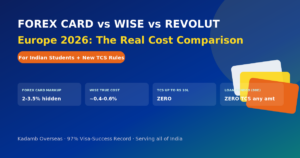
Most Indian Master’s students send money home (₹20,000-₹80,000/month) to support family OR receive money from family. Best transfer services 2026:
| Service | Speed | Cost (mid-market spread) | Best for |
|---|---|---|---|
| Wise (formerly TransferWise) | 1-2 days | ~0.4-0.6% | Best mid-market rate; best for €100-€5,000 transfers |
| Niyo Global | Instant | ~0.3-0.5% | Indian fintech, card-based, ₹10 lakh/transaction |
| BookMyForex | 1-3 days | ~0.4-0.6% + ₹500 fee | India-based forex broker |
| Western Union | 1 hour | ~1-2% + fixed fee | Emergency only (expensive spread) |
| Bank wire (HDFC/SBI/ICICI) | 2-5 days | ~0.7-1.0% + ₹500-₹1,500 fee | Larger amounts (>₹2 lakh) |
| PayPal | 1-2 days | ~3-4% spread | Avoid for student transfers (expensive) |
Tip: Wise saves 60-70% over bank wires for typical student-sized transfers (€500-€2,000).
Healthcare Reality in Europe for Indian Students
Most European countries have universal or heavily subsidised healthcare. Indian students benefit:
- Germany: Statutory health insurance (TK/AOK) covers ALL doctor visits + most procedures. Co-pay: €10/quarter for prescriptions. Prescription medicines: €5-€15 each.
- Italy: SSN (Servizio Sanitario Nazionale) covers GP visits + emergency. Specialist: €25-€80 per visit. Medicines: 100% covered with prescription.
- France: Sécurité Sociale + complementary mutuelle covers 70-100% of all healthcare. GP visit: €0-€25 out-of-pocket.
- Switzerland: Mandatory private insurance (~CHF 280/mo). Higher out-of-pocket but excellent quality.
- Netherlands: Mandatory basic insurance €130-€150/mo + dental separate.
Mental health support: most European universities provide free counselling + therapy services to international students. Use them — cultural adjustment is real.
Working Part-Time as Indian Student in Europe
| Country | Hours/week limit | Typical wage | Common jobs |
|---|---|---|---|
| Germany | 20 hrs (semester); full holidays | €12-€20/hr | HiWi (university research assistant), tutoring, Amazon warehouse, restaurant, retail |
| Italy | 20 hrs (semester); 40 hrs (holidays) | €7-€12/hr | Restaurant server, retail, English tutoring, university canteen |
| France | 964 hrs/yr (~20/wk semester) | €11-€18/hr | Tutoring, restaurant, retail, library, university teaching assistant |
| Switzerland | 15 hrs (semester); full holidays | CHF 22-30/hr | HiWi, tutoring, restaurant, library, canteen |
| Netherlands | 16 hrs (semester); 40 hrs (holidays) | €10-€15/hr | Restaurant, retail, university, tutoring |
Most Indian Master’s students earn €400-€800/month from part-time work — covers food + transport + occasional travel. Internships in your field (often 6 months) pay €1,000-€1,800/month.
Travel + Weekend Getaways Within Europe
The biggest perk of EU studies: cheap weekend travel. Schengen Area = no border controls between 27 European countries.
- Eurail Pass (15-30 day flexi pass): €350-€600 for unlimited train travel. Best deal for student backpacking.
- Eurolines / Flixbus: Cheap intercity buses (€10-€40 between major cities)
- Ryanair / EasyJet / Wizz Air: Budget airlines (€20-€80 one-way for major routes)
- Average weekend trip cost: €100-€200 for 2 days (transport + hostel + food)
Top weekend destinations from Indian student bases:
- From Berlin: Prague, Amsterdam, Copenhagen, Vienna, Paris
- From Munich: Salzburg, Vienna, Innsbruck, Prague, Italian Alps
- From Rome: Florence, Naples, Capri, Sicily, Greek islands (Santorini)
- From Paris: Brussels, Amsterdam, London, Barcelona, Munich
- From Zurich: Italian Alps, French Alps, Black Forest Germany, Vienna, Paris
Budget plan: €100-€300/month for weekend getaways across 2 years = experience 15-20 European countries.
Mental Health + Cultural Adjustment Reality
Cultural adjustment hits 60-70% of Indian students within first 6 months. Common issues:
- Loneliness (smaller social circles than India)
- Food fatigue (cooking same meals repeatedly)
- Weather depression (especially Northern European winters)
- Academic pressure (different teaching style)
- Financial stress (cost surprises)
- Family separation (long-distance with parents)
Strategies that work for Indian students:
- Join Indian Student Associations immediately (don’t isolate)
- Cook in groups + share meals weekly
- Maintain weekly video calls with family + Indian friends
- Use university counselling services (free)
- Participate in cultural events (Diwali, Holi)
- Plan first year travel to feel “European”
- Connect with Kadamb’s alumni network for mentorship
Career Building While Studying — Internship Strategy
The single most important career investment during your Master’s: a 6-month industry internship in your final year.
- Germany: Mandatory at most TUs + HAWs. Pays €1,200-€1,800/month. Often converts to full-time job offer (90%+ conversion rate at SAP, BMW, Bosch).
- Italy: Optional but strongly recommended. Pays €600-€1,200/month at companies like Pirelli, Eni, Luxottica.
- France: Mandatory at most Grandes Écoles. Pays €700-€1,500/month at companies like Schneider, BNP, L’Oréal.
- Switzerland: Optional but highly valued. Pays CHF 1,800-2,500/month at companies like Google, Logitech, ABB.
Apply for internships 6-9 months in advance. Use university Career Services + LinkedIn + company portals.
Top European Employers Hiring Indian Master’s Graduates 2026 — Complete List
Below are the 50+ companies that consistently hire Indian Master’s graduates from European universities, with average entry salaries:
Tier 1 — Big Tech (sponsor Blue Card / EU work permits reliably)
- Google (Munich, Berlin, Zurich, Lausanne, Paris, Dublin) — €85,000-€110,000 entry + sign-on + RSUs
- Microsoft (Munich, Berlin, Dublin, Paris, Zurich) — €75,000-€95,000 entry + sign-on + RSUs
- Amazon (Berlin, Munich, Dublin, Luxembourg, Madrid, Milan) — €68,000-€85,000 entry + sign-on + RSUs
- Meta (Berlin, Dublin, Paris, London) — €90,000-€110,000 entry + sign-on + RSUs
- Apple (Munich, Cork, Dublin) — €78,000-€95,000 entry + sign-on + RSUs
- NVIDIA (Munich, Berlin) — €82,000-€105,000 entry + sign-on + RSUs
- Salesforce (Munich, London, Dublin, Paris) — €72,000-€90,000 entry + sign-on + RSUs
- SAP (Walldorf Germany HQ + multiple EU offices) — €70,000-€85,000 entry + sign-on + RSUs
Tier 2 — Major German/European Industrial
- Siemens (Munich HQ, Erlangen, Berlin, multiple EU) — €58,000-€72,000 + 13th month + IG Metall
- Bosch (Stuttgart-Renningen, Reutlingen, multiple EU) — €55,000-€72,000 + bonus
- BMW Group (Munich, Dingolfing, Leipzig) — €62,000-€78,000 + IG Metall + 13th month
- Mercedes-Benz (Stuttgart-Sindelfingen, Bremen) — €60,000-€76,000 + IG Metall + 13th month
- Volkswagen Group (Wolfsburg, Ingolstadt, Stuttgart) — €58,000-€74,000 + IG Metall
- Audi (Ingolstadt, Neckarsulm) — €60,000-€76,000 + IG Metall
- Porsche (Stuttgart-Zuffenhausen) — €65,000-€80,000 + IG Metall + 13th month
- ABB (Switzerland HQ + Mannheim Germany) — €68,000-€85,000
- ThyssenKrupp (Essen) — €55,000-€68,000
- KION Group (Frankfurt + Aschaffenburg) — €58,000-€70,000
- Festo (Esslingen) — €60,000-€72,000
- Schneider Electric (Paris + multiple EU) — €52,000-€68,000
Tier 3 — Pharma + Chemical
- BASF (Ludwigshafen) — €62,000-€78,000 + IG BCE + 13th month
- Bayer (Leverkusen, Berlin) — €60,000-€76,000 + bonus
- Boehringer Ingelheim (Ingelheim am Rhein, Biberach) — €60,000-€75,000
- Merck KGaA (Darmstadt) — €58,000-€74,000
- Roche (Basel Switzerland + Penzberg Germany) — CHF 88,000-110,000 / €70,000-90,000
- Novartis (Basel + Frankfurt) — CHF 82,000-100,000 / €68,000-85,000
- Sanofi (Paris + Frankfurt + Munich) — €58,000-€72,000
Tier 4 — Banking + Consulting
- McKinsey & Company (Munich, Düsseldorf, Frankfurt, Paris, London, Madrid) — €110,000-€130,000 + bonus + sign-on
- Boston Consulting Group (BCG) (multiple EU) — €105,000-€125,000 + bonus + sign-on
- Bain & Company (multiple EU) — €100,000-€120,000 + bonus + sign-on
- Roland Berger (Munich + multiple EU) — €82,000-€100,000
- Deutsche Bank (Frankfurt + Berlin) — €72,000-€90,000
- Allianz SE (Munich + multiple EU) — €68,000-€85,000
- UBS (Zurich + multiple EU) — CHF 92,000-115,000 / €75,000-95,000
- BNP Paribas (Paris + multiple EU) — €58,000-€75,000
Tier 5 — Tech Unicorns + Scale-ups (Berlin Hot)
- Zalando (Berlin) — €65,000-€80,000 + RSUs
- N26 (Berlin) — €65,000-€80,000 + stock options
- Trade Republic (Berlin) — €70,000-€88,000 + stock
- Personio (Munich + Berlin) — €65,000-€80,000 + stock
- Celonis (Munich) — €72,000-€92,000 + stock
- Doctolib (Paris + Berlin) — €60,000-€75,000 + stock
- BlaBlaCar (Paris) — €55,000-€72,000
- Mirakl (Paris) — €58,000-€75,000
- Algolia (Paris) — €60,000-€78,000
- Wolt (Helsinki + multiple EU) — €58,000-€72,000
EU Mobility — How Indian Master’s Graduates Move Between Countries
One of the under-appreciated benefits of EU Master’s: free movement after Blue Card / settlement permit. Indian alumni mobility patterns (from our 5-year cohort data):
| Starting country (Master’s) | Most common 5-year destination | Why |
|---|---|---|
| Italy | Germany (~40%) | Higher salary + faster PR pathway |
| Italy | France (~15%) | Lifestyle preference + Talent Passport |
| Italy | Switzerland (~10%) | Highest salary in Europe |
| Switzerland | Germany (~25%) | Lower cost of living + family settings |
| Switzerland | Stay in Switzerland (~70%) | Best salary + lifestyle |
| Germany | Stay in Germany (~70%) | Strong PR pathway + Indian community |
| Germany | Netherlands (~8%) | English-speaking + tech ecosystem |
| UK (post-Brexit) | Germany or Ireland (~15%) | EU access + lower cost than UK |
| France | Stay in France (~70%) | Strong career path + lifestyle |
| France | UK (~10%) | English speaking + global brands |
Indian Family Visit + Long-Distance Reality
Most Indian Master’s graduates return to India 1-3 times per year. Round-trip flight costs (2026 baseline):
| Route | Economy fare (₹) | Best months to fly (cheapest) |
|---|---|---|
| Mumbai/Delhi ↔ Frankfurt | 35,000-65,000 | March, May, October-November |
| Mumbai/Delhi ↔ Munich | 40,000-70,000 | March, May, October-November |
| Mumbai/Delhi ↔ Berlin | 40,000-70,000 | March, May, October-November |
| Mumbai/Delhi ↔ Rome/Milan | 35,000-65,000 | April, May, October-November |
| Mumbai/Delhi ↔ Paris | 40,000-70,000 | March, May, October-November |
| Mumbai/Delhi ↔ Zurich | 50,000-80,000 | April, May, October-November |
| Mumbai/Delhi ↔ Amsterdam | 40,000-65,000 | March, May, October-November |
Tips for cheap flights: Book 4-6 months in advance. Avoid peak season (June-July, December). Use Lufthansa, Air India, Qatar Airways, Emirates for best prices. Avoid same-day connections for cost savings.
Indian Family Visit Visa to Europe — Schengen Tourist Visa
Once you’re settled in EU, your parents/family can visit you on a Schengen tourist visa (90 days within 180-day period). Apply via VFS centres in Mumbai/Delhi/Bangalore/Chennai/Kolkata for €80 fee + supporting documents:
- Valid passport (3+ months past intended return)
- Visa application form
- Travel insurance €30,000+ medical coverage
- Proof of accommodation (your invitation + your address proof in EU)
- Financial proof (€80/day shown in your or family’s bank for last 6 months)
- Return ticket booking
- Cover letter explaining purpose
- Schengen photo
Processing: 15-30 days. Approval rate for Indian tourist visa to Europe: ~75% (lower than student visa due to “intent to return” verification).
EU Tax + Social Security Reality for Indians Working in Europe (2026)
Once you start working in Europe, you become an EU country tax resident. Here’s the realistic tax + social security burden by country for €60,000 gross annual income (single, no dependants, no church tax):
| Country | Income Tax (€) | Social Contributions (€) | Total Deductions | Net Take-Home (€/year) | Net (₹/month at €1=₹93) |
|---|---|---|---|---|---|
| Germany (Class I single) | ~€12,720 | ~€12,591 | ~42% | €34,665 | ~₹2.69 lakh |
| France | ~€5,000 | ~€13,200 | ~30% | €41,800 | ~₹3.24 lakh |
| Italy | ~€11,000 | ~€10,000 | ~35% | €39,000 | ~₹3.02 lakh |
| Spain | ~€8,500 | ~€10,000 | ~31% | €41,500 | ~₹3.22 lakh |
| Netherlands | ~€10,500 | ~€8,800 | ~32% | €40,700 | ~₹3.16 lakh |
| Switzerland (Zurich) | ~€6,000 | ~€7,500 | ~22% | €46,500 | ~₹3.61 lakh |
| Switzerland (Zug — lowest) | ~€3,500 | ~€7,500 | ~18% | €49,000 | ~₹3.80 lakh |
| Ireland | ~€10,000 | ~€2,400 | ~21% | €47,600 | ~₹3.69 lakh |
| Belgium | ~€16,000 | ~€8,000 | ~40% | €36,000 | ~₹2.79 lakh |
Key insight: Switzerland (especially Zug + Schwyz cantons) has the lowest tax burden in Europe. Belgium + Germany have highest. France has high social contributions but proportionally lower income tax.
India-Europe Tax Treaty (DTAA) — How to Avoid Double Taxation
India has Double Taxation Avoidance Agreements (DTAA) with all major EU countries:
- India-Germany DTAA (since 1995)
- India-France DTAA (since 1992)
- India-Italy DTAA (since 1995)
- India-Spain DTAA (since 1993)
- India-Netherlands DTAA (since 1990)
- India-Switzerland DTAA (since 1995)
- India-Belgium DTAA (since 1994)
- India-Ireland DTAA (since 2002)
- India-UK DTAA (since 1993)
Key DTAA provisions:
- Resident principle: You’re taxed in your country of residence (where you live for >183 days/year). Once you’re an EU tax resident, your salary is taxed in EU (not India).
- Indian-source income: Rentals from Indian property, dividends from Indian shares — still taxable in India BUT can be claimed as tax credit in EU country.
- Withholding tax reduction: Most DTAAs reduce withholding tax on dividends + interest from 25% to 10-15%.
- Pension portability: After 5 years of contributing to EU pension, you can transfer back to Indian Provident Fund / NPS under the India-EU social security agreements (limited).
How to File Indian ITR After Moving to Europe
Even after becoming an EU tax resident, you may need to file Indian ITR for:
- Indian-source income (rentals, dividends, capital gains)
- Disclosure of foreign assets (mandatory under Black Money Act)
- Closure of Indian PF/NPS accounts
Schedule FA (Foreign Assets): Mandatory in your Indian ITR if you have any foreign bank account, mutual fund, or property. Disclose all EU bank accounts, blocked accounts, salary accounts. Non-disclosure = ₹10 lakh penalty + 30% tax on the asset.
Form 67: To claim foreign tax credit (taxes paid in EU) against Indian taxes on Indian-source income. Submit before due date of Indian ITR.
Practical advice: Hire an Indian CA who specialises in NRI taxation (~₹10,000-20,000/year fee). Avoid DIY for first 2-3 years.
EU Pension System for Indian Workers
Each EU country has its own pension system + India has bilateral social security agreements with most major EU countries:
- Germany: Compulsory Deutsche Rentenversicherung (~9.3% of gross + employer matches). After 5 years contribution, you can transfer back to India under India-Germany Social Security Agreement.
- France: Compulsory Régime général (~10.5% + employer matches). India-France Social Security Agreement allows transfer after 5 years.
- Italy: INPS (~9.19% + employer matches). India-Italy DTAA covers basic; specific social security agreement under negotiation.
- Switzerland: AHV/AVS (~5.3% + employer matches). India-Switzerland Social Security Agreement allows transfer back to India.
- Belgium: ONSS (~13.07% + employer matches). India-Belgium DTAA covers basic.
If you stay in EU permanently: Pension is paid out at retirement age (65-67 depending on country). Combined with EU + Indian pensions, comfortable retirement.
If you return to India: After 5+ years, you can transfer accumulated pension back to Indian Provident Fund. Lump-sum option available; check specific country rules.
Quick Reference — Top 10 Questions Indian Master’s Students Ask About Europe
- How long does it take to get a student visa? Italy: 2-4 weeks. Germany: 6-12 weeks. France: 2-4 weeks. Switzerland: 6-12 weeks. Netherlands: 2-4 weeks. Apply 3-4 months before intended arrival.
- What’s the success rate for Indian student visas to Europe? 85-95% across all major EU countries when documents are complete. Top rejection reasons: insufficient financial proof, missing apostille, weak SOP.
- Can I work part-time during my Master’s? Yes — 16-20 hours/week during semester, full-time during holidays in most EU countries. Wages €10-€20/hour typically.
- Do I need to know the local language? Not for English-taught Master’s. But A2 local language strongly recommended for daily life + significantly improves post-Master’s job search.
- What’s the cheapest European country for MS? Italy with DSU + ISEE Tier 1: ₹15-25 lakh total. Germany TU Berlin / TU Dresden: ₹22-28 lakh.
- Which has the best post-study work permit? Germany — 18-month Job Seeker Visa + EU Blue Card pathway → German PR in 21 months → German citizenship in 5 years.
- Can my family visit me? Yes — Schengen tourist visa for 90 days. Apply at VFS Schengen centre in your home city.
- What if my CGPA is below 7.0? Apply to HAWs (Universities of Applied Sciences) in Germany or smaller universities in Italy. Read our MS Germany Low GPA guide.
- How do I find scholarships? Use our Scholarship Matcher tool + check European Scholarships Database. Combine multiple scholarships for full coverage.
- How do I get help with applications? Talk to Kadamb Overseas — free 30-min consultation. Call +91 99133 33239 or WhatsApp +91 99133 33239.
Final CTA — Ready to Start?
If you’ve read this far, you’re serious about your European Master’s plan. Here’s what to do next:
- Use the cost calculator on our scholarship-assistance page to estimate your total cost
- Check your visa eligibility with our visa checker tool
- Find matching scholarships with our scholarship matcher
- Book a free 30-min consultation with Kadamb Overseas to get a personalised action plan
Direct contact: Contact Form | Phone: +91 99133 33239 | WhatsApp: +91 99133 33239 | Email: kadamboverseas@gmail.com
Read also: Italy | Germany | Switzerland | France | All Scholarships | FAQ | Glossary
Saumitra Rajput
Saumitra Rajput is the founder of Kadamb Overseas Pvt. Ltd., India's leading Europe-focused study abroad consultancy based in Ahmedabad. With 14+ years of expertise in European education, he has personally counselled 2,500+ Indian families and helped 500+ students secure admission to top European universities including TU Munich, ETH Zurich, EPFL, KU Leuven, HEC Paris, Sapienza Rome, TU Wien, and Warsaw University of Technology. He has visited 25+ European universities, partners with 250+ EU institutions, and maintains a 500+ students placed.
Planning to Study Abroad?
Get free expert guidance from our experienced counselors

Saumitra Rajput
Saumitra Rajput is the founder and lead counsellor at Kadamb Overseas, India's trusted Europe education consultancy based in Ahmedabad. With 14+ years of hands-on experience, he has personally guided 500+ students to universities across Germany, Switzerland, France, Italy, Austria, and Spain. Saumitra has visited partner universities across Europe, holds deep expertise in European visa processes, scholarships, and student life, and has achieved a 97% visa success rate for his clients. He is the host of the YouTube channel "Europe with Saumitra", where he shares first-hand insights on studying and living in Europe. His mission: make Europe accessible to every Indian student, with zero consultancy fees.