

Table of Contents
- How health insurance works for Indian students in Germany
- What public insurance costs in 2026
- When you need Mawista or Care Concept instead
- How to enrol, step by step (before you fly)
- What’s actually covered (and what isn’t)
- TK vs AOK vs DAK vs Barmer: the service differences that matter
- Five costly mistakes Indian students make with German insurance
- The over-30 decision, in numbers
- Frequently asked questions
🕑 7 min read
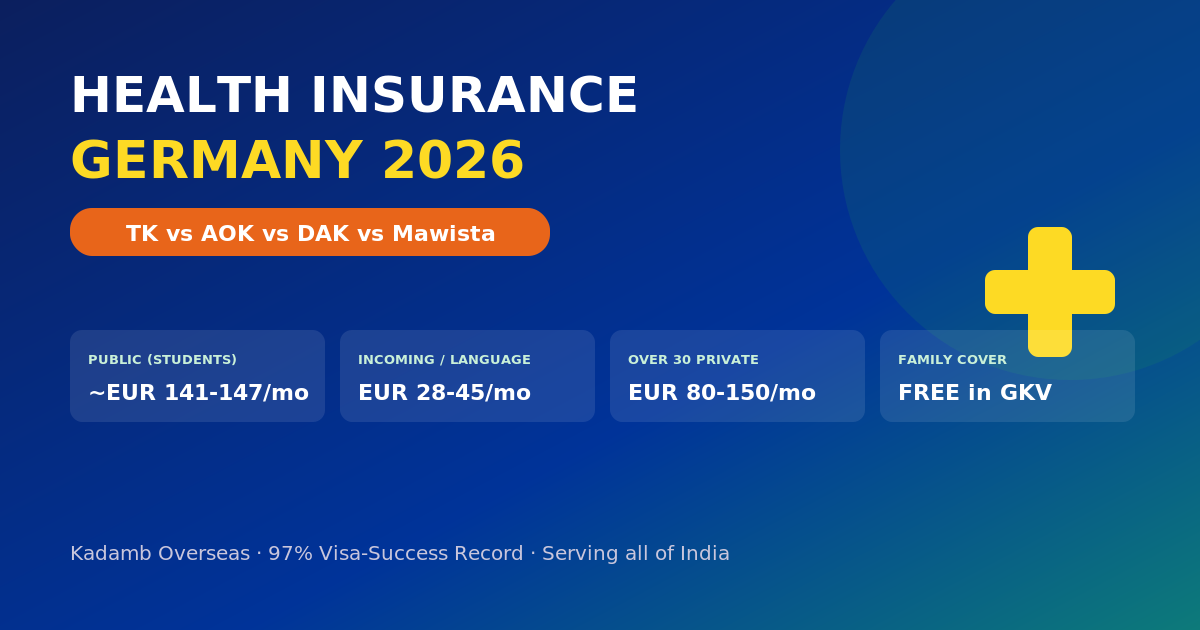
Quick answer: In 2026, public (statutory) student health insurance in Germany costs about €141–€147 per month — roughly the same at TK, AOK, DAK and Barmer, because the student rate is fixed by law (€87.38 base + €30.78 long-term care + the fund’s small supplement). TK (Techniker Krankenkasse) is the best pick for most Indian students thanks to full English support and the strongest app. Private “incoming” insurers like Mawista and Care Concept (€30–€45/month) are only for language-course students, preparatory (Studienkolleg) phases, and students who start their degree after turning 30. Your German university will not enrol you — and your visa may be refused — without the right type of cover.
How health insurance works for Indian students in Germany
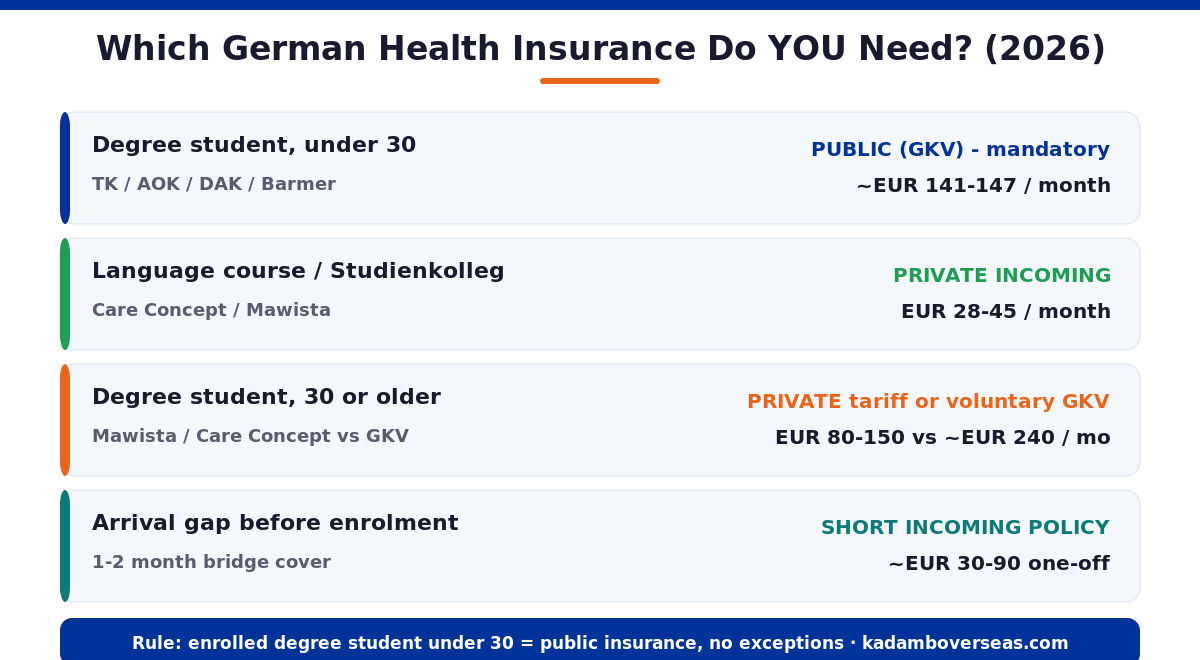
Germany has two systems, and which one you may use is decided by your status, not your preference. Statutory insurance (GKV) — the public funds TK, AOK, DAK, Barmer — is mandatory for enrolled degree students under 30. It covers doctors, hospitals, mental health, pregnancy and most prescriptions with no health questions, no exclusions and no claim forms: you show your card, the fund pays the doctor directly. Private incoming insurance (Mawista, Care Concept, Dr-Walter and similar) is cheap travel-style cover designed for people the public system will not yet accept: language-course and Studienkolleg students, exchange semesters, and degree students who begin after their 30th birthday.
The rule every Indian applicant should memorise: once you are enrolled in a degree program and under 30, public insurance is compulsory — a private incoming policy is not accepted for enrolment, and switching back later is nearly impossible. Getting this wrong is one of the most common (and expensive) mistakes we fix for students.
What public insurance costs in 2026
The student rate is uniform nationwide: a base premium of €87.38/month, plus €30.78/month compulsory long-term care insurance (Pflegeversicherung), plus each fund’s income-independent supplement. In practice:
| Fund | Approx. monthly cost (2026) | Why students pick it |
|---|---|---|
| TK (Techniker) | ~€141 (under 23) / ~€146 (23+) | Best English support, top-rated app, fastest enrolment certificate |
| AOK | ~€142–148 (varies by region) | Local offices in every city; strong for walk-in help |
| DAK | ~€143–148 | Good bonus programs, solid digital service |
| Barmer | ~€142–147 | Large network, English hotline |
The differences are a few euros a month — the deciding factors are service language, app quality and how quickly the fund issues the confirmation your university and the blocked account provider ask for. That is why roughly half of all international students simply choose TK.
When you need Mawista or Care Concept instead
Private incoming policies exist for the gaps the public system leaves open:
- Language course or Studienkolleg phase: you are not yet a degree student, so GKV will not take you. Care Concept’s student tariffs start around €28–35/month and Mawista Student around €35–45/month — both are accepted for the visa.
- The gap between arrival and enrolment: many students land 4–8 weeks before semester start; a one- or two-month incoming policy bridges it cheaply.
- Starting a degree after 30: the student GKV rate no longer applies. Your options become voluntary GKV at roughly €230–260/month, or a private student tariff at €80–150/month. Most over-30 master’s students take the private route for the first years — but check the fine print on pre-existing conditions and pregnancy, which incoming policies exclude.
- PhD and guest researchers: usually not “students” in the GKV sense; they use voluntary GKV or dedicated researcher tariffs.
Caution: incoming policies pay after you submit bills, exclude pre-existing conditions, and cap benefits. They are visa-compliant bridges, not long-term substitutes. The moment you qualify for statutory cover, switch.
How to enrol, step by step (before you fly)
1. Choose your fund online 4–6 weeks before departure. TK, AOK and DAK all accept online applications from India with your passport and admission letter — no German address needed initially.
2. Receive the digital membership certificate (Mitgliedsbescheinigung) within a few days; your university needs it for enrolment, via the electronic M10 notification sent fund-to-university.
3. Show proof for the visa file. For the student visa itself, travel/incoming cover for the first weeks plus the GKV confirmation satisfies the embassy — our Study in Germany guide covers the full document set.
4. After arrival, complete Anmeldung (city registration), send your German address and IBAN to the fund, and premiums start from your enrolment date — not your arrival date.
5. Get the eGK card (electronic health card) by post in 2–3 weeks; from then on every GP visit is cashless.
What’s actually covered (and what isn’t)
Public insurance covers GP and specialist visits, hospital treatment, emergencies, mental-health care, physiotherapy on prescription, pregnancy and childbirth, and most medications (you pay €5–10 per prescription). Dental check-ups are included; major dental work, glasses and contact lenses largely are not — students who need them often add small private top-ups (€10–15/month). There is no annual limit and no network restriction: any doctor who accepts public patients, anywhere in Germany.
TK vs AOK vs DAK vs Barmer: the service differences that matter
Since price and legal coverage are essentially equal, compare the funds on service. TK handles the entire journey in English — application, hotline, app, letters — and issues the digital enrolment certificate fastest, which matters when a university deadline is days away. AOK is actually eleven regional funds; its strength is the walk-in office in practically every university town, useful if you prefer solving problems face to face, though English quality varies by region and supplements differ slightly (hence the €142–148 range). DAK sits in between, with a decent app and bonus programs that pay you €50–100 a year for check-ups and gym membership. Barmer runs an English hotline and a large physiotherapy network. Our honest advice after hundreds of Germany placements: unless you have a specific reason, take TK and spend your energy on things that genuinely differ — housing, Anmeldung and the blocked account.
Five costly mistakes Indian students make with German insurance
1. Buying a one-year Mawista policy for a degree program. The university rejects it at enrolment; the unused premium is often non-refundable. Incoming cover should bridge weeks, not semesters.
2. Delaying GKV sign-up until after arrival. Without the membership certificate you cannot complete enrolment, and without enrolment you cannot open many student services. Apply from India.
3. Forgetting the long-term care component. Budget the full ~€146, not the €87 base figure some blogs quote — Pflegeversicherung is not optional.
4. Letting premiums bounce. Two missed payments can block your enrolment certificate for the next semester and, in the worst case, surface at visa-extension time at the Ausländerbehörde.
5. Staying on a private tariff after becoming eligible for GKV. Working students and graduates entering jobs are automatically GKV-insured; running a parallel private policy wastes €400+ a year. Cancel the incoming policy the day statutory cover begins.
The over-30 decision, in numbers
Suppose you start an M.Sc. at 31. Voluntary GKV at ~€240/month costs about €5,760 over a two-year degree; a private student tariff at ~€110/month costs about €2,640. The private route saves €3,000+ — but if you have a chronic condition, plan a family, or expect to stay in Germany long-term (private-to-public switching after 30 is restrictive), the voluntary GKV route is usually worth the premium. This is a genuinely individual decision; we walk our students through it case by case.
Frequently asked questions
How much is health insurance for international students in Germany in 2026?
Public student insurance costs about €141–€147 per month in 2026 (base €87.38 + long-term care €30.78 + the fund’s supplement), nearly identical across TK, AOK, DAK and Barmer. Private incoming policies for language students cost €28–€45 per month.
Which is better for Indian students: TK or AOK?
Both cost the same within a few euros and cover identical statutory benefits. TK wins for English-language service, its app and fast digital certificates; AOK wins if you want a physical office nearby in your city. Most Indian students choose TK.
Is Mawista accepted for German university enrolment?
Only in the cases where public insurance is unavailable: language courses, Studienkolleg, exchange programs, or degree students over 30. For a regular degree student under 30, universities require statutory insurance (TK, AOK, DAK, Barmer) and will reject a Mawista or Care Concept policy for enrolment.
Can I get German health insurance before arriving from India?
Yes. TK, AOK and DAK accept online applications from India using your passport and admission letter, and email the membership certificate your university needs. Arrange it 4–6 weeks before you fly so enrolment and visa paperwork are seamless.
What happens to my health insurance if I turn 30 during my degree?
You keep the student rate until the end of the semester in which you turn 30, then move to voluntary GKV (~€230–260/month) or switch to a private student tariff. Budget for this jump if you begin your master’s at 28 or 29.
Does German student insurance cover my spouse and children?
Yes — statutory insurance offers free family co-insurance (Familienversicherung): a dependent spouse with no or minimal income and your children are covered at no extra cost. This is a major advantage over private policies, which charge per person.
Get your Germany paperwork done right the first time
Kadamb Overseas manages the complete Germany file — admission, blocked account, health insurance enrolment and visa — for students from every state of India, with a 97% visa-success record. One counsellor, zero guesswork.
Saumitra Rajput
Saumitra Rajput is the founder of Kadamb Overseas Pvt. Ltd., India's leading Europe-focused study abroad consultancy based in Ahmedabad. With 14+ years of expertise in European education, he has personally counselled 2,500+ Indian families and helped 500+ students secure admission to top European universities including TU Munich, ETH Zurich, EPFL, KU Leuven, HEC Paris, Sapienza Rome, TU Wien, and Warsaw University of Technology. He has visited 25+ European universities, partners with 250+ EU institutions, and maintains a 500+ students placed.
Planning to Study Abroad?
Get free expert guidance from our experienced counselors

Saumitra Rajput
Saumitra Rajput is the founder and lead counsellor at Kadamb Overseas, India's trusted Europe education consultancy based in Ahmedabad. With 14+ years of hands-on experience, he has personally guided 500+ students to universities across Germany, Switzerland, France, Italy, Austria, and Spain. Saumitra has visited partner universities across Europe, holds deep expertise in European visa processes, scholarships, and student life, and has achieved a 97% visa success rate for his clients. He is the host of the YouTube channel "Europe with Saumitra", where he shares first-hand insights on studying and living in Europe. His mission: make Europe accessible to every Indian student, with zero consultancy fees.