
Table of Contents
- Is a 3-year B.Com enough for a Masters in Europe?
- Why do B.Com graduates get rejected from MSc Finance?
- Which Masters should a B.Com graduate actually target?
- Which countries are friendliest to a B.Com background?
- What do the entry requirements look like in practice?
- How can a B.Com applicant fix a weak quantitative profile?
- Mistakes to avoid
- What jobs follow a B.Com plus a European Masters?
- Frequently asked questions
🕑 8 min read
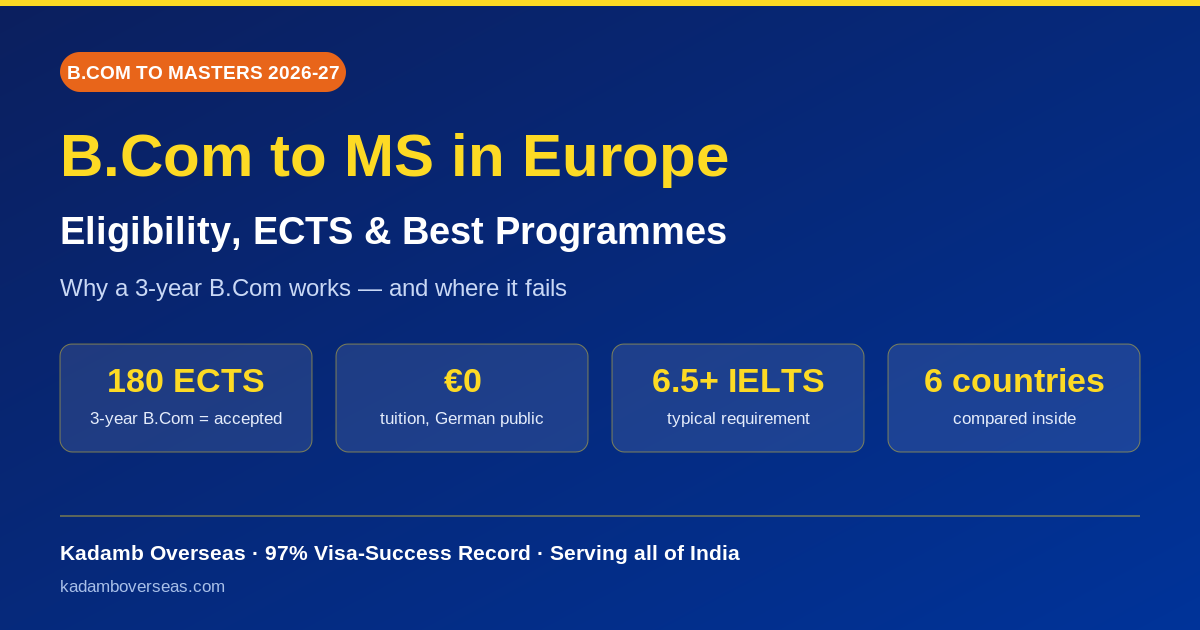
Quick answer: Yes — a 3-year Indian B.Com is accepted for Masters admission across Europe, because it normally maps to 180 ECTS, the standard European bachelor workload. The catch is not the duration, it is the subject mix. Most B.Com syllabi are heavy on accounting, law and commerce but light on mathematics, statistics and econometrics, which is exactly what selective MSc Finance and MSc Economics programmes screen for. So B.Com graduates get in comfortably for MSc Management, MSc International Business, MSc Marketing, MSc Accounting & Auditing, MSc Supply Chain and MSc Business Analytics (applied track), and get rejected most often from quant-heavy MSc Finance. Budget approx. ₹4–14 lakh a year all-in for Germany, France, Italy, Spain, Poland or Ireland, and always confirm your degree shows H+ on anabin before you pay any application fee. Verify every figure on the official programme page.
Is a 3-year B.Com enough for a Masters in Europe?
In most cases, yes. European degree structures run on ECTS credits rather than years. A standard European bachelor is 180 ECTS earned over three years, and an Indian 3-year B.Com from a UGC-recognised university is generally treated as equivalent to that 180 ECTS baseline. This is why the old fear that “Europe needs a 4-year degree” is mostly an American concern, not a European one.
Three things decide the outcome, in this order:
- Recognition of your university. Germany publishes this openly through the anabin database. Your institution should carry H+ status. H+/- means further checking, and H- means the degree is not recognised — applying there wastes money.
- Credit volume. Some programmes, particularly in the Netherlands and a handful of German technical universities, ask for 210 or 240 ECTS. Those are the programmes where a 3-year B.Com genuinely struggles, and where a bridging year or an Indian PG diploma helps.
- Subject relevance. This is where most B.Com applications actually fail, and it deserves its own section.
Why do B.Com graduates get rejected from MSc Finance?
Because MSc Finance in Europe is a quantitative degree, not a commerce degree. Admissions committees read your transcript module by module and count how many credits you earned in calculus, linear algebra, probability, statistics and econometrics. A typical B.Com transcript shows Business Mathematics and Business Statistics — often one paper each, in the first or second year — and then three years of Financial Accounting, Corporate Law, Auditing, Taxation and Cost Accounting.
Several German MSc Finance programmes state this explicitly: a degree in business, commerce or accounting is usually not sufficient, because such programmes do not contain the required volume of mathematics and statistics training. Economics degrees pass more often, provided the applicant has taken a meaningful number of quantitative courses.
The practical fix is not to argue with the committee. It is to pick the right target degree, or to visibly add the missing credits before applying.
Which Masters should a B.Com graduate actually target?
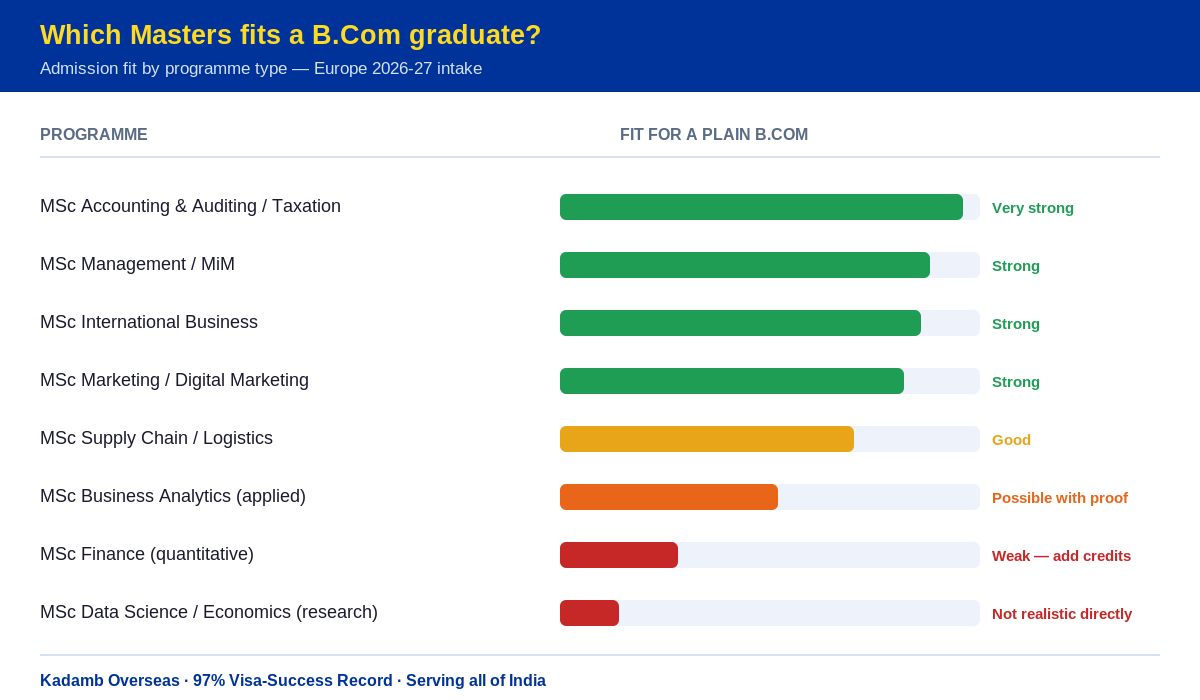
| Masters programme | Fit for a plain B.Com | What they check hardest |
|---|---|---|
| MSc Management / MiM | Strong | GPA, SOP, sometimes GMAT/GRE |
| MSc International Business | Strong | English score, motivation fit |
| MSc Accounting & Auditing / Taxation | Very strong | Accounting credits — your advantage |
| MSc Marketing / Digital Marketing | Strong | Portfolio, internships |
| MSc Supply Chain / Logistics | Good | Basic statistics, quant aptitude |
| MSc Business Analytics (applied) | Possible with proof | Statistics + coding evidence |
| MSc Finance (quantitative) | Weak without extra credits | Maths, statistics, econometrics ECTS |
| MSc Data Science / Economics (research) | Not realistic directly | Heavy maths prerequisites |
If your heart is set on finance, a sensible two-step route works better than a rejection: take an MSc in Management or International Business with a finance specialisation, then move into finance roles through internships. Employers in Frankfurt, Paris and Amsterdam hire on internship track record far more than on degree title.
Which countries are friendliest to a B.Com background?
| Country | Typical annual tuition (approx.) | B.Com-friendliness | Post-study stay |
|---|---|---|---|
| Germany (public) | €0 tuition + approx. €200–400 semester contribution (Baden-Württemberg approx. €1,500/semester for non-EU) | Good for management, strict for finance | 18 months |
| France | approx. €8,000–20,000 (business schools higher) | Very good — MiM culture | 12–24 months |
| Italy | approx. €1,000–4,000 public, income-linked | Good, generous fee waivers | 12 months |
| Spain | approx. €2,000–12,000 | Good for business Masters | 12 months |
| Poland | approx. €2,500–5,000 | Very accommodating | 9–12 months |
| Ireland | approx. €14,000–25,000 | Good, English-native | 24 months |
Converted roughly, Germany can run at approx. ₹12–14 lakh a year once living costs are included, Poland and Italy closer to approx. ₹9–11 lakh, and Ireland or a top French business school approx. ₹22–35 lakh. Tuition is only part of the story — the blocked account, health insurance and rent decide your real budget. See our guides on studying in Germany, studying in France, the Germany blocked account and German health insurance options.
What do the entry requirements look like in practice?
For a B.Com graduate applying to a reputable European business Masters in 2026–27, plan for roughly this profile:
- Academics: 65–75% or CGPA 7.0+ for competitive programmes; 55–60% still opens doors in Poland, Italy and parts of Germany.
- English: IELTS 6.5–7.5 or TOEFL 80–100. Duolingo 110–120 is now accepted at many institutions, though some visa offices still prefer IELTS — check before you book.
- GMAT/GRE: Optional at most public universities; expected at selective French and Spanish business schools, where GMAT 640–730 (Focus approx. 595–645) or GRE 310–325 is the working band.
- Documents: 2–3 recommendation letters, a specific SOP, CV, and proof of funds.
- Germany-specific: APS certificate is mandatory for Indian applicants before the visa stage, so start it early — it takes weeks, not days.
- Intakes: September/October is the main intake; January/February exists but with far fewer programmes and scholarships.
How can a B.Com applicant fix a weak quantitative profile?
This is the section that changes outcomes. If you want a finance-adjacent or analytics Masters, add provable quantitative credits before you apply:
- Credited university courses beat MOOCs. A certificate-only online course carries little weight. A semester course from a recognised university with a transcript, grade and credit value does.
- Name the modules in your SOP. Do not write “I am passionate about finance”. Write that you completed Business Statistics (4 credits), Financial Management (5 credits) and an econometrics elective, and list the software you used.
- Use work experience as evidence. Two years in audit, FP&A, treasury or MIS reporting, described with actual tools — advanced Excel modelling, SQL, Power BI, Tally, SAP — proves applied quant far better than a claim of interest.
- Consider a pre-Masters or foundation semester. Several German and Dutch institutions offer one or two semesters that close the credit gap and lead into the Masters. It costs a semester; a rejection costs a year.
- Pair CA/CMA/CS or ACCA progress with the B.Com. Cleared professional exam groups strengthen accounting, audit and taxation Masters applications considerably.
Mistakes to avoid
- Applying to quant MSc Finance with an unmodified B.Com transcript. The most common single reason B.Com applicants collect rejections. Read the prerequisite paragraph, not the brochure.
- Skipping the anabin check. Application fees paid on an H- university are money gone. Check the institution and the degree type separately.
- Assuming 3 years automatically disqualifies you. It usually does not. Confirm the ECTS requirement on the specific programme page instead of believing forum rumours.
- Ignoring the 210/240 ECTS programmes until too late. If your shortlist is full of them, you need a bridging plan from day one.
- Starting the APS too late. It gates the German visa appointment and cannot be rushed.
- Writing one SOP for eight universities. Committees can tell. Each SOP should name the programme’s specific modules and explain the credit story your transcript tells.
- Underestimating living costs. A €0 tuition degree is not a free degree. The blocked account requirement alone is a serious number.
- Not planning for the job market. Look at the EU Blue Card salary thresholds before you choose a country, and prepare properly with our Schengen visa interview guide.
What jobs follow a B.Com plus a European Masters?
Graduates typically move into financial analysis, audit and assurance, controlling, consulting, procurement and supply chain, business analytics, and marketing analytics. Germany’s controlling and shared-services sector absorbs accounting-strong graduates in volume. The Netherlands, Ireland and Poland host large finance shared-service centres where Indian graduates with English-taught Masters do well. Starting salaries for business Masters graduates in Germany commonly sit in the approx. €42,000–55,000 band, France approx. €38,000–48,000, and Poland lower in euro terms but with far lower living costs — verify current figures for your target city and role, as these move every year.
Frequently asked questions
Can I do a Masters in Europe with a 3-year B.Com?
Yes. A 3-year Indian B.Com generally maps to 180 ECTS, which meets the standard requirement at most European universities. Some programmes ask for 210 or 240 ECTS, and those specific programmes will need a bridging course or an additional qualification. Always check the ECTS requirement on the individual programme page.
Is B.Com accepted for MS Finance in Germany?
Often not directly. Several German MSc Finance programmes state that commerce, business and accounting degrees usually lack the required mathematics and statistics training. You will need documented quantitative credits, or you should target MSc Management, MSc Accounting or MSc International Business instead, which accept B.Com comfortably.
Do I need GMAT for a Masters in Europe after B.Com?
Not at most public universities in Germany, Italy, Spain and Poland. Selective French and Spanish business schools do expect it, typically GMAT 640–730 (GMAT Focus approx. 595–645) or GRE 310–325. Check each school, since several have moved to test-optional admissions.
What percentage in B.Com is needed for a European Masters?
Competitive programmes look for 65–75% or CGPA 7.0 and above. Programmes in Poland, Italy and several German universities of applied sciences admit students in the 55–65% range, particularly with relevant work experience and a strong statement of purpose.
How much does a Masters in Europe cost for a B.Com graduate from India?
Public universities in Germany charge no tuition beyond a semester contribution of approx. €200–400, so the total annual outlay including living costs runs to approx. ₹12–14 lakh. Poland and Italy come in around approx. ₹9–11 lakh a year. Ireland and top French business schools can reach approx. ₹22–35 lakh. Verify current fees on each official page.
Should I take a pre-Masters or foundation programme after B.Com?
Take one only if your shortlist demands credits you do not have — a 210 or 240 ECTS requirement, or a quantitative prerequisite for finance or analytics. If your target is MSc Management, International Business, Marketing or Accounting, a pre-Masters is usually an unnecessary extra semester and cost.
Not sure whether your B.Com transcript clears the credit bar?
Kadamb Overseas maps your actual marksheet module by module against programme prerequisites across Germany, France, Italy, Spain, Poland and Ireland — before you spend a rupee on application fees. We work with students in Ahmedabad, Mumbai, Delhi, Bengaluru, Hyderabad, Pune, Chennai, Jaipur, Surat, Kolkata and across all of India, backed by a 97% visa-success record.
Saumitra Rajput
Saumitra Rajput is the founder of Kadamb Overseas Pvt. Ltd., India's leading Europe-focused study abroad consultancy based in Ahmedabad. With 14+ years of expertise in European education, he has personally counselled 2,500+ Indian families and helped 500+ students secure admission to top European universities including TU Munich, ETH Zurich, EPFL, KU Leuven, HEC Paris, Sapienza Rome, TU Wien, and Warsaw University of Technology. He has visited 25+ European universities, partners with 250+ EU institutions, and maintains a 500+ students placed.
Planning to Study Abroad?
Get free expert guidance from our experienced counselors

Saumitra Rajput
Saumitra Rajput is the founder and lead counsellor at Kadamb Overseas, India's trusted Europe education consultancy based in Ahmedabad. With 14+ years of hands-on experience, he has personally guided 500+ students to universities across Germany, Switzerland, France, Italy, Austria, and Spain. Saumitra has visited partner universities across Europe, holds deep expertise in European visa processes, scholarships, and student life, and has achieved a 97% visa success rate for his clients. He is the host of the YouTube channel "Europe with Saumitra", where he shares first-hand insights on studying and living in Europe. His mission: make Europe accessible to every Indian student, with zero consultancy fees.