

Table of Contents
- What exactly is Anmeldung, and why does everything depend on it?
- The 14-day rule (and what actually happens if you miss it)
- Documents checklist
- City by city: what to expect in 2026
- Special situations Indian students actually face
- Appointment-hunting tactics that actually work
- Leaving Germany? Don’t forget Abmeldung
- After Anmeldung: the domino effect
- Frequently asked questions
🕑 7 min read
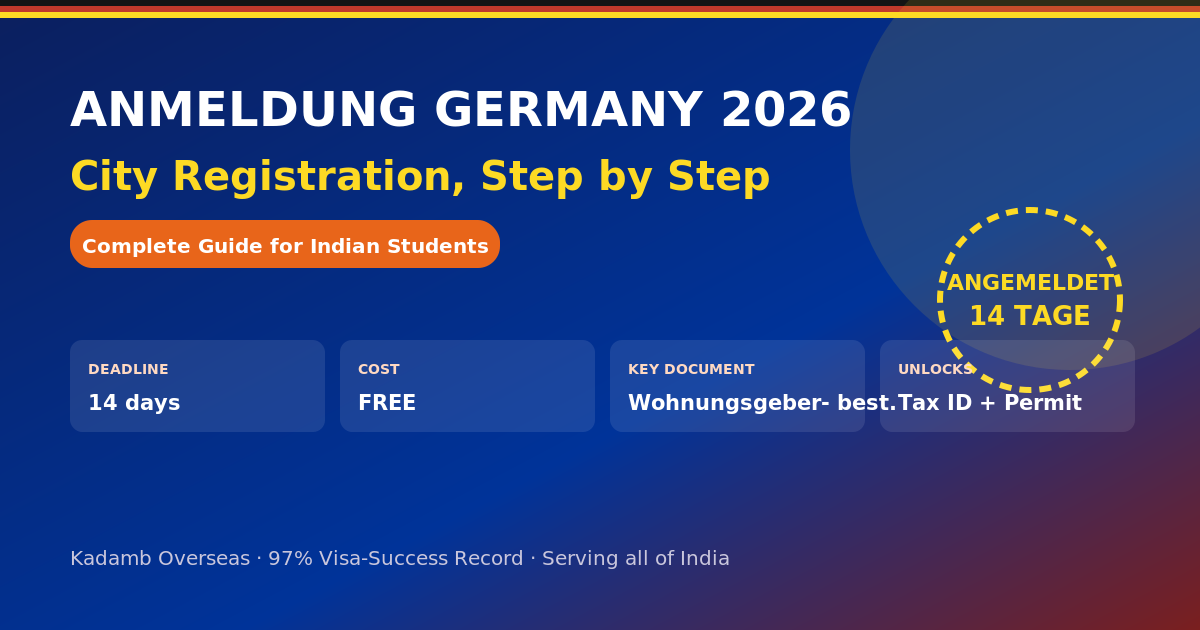
Quick answer: Anmeldung is Germany’s compulsory city registration. Every Indian student must register their address at the local Bürgeramt within 14 days of moving in, carrying a passport, the landlord’s confirmation letter (Wohnungsgeberbestätigung) and the registration form. It is free, takes about 10 minutes at the counter — and unlocks everything else: your tax ID, bank account, health-insurance activation, phone contract and residence permit all depend on it. In Berlin, Munich, Hamburg and Frankfurt, appointments book out 2–6 weeks ahead, so reserve a slot the day you have a confirmed address, even before you fly.
What exactly is Anmeldung, and why does everything depend on it?
Germany runs on a resident register: the state expects to know where every person lives. Anmeldung (“registration”) is the act of recording your address at the city’s citizens’ office — called Bürgeramt, Bürgerbüro or Kreisverwaltungsreferat (KVR) depending on the city. The certificate you receive, the Meldebescheinigung (or Anmeldebestätigung), is the master key of German bureaucracy. Without it you cannot receive your tax ID (steuerliche Identifikationsnummer) — which arrives automatically by post 1–3 weeks after registering — and without the tax ID you cannot be paid legally for a working-student job. Banks ask for it, your health insurer needs your registered address to send the eGK card, and the Ausländerbehörde will not issue your residence permit without it.
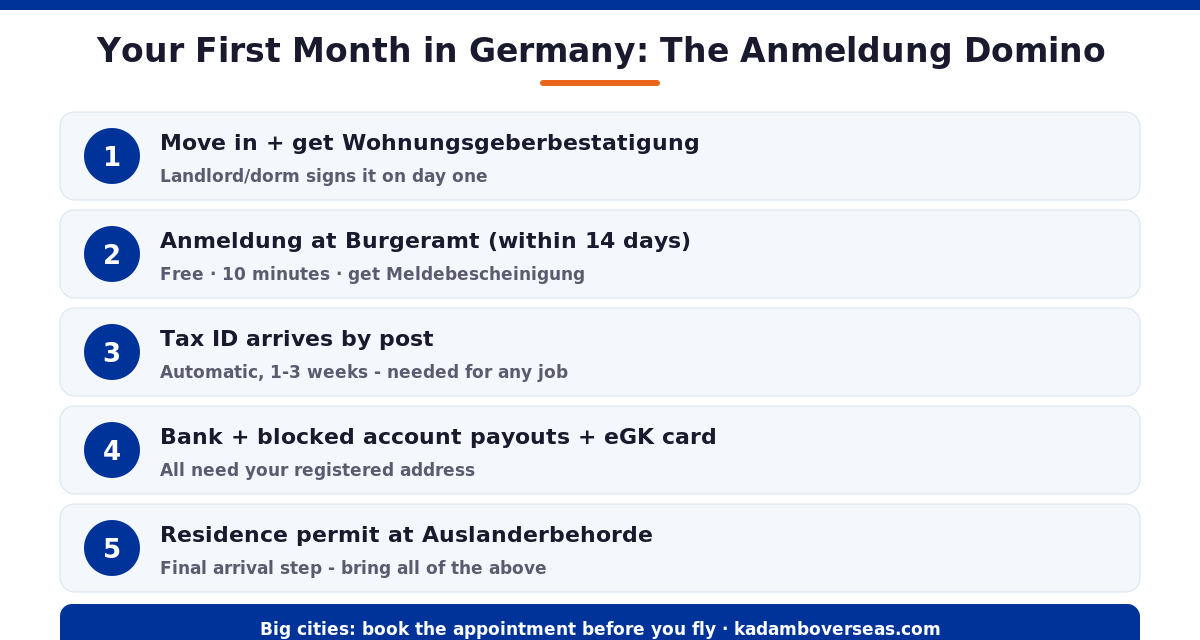
For students, the sequence in your first month in Germany is therefore fixed: move in → Anmeldung → tax ID arrives → bank account and blocked-account payout activation → residence permit appointment. Get step two wrong and every later step slips.
The 14-day rule (and what actually happens if you miss it)
The law requires registration within two weeks of moving into your accommodation — the clock starts at move-in, not at your flight’s landing. In practice, big-city appointment backlogs make the literal deadline impossible, and officials know it: booking an appointment within the 14 days is treated as compliance, even if the earliest slot is weeks away. Keep the booking confirmation email as proof. Fines (theoretically up to €1,000) are almost never applied to newcomers who can show they booked promptly — but chronic non-registration can surface painfully at visa-extension time.
Documents checklist
- Passport (with your entry visa).
- Wohnungsgeberbestätigung — the landlord’s confirmation of your move-in, a one-page form the landlord or dorm office must sign. A rental contract alone is not accepted. Student dorms and reputable providers hand it over routinely; ask for it on move-in day.
- Anmeldung form (Anmeldeformular) — download from the city website and fill it at home; Berlin and Munich provide English guidance.
- Marriage/birth certificates (apostilled) only if a spouse or children register with you.
No proof of enrolment, no photos, no fee — Anmeldung is free everywhere in Germany.
City by city: what to expect in 2026
Berlin: book at any Bürgeramt in the city (you are not tied to your district) through the central portal; slots vanish fast but cancellations appear every morning around 7–8 am. Berlin also runs a limited online Anmeldung service for standard cases with a BundID account — worth trying, though most first-time international registrations still end up in person.
Munich: everything goes through the KVR; lead times of 3–6 weeks are normal in October. Book the moment your dorm contract is signed — from India, before you fly.
Hamburg & Frankfurt: 2–4 weeks typical; both accept any district office.
University towns (Aachen, Erlangen, Magdeburg, Kaiserslautern …): usually walk-in or same-week appointments — one of the underrated perks of studying outside the big four.
At the counter, the visit itself is quick: documents checked, address entered, and the stamped Meldebescheinigung printed on the spot. German helps but is not required in the big cities; bring the filled form and the process rarely needs more than basic English.
Special situations Indian students actually face
Temporary accommodation first? Hostels and short Airbnb stays usually cannot issue a Wohnungsgeberbestätigung. If your first weeks are temporary, register as soon as you move into your real (semester) address — the 14-day clock runs from that move-in. Do not invent an address: registering somewhere you don’t live (Scheinanmeldung) is an offence for both you and the “landlord”.
Moving flats later? Every move requires a new Anmeldung (Ummeldung) within 14 days — same documents, same counter, still free. Your tax ID stays the same.
Moving cities? Register in the new city; the old registration is updated automatically. There is no separate deregistration when moving within Germany — Abmeldung is only needed when you leave the country for good.
Sharing a WG (flat-share)? The main tenant or the actual owner signs your Wohnungsgeberbestätigung. Confirm this is possible before paying a deposit — a room where the landlord refuses registration is useless for a student visa holder, and this is a classic scam pattern targeting internationals.
Appointment-hunting tactics that actually work
In the crowded cities, getting the slot is the real challenge, so borrow the tactics German locals use. Check the booking portal between 7:00 and 8:00 in the morning — most offices release cancellations and fresh same-week slots then, and persistence for two or three mornings almost always beats the official “next free date” shown weeks away. Select every office in the city, not just the nearest one: in Berlin and Hamburg you may register at any district office, and the outer districts often have slots days earlier. Book from India as soon as your accommodation contract is signed — nothing about booking requires you to be in Germany. If the portal shows nothing at all, some cities still accept walk-ins in the first hour of opening; arrive 30–45 minutes before the doors open with your paperwork complete. And if a genuine emergency looms (a residence-permit deadline, a job contract), write to the office citing the deadline — many keep emergency slots off the portal.
Leaving Germany? Don’t forget Abmeldung
The mirror process matters too: when you leave Germany permanently — after graduation, or transferring to another country — file an Abmeldung (deregistration) within two weeks of moving out. It can usually be done by post or online, and the confirmation is the document that lets you cancel health insurance, end phone and gym contracts, and stop the broadcast-fee (Rundfunkbeitrag) billing. Students who skip it routinely discover months of Rundfunkbeitrag debt collectors chasing their old address. Within Germany, though, remember: moving flats or cities needs only the new registration — never a separate deregistration.
After Anmeldung: the domino effect
Within days of registering, three things should happen almost automatically. Your tax ID letter arrives by post (1–3 weeks; needed for any part-time job). Your bank upgrades or opens your full current account — and your blocked account provider activates monthly payouts to it. And your health insurer mails the eGK card to your registered address — if you haven’t sorted insurance yet, our Germany health insurance guide (TK vs AOK vs Mawista) walks through it. With Meldebescheinigung, insurance certificate and enrolment letter in hand, you book the Ausländerbehörde appointment for the residence permit — the final step of arrival, all covered in our complete Study in Germany guide.
Frequently asked questions
What is Anmeldung in Germany and is it mandatory for students?
Anmeldung is the legal registration of your home address at the city’s Bürgeramt, mandatory for everyone living in Germany longer than three months — including every international student. It must be done within 14 days of moving into your accommodation and is free of charge.
What documents do I need for Anmeldung in Germany in 2026?
Three things: your passport, the signed Wohnungsgeberbestätigung from your landlord or dorm office, and the completed registration form. A rental contract alone is not sufficient — the landlord confirmation letter is the document offices insist on.
What happens if I miss the 14-day Anmeldung deadline?
If you booked an appointment within the 14 days, you are treated as compliant even when the slot itself is weeks later — keep the booking confirmation. Genuine long delays risk a fine (up to €1,000 in theory, rare in practice for newcomers) and can complicate your residence-permit application.
Can I do Anmeldung online in Germany?
Mostly no. As of 2026, registration remains an in-person appointment in nearly all cities; Berlin and some Bavarian municipalities offer limited online registration via a BundID account for standard cases. Book the in-person slot as your default plan.
Can I register with an Airbnb or hostel address?
Usually not — short-stay hosts typically cannot issue the Wohnungsgeberbestätigung. Wait until you move into your semester accommodation and register that address within 14 days of moving in. Never register an address you don’t actually live at.
How long does it take to get the tax ID after Anmeldung?
The tax identification number is generated automatically and arrives by post within one to three weeks of registration. You need it before your first working-student paycheck, so register promptly if you plan to work.
Land in Germany with every step already planned
Kadamb Overseas prepares students from every state of India for the full arrival sequence — accommodation with registration guarantee, Anmeldung booking, blocked account, insurance and residence permit — backed by a 97% visa-success record.
Saumitra Rajput
Saumitra Rajput is the founder of Kadamb Overseas Pvt. Ltd., India's leading Europe-focused study abroad consultancy based in Ahmedabad. With 14+ years of expertise in European education, he has personally counselled 2,500+ Indian families and helped 500+ students secure admission to top European universities including TU Munich, ETH Zurich, EPFL, KU Leuven, HEC Paris, Sapienza Rome, TU Wien, and Warsaw University of Technology. He has visited 25+ European universities, partners with 250+ EU institutions, and maintains a 500+ students placed.
Planning to Study Abroad?
Get free expert guidance from our experienced counselors

Saumitra Rajput
Saumitra Rajput is the founder and lead counsellor at Kadamb Overseas, India's trusted Europe education consultancy based in Ahmedabad. With 14+ years of hands-on experience, he has personally guided 500+ students to universities across Germany, Switzerland, France, Italy, Austria, and Spain. Saumitra has visited partner universities across Europe, holds deep expertise in European visa processes, scholarships, and student life, and has achieved a 97% visa success rate for his clients. He is the host of the YouTube channel "Europe with Saumitra", where he shares first-hand insights on studying and living in Europe. His mission: make Europe accessible to every Indian student, with zero consultancy fees.