Table of Contents
- Before day 1: know your legal runway
- Days 1–14: build the German-standard toolkit
- Days 15–45: the application engine
- Days 45–90: interviews, offers, conversion
- The parallel tracks that double your odds
- Where the jobs actually are in 2026
- Five mistakes that stretch a 90-day search into a year
- Frequently asked questions
🕑 7 min read
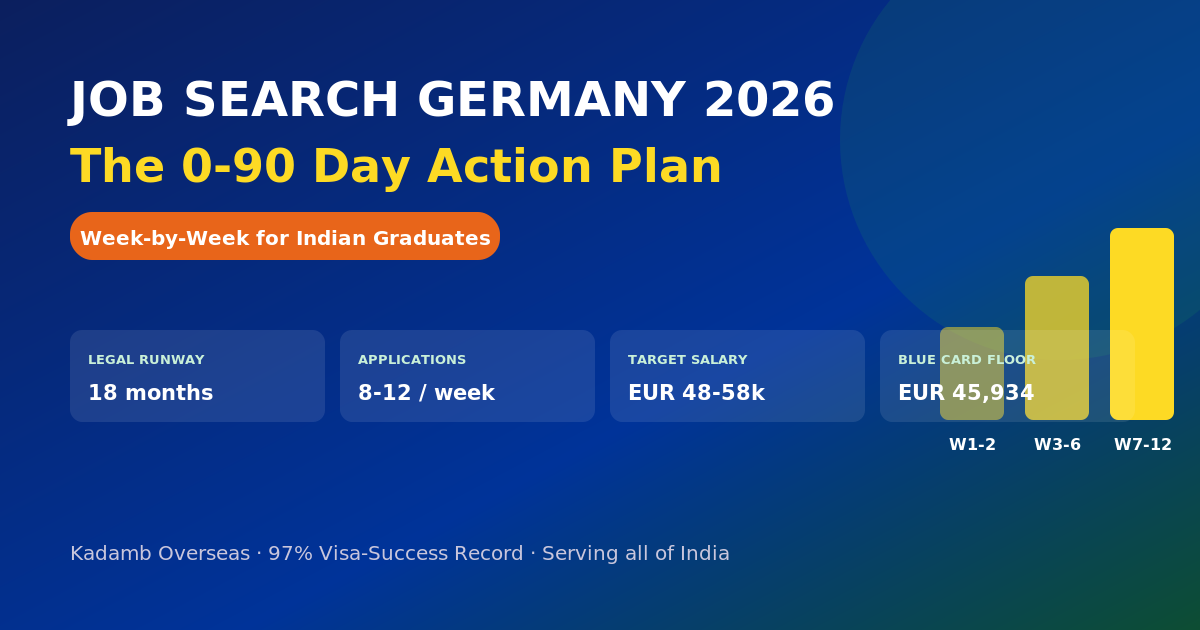
Quick answer: Most Indian graduates who land a job in Germany do it in 3–6 months — and the ones who do it in 90 days follow the same pattern: a German-format CV (Lebenslauf) ready in week 1, 30–40 tailored applications by week 6 through LinkedIn, StepStone, Indeed.de and Xing, interview pipelines running by week 8, and relentless follow-up. You have time on your side: Germany’s 18-month post-study job-seeker permit, or the Opportunity Card if you arrive without a degree from Germany, both let you work part-time (20 h/week) while you search. Here is the week-by-week plan we give our students — the same one that converts a fresh master’s degree into an EU Blue Card offer above €45,934.
Before day 1: know your legal runway
Your search strategy depends on your permit. Graduates of German universities get an 18-month residence permit to find a qualifying job — ample time, but treat it as 6 months of focused searching, not 18 of drifting. Opportunity Card holders get 12 months, extendable in some cases, with 20 h/week work rights. Both convert to an EU Blue Card the day you sign a contract above the threshold (€45,934.20 for recent graduates and shortage occupations in 2026) — and the PR clock starts immediately. Knowing this arithmetic keeps panic away and negotiation power in your hands.
Days 1–14: build the German-standard toolkit
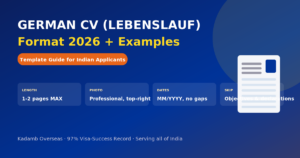
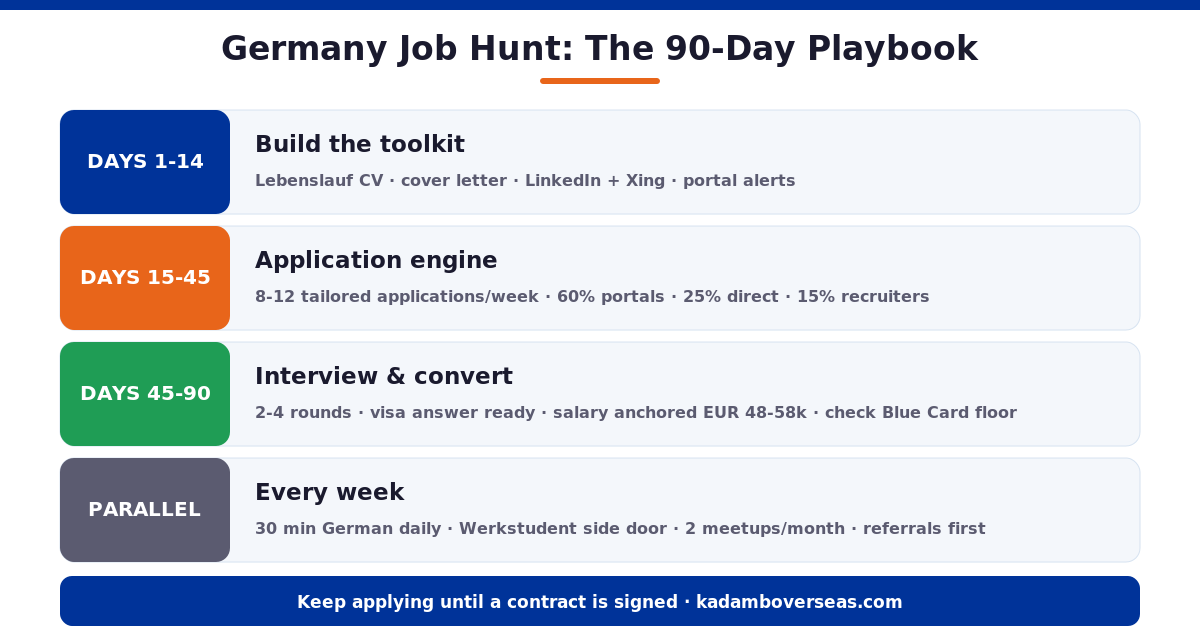
Week 1 — documents. Convert your CV to the German Lebenslauf format: 1–2 pages, reverse-chronological, a professional photo (still customary in Germany), personal details block, precise dates with no unexplained gaps, and skills quantified (“built ETL pipeline processing 2M records/day”, not “worked on data”). Write one master Anschreiben (cover letter) you can tailor in 15 minutes per role. Get transcripts, degree certificate and (for regulated roles) recognition documents scanned into a single clean PDF portfolio.
Week 2 — profiles. LinkedIn: headline with target role + key stack + location (“Data Engineer | Python · Spark · Azure | Munich”), the green “Open to Work” for recruiters, and a summary that names your visa status honestly (“18-month German job-seeker permit — no sponsorship required for Blue Card conversion” is a genuine advantage; say it). Create a Xing profile — still used by German Mittelstand recruiters. Register on StepStone and Indeed.de with saved alerts.
Days 15–45: the application engine
This is a volume-plus-precision game. Target 8–12 tailored applications per week — enough for statistical traction, few enough to customise each one. Split your pipeline three ways: 60% job portals (StepStone, LinkedIn Jobs, Indeed.de, plus niche boards — Honeypot and Wemakeit for developers, MotionRecruitment-style engineering boards, Stellenwerk for working-student roles), 25% direct company pages (DAX firms, hidden-champion Mittelstand in your field — these get a fraction of the applications the portals do), and 15% recruiters (Hays, Michael Page, Academic Work; German recruiters are transactional — a crisp profile email works).
Track everything in a simple sheet: company, role, date, contact, status, follow-up date. Follow up politely after 10–14 days — in Germany this reads as professional, not pushy. And apply to jobs asking for German even if yours is A2–B1: for developer, data and research roles, hundreds of teams work in English, and “German: learning, currently B1 course” on a CV keeps you in the pile.
Days 45–90: interviews, offers, conversion
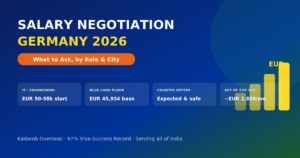
German interview processes run 2–4 rounds over 3–6 weeks: recruiter screen, technical/case round, team fit, sometimes a paid trial task. Prepare the three questions every Indian candidate gets: your visa situation (answer in one sentence: “I hold an 18-month job-seeker permit; hiring me needs no sponsorship — my Blue Card converts within weeks”), your German level (honest + trajectory), and salary expectation (research a range on StepStone’s salary tool and Kununu; for master’s-level engineering and IT starts, €48,000–58,000 is the realistic 2026 corridor — anchor near the top with evidence, and remember the €45,934 Blue Card floor). When the offer comes, check the base salary clears the Blue Card bar before signing; bonuses don’t count toward the threshold.
The parallel tracks that double your odds
German, 30 minutes daily. B1 unlocks the Mittelstand — the thousands of world-class mid-size firms that dominate German employment and see far fewer international applicants than Berlin startups. It is the single highest-return investment of your search.
Werkstudent and internship side door. If you are still enrolled, a working-student job in your field is the strongest pipeline into a full-time offer — German employers overwhelmingly convert people they already know. Even during the job-seeker period, a part-time role in your domain keeps skills warm, pays rent and often becomes the offer itself.
Meetups and career fairs. Tech meetups in Berlin/Munich/Hamburg, university career fairs, and the big ones (connecticum, IKOM) put you in front of hiring managers without an ATS in between. Two events a month is plenty.
Referrals. Every application to a company where any acquaintance works should go through a referral request first — referred CVs get read at multiples of the portal rate.
Where the jobs actually are in 2026
Aim your search where German demand is deepest. IT and data remain the widest funnel — software engineering, data engineering, cloud/DevOps, SAP, cybersecurity and, fastest-growing of all, ML/AI roles (if you are still choosing a program, our top 20 AI/ML master’s guide maps degrees to exactly these jobs). Engineering demand clusters in automotive transformation (EV, battery, software-defined vehicles) around Stuttgart and Munich, machine building across Baden-Württemberg and Bavaria, and renewables in the north. Healthcare and life sciences hire continuously, from pharma in the Rhine region to biotech in Munich and Heidelberg. Geographically, don’t stop at Berlin: Munich and Stuttgart pay the most, Hamburg and Frankfurt balance salary and rent, and the eastern hubs — Dresden (chips), Leipzig, Jena (optics) — combine genuine demand with the country’s lowest living costs. A €50,000 offer in Dresden leaves more in your pocket than €58,000 in Munich. One more filter worth applying: check each employer’s history of hiring internationals — a quick LinkedIn search of current employees tells you in two minutes whether a company already runs English-speaking teams and handles Blue Card paperwork routinely, which makes every later step faster and safer.
Five mistakes that stretch a 90-day search into a year
1. The un-German CV. A 4-page Indian-style resume with paragraphs of duties gets filtered instantly. One to two pages, dates exact, achievements quantified.
2. Spraying identical applications. 200 copy-paste applications lose to 40 tailored ones every time; German HR notices the generic Anschreiben in seconds.
3. Hiding the visa question. Evasiveness reads as risk. State your permit and the no-sponsorship reality upfront — it is a selling point.
4. Ignoring the Mittelsand and smaller cities. Everyone applies in Berlin. Salaries in Stuttgart, Nürnberg, Dresden or Leipzig stretch further and competition is thinner.
5. Stopping the search during interviews. Pipelines collapse; keep applying until a contract is signed. A second offer is also your only real negotiation lever.
Frequently asked questions
How long does it take an Indian graduate to find a job in Germany?
Typically 3–6 months of active searching; disciplined candidates in IT, data and engineering regularly sign within 90 days. The 18-month post-study permit gives ample legal runway, but treating the search as a full-time project from day one is what compresses the timeline.
Can I get a job in Germany without speaking German?
Yes — in software, data, research and many engineering teams English is the working language, especially in Berlin, Munich and Hamburg. But B1 German roughly doubles your addressable market by unlocking mid-size German-speaking employers, so keep learning while you apply.
Which job portals work best in Germany in 2026?
StepStone, LinkedIn Jobs and Indeed.de carry the bulk of professional roles; Xing still matters for German Mittelstand recruiters; Honeypot (reverse marketplace) works well for developers; Stellenwerk and university boards for working-student roles. Company career pages remain the least crowded channel.
What salary should a fresh master’s graduate expect in Germany?
For engineering, IT and data roles, €48,000–58,000 gross per year is the realistic 2026 starting corridor (higher in Munich/Stuttgart, lower in the east). Crucially, anything above €45,934 base lets a recent graduate convert straight to an EU Blue Card.
Can I work while searching for a job in Germany?
Yes. Both the 18-month post-study permit and the Opportunity Card allow part-time work up to 20 hours per week, and enrolled students may work 20 h/week as Werkstudenten. Part-time roles in your own field frequently convert into the full-time offer.
What happens if I don’t find a job within 18 months?
You can switch to another permit you qualify for (further study, Opportunity Card in some cases) or leave and reapply later — time already spent in Germany still counts toward future settlement in several scenarios. In practice, candidates who follow a structured search rarely reach that point; the failure mode is an unstructured search, not a lack of jobs.
Turn your German degree into a German paycheck
Kadamb Overseas supports students from Mumbai, Delhi, Bengaluru, Hyderabad, Pune, Ahmedabad and all of India beyond admission — CV conversion, application strategy and Blue Card planning — with a 97% visa-success record behind every file.
Saumitra Rajput
Saumitra Rajput is the founder of Kadamb Overseas Pvt. Ltd., India's leading Europe-focused study abroad consultancy based in Ahmedabad. With 14+ years of expertise in European education, he has personally counselled 2,500+ Indian families and helped 500+ students secure admission to top European universities including TU Munich, ETH Zurich, EPFL, KU Leuven, HEC Paris, Sapienza Rome, TU Wien, and Warsaw University of Technology. He has visited 25+ European universities, partners with 250+ EU institutions, and maintains a 500+ students placed.
Planning to Study Abroad?
Get free expert guidance from our experienced counselors

Saumitra Rajput
Saumitra Rajput is the founder and lead counsellor at Kadamb Overseas, India's trusted Europe education consultancy based in Ahmedabad. With 14+ years of hands-on experience, he has personally guided 500+ students to universities across Germany, Switzerland, France, Italy, Austria, and Spain. Saumitra has visited partner universities across Europe, holds deep expertise in European visa processes, scholarships, and student life, and has achieved a 97% visa success rate for his clients. He is the host of the YouTube channel "Europe with Saumitra", where he shares first-hand insights on studying and living in Europe. His mission: make Europe accessible to every Indian student, with zero consultancy fees.