

Table of Contents
- First: decode your refusal letter properly
- Germany after July 2025: reapply smart, or go to court
- France: the CRRV recourse, step by step
- Italy: TAR appeal within 60 days
- The reapplication playbook (all three countries)
- When is a lawyer genuinely worth it?
- Sample reapplication cover letter (adapt, don’t copy)
- Frequently asked questions
🕑 7 min read
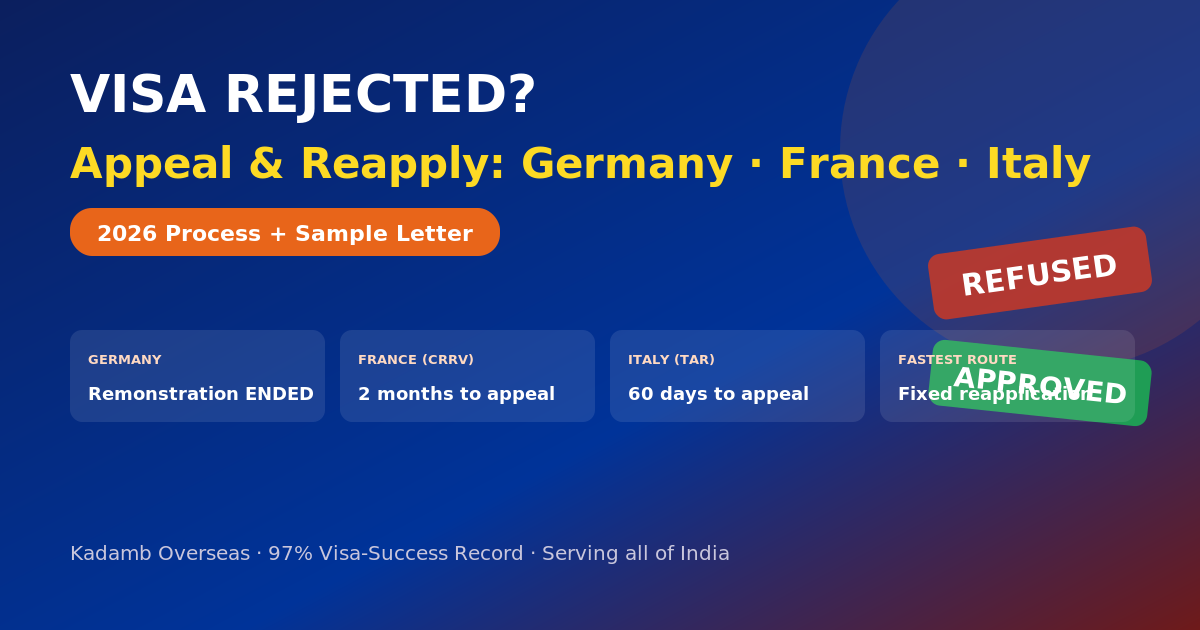
Quick answer: The rules changed. Since 1 July 2025, Germany has abolished the remonstration (administrative appeal) procedure worldwide — a rejected German visa can now only be challenged in court (a 1–2 year judicial process) or, far more practically, fixed through a corrected reapplication, which has no waiting period. France still runs a true appeal: a written recourse to the CRRV in Nantes within 2 months (mandatory before any court case). Italy allows a judicial appeal to the TAR (regional administrative court) within 60 days. For most Indian students, the fastest route back to a visa in all three countries is the same: decode the exact refusal ground, repair the file, and reapply stronger — typically within 4–8 weeks.
First: decode your refusal letter properly
Every refusal letter names a legal ground, and your entire strategy follows from it. The recurring ones for Indian applicants: purpose of stay not credible (inconsistent SOP, weak course logic, shaky interview answers — the ground behind most student refusals), insufficient or unverifiable funds (blocked account short, unexplained deposits, sponsor documents that don’t add up), doubts about intention to return / comply (short-stay classics), fraudulent or inconsistent documents (the most serious — get professional help before doing anything), and inadequate insurance or accommodation proof (the easy fixes). Read the letter twice, list every cited article, and be brutally honest about which weakness in your file triggered it — the repair has to address the actual ground, not the one that feels least embarrassing.
Germany after July 2025: reapply smart, or go to court
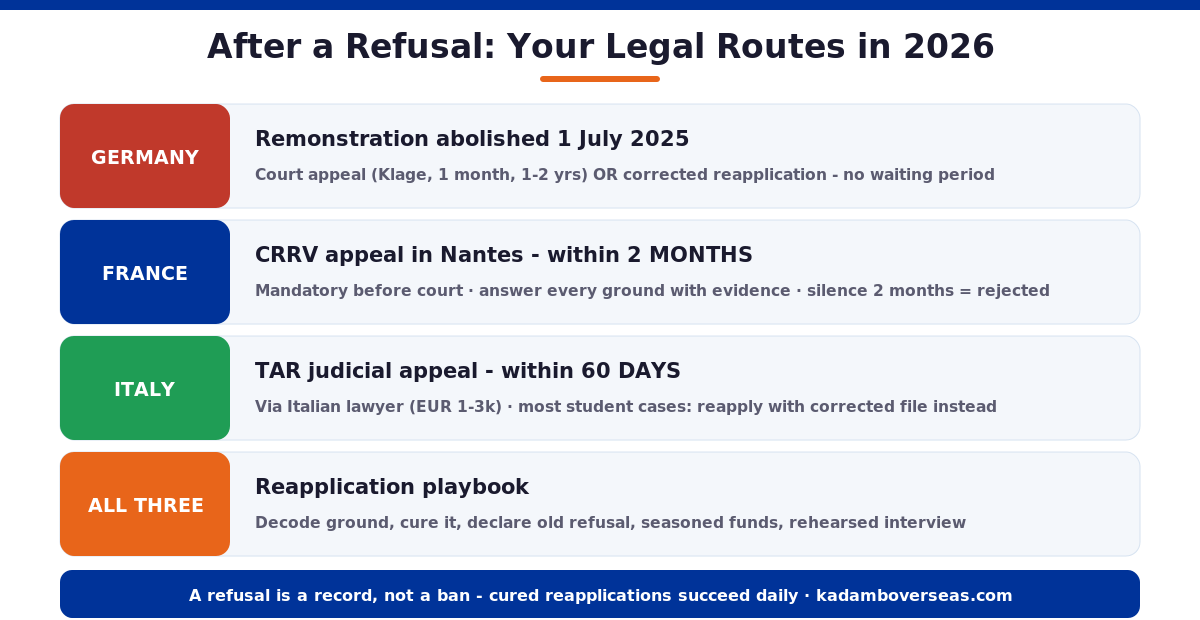
Until mid-2025, roughly 40% of German refusals were reversed through the free remonstration letter. That path is gone: the Federal Foreign Office scrapped remonstration for both Schengen and national visas worldwide from 1 July 2025. What remains:
- Reapplication (the practical route): permitted immediately, no cooling-off period. A reapplication is not a re-roll of the dice — it must visibly cure the refusal ground: a fresh SOP that closes the credibility gap, a properly seasoned bank trail or corrected blocked account, an admission letter matching your academic story, and interview answers rehearsed against our 50-question bank. Expect the officer to have your previous file open on screen — consistency between attempts is itself being tested.
- Judicial appeal (Klage): filed at the Administrative Court in Berlin within one month of refusal, realistically through a German lawyer (€1,500–5,000+), taking one to two years. It makes sense only where reapplication cannot help — e.g., an (incorrect) finding of document fraud that will poison every future file, or a legal error worth fighting on principle.
For a student racing an intake deadline, the arithmetic is one-sided: a strong reapplication decided in weeks beats a court date in 2028.
France: the CRRV recourse, step by step
France kept its administrative appeal. After a refusal (including the deemed refusal when 2 months pass in silence), you may file a recours gracieux with the consulate itself and/or — the one that matters legally — a written appeal to the Commission de Recours contre les Refus de Visa (CRRV) in Nantes, within 2 months of the refusal. The CRRV appeal is mandatory before any court challenge at the Nantes administrative tribunal. Write it in French where possible: facts only — refusal date and reference, each cited ground answered with documentary evidence (enclose copies), and the request to reconsider. The CRRV can recommend the visa be granted or reject the appeal (silence for 2 months = rejection); serious student cases with genuine Campus France validation and solid funding do get reversed here. Run the reapplication track in parallel — nothing forbids it, and whichever succeeds first wins (our Study in France guide covers the full application stack).
Italy: TAR appeal within 60 days
Italy has no consular-level appeal commission; the formal route is a judicial appeal to the TAR (Tribunale Amministrativo Regionale — for visa matters, TAR Lazio in Rome) within 60 days of notification, through an Italian lawyer (€1,000–3,000 typical for student matters). Student-visa refusals tied to funds or documentation are usually faster to fix by reapplying with a corrected file at the same consulate — Italian consulates in India routinely approve reapplications that cure a specific defect (DOV/CIMEA declarations in order, Uni-Italia pre-enrolment consistent, funds documented per the published minimums). Reserve the TAR for refusals alleging misrepresentation or where a scholarship (regional DSU) deadline collapses without this exact intake.
The reapplication playbook (all three countries)
1. Map ground → fix. One-line table for yourself: each refusal ground, the exact document or narrative that cures it.
2. Rebuild the money story. Funds must be sufficient, seasoned (no fresh lump sums without paper trails), and internally consistent across ITRs, bank letters and sponsorship affidavits.
3. Rewrite, don’t recycle, the SOP. Address the doubt head-on: why this course, why this country, why now, and what changed since the refusal. Never pretend the refusal didn’t happen.
4. Declare the previous refusal honestly. Every form asks; a concealed refusal converts a fixable file into a misrepresentation case.
5. Rehearse the interview against your own file. After a refusal, expect sharper questions on precisely the failed ground.
6. Time it. Reapply only when the cure is complete — a rushed second refusal is twice as hard to explain as one.
When is a lawyer genuinely worth it?
Three situations justify legal spend. First, any refusal alleging false or fraudulent documents — that finding follows you across Schengen systems, and clearing it properly matters more than this year’s intake. Second, Germany when reapplication is structurally impossible: the refusal rests on a legal interpretation (say, of your degree’s recognisability) that no new document can change — only a court can. Third, a deadline-critical scholarship or admission where the French CRRV or Italian TAR route runs in parallel as insurance while you reapply. Outside these, money spent on litigation is usually better spent on the file itself: a professional review typically finds the fixable defect within an hour, and the corrected reapplication is decided in weeks, not years.
Sample reapplication cover letter (adapt, don’t copy)
Subject: Reapplication for a national (study) visa — previous application ref. [number], refused [date]
Dear Sir or Madam,
I respectfully resubmit my application for a student visa for [program] at [university], following the refusal of [date] on the ground of [cited ground]. I have addressed this as follows: [one to three numbered points — e.g., “1. My blocked account with [provider] now shows the full €11,904, funded on [date] from my father’s fixed deposit maturing on [date] (statements enclosed).”]. All previously submitted information remains accurate, and I have declared the earlier refusal in the application form. I would be grateful for a fresh assessment of the enclosed, corrected file.
Yours faithfully, [Name, passport number]
Three sentences of substance beat three pages of appeal rhetoric. Officers reward files that make their decision easy.
Frequently asked questions
Can I still file a remonstrance against a German visa rejection?
No — Germany abolished the remonstration procedure worldwide on 1 July 2025 (only refusals dated before 30 June 2025 could still use it). Your options now are a judicial appeal at the Berlin Administrative Court within one month, or an immediate corrected reapplication — which is the practical choice for almost all students.
How soon can I reapply after a Schengen or student visa rejection?
Immediately — Germany, France and Italy impose no waiting period. What matters is not speed but that the new file visibly cures the refusal ground; an unchanged reapplication invites an identical refusal and weakens future files.
How do I appeal a French visa refusal?
File a written appeal with the CRRV (Commission de Recours contre les Refus de Visa) in Nantes within 2 months of the refusal — this step is mandatory before any court challenge. Address every cited ground with enclosed evidence; silence from the CRRV for 2 months counts as rejection, after which the Nantes administrative tribunal is the next step.
What is the time limit to appeal an Italian visa refusal?
60 days from notification, by judicial appeal to the TAR (for visas, TAR Lazio in Rome) through an Italian lawyer. For most student refusals over funds or paperwork, a corrected reapplication at the consulate resolves the matter faster and cheaper.
Does a visa rejection affect my future applications?
A refusal is recorded but is not a ban. Declared honestly and paired with a corrected file, it has little lasting effect — consulates see cured reapplications succeed every day. What causes lasting damage is concealing a refusal or submitting inconsistent documents across attempts.
Should I hire a lawyer to appeal a visa rejection?
For judicial routes (German Klage, Italian TAR), yes — they are formal court proceedings. For reapplications and the French CRRV letter, a lawyer is optional; what you need is a rigorous file review that finds the real weakness. That review is exactly what a good counsellor does before you spend on litigation.
Refused once? Make the second file bulletproof
Kadamb Overseas runs forensic file reviews and rebuilt reapplications for students from Mumbai, Delhi, Bengaluru, Hyderabad, Pune, Ahmedabad and all of India — the discipline behind our 97% visa-success record.
Saumitra Rajput
Saumitra Rajput is the founder of Kadamb Overseas Pvt. Ltd., India's leading Europe-focused study abroad consultancy based in Ahmedabad. With 14+ years of expertise in European education, he has personally counselled 2,500+ Indian families and helped 500+ students secure admission to top European universities including TU Munich, ETH Zurich, EPFL, KU Leuven, HEC Paris, Sapienza Rome, TU Wien, and Warsaw University of Technology. He has visited 25+ European universities, partners with 250+ EU institutions, and maintains a 500+ students placed.
Planning to Study Abroad?
Get free expert guidance from our experienced counselors

Saumitra Rajput
Saumitra Rajput is the founder and lead counsellor at Kadamb Overseas, India's trusted Europe education consultancy based in Ahmedabad. With 14+ years of hands-on experience, he has personally guided 500+ students to universities across Germany, Switzerland, France, Italy, Austria, and Spain. Saumitra has visited partner universities across Europe, holds deep expertise in European visa processes, scholarships, and student life, and has achieved a 97% visa success rate for his clients. He is the host of the YouTube channel "Europe with Saumitra", where he shares first-hand insights on studying and living in Europe. His mission: make Europe accessible to every Indian student, with zero consultancy fees.
Related Articles
- Education Loan Process for Abroad Study: Guide 2026
- Gap Year Before Studying in France – Impact on Admission & Visa
- MBA in Europe Salary and Job Prospects for Indian Students 2026
- Master in Sustainable Development at University of Basel
- Scholarships & Financial Aid for International Students – Luxembourg