
Table of Contents
- Is it too late to study in Europe after 10+ years of work experience?
- What are your study options in Europe at 10+ years of experience?
- Which European business schools should you shortlist?
- How much does an Executive MBA in Europe cost in rupees?
- What do EMBA admissions teams look for from senior candidates?
- Do you need a visa for a modular Executive MBA?
- Which mistakes should senior applicants avoid?
- How do you decide: EMBA, Executive MSc or a full-time MBA?
- How do you make the business case for employer sponsorship?
- What does a 12-month preparation timeline look like?
- Frequently asked questions
🕑 7 min read
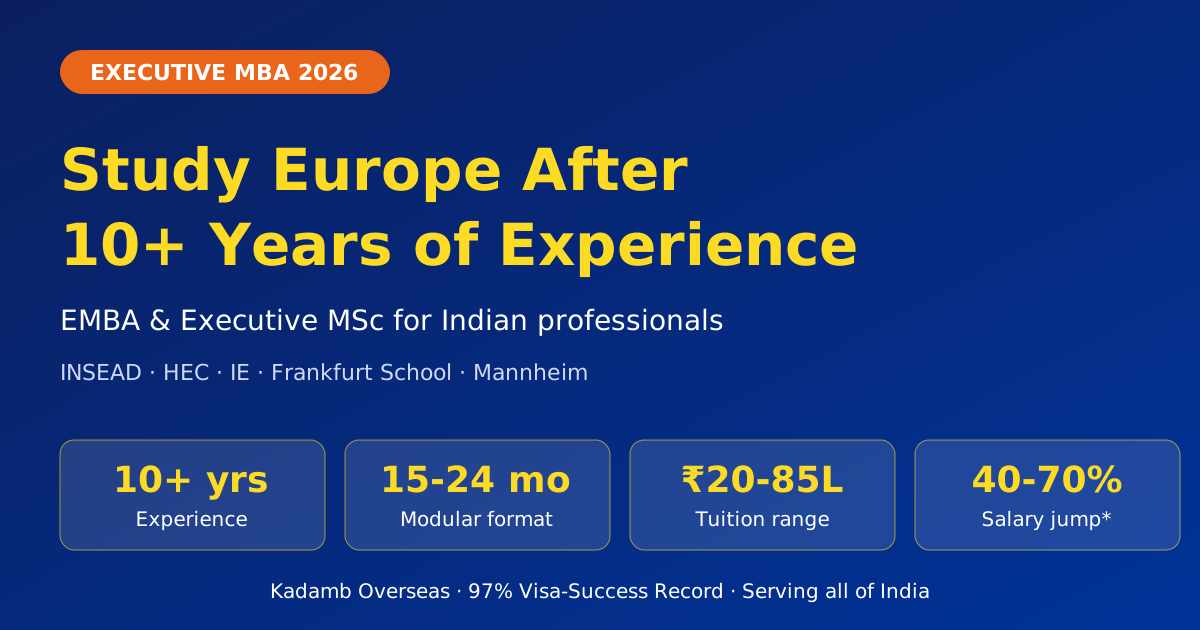
Quick answer: Yes, Indian professionals with 10+ years of experience can study in Europe through an Executive MBA (EMBA) or Executive MSc. Most programmes run 15-24 months in weekend or modular format, so you keep your job. Tuition typically ranges from about ₹20 lakh to ₹85 lakh (approx. €20,000-€85,000). Top names include INSEAD, HEC Paris, IE Business School, Frankfurt School and Mannheim Business School. School-reported salary jumps of 40-70% are common claims, but you should verify them on each official page.
Is it too late to study in Europe after 10+ years of work experience?
No. In fact, a decade of experience is exactly what executive programmes look for. Admissions teams at EMBA level care less about your undergraduate marks and more about your leadership scope: team size, budget ownership, P&L responsibility and the quality of your references. A 33-year-old with 10 years in operations, IT delivery, banking or pharma can be a stronger candidate than a 27-year-old with a perfect GPA.
The mistake most senior professionals make is applying to a one-year full-time MS designed for fresh graduates. These programmes assume you will pause your career and restart at entry level. For a mid-career manager, that is rarely the right trade. The executive formats exist so that you can add a European credential and network without giving up your salary.
What are your study options in Europe at 10+ years of experience?
There are three realistic routes, and each solves a different problem.
| Route | Duration | Format | Best for |
|---|---|---|---|
| Executive MBA (EMBA) | 15-24 months | Weekend / modular, work continues | Moving into general management or a bigger P&L role |
| Executive MSc (finance, analytics, leadership) | 12-24 months | Part-time or block weeks | Deepening a specialism without a full MBA |
| Full-time one-year MBA | 10-12 months | On campus, career break | Switching country, industry or function completely |
If your goal is promotion within your current Indian employer, the EMBA is usually the most efficient choice. If you want to relocate to Europe, a full-time programme is more realistic, because modular students typically stay based in India. Our Germany study guide and France study guide explain the full-time pathways in those two countries.
Which European business schools should you shortlist?
The table below is a starting point, not a ranking. Fees and formats change every intake, so treat every figure as approximate and confirm on the official page.
| School | Country | Typical format | Approx. fee range |
|---|---|---|---|
| INSEAD (Global EMBA) | France / Singapore / UAE | Modular, around 14-17 months | Among the highest; verify on official page |
| HEC Paris (Executive MBA) | France | Part-time, around 16 months | Approx. €70,000+; verify |
| IE Business School (Global EMBA) | Spain | Blended online + on campus | Approx. €70,000-€90,000; verify |
| Frankfurt School (EMBA) | Germany | Part-time modular | Approx. €40,000-€60,000; verify |
| Mannheim Business School (EMBA) | Germany | Part-time modular | Approx. €40,000-€60,000; verify |
Note the pattern: French and Spanish flagship programmes are priced at the top end, while German public-adjacent schools are often more moderate. Within your budget, rank schools on three things only: alumni strength in your target industry, module location (can you realistically travel?), and employer sponsorship rules.
How much does an Executive MBA in Europe cost in rupees?
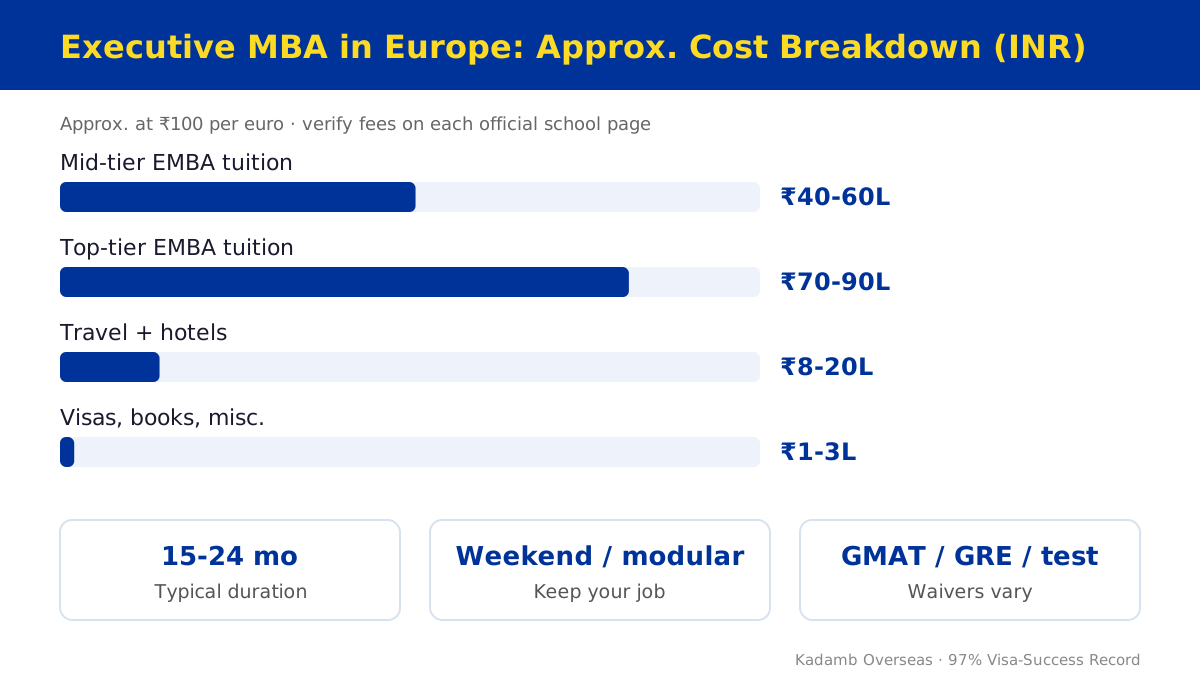
Tuition is only part of the bill. A realistic budget includes tuition, flights for every module, hotels for 5-7 night blocks, Schengen visa fees, textbooks, and an international residency week. At approx. ₹100 per euro, the ranges look like this:
| Budget item | Approx. EUR | Approx. INR |
|---|---|---|
| Tuition (mid-tier EMBA) | €40,000-€60,000 | ₹40-60 lakh |
| Tuition (top-tier EMBA) | €70,000-€90,000 | ₹70-90 lakh |
| Travel and hotels across modules | €8,000-€20,000 | ₹8-20 lakh |
| Visas, books, misc. | €1,000-€3,000 | ₹1-3 lakh |
Because most students keep earning, the true cost is net of salary, not gross of it. Also ask whether your employer will sponsor part of the fee. Many Indian MNCs do, in exchange for a 1-2 year retention bond.
What do EMBA admissions teams look for from senior candidates?
Expect a structured file: updated CV, two or three essays, recommendation letters, an interview, and in many cases a GMAT, GRE or school-specific assessment. Some schools waive the test for strong profiles, but that is school-specific. Your profile should demonstrate:
Leadership scope. Number of direct and indirect reports, budget size, geographies covered. Clear purpose. A one-line answer to “why this EMBA, why now, why Europe”. Strong references. A current or former manager who can speak specifically about your impact. Employer support. Letters of release for travel weeks show that you can finish the programme.
Do you need a visa for a modular Executive MBA?
It depends on how each stay is structured. Short modules of a week or two are normally attended on a Schengen short-stay visa, which means your documents are closer to a business visit than a student application: enrolment letter, employer leave letter, bank statements, travel insurance and a clear itinerary. Full-time one-year programmes need a long-stay national student visa and, in Germany, proof of funds such as a blocked account; see our Germany blocked account guide. Prepare for the consular interview using our Schengen visa interview questions guide.
Which mistakes should senior applicants avoid?
Choosing on brand alone. A top-3 name with modules in Singapore, Paris and San Francisco may be impossible to attend if your leave is limited. Underestimating total cost. Travel and hotels can add 20-30% to the fee. Skipping the employer conversation. Without sponsorship or leave approval, even an admit becomes a burden. Writing generic essays. Recycled “I want to grow” essays fail; use specific results, numbers and a post-EMBA plan. Assuming an EMBA gives you a European work permit. It generally does not; relocation needs its own route such as the EU Blue Card (see our EU Blue Card salary thresholds guide).
How do you decide: EMBA, Executive MSc or a full-time MBA?
Ask three questions. First, do I want to leave India? If yes, lean towards full-time. Second, can my employer or my savings carry 15-24 months of travel? If yes, the EMBA works. Third, do I need a general-management credential or a specialist one? Choose the MBA for the first, the Executive MSc for the second. If you are still unsure, shortlist two programmes per route and compare total cost, travel load and alumni outcomes side by side before applying.
How do you make the business case for employer sponsorship?
Sponsorship is often the difference between an EMBA being affordable and being a stretch. Frame the request around business value, not personal growth. Quantify what you will bring back: the projects you will lead, the new markets you will understand, and the cross-border network you will add. Offer a retention commitment, propose a split of fees, and show how you will protect delivery during travel weeks. HR teams respond to a one-page proposal with numbers, not to a verbal request.
What does a 12-month preparation timeline look like?
| Months before intake | What to do |
|---|---|
| 12-9 | Shortlist 4-6 schools, attend online info sessions, speak to alumni in your industry |
| 9-6 | Take GMAT, GRE or the school assessment if required; draft your leadership story |
| 6-4 | Request references, finalise essays, secure employer support letter |
| 4-2 | Submit applications, prepare for interviews, confirm fee and travel budget |
| 2-0 | Pay deposit, plan leave calendar, apply for the correct visa for each module |
Starting early matters because the strongest schools run rolling admissions and fill seats in earlier rounds. A late application with a rushed essay is the most common reason otherwise strong candidates are rejected.
Frequently asked questions
Is an Executive MBA in Europe worth it after 10+ years of experience?
It is worth it if you have hit a real ceiling, such as a move into general management, a function or industry switch, or an international posting. Reported salary uplifts after top European programmes are often quoted at 40-70%, but these are school-reported averages and vary widely. Do the maths on total cost (fees plus travel plus lost income) before you commit.
Can I keep working while doing a European Executive MBA?
Yes. That is the entire design of the format: weekend, block-week or modular teaching, usually spread over 15-24 months. Most students stay with their Indian employer and fly in for sessions, so you typically need your employer to approve the time off and, ideally, to sponsor part of the fees.
Do I need a student visa for a modular Executive MBA?
It depends on the school and how long each stay is. Many modules are short (about a week) and are attended on a Schengen short-stay visa, while full-time one-year programmes require a long-stay national student visa. Confirm the exact visa category with your school and the consulate before booking anything.
Do Executive MBA programmes require GMAT or GRE?
Policies differ. Several schools accept the GMAT, GRE or their own assessment, and some waive the test for candidates with strong seniority and track record. Always check the current admissions page of each school, because waiver rules change from intake to intake.
What is the typical cost of an Executive MBA in Europe in rupees?
Plan for roughly ₹20 lakh to ₹85 lakh in tuition depending on the school, plus travel, accommodation and visas. At approx. ₹100 per euro, a €60,000 programme is about ₹60 lakh. Verify current fees and exchange rates on each official page.
Can an Executive MBA lead to residence or a job in Europe?
It can help, but it is not automatic. Modular students usually remain based in India, so there is no post-study work route. If you want to relocate, a full-time one-year MBA or an MSc with a post-study job-search permit, or an EU Blue Card route, is a more direct path.
Planning a Europe executive programme or a mid-career move?
Kadamb Overseas guides professionals from Mumbai, Delhi, Bengaluru, Hyderabad, Pune, Ahmedabad and every other city across India, backed by a 97% visa-success record.
Saumitra Rajput
Saumitra Rajput is the founder of Kadamb Overseas Pvt. Ltd., India's leading Europe-focused study abroad consultancy based in Ahmedabad. With 14+ years of expertise in European education, he has personally counselled 2,500+ Indian families and helped 500+ students secure admission to top European universities including TU Munich, ETH Zurich, EPFL, KU Leuven, HEC Paris, Sapienza Rome, TU Wien, and Warsaw University of Technology. He has visited 25+ European universities, partners with 250+ EU institutions, and maintains a 500+ students placed.
Planning to Study Abroad?
Get free expert guidance from our experienced counselors

Saumitra Rajput
Saumitra Rajput is the founder and lead counsellor at Kadamb Overseas, India's trusted Europe education consultancy based in Ahmedabad. With 14+ years of hands-on experience, he has personally guided 500+ students to universities across Germany, Switzerland, France, Italy, Austria, and Spain. Saumitra has visited partner universities across Europe, holds deep expertise in European visa processes, scholarships, and student life, and has achieved a 97% visa success rate for his clients. He is the host of the YouTube channel "Europe with Saumitra", where he shares first-hand insights on studying and living in Europe. His mission: make Europe accessible to every Indian student, with zero consultancy fees.