
Table of Contents
- Is a BA enough to apply for a master's in Europe?
- Which master's fields suit BA graduates?
- How much does a BA to master's in Europe cost?
- What are the admission requirements for BA graduates?
- Can a BA graduate get a job in Europe after the master's?
- Which mistakes do BA applicants make most often?
- How should a BA graduate plan the timeline?
- Frequently asked questions
- Ready to plan your BA-to-master's route?
🕑 7 min read
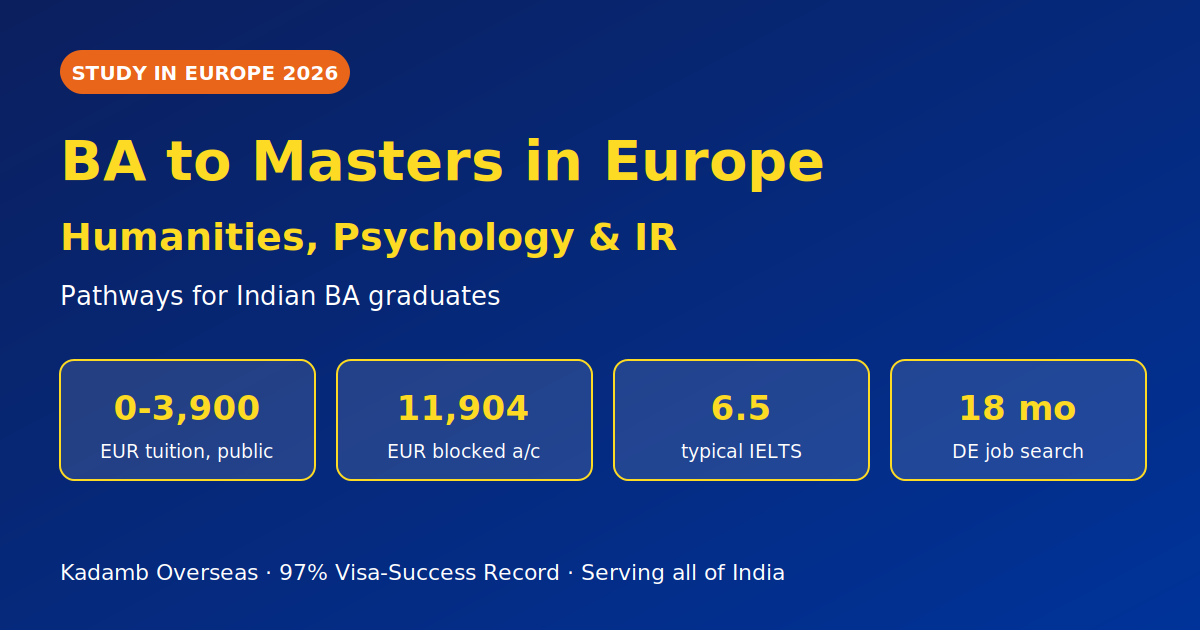
Quick answer: Yes, a BA graduate from India can do a master’s in Europe. Humanities, psychology, international relations (IR), media, sociology and political science master’s programmes are open to BA holders in Germany, France, the Netherlands, Sweden, Italy and Poland. Budget approx. €0–€3,900 a year in tuition at public universities (Germany, France, Italy) and approx. €10,000–€20,000+ at Dutch and some Nordic universities. Germany needs about €11,904 (approx. ₹11 lakh) in a blocked account. The main risk is not admission, it is a 3-year degree that some universities want bridged. Verify every figure on the official university page.
Is a BA enough to apply for a master’s in Europe?
A BA is the standard entry route for arts, humanities and social science master’s degrees. Europe does not require a BSc or BTech for these fields. What admission committees check is (1) the subject fit between your BA and the master’s, (2) the length of your degree, (3) your grades, and (4) your language proof.
The length question is where most Indian BA applicants get stuck. European bachelor’s degrees are often 180 ECTS (3 years) in Germany and France, and 240 ECTS in some other systems. Many German universities accept a 3-year Indian BA for humanities master’s programmes, while some ask for 4 years or a bridging semester. France and Italy generally accept 3-year degrees for their own master’s (Master 1 and Laurea Magistrale). Always read the admission page of the exact programme, because rules differ even inside one country. For a wider look at the 3-year question, see our guide on studying abroad after a 3-year degree.
Which master’s fields suit BA graduates?
Match your BA major to the master’s. A weak match is the fastest way to a rejection, and it is the mistake we see most often. These are the pathways that work:
| BA background | Strong master’s options | Where to look |
|---|---|---|
| English, History, Philosophy | MA English Studies, MA History, MA Philosophy, Cultural Studies | Germany, Netherlands, Sweden, Italy |
| Psychology | MSc Psychology, Clinical/Cognitive Psychology, Neuroscience-linked tracks | Germany, Netherlands, France, Sweden |
| Political Science / IR | MA International Relations, Public Policy, European Studies, Conflict Studies | Netherlands, France, Germany, Sweden |
| Sociology / Economics (BA) | MSc Sociology, Development Studies, Economics (with maths proof) | Germany, Netherlands, Italy |
| Journalism / Mass Communication | MA Media Studies, Communication, Digital Media | Germany, Netherlands, Poland, Sweden |
| Design / Fine Arts (BA) | MA Design, Visual Culture, Curatorial Studies | Germany, Italy, France |
Economics BAs face a specific hurdle: most quantitative programmes want proof of calculus and statistics. Check the prerequisite list before applying.
How much does a BA to master’s in Europe cost?
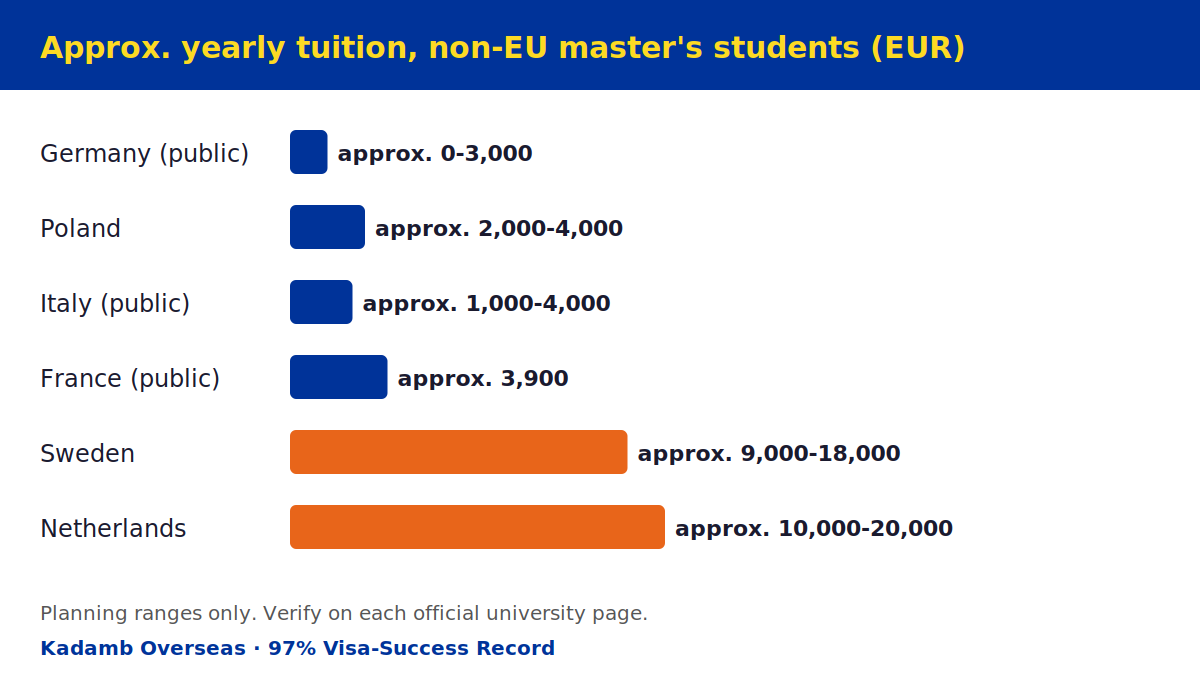
Costs vary hugely by country. The figures below are approximate tuition ranges for non-EU students in 2026–27 and change by university. Treat them as planning numbers only and verify on each official page. The INR column uses a rough rate of ₹100 per euro.
| Country | Approx. tuition per year (non-EU) | Approx. INR | Living cost per month (approx.) |
|---|---|---|---|
| Germany (public) | €0 (most states); up to €3,000 in Baden-Württemberg | ₹0 – ₹3 lakh | €992+ (visa benchmark) |
| France (public) | approx. €3,900 for master’s | approx. ₹3.9 lakh | €900–€1,300 |
| Italy (public) | approx. €1,000–€4,000 | ₹1–4 lakh | €800–€1,200 |
| Netherlands | approx. €10,000–€20,000 | ₹10–20 lakh | €1,000–€1,500 |
| Sweden | approx. SEK 100,000–SEK 200,000 | approx. ₹8–16 lakh | SEK 10,000–SEK 12,000 |
| Poland | approx. €2,000–€4,000 | ₹2–4 lakh | €600–€900 |
For Germany, budget the visa proof as well. Our blocked account guide explains how the €11,904 requirement works and how to fund it, and our Study in Germany page lists the intakes.
What are the admission requirements for BA graduates?
Requirements are set by the programme, not by the country. Most BA-route programmes ask for the following. Confirm each item on the official page, because thresholds move from year to year.
Academic proof. Degree certificate, transcripts and often a grade conversion. Germany uses the modified Bavarian formula; France and Italy look at your overall percentage. A first class or 60%+ gives you a comfortable position for competitive programmes, while 50–60% works for less selective ones.
Statement of purpose (SOP) and CV. For humanities and social science, the SOP carries more weight than in engineering. Admission committees read for academic direction: a research question, a reading list you have engaged with, a reason for choosing that department, and a link to a career plan. A generic “I want to study in Europe” essay is rejected fast.
Language proof. English-taught programmes usually want IELTS or TOEFL, often around 6.5 overall, though this varies. German-taught programmes need C1-level German. French-taught ones need DELF/DALF or TCF at about B2–C1.
Extras. Two academic references, a writing sample for some MA programmes, and portfolios for design and architecture-adjacent fields. Psychology courses may want a statistics and research-methods transcript.
Can a BA graduate get a job in Europe after the master’s?
Yes, but be realistic. Humanities and social science graduates compete in a narrower market than engineers, and the salary levels are lower. The visa rules are supportive, though: Germany allows up to 18 months to look for a qualified job after graduation, and France and the Netherlands also offer post-study search permits. Confirm the current durations on official government pages.
If you want to stay, choose a course with a career pipeline: policy, data-driven social science, UX research, communications, or a language you can work in. For the salary bar that applies to skilled-worker routes, read our explainer on the EU Blue Card thresholds. Note that a Blue Card is easier for STEM profiles, so humanities graduates should plan on a standard skilled-worker permit.
Which mistakes do BA applicants make most often?
Most rejections we see follow the same handful of errors. Avoid these:
1. Applying to mismatched programmes. A BA in Commerce applying to an MA in Philosophy has no case. Choose programmes that build on your major.
2. Ignoring degree length. Check whether the university accepts a 3-year degree before you pay an application fee.
3. Using one SOP for every university. Committees can tell. Name the professors, courses and research groups that attract you.
4. Underestimating funding. Show the required funds early. A late blocked account is a common cause of visa delay.
5. Skipping the language plan. Even in English-taught programmes, daily life and part-time jobs run better with basic German, French or Dutch. Start learning before you fly.
6. Applying too late. Winter intake deadlines for popular programmes often fall between January and May of the same year; start 8–10 months ahead.
Also prepare for the embassy interview. Our list of Schengen visa interview questions covers the most common questions and model answers.
How should a BA graduate plan the timeline?
Work backwards from the intake. For a September or October start, begin in November of the previous year. Months 1–2: shortlist 6–8 programmes and confirm degree-length acceptance. Months 3–4: take IELTS or start language classes, request transcripts, and secure references. Months 5–6: write and refine the SOP, and submit applications through uni-assist or the university portal. Months 7–8: receive offers, open the blocked account, and book the visa appointment. Month 9: fly and complete registration. Our Anmeldung guide covers the first-week paperwork in Germany.
Frequently asked questions
Can I do a master’s in Europe with a 3-year BA from India?
Often yes, but it depends on the university and country. Many German, French, Dutch and Nordic universities accept a 3-year BA if it comes from a recognised Indian university, sometimes with a bridging year or a strong profile. Check the anabin/DAAD entry for Germany and the programme’s own admission page before you apply.
Do I need work experience for an MA or MSc after a BA?
Not for most academic master’s degrees. Work experience helps for management, international relations and some policy programmes, but a strong statement of purpose, relevant internships and good grades usually matter more for humanities and social science courses.
Which European countries are cheapest for BA graduates?
Germany’s public universities charge little or no tuition (Baden-Württemberg is an exception for non-EU students), and Italy and Poland are also affordable. France has moderate public tuition. The Netherlands and Nordic private-cost programmes are more expensive, so verify current fees on each official page.
Do I need IELTS or German for these programmes?
English-taught programmes typically ask for IELTS or TOEFL, often around 6.5 overall, though the requirement varies by university. German-taught programmes need TestDaF or DSH, usually around C1. Always confirm the exact score on the programme page.
Can a BA graduate get a job in Europe after the master’s?
Yes, though humanities graduates face a narrower job market than engineers. Germany offers an 18-month post-study job-search permit, France a similar post-study permit, and the Netherlands a one-year orientation year. Language skills, internships and a clear career target improve your odds.
How much money do I need to show for the visa?
For Germany, the blocked account requirement is approx. €11,904 per year (about ₹11 lakh at current rates), which is roughly €992 a month. Other countries set their own proof-of-funds amounts, so verify on the official embassy or immigration page before you apply.
Ready to plan your BA-to-master’s route?
Kadamb Overseas guides students across India – Ahmedabad, Mumbai, Delhi, Bengaluru, Hyderabad, Pune, Chennai and beyond – with a 97% visa-success record. Get a free profile evaluation today.
Saumitra Rajput
Saumitra Rajput is the founder of Kadamb Overseas Pvt. Ltd., India's leading Europe-focused study abroad consultancy based in Ahmedabad. With 14+ years of expertise in European education, he has personally counselled 2,500+ Indian families and helped 500+ students secure admission to top European universities including TU Munich, ETH Zurich, EPFL, KU Leuven, HEC Paris, Sapienza Rome, TU Wien, and Warsaw University of Technology. He has visited 25+ European universities, partners with 250+ EU institutions, and maintains a 500+ students placed.
Planning to Study Abroad?
Get free expert guidance from our experienced counselors

Saumitra Rajput
Saumitra Rajput is the founder and lead counsellor at Kadamb Overseas, India's trusted Europe education consultancy based in Ahmedabad. With 14+ years of hands-on experience, he has personally guided 500+ students to universities across Germany, Switzerland, France, Italy, Austria, and Spain. Saumitra has visited partner universities across Europe, holds deep expertise in European visa processes, scholarships, and student life, and has achieved a 97% visa success rate for his clients. He is the host of the YouTube channel "Europe with Saumitra", where he shares first-hand insights on studying and living in Europe. His mission: make Europe accessible to every Indian student, with zero consultancy fees.