
Table of Contents
- What a “backlog” even means to a European admissions office
- Country by country: where backlog profiles actually get admits
- Building the file that gets past the doubt
- The visa question: will backlogs get me refused?
- Program-level strategy: aim where the door is open
- Two real profiles, two different right answers
- Five mistakes backlog students make
- Frequently asked questions
🕑 7 min read
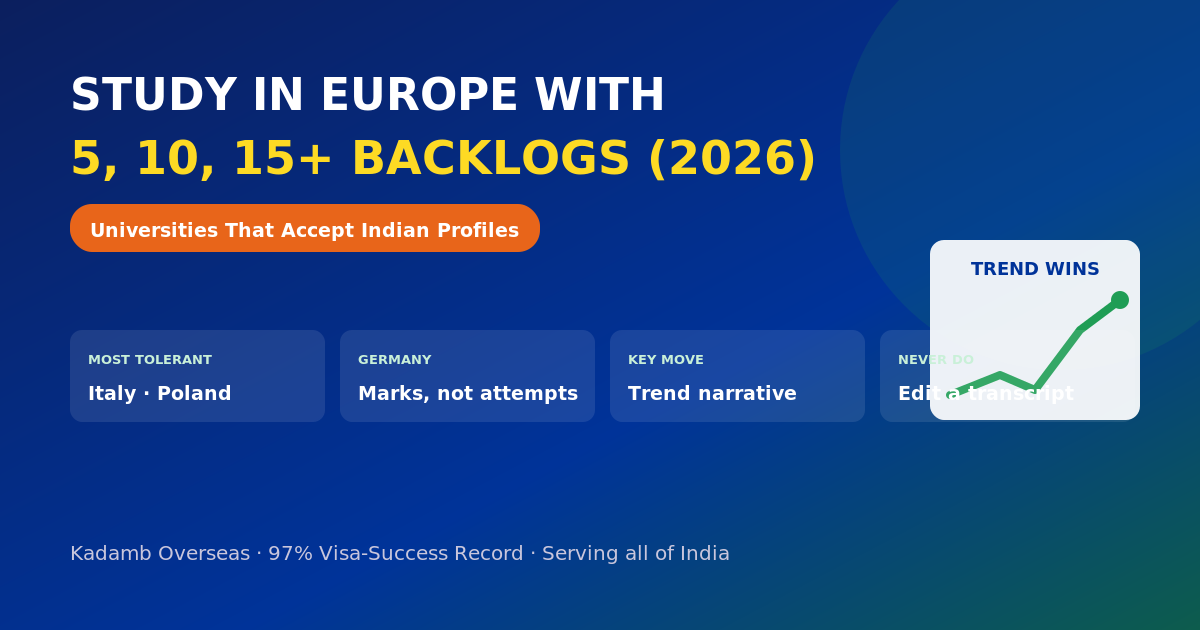
Quick answer: Yes, you can study in Europe with backlogs — including 5, 10 or even 15+ — because most European universities count backlogs differently from Indian perception: what matters is the final degree award, the last-two-years trend, and whether attempts are visible at all on your transcript format. Practical map for 2026: Italy and Poland read whole profiles and routinely admit 10–15+ backlog cases; Germany’s uni-assist system converts your grades via the Bavarian formula where cleared backlogs often matter less than Indians fear (though TU9-tier programs stay strict); France, Hungary and Czechia sit in between; and one-year UK-style selectivity does not apply across most of the continent. The real work is presentation: transcript format, a trend story, and an SOP that answers the question before it’s asked.
What a “backlog” even means to a European admissions office
Indian students carry backlog counts like a criminal record; European evaluators mostly never see the number. Admissions teams receive your consolidated transcript and degree certificate — and different universities issue these differently. Some Indian universities print every attempt; many print only final grades per subject. Where attempts aren’t itemised, the “backlog count” simply is not a data point — the CGPA and the degree are. Where they are itemised, evaluators look at three things: did you clear everything (an awarded degree answers yes), what is the trajectory (a weak second year followed by strong final years reads as growth), and is the overall conversion competitive for that program. Germany’s uni-assist computes a German grade from your marks; the formula has no “backlog” input — failed attempts hurt only insofar as they dragged the marks that feed it.
Country by country: where backlog profiles actually get admits
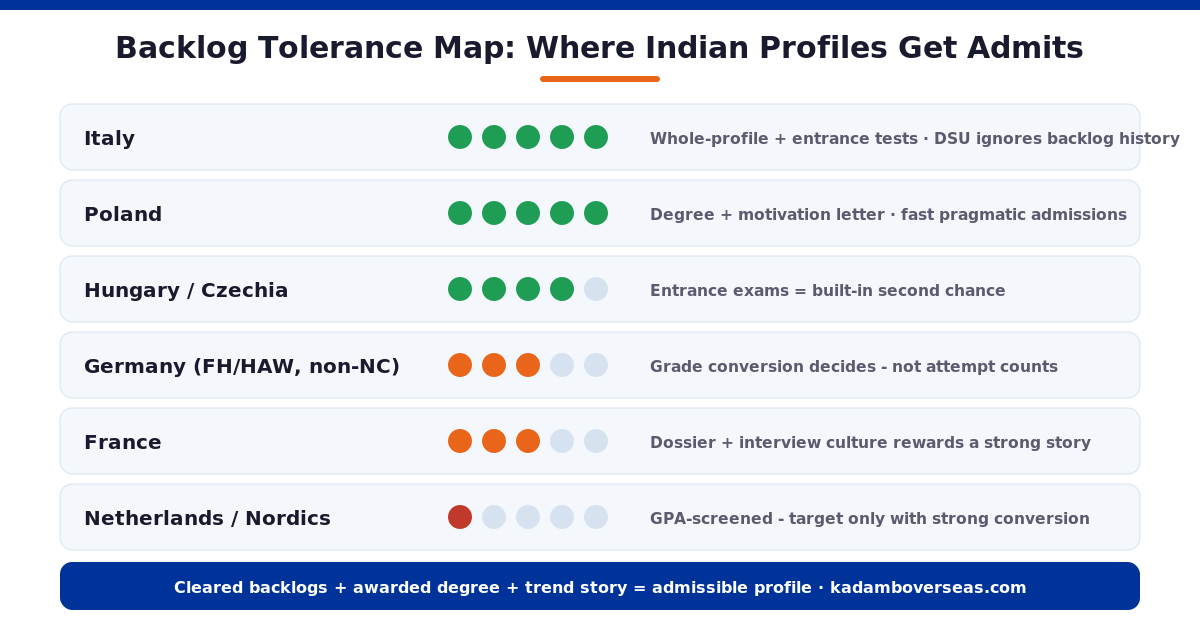
| Country | Realistic tolerance | Notes for 2026 |
|---|---|---|
| Italy | High (10–15+) | Whole-profile review; entrance tests/interviews let you outperform the transcript; DSU scholarships unaffected by backlog history |
| Poland | High (10–15+) | Degree + motivation letter driven; fast, pragmatic admissions |
| Hungary / Czechia | Moderate–high | Entrance exams common — a second chance by design |
| Germany | Moderate (program-dependent) | Grade conversion decides; TU9/NC programs strict, many strong universities are not; APS verifies documents, not backlog counts |
| France | Moderate | Dossier + interview culture; a strong story moves committees |
| Netherlands / Nordics | Low | GPA-driven screening; target only with a strong overall conversion |
Building the file that gets past the doubt
The transcript audit (do this first). Get your consolidated transcript and check what it actually shows. If attempts aren’t printed, your file is a CGPA file — behave accordingly. If they are, decide where honesty must be proactive (visa forms, APS) versus where the document simply speaks (admissions).
The trend narrative. Split your marks by year. If the last two years beat the first two, lead with that everywhere: “final-two-year average 68% (7.2 CGPA), up from a difficult second year” is a legitimate, verifiable framing that evaluators accept across Europe.
The SOP paragraph that works. One paragraph, never more: name the difficulty factually (health, family, a wrong-fit subject), state what changed, and point at the evidence — the cleared record, the project, the internship, the IELTS score. No melodrama, no blame, no five-sentence apology. Then move on to why this program.
Compensating signals. A relevant certification (cloud, CAD, analytics), one substantial project with a repo or report, or 6–12 months of work experience each outweigh two or three old backlogs in a whole-profile system. This is where the “wasted” year between intakes becomes the upgrade year — the same logic as our rebuild strategy.
The visa question: will backlogs get me refused?
Visa officers assess credibility and funding, not academic elegance — but backlogs intersect with credibility in two ways. First, education gaps created by extra semesters must be explained the same way as any gap: one factual line, consistent across forms, SOP and interview (rehearse with our 50-question interview guide). Second, the officer’s real question is “can this student plausibly finish this program?” — and your admission itself, plus a coherent course-fit story, answers it. What actually triggers refusals in backlog files: inconsistency (a “year off for family reasons” that the transcript shows as failed semesters), not the backlogs themselves. Germany’s APS deserves a special note: it authenticates documents — genuine transcripts with backlogs pass; “cleaned up” documents end careers. Never, ever edit a transcript.
Program-level strategy: aim where the door is open
Within any country, tolerance varies by program more than by university. Open doors: newer English-taught master’s hungry for international cohorts, applied-sciences universities (Germany’s excellent FH/HAW sector judges practice-fit as much as grades), interdisciplinary programs (management + tech, sustainability, data + domain), and any program with an entrance test or interview — every live evaluation is a chance to beat your paper. Guarded doors: numerus-fixus Dutch programs, TU9 flagship courses, Nordic research tracks, and anything whose page states a hard GPA floor. The two-application structure fits backlog profiles perfectly: one realistic reach (a German FH, a Politecnico test-entry), one open-door anchor (Poland, a solid Italian public), sharing one document set.
Two real profiles, two different right answers
Profile A: B.E. Mechanical, 12 backlogs (all cleared), CGPA 6.4, one year’s CAD workshop experience. The Netherlands and TU9 are closed doors, and knocking wastes a season. The winning route ran through an Italian public university’s mechanical program with an entrance evaluation, a DSU application filed on family income, and an SOP built on the workshop portfolio. Admitted with a fee waiver; the transcript question never dominated because the system never asked it to.
Profile B: B.Tech CSE, 4 backlogs (cleared in one extra semester), CGPA 7.3 with an 8.1 final year, one hackathon win. This profile under-applies out of fear more often than it gets rejected. Germany was fully in range: an FH master’s in software engineering plus one non-NC universität option, the trend framed in one SOP line, APS filed early with genuine documents. Both admits arrived; the student is now a Werkstudent at a Mittelstand firm. The lesson in both cases is the same: the backlog count set the doors, not the ceiling — and matching profile to door converted anxiety into an itinerary. Run your own numbers through the same filter before you write a single application.
Five mistakes backlog students make
1. Hiding or minimising on official forms. Admissions essays can frame; visa forms and APS cannot. Declare what documents show, always.
2. Mass-applying to GPA-screened programs. Ten Dutch rejections cost money and morale that one Italian entrance test would have converted.
3. The apology SOP. Committees fund futures, not remorse. One factual paragraph, then forward-looking substance.
4. Waiting for a “perfect” profile. A 26-year-old with cleared backlogs, a certification and work experience out-competes a 22-year-old excuse-free transcript in whole-profile systems. Apply.
5. Paying “guaranteed admission” agents. Backlog anxiety is their business model. Everything above is doable openly — the honest file is also the safest one.
Frequently asked questions
Can I study in Europe with 10 or 15 backlogs?
Yes — if they are cleared and your degree is awarded. Italy, Poland, Hungary and Czechia routinely admit 10–15+ backlog profiles through whole-profile review or entrance tests; Germany’s grade-conversion system cares about final marks more than attempt counts. Target the right doors and present a trend story.
Do German universities count backlogs?
Not as a separate criterion. Uni-assist converts your final marks into a German grade (the modified Bavarian formula), which drives admission decisions; backlogs matter only through the marks they affected. Program-level competitiveness varies — TU9 flagships are strict, many strong universities and FH/HAW programs are not.
Will backlogs cause my student visa to be rejected?
Backlogs themselves, no. Inconsistency does: gaps explained differently across forms, SOP and interview, or edited documents (which Germany’s APS detects and which permanently damage your record). Declare honestly, explain factually once, and keep every version identical.
Which European country is best for students with a low CGPA and backlogs?
Italy first — whole-profile admissions, entrance-test second chances, and DSU scholarships that ignore backlog history — with Poland as the fastest pragmatic alternative. Germany remains viable for moderate cases via FH/HAW and non-NC programs.
Should I mention backlogs in my SOP?
Only if your transcript makes them visible — then one factual paragraph: what happened, what changed, and the evidence of the change. If your consolidated transcript shows only final grades, spend the SOP on course fit and goals instead; don’t volunteer a framing the documents don’t raise.
Do backlogs affect scholarship chances in Europe?
Merit scholarships (DAAD, Eiffel, Nordic waivers) are grade-competitive, so indirectly yes. Need-based support is not: Italy’s DSU awards on family income, not academic history — making Italy uniquely generous to backlog profiles with modest budgets.
Backlogs on the transcript? Let’s build the file that gets past them
Kadamb Overseas has placed backlog and low-CGPA profiles from Mumbai, Delhi, Bengaluru, Hyderabad, Pune, Ahmedabad and every state of India into European programs — transcript audit, country targeting and the SOP that answers the question first. 97% visa-success record.
Saumitra Rajput
Saumitra Rajput is the founder of Kadamb Overseas Pvt. Ltd., India's leading Europe-focused study abroad consultancy based in Ahmedabad. With 14+ years of expertise in European education, he has personally counselled 2,500+ Indian families and helped 500+ students secure admission to top European universities including TU Munich, ETH Zurich, EPFL, KU Leuven, HEC Paris, Sapienza Rome, TU Wien, and Warsaw University of Technology. He has visited 25+ European universities, partners with 250+ EU institutions, and maintains a 500+ students placed.
Planning to Study Abroad?
Get free expert guidance from our experienced counselors

Saumitra Rajput
Saumitra Rajput is the founder and lead counsellor at Kadamb Overseas, India's trusted Europe education consultancy based in Ahmedabad. With 14+ years of hands-on experience, he has personally guided 500+ students to universities across Germany, Switzerland, France, Italy, Austria, and Spain. Saumitra has visited partner universities across Europe, holds deep expertise in European visa processes, scholarships, and student life, and has achieved a 97% visa success rate for his clients. He is the host of the YouTube channel "Europe with Saumitra", where he shares first-hand insights on studying and living in Europe. His mission: make Europe accessible to every Indian student, with zero consultancy fees.