
Table of Contents
- Does Europe really accept students over 30?
- Which Europe study route suits a 30+ applicant?
- How do you present a career gap or long work history?
- How much does it cost for a mature student?
- Which funding and bank documents does a 30+ applicant need?
- What are the best Master's choices after 30?
- How should you prepare for the visa interview at 30+?
- What mistakes should 30+ applicants avoid?
- What does the application timeline look like?
- Frequently asked questions
- Plan your Europe move with Kadamb Overseas
🕑 7 min read
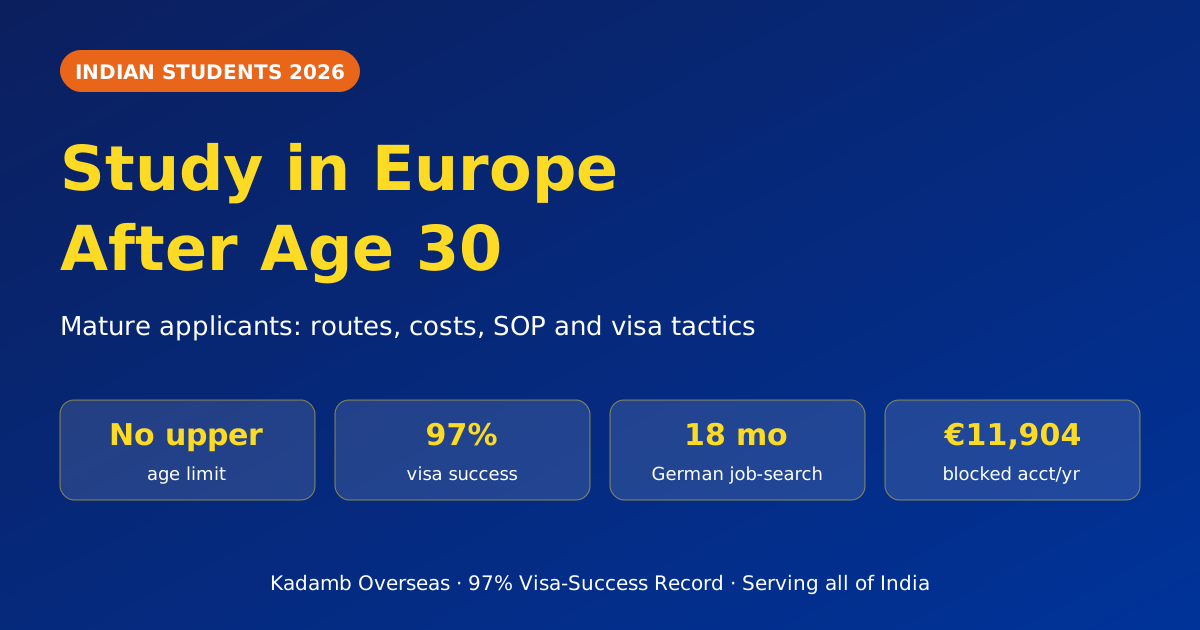
Quick answer: Yes, you can study in Europe after 30, and many people do. There is no legal upper age limit for Master’s programmes in Germany, France, Italy, Spain, Poland or the Nordics. What decides your admission is your degree, grades, work story and a convincing study plan. At 30+ you need to prove funds, purpose and a post-study career path, and your experience is an asset, not a weakness.
Does Europe really accept students over 30?
Yes. European universities admit on academic merit, not birth year. Public German universities, Italian state universities and Nordic institutions have mature students in every intake. The real obstacles for Indian applicants over 30 are practical: explaining gaps, matching the programme to a career story, and showing enough money. Visa officers ask one core question: why this course, why now, and how will you fund it?
Age becomes a visible factor in only three places: some scholarships with age caps, certain Bachelor’s pathways such as the Studienkolleg route, and visa interviews where a vague plan looks risky. Everything else is within your control.
Which Europe study route suits a 30+ applicant?
Choose the route by your goal, not your comfort zone. A career switcher, a returning professional and a mid-level manager need different programmes. Here is a practical comparison.
| Your situation | Best-fit route | Why it works after 30 |
|---|---|---|
| Technical professional (5-10 yrs) | MS in Germany, Netherlands or Finland | Industry experience strengthens the SOP; strong job market after graduation |
| Manager seeking leadership role | MBA in France, Spain or Italy | Cohorts value 3-10 years of experience; strong networking |
| Career switcher | MS / MSc in a new field with bridging courses | Shows clear motivation if your SOP connects old and new skills |
| Budget-focused applicant | Public universities in Germany, low-fee options in Poland or Italy | Low or no tuition; funds mainly cover living costs |
| Applicant with a family | Germany, Finland or Sweden | Established family reunification rules and strong support systems |
If your target is Germany, read our Study in Germany guide first. For Master’s in Sweden, see our Sweden complete guide.
How do you present a career gap or long work history?
Your SOP should read like a business case, not an apology. Lead with what you achieved at work, then name the specific skill gap that this Master’s closes. Admission committees at European universities read hundreds of SOPs from 22-year-olds. A 33-year-old with a sharp, evidence-backed plan stands out immediately.
For gaps, use this simple structure: what you did, what you learned, why you are ready now. Attach experience letters, salary slips or tax returns, and certificates for any courses completed. If you ran a business or freelanced, include client proof or registration documents. Unexplained gaps of two years or more are what trigger doubt, so explain them in one clear paragraph.
How much does it cost for a mature student?
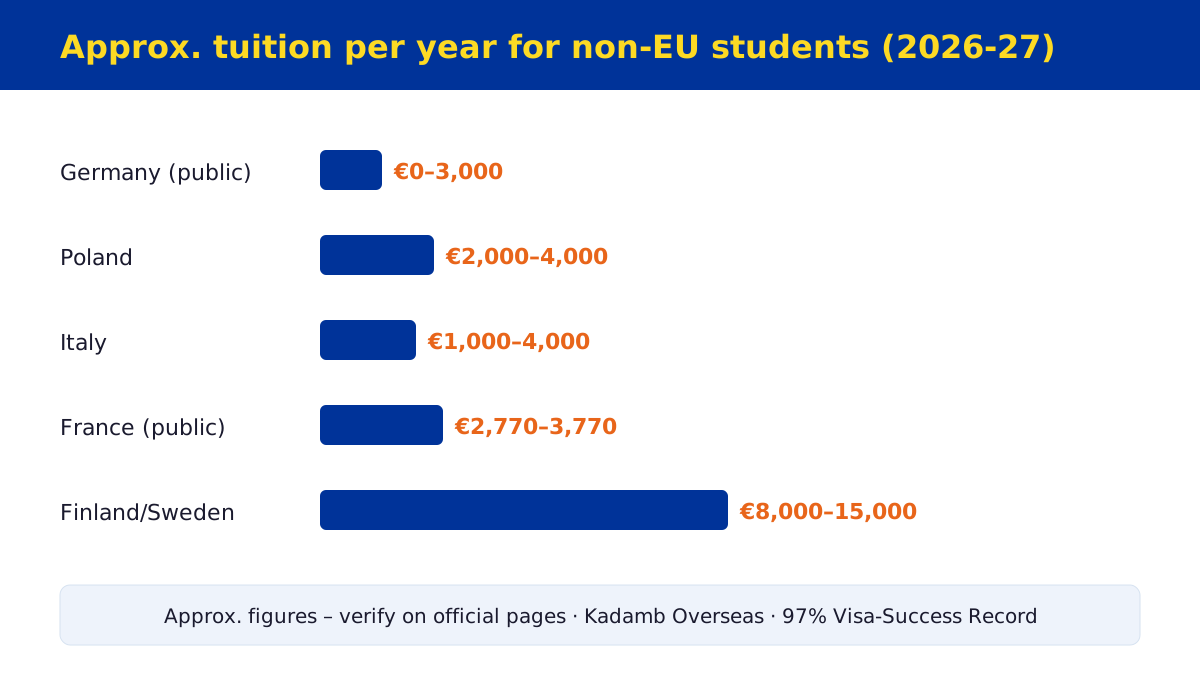
Costs depend mostly on the country and whether the university is public or private. Figures below are approximate for 2026-27; verify on the official university and embassy pages before you commit.
| Country | Tuition (approx. per year) | Living funds shown for visa | Note |
|---|---|---|---|
| Germany (public) | €0 to €3,000 (some states and non-EU fees apply) | €11,904 blocked account (approx. ₹11-12 lakh) | Low tuition; strongest post-study job market |
| France | €2,770 to €3,770 at public universities for non-EU students (approx.) | Approx. €615 per month | Private business schools cost far more |
| Italy | Approx. €1,000 to €4,000 at public universities | Varies by region | Regional scholarships possible |
| Poland | Approx. €2,000 to €4,000 | Lower living costs | Good value for budget planners |
| Finland / Sweden | Approx. €8,000 to €15,000+ for non-EU students | Approx. €800 to €1,000 per month | Scholarships for strong profiles |
For Germany, our blocked account guide explains how to open it and what to deposit. For funding support, explore the Erasmus Mundus scholarship guide, but check age and eligibility rules for each call.
Which funding and bank documents does a 30+ applicant need?
Mature applicants are often self-funded or partly funded by savings, which means the financial file gets more scrutiny. Prepare the following well before your visa appointment:
- Savings statements for the last 6 to 12 months with a clear source of funds.
- Income tax returns for 2 to 3 years, plus salary slips or business records.
- Sponsor affidavits if a spouse or parent funds you, with their own income proof.
- Education loan sanction letter if you borrow, from an approved lender.
Large sudden deposits are a classic rejection trigger. Keep funds in your account for several months and keep the paper trail clean.
What are the best Master’s choices after 30?
Pick fields where experience counts and demand is visible. In engineering and IT, data analytics, supply chain, renewable energy, cybersecurity and healthcare management are popular and have clear job pipelines. For management, an MBA or a Master’s in Management in France, Spain and Italy values work history. Look at employer demand first, because your timeline for return on investment is shorter than a 22-year-old’s.
Think about the end goal as well. Germany’s pathway from student to job seeker to the EU Blue Card suits professionals with experience; see our EU Blue Card salary thresholds for the current picture.
How should you prepare for the visa interview at 30+?
Expect direct questions about your age, your job, your savings and your plan after graduation. Answer in two or three calm sentences with facts. For example: you have eight years in logistics, you chose a supply chain Master’s because your employer lacks analytics skills, and you intend to work in Europe for a few years and then build that capability in India or abroad. Carry originals of every document you uploaded, and make sure your SOP, CV and bank file tell the same story. Inconsistent answers cause more rejections than age ever does.
Also plan health insurance, accommodation proof and a realistic monthly budget. Mature applicants who show a written budget look organised and credible.
What mistakes should 30+ applicants avoid?
- Applying to the wrong level. Do not take a second Bachelor’s if a Master’s is possible. It wastes years and weakens your visa story.
- A generic SOP. Copy-paste statements built for fresh graduates fail with experienced profiles. Name employers, projects and results.
- Ignoring language rules. Many English programmes need IELTS or TOEFL, and some need basic German or French for daily life. Start language learning early.
- Underestimating family costs. Dependants need extra funds, housing and often longer processing time.
- Weak ties and return story. Officers want a believable plan. Show career progress, not escape.
- Leaving it late. Mature profiles need more documents. Begin 9 to 12 months before the intake.
What does the application timeline look like?
Work backwards from your target intake. Twelve months out, shortlist programmes and book language tests. Nine months out, collect experience letters, transcripts and recommendations. Six months out, submit applications, since many German and French deadlines fall between January and May for the autumn intake. After admission, open your blocked account, arrange health insurance and book the visa appointment. Prepare for the interview with our visa interview question bank.
Frequently asked questions
Is there an upper age limit for a Master’s in Europe?
No. Germany, France, Italy, Spain, Poland and the Nordic countries do not set a legal upper age limit for Master’s admission. Universities assess your degree, grades, language scores and a clear study plan. Only a few scholarships, such as some DAAD and national programmes, set age caps, so check each call individually.
Will a gap of several years hurt my application?
Not if you explain it. A gap filled with work, a business, caregiving or upskilling is normal for applicants over 30. Add a one-page timeline to your SOP, attach proof such as experience letters and tax records, and link your past work directly to the programme you chose.
Can I bring my spouse and children on a student visa?
Often yes, but the rules differ by country. Germany allows family reunification for students, usually with proof of extra funds and suitable accommodation. Expect to show a larger budget for each dependant and to wait longer for appointments. Approx. figures change, so verify on the official embassy page.
Is an MBA better than an MS if I am over 30 with experience?
Usually yes if you want a leadership or career-switch role. MBA programmes in Europe value 3 to 10 years of experience and often prefer older cohorts. An MS suits you if you want a technical specialisation. Choose by target job, not by age.
How much money should I plan for as a mature student?
In Germany the blocked account requirement is approx. ₹11-12 lakh (about €11,904 per year) for living costs, plus tuition if applicable. Public universities charge little or no tuition, while private programmes in France, Italy and Spain can cost several times more. Verify current figures on the official pages before applying.
Can I stay and work in Europe after studying at 32 or 35?
Yes. Germany offers an 18-month post-study job-search permit, and a qualifying job can lead to an EU Blue Card. Older graduates with prior experience often reach the salary thresholds faster than fresh graduates, which is a real advantage.
Plan your Europe move with Kadamb Overseas
Over 30 and worried about age, gaps or funds? Our counsellors guide students from Delhi, Mumbai, Bengaluru, Hyderabad, Chennai, Pune, Ahmedabad and every other city in India, backed by a 97% visa-success record. Get a free profile review today.
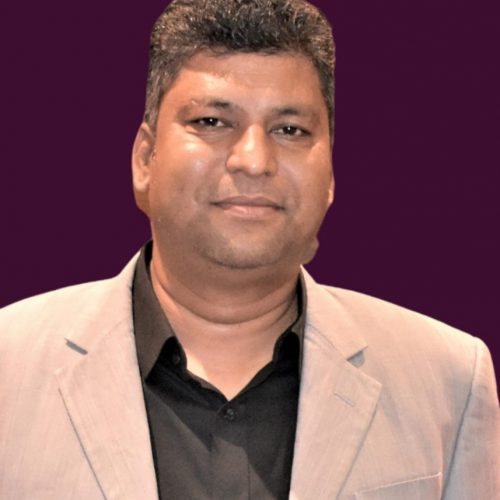
Saumitra Rajput
Saumitra Rajput is the founder of Kadamb Overseas Pvt. Ltd., India's leading Europe-focused study abroad consultancy based in Ahmedabad. With 14+ years of expertise in European education, he has personally counselled 2,500+ Indian families and helped 500+ students secure admission to top European universities including TU Munich, ETH Zurich, EPFL, KU Leuven, HEC Paris, Sapienza Rome, TU Wien, and Warsaw University of Technology. He has visited 25+ European universities, partners with 250+ EU institutions, and maintains a 500+ students placed.
Planning to Study Abroad?
Get free expert guidance from our experienced counselors

Saumitra Rajput
Saumitra Rajput is the founder and lead counsellor at Kadamb Overseas, India's trusted Europe education consultancy based in Ahmedabad. With 14+ years of hands-on experience, he has personally guided 500+ students to universities across Germany, Switzerland, France, Italy, Austria, and Spain. Saumitra has visited partner universities across Europe, holds deep expertise in European visa processes, scholarships, and student life, and has achieved a 97% visa success rate for his clients. He is the host of the YouTube channel "Europe with Saumitra", where he shares first-hand insights on studying and living in Europe. His mission: make Europe accessible to every Indian student, with zero consultancy fees.