


Table of Contents
- What is the Belgium Long-Stay (Type D) visa?
- Who needs a Type D student visa?
- Before the visa: get your admission right first
- Type D vs Type C: which visa do you need?
- Belgium student visa costs at a glance
- The Belgium student visa process, step by step
- Belgium student visa document checklist
- Proof of funds: the make-or-break step
- How a blocked account works, step by step
- Health insurance for your Belgian student visa
- Legalisation and apostille for Indian documents
- Biometrics, VFS and tracking your application
- Processing time: how early should you apply?
- After approval: arrival and residence permit
- If your visa is delayed or refused
- Can I bring my family on a student visa?
- Working and staying after your studies
- 6 things that make a Belgium student visa application strong
- Common reasons Belgium student visas get refused
- Your Belgium student visa timeline (2027 intake)
- How Kadamb Overseas handles your Belgium visa — from anywhere in India
- The bottom line on the Belgium student visa
- Related guides
- Frequently asked questions
🕑 15 min read
Last reviewed: September 2026 · By Saumitra Rajput, Founder, Kadamb Overseas — 14+ years guiding Indian students to Europe.
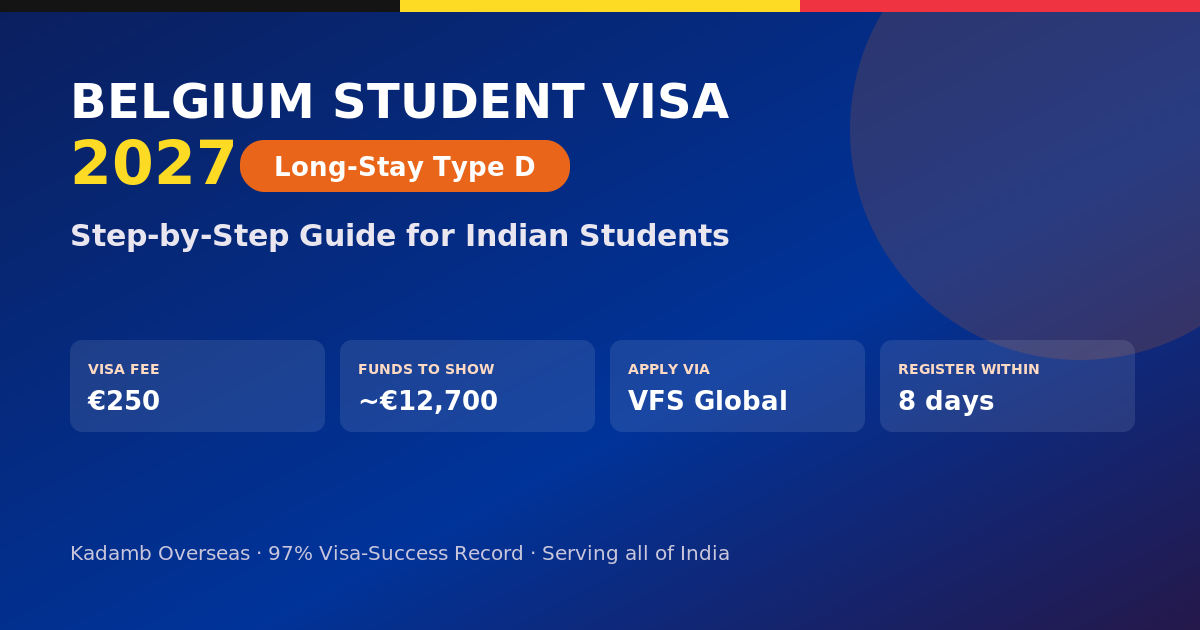
You’ve secured your admission to a Belgian university — congratulations. Now comes the step that decides whether you actually make it to Belgium: the Long-Stay (Type D) student visa. This is where most avoidable failures happen, not because students aren’t qualified, but because the financial proof is weak, a document isn’t legalised, or the application is submitted too late. This is the complete, honest, step-by-step Belgium student visa guide for Indian students, built for the 2027 intake — every document, every fee, every deadline, and every mistake that gets applications refused.
TL;DR — Key Takeaways
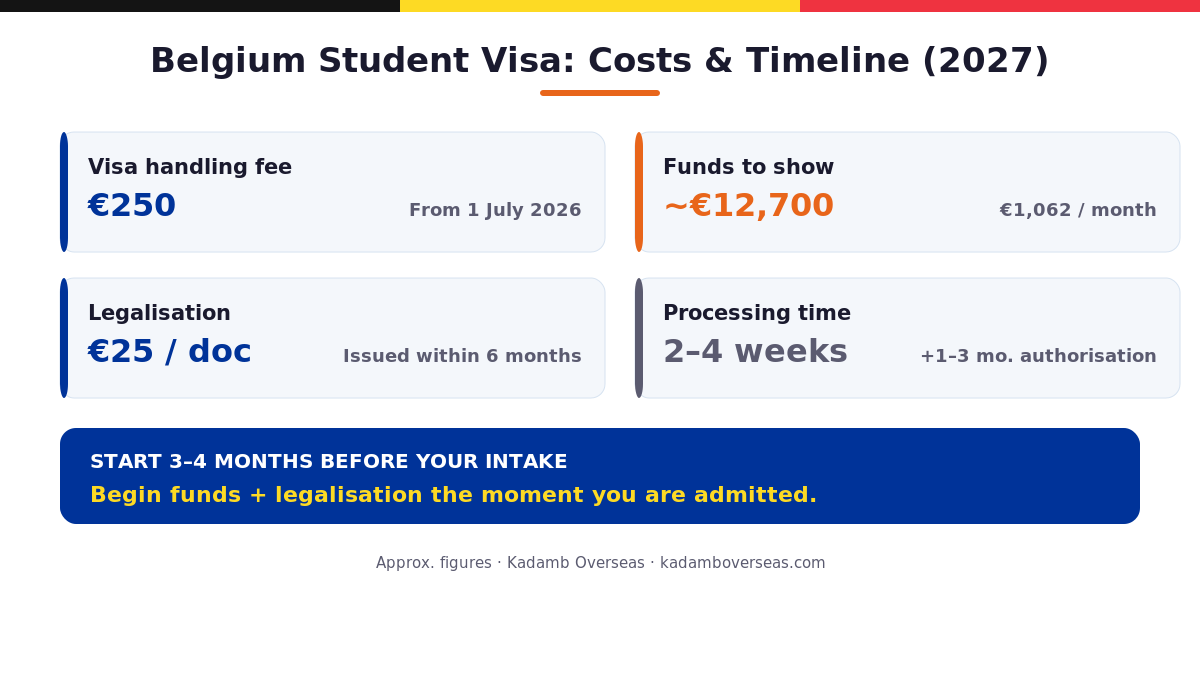
- You need a Long-Stay (Type D) visa for any Belgian course longer than 90 days.
- Visa handling fee: €250 (from 1 July 2026), paid at VFS Global when you submit.
- Proof of funds: €1,062/month — about €12,700 for the year — via a blocked account or a financial guarantor (Annex 32).
- Documents must be legalised/apostilled (₹/€25 per document via India’s MEA), issued within the last 6 months.
- Processing: the D visa itself takes about 2–4 weeks, but the underlying study authorisation can add 1–3 months — so apply early.
- After arrival: register at your local commune (town hall) within 8 days to get your residence permit.
What is the Belgium Long-Stay (Type D) visa?
Quick answer: The Type D visa is Belgium’s long-stay national visa — the one you need if you’re going to study in Belgium for more than 90 days, which covers every full degree and most exchange programmes. It’s different from a Schengen “Type C” short-stay visa (for tourism or stays under 90 days). As an Indian student with a Belgian admission letter, the Type D is the visa that lets you enter Belgium, live there, and — once you register locally — receive your Belgian residence permit for the duration of your studies.
Who needs a Type D student visa?
Every Indian student enrolling in a Belgian programme longer than 90 days needs a Type D visa — whether it’s a bachelor’s, an English-taught master’s, a PhD, or a long preparatory/language year. You apply after you have your official admission (or registration) letter from a recognised Belgian institution, and you apply from India, through the official visa application centre, before you travel.
Before the visa: get your admission right first
The visa is step two — a strong admission is step one, because your official admission letter is the document the whole visa file is built around. If you’re still choosing a university, start with our Study in Belgium 2027 handbook (Flanders vs Wallonia, costs and universities) and, if KU Leuven is your target, our KU Leuven admission guide for Indian students. To compare Belgium with cheaper routes like Germany, see our public universities in Europe guide. Once your admission is confirmed, this visa guide takes you the rest of the way.
Type D vs Type C: which visa do you need?
Students often confuse the two Belgian visa types, so let’s be clear:
| Feature | Type D (Long-Stay) — you need this | Type C (Schengen Short-Stay) |
|---|---|---|
| Duration | More than 90 days | Up to 90 days |
| Purpose | Full degrees, long courses | Tourism, short courses, family visits |
| Leads to | A Belgian residence permit | No residence permit |
| Fee | €250 | Lower (Schengen fee) |
Every Indian student doing a full degree at a Belgian university needs the Type D. The rest of this guide is about that visa.
Belgium student visa costs at a glance
Budget for three separate costs — the visa fee, document legalisation, and the funds you must show (not spend):
| Item | Amount | Notes |
|---|---|---|
| Visa handling fee (Type D) | €250 | From 1 July 2026; paid at VFS |
| VFS Global service charge | Extra (varies) | Centre handling fee, per applicant |
| Legalisation / apostille | €25 per document | Via India’s MEA; issued within 6 months |
| Proof of funds (shown, not a fee) | €1,062/mo (~€12,700/yr) | Blocked account or guarantor |
The Belgium student visa process, step by step
This is the core of the guide. Follow these steps in order — the sequence matters.
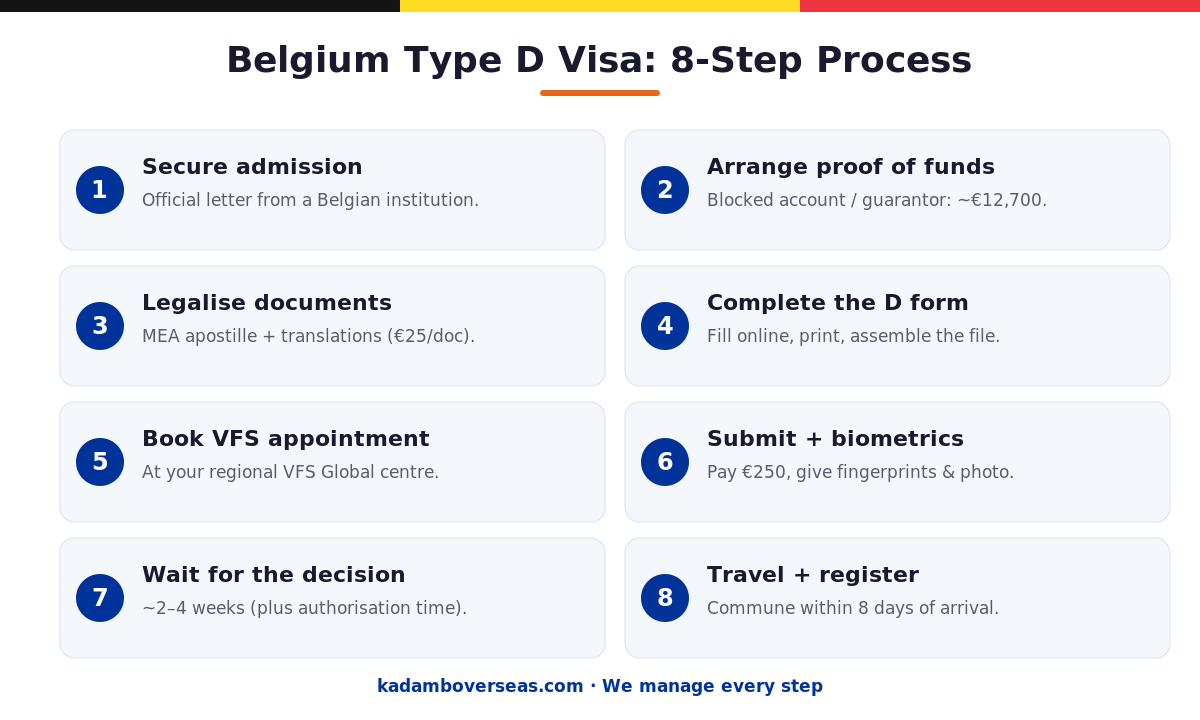
- Secure your admission. You can only apply once you hold an official admission or registration letter from a recognised Belgian institution.
- Arrange your proof of funds. Open a blocked account (or arrange a financial guarantor via Annex 32) showing at least €1,062 per month — about €12,700 for the year. This is the step that decides most applications, so do it early and cleanly.
- Get your documents legalised/apostilled. Degree certificates, transcripts and other civil documents usually need an apostille from India’s Ministry of External Affairs (MEA), and translations if they aren’t in English, Dutch, French or German. Every document must have been issued within the last 6 months.
- Complete the visa application form. Fill in the long-stay (D) application online, print it, and prepare the full document set.
- Book your VFS Global appointment. Belgium accepts student-visa applications in India through VFS Global. Book at the centre covering your region — Delhi, Mumbai, Kolkata, Chennai, Bengaluru, Hyderabad or the nearest.
- Attend the appointment & give biometrics. Submit your documents, pay the €250 fee, and provide your fingerprints and photo. Keep every original and a copy.
- Wait for the decision. The consulate reviews your file (and, where required, the underlying study authorisation). You’ll get an email when the decision is returned to the centre.
- Collect your visa and travel. On approval, collect your passport with the Type D visa and travel to Belgium before your programme starts.
- Register at the commune within 8 days. Once in Belgium, report to your local town hall (commune) within eight days of arrival to begin your residence-permit registration.
Belgium student visa document checklist
Prepare these carefully — an incomplete or inconsistent file is the number-one cause of delays and refusals:
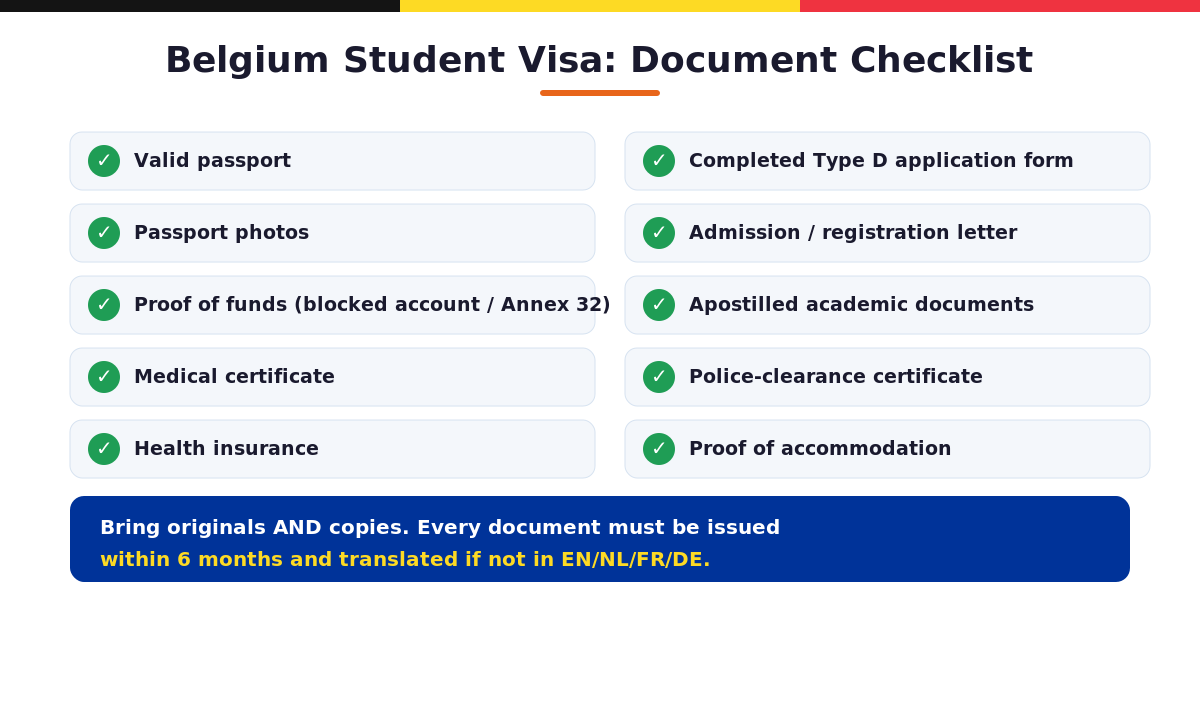
- A valid passport (valid well beyond your intended stay, with blank pages).
- The completed long-stay (D) visa application form, signed.
- Recent passport-size photos meeting the specifications.
- Your official admission / registration letter from the Belgian institution.
- Proof of sufficient funds — a blocked account statement or a signed financial guarantee (Annex 32) with the guarantor’s income proof.
- Academic documents — degree certificates and transcripts, apostilled/legalised and translated if required.
- A medical certificate from a doctor recognised by the embassy, confirming you’re free of specified conditions.
- A police-clearance certificate (good-conduct certificate) — usually required for students over 21.
- Health insurance covering your stay.
- Proof of accommodation or a plan for it.
- Proof of payment of the €250 visa fee.
Proof of funds: the make-or-break step
More Belgian student-visa refusals come from a weak financial file than from anything else. You must convincingly show you can cover €1,062 per month — about €12,700 for the 2026–27 year. You can do this two main ways:
- A blocked account: you deposit the required annual amount into a designated account, and it’s released to you in monthly instalments after you arrive. This is the cleanest, most reliable proof.
- A financial guarantor (Annex 32 / “prise en charge”): a solvent person (often a parent or relative, sometimes with Belgian ties) formally commits to covering your costs, backed by their income and tax documents.
Whichever route you choose, the money trail must be clean, consistent and well-documented — matching bank statements, clear sources of funds, and no last-minute large deposits that look arranged. This is exactly the file we build with you.
How a blocked account works, step by step
Because the blocked account is the cleanest proof of funds, here’s exactly how it works:
- Open the account with a provider that Belgian consulates recognise for this purpose.
- Deposit the full annual amount — roughly €12,700 — before your visa appointment.
- Receive the confirmation certificate from the provider, which you submit with your visa application as proof of funds.
- After you arrive and register in Belgium, the money is released to you in monthly instalments of about €1,062 to cover your living costs.
The advantage is simplicity and credibility: the consulate sees a clear, ring-fenced fund rather than a bank balance that could disappear the day after the appointment. If you use a guarantor (Annex 32) instead, the guarantor’s income, employment and tax documents must be strong and consistent — we advise on which route fits your situation.
Health insurance for your Belgian student visa
You must show health insurance covering your stay when you apply. Many students use a policy that covers the initial period, then register with a Belgian health insurance fund (a “mutualité” / “ziekenfonds”) after arrival, which is affordable and often required for enrolment. Make sure your initial policy meets the coverage level the consulate expects — inadequate insurance is an easy way to get a file delayed.
Legalisation and apostille for Indian documents
Belgium requires your Indian civil and academic documents to be legalised so they’re officially recognised. For India, this normally means an apostille from the Ministry of External Affairs (MEA) (India is part of the Apostille Convention), often after prior authentication by the relevant state authority. Key rules:
- The fee is typically about €25 (₹-equivalent) per document for legalisation/apostille.
- Documents must generally have been issued within the last 6 months.
- If a document isn’t in English, Dutch, French or German, you’ll need an official translation — a very common cause of delay.
Getting legalisation wrong — or leaving it to the last minute — is one of the most frequent, and most avoidable, reasons applications stall. Start this early.
Biometrics, VFS and tracking your application
You submit your Belgian student-visa application in India through VFS Global. At your appointment you’ll hand over your documents, pay the fee, and provide biometrics (fingerprints and a photo). After submission you can track your application online, and you’ll receive an email when the decision has been returned to the centre for collection. Book your appointment as soon as your documents are ready — appointment slots fill up quickly before the autumn intake.
Processing time: how early should you apply?
Plan for weeks to months, not days. The Type D visa itself is often decided within about 2–4 weeks, but where an underlying study authorisation is required, that can add one to three months (occasionally longer). Because appointment availability, document legalisation and the decision all take time, the safe rule is to begin the whole visa process 3–4 months before your intake, immediately after you accept your admission. Students who start late are the ones who miss their September start — not students with weak profiles.
After approval: arrival and residence permit
Once your Type D visa is stamped, you travel to Belgium before your programme begins. Within eight days of arrival you must report to your local commune (town hall) to register your address and begin the process of receiving your Belgian residence permit (the card that formalises your right to live there for your studies). Your university’s international office helps with this, and it’s a routine step as long as you register on time and have your documents in order.
If your visa is delayed or refused
If processing runs long, stay calm and responsive: reply to any request for additional documents immediately and completely, because incomplete responses are what stretch timelines. If a visa is refused, the decision letter states the reason — most commonly funds or documentation — and you generally have the right to appeal or to re-apply with a corrected file. The key is to fix the exact issue cited (for example, strengthen the financial proof or add a missing legalisation) rather than simply resubmitting the same application. This is one more reason to get the file right the first time and to apply early enough to have room for a second attempt if needed.
Can I bring my family on a student visa?
Belgium does allow family reunification for students in certain cases, but it has its own conditions — proof that you can support dependents, suitable accommodation, and separate applications for each family member. For most Indian students coming for a one or two-year master’s, it’s simpler to travel alone first and explore family options once you’re settled. If family reunification matters to your plans, raise it with us early so we can check feasibility for your specific situation.
Working and staying after your studies
Your Belgian student status lets you work up to 20 hours a week during term (and full-time during holidays) on a student work permit — useful support for living costs. After you graduate, Belgium offers a 12-month post-study job-search visa (a “search year”) to find skilled work, after which you can move onto a work permit or EU Blue Card. For the full study, cost and career picture, read our Study in Belgium 2027 handbook.
6 things that make a Belgium student visa application strong
- Start early. Begin funds and legalisation the moment you’re admitted — three to four months before intake — so nothing is rushed.
- Use a clean blocked account. A ring-fenced fund is more convincing than a fluctuating bank balance and removes doubt about your finances.
- Legalise everything correctly. Apostille your academic and civil documents, keep them within the 6-month window, and translate anything not in English/Dutch/French/German.
- Submit a complete, tidy file. Every form, photo, certificate, insurance and proof in order, with originals and copies — a well-organised file reads as a serious applicant.
- Show genuine, coherent intent. Your admission, funds and plans should line up into one clear story of why you’re studying this programme in Belgium.
- Respond fast to any request. If the consulate asks for more, reply immediately and completely — slow or partial responses are what drag out timelines.
Common reasons Belgium student visas get refused
- Weak or inconsistent proof of funds. The single biggest cause — insufficient amount, unclear sources, or last-minute deposits.
- Missing or incorrect legalisation. Documents not apostilled, out of date (older than 6 months), or not translated.
- Incomplete application. A missing form, photo, insurance, medical or police certificate stalls the whole file.
- Applying too late. Underestimating processing time and missing the intake.
- Doubts about genuine intent. An application that doesn’t clearly show a real, coherent study plan.
Your Belgium student visa timeline (2027 intake)
- As soon as you’re admitted (3–4 months before intake): start the funds arrangement and document legalisation.
- Next: complete the online D-visa form, gather the full document set, and book your VFS appointment.
- At the appointment: submit documents, pay €250, give biometrics.
- During processing (2–4 weeks, plus authorisation time): track online and respond fast to any request.
- On approval: collect your passport, book flights, arrange accommodation.
- On arrival: register at the commune within 8 days and complete your residence permit.
How Kadamb Overseas handles your Belgium visa — from anywhere in India
We are a Europe-focused consultancy working with students across all of India — Delhi, Mumbai, Kolkata, Chennai, Hyderabad, Bengaluru, Pune, Guwahati, Bhubaneswar, Kochi and beyond — online and from our Ahmedabad base. For the Belgian Type D visa, we build a clean, consistent proof-of-funds file (blocked account or guarantor), sequence your apostille and translations correctly, complete and check your application, prepare you for the VFS appointment and biometrics, and keep your timeline ahead of the intake. With 500+ students placed across Europe and a 97% visa-success record, we’ve run this process many times over. Book a free consultation to start your Belgium 2027 visa the right way.
The bottom line on the Belgium student visa
The Belgian Type D student visa is not difficult to get — it is difficult to get casually. There’s no hidden trick and no reason a genuine, admitted student should fail: the whole outcome comes down to four things done properly and on time — a clean proof of funds of about €12,700, correctly apostilled and translated documents, a complete and consistent application file, and starting three to four months before your intake. Do those and the visa becomes a formality; skip or rush any of them and even a strong student can miss their September start. Treat it as a project with a checklist, not a last-minute errand, and you’ll be fine — from Delhi, Mumbai, Bengaluru, Kolkata, Hyderabad or anywhere in India.
Related guides
Plan your whole Belgium journey with our connected guides:
- Study in Belgium 2027: The Complete Indian Student Handbook — Flanders vs Wallonia, universities, tuition and costs.
- KU Leuven Admission Guide for Indians (2027) — the full application process for Belgium’s top university.
- Study in Belgium — our main Belgium destination guide.
- Public Universities in Europe — compare Belgium with tuition-free Germany and other low-cost routes.
- Scholarship Assistance — Master Mind, Erasmus Mundus and more to cut your costs.
Frequently asked questions
What visa do Indian students need for Belgium?
A Long-Stay (Type D) national visa, required for any course longer than 90 days — which covers every full degree. You apply from India through VFS Global after receiving your Belgian admission letter.
How much is the Belgium student visa fee in 2027?
The handling fee for a Long-Stay (Type D) visa is €250 (effective 1 July 2026), paid when you submit at VFS Global, plus a separate VFS service charge and roughly €25 per document for legalisation/apostille.
How much money do I need to show for a Belgium student visa?
You must prove about €1,062 per month — roughly €12,700 for the year — through a blocked account or a financial guarantor (Annex 32). Clean, consistent documentation of the source of funds is essential.
How long does the Belgium student visa take to process?
The Type D visa itself is often decided within about 2–4 weeks, but an underlying study authorisation can add one to three months. Begin the whole process 3–4 months before your intake to be safe.
Do I need to apostille my documents for Belgium?
Yes. Indian academic and civil documents generally need an apostille from India’s Ministry of External Affairs (about €25 per document), must be issued within the last 6 months, and require an official translation if they aren’t in English, Dutch, French or German.
Where do I apply for a Belgium student visa in India?
Through VFS Global, the official visa application centre for Belgium in India, at the centre covering your region (Delhi, Mumbai, Kolkata, Chennai, Bengaluru, Hyderabad and others). You attend in person to submit documents and give biometrics.
What is a blocked account for a Belgium student visa?
A blocked account is a designated account into which you deposit the required annual living amount; it’s then released to you in monthly instalments after you arrive in Belgium. It’s the cleanest way to prove sufficient funds.
Can I work on a Belgium student visa?
Yes — up to 20 hours a week during term (full-time during holidays) on a student work permit, and there’s a 12-month post-study job-search visa after graduation.
What happens after I reach Belgium on a Type D visa?
You must register at your local commune (town hall) within eight days of arrival to record your address and begin receiving your Belgian residence permit, which formalises your right to stay for your studies.
Why do Belgium student visas get refused?
Most refusals come from weak or inconsistent proof of funds, missing or incorrect legalisation, an incomplete application, applying too late, or an unclear study plan — nearly all of which are preventable with a complete, early, well-documented file.
Is the Belgium student visa hard to get for Indian students?
No — it’s process-heavy but very achievable. Belgium has a high approval rate for genuine, well-prepared students. The difficulty is entirely in the paperwork: strong proof of funds, correct legalisation, a complete file and an early application. Get those right and approval is straightforward.
Can I travel while my Belgium student visa is being processed?
You should not make firm travel plans until your Type D visa is approved and stamped, because processing times vary. Book flights only after you have the visa in your passport, and keep your intake date in mind when planning your appointment.
What is the difference between the visa and the residence permit?
The Type D visa lets you enter Belgium; the residence permit (the card you receive after registering at your commune within 8 days of arrival) is what formally authorises you to live there for your studies. You need the visa first, then the permit.
Do I need IELTS for the Belgium student visa?
IELTS is an admission requirement for your university, not a visa requirement — but your admission letter (which depends on meeting the university’s English and academic requirements) is a mandatory visa document, so the two are connected.
Kadamb Overseas · Europe study-abroad specialists · Serving students across India · +91 99131 42345 · support@kadamboverseas.com
Saumitra Rajput
Saumitra Rajput is the founder of Kadamb Overseas Pvt. Ltd., India's leading Europe-focused study abroad consultancy based in Ahmedabad. With 14+ years of expertise in European education, he has personally counselled 2,500+ Indian families and helped 500+ students secure admission to top European universities including TU Munich, ETH Zurich, EPFL, KU Leuven, HEC Paris, Sapienza Rome, TU Wien, and Warsaw University of Technology. He has visited 25+ European universities, partners with 250+ EU institutions, and maintains a 500+ students placed.
Planning to Study Abroad?
Get free expert guidance from our experienced counselors

Saumitra Rajput
Saumitra Rajput is the founder and lead counsellor at Kadamb Overseas, India's trusted Europe education consultancy based in Ahmedabad. With 14+ years of hands-on experience, he has personally guided 500+ students to universities across Germany, Switzerland, France, Italy, Austria, and Spain. Saumitra has visited partner universities across Europe, holds deep expertise in European visa processes, scholarships, and student life, and has achieved a 97% visa success rate for his clients. He is the host of the YouTube channel "Europe with Saumitra", where he shares first-hand insights on studying and living in Europe. His mission: make Europe accessible to every Indian student, with zero consultancy fees.

