

Last Updated: September 7, 2026
Table of Contents
- 🌡️ Understanding the German Climate in 2026
- ❄️ Surviving Your First German Winter: Complete Guide
- 🌸 Embracing German Spring (March-May)
- ☀️ Enjoying German Summers (June-August)
- 🍂 Autumn in Germany: Oktoberfest & Golden Foliage
- 🧠 Mental Health: Beating the "Winter Blues" (SAD)
- 💰 Weather Gear on a Student Budget
- ❓ Frequently Asked Questions
- 🎯 Conclusion: Embrace the Seasons
🕑 11 min read
German winters can drop to -5°C with just 5 hours of daylight, while summers reach 30°C+ with 16+ hours of sunshine. For Indian students accustomed to tropical weather, adapting to Germany’s four distinct seasons is one of the biggest challenges—but also one of the most rewarding experiences. In this comprehensive 2026 guide, we’ll cover everything from building your winter wardrobe on a student budget to beating the “winter blues” and making the most of Germany’s spectacular seasonal festivals. Whether you’re arriving for the September 2026 intake or February 2027, this guide will prepare you for every season in Germany.
⚡ Quick Facts: German Weather at a Glance
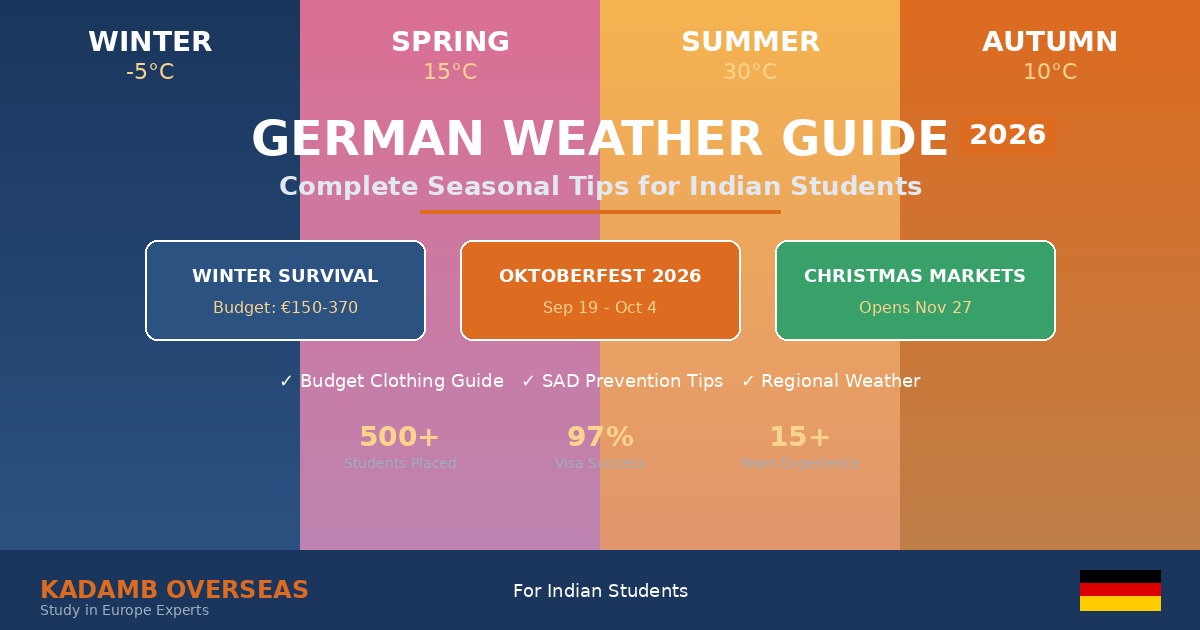
- Winter (Dec-Feb): -5°C to 5°C | 5-8 hours daylight | Snow common in south
- Spring (Mar-May): 5°C to 17°C | 10-14 hours daylight | Unpredictable rain
- Summer (Jun-Aug): 20°C to 30°C+ | 14-17 hours daylight | Occasional heatwaves
- Autumn (Sep-Nov): 7°C to 15°C | 8-12 hours daylight | Beautiful foliage
- Average Annual Rainfall: 700-850mm (well-distributed)
- Regional Variation: North = milder but wetter; South = colder but sunnier
📑 What You’ll Learn in This Guide
🌡️ Understanding the German Climate in 2026
Germany experiences a temperate seasonal climate with four distinct seasons—a stark contrast to India’s tropical weather. The country’s central European location means it’s influenced by both Atlantic Ocean air masses (bringing mild, rainy weather) and continental air from the east (bringing cold, dry weather in winter and heat in summer).
Recent climate data from the German Meteorological Service (DWD) shows that average temperatures have been trending slightly higher, with 2024 recording an average winter temperature of over 4°C—milder than historical averages. However, sudden cold snaps still occur, and preparation remains essential for Indian students.
📱 Scroll horizontally on mobile to view full table
Regional Weather Differences
Germany’s weather varies significantly by region. Here’s what to expect based on where you’ll be studying:
- Northern Germany (Hamburg, Bremen, Berlin): Milder winters (rarely below -5°C), but wetter and windier year-round. Atlantic influence keeps temperatures moderate.
- Southern Germany (Munich, Stuttgart): Colder winters with regular snowfall, but more sunshine. Bavaria can drop to -10°C but has beautiful sunny winter days.
- Rhine Valley (Cologne, Frankfurt): Warmest region with mild winters and hot summers. Wine-growing climate.
- Eastern Germany (Dresden, Leipzig): Continental climate with colder winters and warmer summers. Less rainfall than the west.
❄️ Surviving Your First German Winter: Complete Guide
For most Indian students, the German winter is the biggest climate shock. With temperatures regularly dropping below freezing and as few as 5 hours of daylight in December, preparation is essential. Here’s everything you need to know:
🧥 Essential Winter Clothing Checklist
💡 The Layering System: German Winter Survival Strategy
Germans use a “layering” approach rather than one thick coat. This is more effective because you can adjust throughout the day:
- Base Layer: Thermal underwear (top + bottom) that wicks moisture away from your body
- Mid Layer: Wool sweater or fleece for insulation—traps body heat
- Outer Layer: Waterproof, windproof jacket—your shield against the elements
💡 Pro Tip: Most German buildings are well-heated (20-22°C), so you’ll want to remove layers indoors. Restaurants and shops have coat racks near entrances.
🎄 Winter Highlights: Christmas Markets 2026
German winters aren’t all about surviving—they’re also magical! The famous Weihnachtsmärkte (Christmas Markets) run from late November through December 23rd. In 2026, expect markets to open around November 27th (first Friday before Advent).
Top Christmas markets for students:
- Nuremberg Christkindlesmarkt: Germany’s most famous, dating back to the 1500s
- Munich Marienplatz: Stunning backdrop of neo-Gothic town hall
- Cologne Cathedral Market: Set against the dramatic Gothic cathedral
- Dresden Striezelmarkt: Germany’s oldest (since 1434!)
Budget for Christmas markets: €10-20 per visit (Glühwein ≈ €4-5, Bratwurst ≈ €4-5, handmade gifts ≈ €5-20)
Planning Your Move to Germany for September 2026?
Get a complete pre-departure checklist including weather preparation, packing essentials, and budget planning. Our experts have helped 500+ students transition smoothly to German life.
✓ No spam. Response within 24 hours.
🌸 Embracing German Spring (March-May)
Spring is when Germany transforms—cherry blossoms bloom in Bonn (famous “Cherry Blossom Tunnel”), parks fill with picnickers, and outdoor café culture returns. Temperatures are unpredictable (Germans say “April macht was er will”—April does what it wants), so always be prepared.
🌷 Spring Weather Patterns
- March: Still cold (5-10°C), possible late snow, daylight increasing rapidly
- April: Highly unpredictable—can be 20°C one day, 8°C with rain the next
- May: Generally pleasant (15-20°C), but beware “Eisheiligen” (Ice Saints) around May 11-15 when late frost can occur
🎉 Spring Events & Festivals 2026
- Cologne Carnival (Karneval): February/March 2026—massive street party with costumes
- May Day (Maifeiertag): May 1st public holiday—festivals, dancing around maypoles
- Stuttgart Spring Festival: Mid-April to May—one of Europe’s largest spring festivals
- Cherry Blossom Festival, Bonn: Mid-April—Instagram-famous pink canopy
📚 Related Reading
Cost of Living in Germany for Indian Students 2026
Complete breakdown of monthly expenses including seasonal costs, budget tips, and city-wise comparisons.
☀️ Enjoying German Summers (June-August)
German summers are glorious—long days with sunshine until 10 PM, outdoor beer gardens, lake swimming, and countless festivals. Temperatures typically range from 20-30°C, though heatwaves above 35°C have become more common (Germany recorded 42.6°C in July 2019).
🏖️ Summer Activities for Students
- Freibäder (outdoor pools): Public swimming pools with affordable entry (€3-5)
- Lake swimming: Free swimming at natural lakes (Ammersee, Wannsee, etc.)
- Beer gardens: Iconic German social spots—bring your own food to save money!
- Cycling: Germany has excellent cycling infrastructure—explore cities on two wheels
- Parks: Englischer Garten (Munich), Tiergarten (Berlin), Stadtwald (Frankfurt)
🎶 Summer Festivals 2026
- Rock am Ring: June 5-7, 2026 (Nürburg)—major rock music festival
- Kieler Woche: June 20-28, 2026—world’s largest sailing event
- Berlin Pride (Christopher Street Day): July 25, 2026
- Berlin International Beer Festival: August 2026—2km of beer stands!
- Rhine in Flames: Multiple dates July-August—spectacular fireworks along the Rhine
💡 EXPERT INSIGHT
“Many Indian students struggle with their first German winter, but the ones who embrace it—join winter sports clubs, explore Christmas markets, learn to cook hearty German food—have the best experiences. Germany’s seasons are a feature, not a bug. The contrast makes each season special.”
— Saumitra Rajput, Founder, Kadamb Overseas (15+ years experience)
🍂 Autumn in Germany: Oktoberfest & Golden Foliage
Autumn is arguably Germany’s most beautiful season. The forests transform into stunning displays of red, orange, and gold, and the country’s wine regions celebrate the harvest. Of course, the highlight is Oktoberfest—the world’s largest folk festival.
🍺 Oktoberfest 2026: Everything You Need to Know
- Dates: September 19 – October 4, 2026
- Location: Theresienwiese, Munich
- Expected Visitors: 6-7 million
- Traditional Costume Parade: September 20, 2026
- Entry: FREE (you pay for beer & food)
- Beer Price: ~€14-15 per Maß (1 liter)
Student tip: Weekday afternoons are less crowded and more affordable. Many tents offer special “Family Day” discounts on Tuesdays. With your German student visa, you can work up to 20 hours/week to fund your Oktoberfest budget!
🍷 Other Autumn Events
- Wine Festivals (Weinfeste): September-October in Rhine, Moselle, and Franconia regions
- Erntedankfest (Harvest Festival): Early October—traditional thanksgiving celebrations
- Day of German Unity: October 3rd—public holiday with celebrations nationwide
🧠 Mental Health: Beating the “Winter Blues” (SAD)
One of the most overlooked challenges for Indian students is Seasonal Affective Disorder (SAD)—a type of depression linked to reduced sunlight during winter. With only 5-8 hours of daylight in December-January (compared to 12+ hours in India), many students experience low energy, mood changes, and difficulty concentrating.
⚠️ Signs of Winter Blues to Watch For
- Persistent low mood or feeling “heavy”
- Increased sleep but still feeling tired
- Craving carbohydrates and sweets
- Difficulty concentrating on studies
- Withdrawing from social activities
- Feeling homesick more intensely than expected
✅ Evidence-Based Strategies to Beat SAD
🎓 STUDENT SUCCESS STORY
Neha from Chennai, a healthcare trainee in Hamburg, shares: “My first German winter was challenging—the darkness affected my mood more than the cold. I invested in a light therapy lamp (€40), took Vitamin D supplements, and joined a gym for regular exercise. I found secondhand shops like Vinted for affordable winter gear and learned that proper layering is more effective than one thick coat.”
Now thriving in her second year with excellent grades and a part-time job 💼
Important: German student health insurance covers mental health services. If you’re struggling, you can access counseling through your university’s psychological services or through your insurance. Don’t hesitate to seek help—it’s completely normal and widely used in Germany.
💰 Weather Gear on a Student Budget
You don’t need to spend hundreds on winter gear. Here are student-tested tips for weather preparation on a budget:
🛒 Budget Shopping Options in Germany
- KiK, Tedi, Primark: Budget clothing stores—winter basics from €5-20
- Woolworth, Kaufland: Supermarkets with affordable clothing sections
- Vinted, eBay Kleinanzeigen: Secondhand apps—quality winter coats for 50-70% off
- Decathlon: Sports store with affordable, functional outdoor gear
- H&M, C&A: Mid-range options, watch for sales (especially end of season)
- TK Maxx: Discount designer store—branded items at reduced prices
💡 Money-Saving Tips
- Wait for German sales: End-of-season sales (January, July) offer 50-70% discounts
- Buy thermals in India: Jockey India thermals are high quality and cheaper than in Germany
- Layer cheap items: Multiple €10 layers work better than one expensive coat
- University lost & found: Unclaimed items are sometimes donated—check with your Studentenwerk
- Facebook Marketplace: Students leaving Germany often sell winter gear cheap
❓ Frequently Asked Questions
Germany’s winter temperatures typically range from -5°C to 5°C, though temperatures can drop to -15°C during cold snaps. The coldest month is usually January, with Berlin averaging 0.5°C and Munich averaging -0.5°C. The record low was -29.4°C in Oberstdorf in February 2012. However, with proper layering and winter gear, the cold is very manageable. Most buildings are heated to 20-22°C, so you’ll be comfortable indoors.
A mix is best! Buy thermal underwear in India (Jockey is excellent and cheaper), but purchase your main winter jacket and waterproof boots in Germany. German stores have weather-appropriate options and know what works. Budget stores like KiK, Primark, and secondhand apps like Vinted offer affordable options. Total winter wardrobe budget: €150-370. See our complete cost of living guide for more budgeting tips.
SAD is a type of depression linked to reduced sunlight during winter months. It affects approximately 5% of adults, with symptoms including low mood, fatigue, carbohydrate cravings, and difficulty concentrating. Indian students are particularly susceptible because they’re adjusting from 12+ hours of daily sunlight to just 5-8 hours in German winters. Effective treatments include light therapy lamps (€30-60), Vitamin D supplements, regular exercise, and maintaining social connections. German student health insurance covers mental health support if needed.
Christmas markets typically open the last week of November (around November 27, 2026) and run until December 23rd. Major markets like Nuremberg Christkindlesmarkt, Munich Marienplatz, Cologne Cathedral, and Dresden Striezelmarkt are must-visits. Budget €10-20 per visit for Glühwein (mulled wine, €4-5), food (€4-8), and small gifts. These markets are magical experiences and a highlight of German winter life!
Oktoberfest 2026 runs from Saturday, September 19 to Sunday, October 4, 2026 at Theresienwiese, Munich. Entry is FREE—you only pay for beer (~€14-15 per liter) and food. The Traditional Costume Parade is September 20, 2026. Student tip: Weekday afternoons are less crowded and more budget-friendly. With your student visa allowing 20 hours/week work, you can easily fund your Oktoberfest budget with a part-time job!
The Rhine Valley region (including Freiburg, Karlsruhe, and Mainz) has Germany’s mildest climate with more sunshine, warmer temperatures, and less harsh winters. Freiburg is often called “Germany’s sunniest city.” However, all German cities are manageable with proper preparation. Munich has colder winters but more sunny days. Berlin has mild winters but more grey, overcast days. Choose your university based on program quality, not weather alone!
Germans use a layering system: thermal base layer, wool/fleece mid-layer, and waterproof outer layer. Key items include insulated boots with good traction, wool socks, quality gloves, and a warm hat (30% of body heat is lost through the head!). Indoor heating is reliable (20-22°C), so the challenge is outdoor transitions. Popular German brands include Jack Wolfskin (similar to North Face). Most importantly, Germans embrace winter with activities like Christmas markets, mulled wine, ice skating, and winter sports rather than just “surviving” it.
🎯 Conclusion: Embrace the Seasons
Adapting to German weather is one of the most significant adjustments for Indian students, but it’s also one of the most rewarding. Each season brings unique experiences—Christmas markets in winter, cherry blossoms in spring, beer gardens in summer, and Oktoberfest in autumn. With proper preparation, the right mindset, and a good winter jacket, you’ll not only survive but thrive in Germany’s climate.
Remember: 500+ students from Kadamb Overseas have successfully adapted to German weather and gone on to build amazing careers in Europe. With our scholarship guidance and pre-departure support, you’ll arrive prepared for every season.
Ready to Study in Germany?
September 2026 applications are now open. Get personalized guidance on universities, visas, and preparing for life in Germany—including weather preparation.
📋 In Your Consultation:
- Personalized university recommendations
- Complete cost estimate for your profile
- Pre-departure checklist & weather guide
- Scholarship eligibility assessment
- Visa application support
📞 +91-9913333239 |
💬 WhatsApp Us
📍 Kadamb Overseas, Ahmedabad, Gujarat | ⏰ Mon-Sat: 10AM – 7PM IST
Saumitra Rajput
Founder & European Education Expert
With 15+ years of experience in overseas education consulting, Saumitra has helped 500+ Indian students achieve their European study dreams. His expertise spans Germany, Switzerland, Austria, France, and other European destinations, with a remarkable 97% visa success rate.
📚 Related Articles You’ll Find Helpful
Saumitra Rajput
Saumitra Rajput is the founder of Kadamb Overseas Pvt. Ltd., India's leading Europe-focused study abroad consultancy based in Ahmedabad. With 14+ years of expertise in European education, he has personally counselled 2,500+ Indian families and helped 500+ students secure admission to top European universities including TU Munich, ETH Zurich, EPFL, KU Leuven, HEC Paris, Sapienza Rome, TU Wien, and Warsaw University of Technology. He has visited 25+ European universities, partners with 250+ EU institutions, and maintains a 500+ students placed.
Planning to Study Abroad?
Get free expert guidance from our experienced counselors

Saumitra Rajput
Saumitra Rajput is the founder and lead counsellor at Kadamb Overseas, India's trusted Europe education consultancy based in Ahmedabad. With 14+ years of hands-on experience, he has personally guided 500+ students to universities across Germany, Switzerland, France, Italy, Austria, and Spain. Saumitra has visited partner universities across Europe, holds deep expertise in European visa processes, scholarships, and student life, and has achieved a 97% visa success rate for his clients. He is the host of the YouTube channel "Europe with Saumitra", where he shares first-hand insights on studying and living in Europe. His mission: make Europe accessible to every Indian student, with zero consultancy fees.