
Last Updated: September 7, 2026
Table of Contents
- Why Germany for MS Electrical Engineering? The Industry 4.0 Advantage
- Germany vs USA vs UK: Complete Cost Comparison for MS Electrical Engineering
- Top 10 Universities for MS Electrical Engineering in Germany (2026 Rankings)
- Top Specializations in MS Electrical Engineering Germany
- Complete Admission Process for MS Electrical Engineering
- Career Opportunities After MS Electrical Engineering in Germany
- Frequently Asked Questions (FAQs)
- Conclusion: Power Your Career with Germany's Electric Future
🕑 9 min read
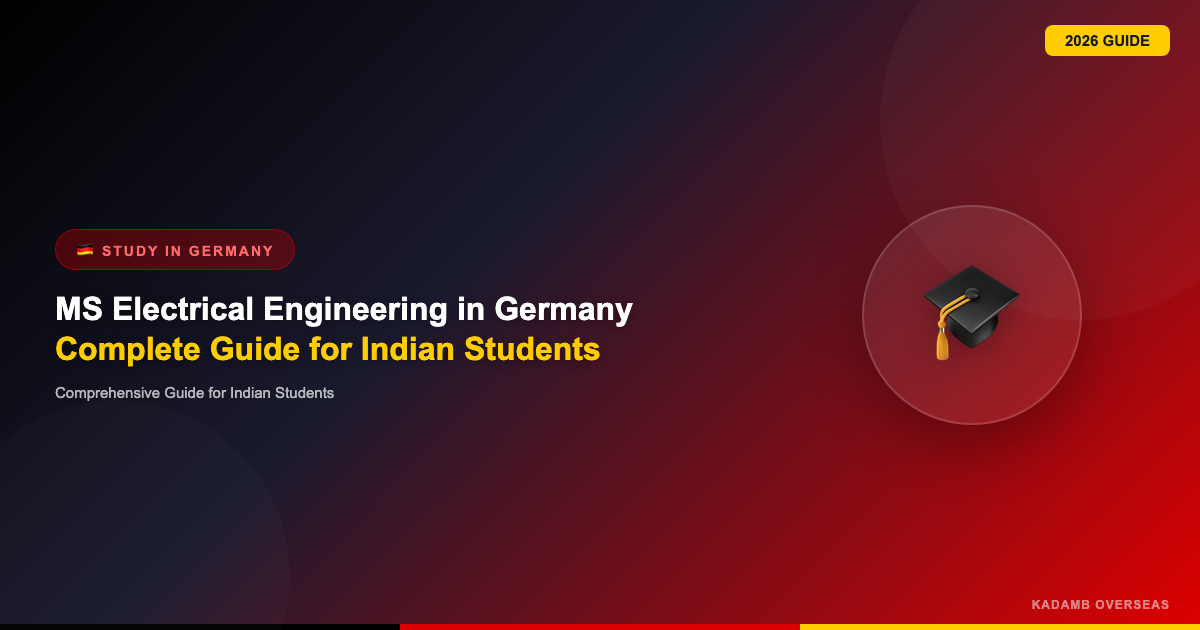
MS Electrical Engineering in Germany 2026: Complete Guide for Indian Students
Germany needs 400,000+ electrical engineers by 2030 to power its Industry 4.0 revolution, electric vehicle transformation, and renewable energy transition—creating unprecedented opportunities for international graduates. While USA charges ₹50-80 lakh for MS Electrical Engineering, Germany offers the same education at 171+ universities for ₹0 tuition fees, training you at companies that invented modern electrical engineering: Siemens, Bosch, ABB, and Infineon.
This isn’t just about affordable education—it’s about studying where innovation happens. Germany leads Europe in electric mobility (60+ EV models from German automakers), smart grid technology (€40 billion Energiewende investment), and industrial automation (home to Siemens and Bosch). Your MS thesis won’t collect dust; it could become the foundation for next-generation EV battery systems, smart manufacturing processes, or 5G telecommunications infrastructure.
For Indian B.Tech Electrical/Electronics graduates from Gujarat, this represents career acceleration: invest ₹15-21 lakh for a 2-year program, graduate debt-free, and earn €53,000-€64,000 (₹48-58 lakh) annually—that’s 6-10x higher than India’s average electrical engineer salary of ₹6-8 lakh. This comprehensive 2026 guide covers everything from university selection and Industry 4.0 specializations to visa requirements and career pathways in Germany’s electrification boom.
📌 MS Electrical Engineering Germany 2026: Quick Facts
- Universities: 171+ programs across Germany | Mix of public and technical universities
- Program Duration: 2 years (4 semesters) | Some 1.5-year intensive options
- Tuition Fees: ₹0-1.5 lakh per year | Semester fee: €300-400 (₹27,000-36,000)
- Total Cost: ₹15-21 lakh for 2 years (vs ₹55-85 lakh in USA/UK)
- Top Universities: TUM, RWTH Aachen, KIT, TU Berlin, TU Dresden
- Starting Salary: €53,000-€64,000 (₹48-58 lakh) annually after graduation
- Work Visa: 18-month job seeker visa | 85% employed within 12 months
- Hot Specializations: EV Engineering, Industry 4.0, Renewable Energy, Robotics, 5G
Why Germany for MS Electrical Engineering? The Industry 4.0 Advantage
Germany didn’t just adopt Industry 4.0—it invented the term. As the birthplace of the Fourth Industrial Revolution, Germany leads the world in smart manufacturing, electric mobility, and renewable energy technology. This creates exceptional opportunities for electrical engineers trained in German standards.
1. 171+ Universities = Maximum Choice and Flexibility
Unlike USA or UK with limited affordable options, Germany offers 171+ MS Electrical Engineering programs across technical universities, research universities, and universities of applied sciences. This variety means you can find the perfect match for your specialization—from EV systems at TUM to renewable energy at Freiburg University to semiconductor technology at TU Dresden.
2. Zero to Minimal Tuition at World-Class Institutions
German public universities charge ₹0 tuition for MS Electrical Engineering. Even universities in Baden-Württemberg charging €1,500/semester (₹1.35 lakh) cost 95% less than USA’s $45,000-$65,000 (₹37-54 lakh) per year. You invest in living expenses only—not tuition—graduating debt-free unlike peers in USA/UK.
3. Industry 4.0 Leader: Learn from the Inventors
Germany contributes €410 billion annually to the automotive industry and leads global industrial automation. Companies like Siemens (€62 billion revenue), Bosch (€91 billion revenue), and ABB actively recruit from German universities. Your professors often consult for these companies, bringing real-world projects into classrooms.
4. Electric Vehicle Revolution Creating Massive Demand
Germany’s automotive giants (VW, BMW, Mercedes-Benz, Audi, Porsche) are investing €150+ billion in electric vehicle development by 2030. This transformation requires electrical engineers specializing in battery systems, power electronics, charging infrastructure, and autonomous driving. MS programs integrate EV technology across specializations.
5. Renewable Energy Transition (Energiewende)
Germany’s Energiewende (energy transition) policy aims for 80% renewable energy by 2030, requiring smart grid engineers, power systems specialists, and renewable energy experts. The €40 billion investment creates thousands of jobs for electrical engineers who understand grid integration, energy storage, and sustainable power systems.
6. Exceptional Salaries with Rapid Career Growth
MS Electrical Engineering graduates earn €53,000-€64,000 (₹48-58 lakh) annually in starting positions. Within 3-5 years, salaries increase to €70,000-€85,000 (₹63-76.5 lakh). Senior engineers and technical leads earn €90,000-€1,20,000 (₹81-1.08 crore). Compare this to India’s ₹6-12 lakh starting salaries.
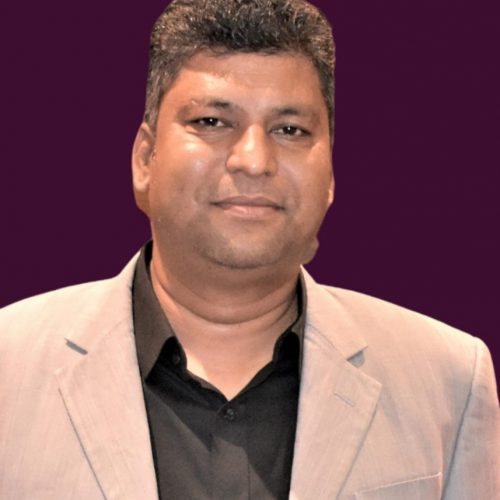
💡 Expert Insight from Saumitra Rajput, Founder of Kadamb Overseas
“The shift from combustion engines to electric vehicles is creating the biggest opportunity for electrical engineers since the invention of transistors. Germany is ground zero for this transformation—not Silicon Valley. I’ve placed students who interned at BMW’s EV division in Munich, Siemens’ smart grid research in Erlangen, and Bosch’s power electronics lab in Stuttgart. These aren’t distant internships; they’re pathways to full-time positions earning €60,000-€75,000 (₹54-67.5 lakh) annually. The combination of free education, cutting-edge research, and industry integration makes Germany the obvious choice for electrical engineers focused on future technologies.”
Germany vs USA vs UK: Complete Cost Comparison for MS Electrical Engineering
| Cost Factor | 🇩🇪 Germany | 🇺🇸 USA | 🇬🇧 UK | 🇨🇦 Canada |
|---|---|---|---|---|
| Tuition (2 years) | ₹0-3 lakh | ₹42-70 lakh | ₹32-50 lakh | ₹28-45 lakh |
| Living Costs (2 years) | ₹15-19 lakh | ₹24-35 lakh | ₹20-30 lakh | ₹18-28 lakh |
| Total Investment | ₹15-21 lakh | ₹66-1,05 lakh | ₹52-80 lakh | ₹46-73 lakh |
| Starting Salary (Annual) | ₹48-58 lakh | ₹58-80 lakh | ₹42-60 lakh | ₹45-65 lakh |
| Employment Rate (12 months) | 85%+ ✅ | 78-82% | 75-80% | 80-85% |
| ROI Timeline | 6-9 months ✅ | 7-10 years | 6-8 years | 5-7 years |
| Total Savings vs Germany | Baseline | ₹45-84 lakh | ₹31-59 lakh | ₹25-52 lakh |
Winner: Germany offers maximum value with fastest ROI. You save ₹35-85 lakh compared to USA/UK while earning competitive salaries and gaining hands-on experience with companies driving global electrical innovation.
Top 10 Universities for MS Electrical Engineering in Germany (2026 Rankings)
1. Technical University of Munich (TUM) — Electric Mobility Pioneer
QS Ranking: #1 in Germany for Electrical Engineering | #14 Worldwide
Tuition: €0-1,500/semester (₹0-1.35 lakh)
Key Specializations: Electric Vehicles, Power Systems, Robotics, AI & Automation
Why Choose: TUM operates Europe’s largest research program in electric mobility with BMW, Audi, and Siemens. Students work on actual EV prototypes, battery management systems, and autonomous driving algorithms.
2. RWTH Aachen University — Power Electronics Excellence
QS Ranking: #2 in Germany | #17 Worldwide
Tuition: €0 (Semester fee: €300/₹27,000)
Key Specializations: Power Electronics, Energy Technology, Communication Systems, Automotive Electronics
Why Choose: RWTH Aachen’s E.ON Energy Research Center is Europe’s premier facility for power systems research. Direct partnerships with Siemens, Ericsson, and Ford provide internship opportunities.
3. Karlsruhe Institute of Technology (KIT) — Smart Grid Leader
QS Ranking: #3 in Germany | #20 Worldwide
Tuition: €0 (Semester fee: €350/₹31,500)
Key Specializations: Smart Grids, Renewable Energy Integration, Power Systems, Semiconductor Technology
Why Choose: KIT’s Institute for Electric Energy Systems leads Germany’s smart grid research. Strong focus on renewable energy integration and energy storage systems.
4. TU Berlin — Telecommunications and 5G
QS Ranking: #4 in Germany | #22 Worldwide
Tuition: €0 (Semester fee: €315/₹28,350)
Key Specializations: Telecommunications, Wireless Networks, 5G Technology, Signal Processing
Why Choose: Located in Germany’s tech startup capital with strong industry connections to Nokia, Ericsson, and Deutsche Telekom. Focus on next-gen wireless communication.
5. TU Dresden — Semiconductor and Microelectronics
QS Ranking: #5 in Germany | #25 Worldwide
Tuition: €0 (Semester fee: €280/₹25,200)
Key Specializations: Microelectronics, Semiconductor Technology, Nanoelectronics, Photonics
Why Choose: Dresden is Germany’s “Silicon Saxony”—home to Infineon, Globalfoundries, and Bosch semiconductor facilities. Direct industry access for research and internships.
🎓 Student Success Story: From Ahmedabad to Siemens Erlangen
Neha Kulkarni, B.Tech Electronics, Ahmedabad
“I chose KIT’s Power Systems specialization through Kadamb Overseas. During my thesis semester, I secured an internship at Siemens Energy in Erlangen working on smart grid integration projects. The hands-on experience with industry-leading technology was incredible—we were designing systems that manage renewable energy for entire cities. Siemens offered me a full-time position as a Power Systems Engineer before I defended my thesis. Today, I earn €62,000 (₹56 lakh) annually and work on projects across Europe and Middle East. My total investment was ₹18 lakh, which I recovered in just 6 months!”
Total Savings vs USA: ₹60 lakh | Current Role: Power Systems Engineer at Siemens Energy AG
🎯 Ready for Germany’s Electric Future?
Germany’s Industry 4.0 revolution needs 400,000+ electrical engineers by 2030. Application deadlines (July 15, 2026) are approaching. Start your journey with Kadamb Overseas’ proven track record.
⏰ Winter 2026 Intake Consultations Now Open
Top Specializations in MS Electrical Engineering Germany
1. Electric Vehicle (EV) Engineering — Hottest Specialization in 2026
Best Universities: TUM, RWTH Aachen, University of Stuttgart
Focus Areas: Battery systems, Power electronics, Charging infrastructure, Motor control
Career Prospects: EV Systems Engineer at BMW, VW, Audi, Porsche, Bosch
Starting Salary: €58,000-€68,000 (₹52-61 lakh) annually
Why Hot: German automakers investing €150+ billion in EV technology by 2030, creating massive demand for specialists.
2. Power Systems and Smart Grids — Renewable Energy Focus
Best Universities: KIT, RWTH Aachen, TU Munich
Focus Areas: Grid integration, Energy storage, Renewable energy systems, Power distribution
Career Prospects: Grid Engineer at Siemens Energy, E.ON, RWE, TenneT
Starting Salary: €54,000-€64,000 (₹49-58 lakh) annually
Why Growing: Germany’s 80% renewable energy target by 2030 requires smart grid engineers.
3. Robotics and Automation (Industry 4.0)
Best Universities: TUM, KIT, TU Darmstadt
Focus Areas: Industrial robotics, AI in manufacturing, Control systems, Machine vision
Career Prospects: Automation Engineer at Siemens, Bosch, KUKA, ABB
Starting Salary: €56,000-€66,000 (₹50-59 lakh) annually
Why Future-Proof: Industry 4.0 transformation requires 200,000+ automation engineers by 2030.
4. Telecommunications and 5G Technology
Best Universities: TU Berlin, TU Dresden, University of Erlangen-Nuremberg
Focus Areas: 5G networks, Wireless communication, Signal processing, IoT systems
Career Prospects: Network Engineer at Nokia, Ericsson, Deutsche Telekom, Qualcomm
Starting Salary: €53,000-€63,000 (₹48-57 lakh) annually
5. Semiconductor Technology and Microelectronics
Best Universities: TU Dresden, RWTH Aachen, University of Stuttgart
Focus Areas: Chip design, Nanotechnology, VLSI systems, Photonics
Career Prospects: Design Engineer at Infineon, Bosch Semiconductors, GlobalFoundries
Starting Salary: €57,000-€67,000 (₹51-60 lakh) annually
Why Secure: Dresden’s “Silicon Saxony” hosts Europe’s largest semiconductor cluster.
Complete Admission Process for MS Electrical Engineering
Step 1: Research and University Shortlisting (12-15 months before)
Action: Research 171+ programs, identify 10-15 matching your specialization
Cost: ₹0
Kadamb Support: Free profile evaluation, specialization counseling, university shortlisting
Step 2: Prepare Documents and Tests (9-12 months before)
Required: B.Tech transcripts, APS Certificate, IELTS/TOEFL, SOP, 2 LORs
Cost: APS ₹18,000 + IELTS ₹16,000 = ₹34,000
Timeline: APS takes 8-12 weeks, start early
Step 3: Submit Applications (December-July)
Platforms: Uni-Assist or direct university portals
Cost: €75 first university + €30 each additional
Deadline: July 15, 2026 (Winter intake) | January 15, 2027 (Summer intake)
Step 4: Blocked Account Setup (After Admission)
Amount: €11,904 (₹10.8 lakh)
Providers: Fintiba, Expatrio, Coracle
Processing: 1-2 weeks
Step 5: Student Visa Application
Documents: Passport, admission, blocked account, insurance, APS
Fee: €75 (₹6,750)
Processing: 6-10 weeks from German Embassy
Career Opportunities After MS Electrical Engineering in Germany
| Job Role | Starting Salary (₹) | 5-Year Salary (EUR) |
|---|---|---|
| EV Systems Engineer | ₹52-61 lakh | €75,000-€90,000 |
| Power Systems Engineer | ₹49-58 lakh | €70,000-€85,000 |
| Automation Engineer | ₹50-59 lakh | €72,000-€87,000 |
| R&D Engineer (Electronics) | ₹54-63 lakh | €75,000-€92,000 |
Top Hiring Companies: Siemens AG, Robert Bosch GmbH, ABB Group, Infineon Technologies, Continental AG, BMW Group, Volkswagen Group, SAP SE
Frequently Asked Questions (FAQs)
Is MS Electrical Engineering free in Germany for Indian students?
Yes, most public universities offer tuition-free MS Electrical Engineering. Indian students pay only semester fees of €300-400 (₹27,000-36,000). Some universities charge €1,500/semester (₹1.35 lakh)—still 95% cheaper than USA/UK.
What is the salary after MS Electrical Engineering in Germany?
Starting salaries range from €53,000 to €64,000 (₹48-58 lakh) annually. With 3-5 years experience, this increases to €70,000-€85,000 (₹63-76.5 lakh). Senior positions earn €90,000-€1,20,000 (₹81-1.08 crore) per year.
Which universities are best for MS Electrical Engineering in Germany?
Top universities are Technical University of Munich (TUM) #1, RWTH Aachen #2, Karlsruhe Institute of Technology (KIT) #3, TU Berlin, and TU Dresden. All offer English-taught programs with strong industry connections.
What are the eligibility requirements for Indian students?
Students need 4-year B.Tech/B.E. in Electrical/Electronics Engineering with 70-75% marks, IELTS 6.5-7.0 or TOEFL 90-100, and APS Certificate (mandatory, ₹18,000). Core coursework in circuits, power systems, and electronics required.
How long is the MS Electrical Engineering program in Germany?
The program is 2 years (4 semesters) combining advanced coursework, research projects, industry internships at Siemens/Bosch/ABB, and a master’s thesis on cutting-edge technology.
Can I work in Germany after MS Electrical Engineering?
Yes, graduates receive an 18-month job seeker visa. Over 85% find jobs within 12 months with starting salaries of €53,000-€64,000 (₹48-58 lakh). Germany’s Industry 4.0 boom ensures strong demand for electrical engineers.
What is the total cost for 2 years for Indian students?
Total cost is ₹15-21 lakh including semester fees (₹54,000-1.08 lakh), blocked account (₹10.8 lakh), and living expenses (₹7-10 lakh/year). This is ₹35-85 lakh cheaper than USA/UK for equivalent programs.
🚀 Join Germany’s Electric Revolution Today!
Don’t miss the Industry 4.0 opportunity. With 14+ years placing students at TUM, RWTH, and top German universities, Kadamb Overseas provides complete end-to-end support from profile evaluation to visa stamping.
✅ Free Counseling | ✅ University Selection | ✅ APS Coaching | ✅ Visa Support
📍 Ahmedabad Office | 📞 +91-9913333239
🎓 14+ Years | 500+ Students | 97% Visa Success Rate
Conclusion: Power Your Career with Germany’s Electric Future
Germany’s €150 billion investment in electric vehicles and €40 billion in renewable energy isn’t just reshaping the automotive industry—it’s creating the career opportunity of a generation for electrical engineers. Investing ₹15-21 lakh in MS Electrical Engineering delivers starting salaries of ₹48-58 lakh annually, with ROI within 6-9 months.
You’re not just studying electrical engineering—you’re training at the epicenter of Industry 4.0, learning from companies that invented modern electrical systems. Your thesis could contribute to BMW’s next-generation EV platform, Siemens’ smart grid solutions, or Bosch’s autonomous driving sensors.
For students from Ahmedabad, Surat, and Vadodara, this represents more than career advancement—it’s financial freedom without crushing debt. Kadamb Overseas has successfully placed 500+ students at German universities, and we’re ready to help you join them.
👨💼 About the Author
Saumitra Rajput is the Founder and Director of Kadamb Overseas, specializing in European education for Indian students. With 14+ years of experience, he has helped 500+ electrical and electronics engineering graduates build successful international careers in Germany.
📚 Related Articles
Saumitra Rajput
Saumitra Rajput is the founder of Kadamb Overseas Pvt. Ltd., India's leading Europe-focused study abroad consultancy based in Ahmedabad. With 14+ years of expertise in European education, he has personally counselled 2,500+ Indian families and helped 500+ students secure admission to top European universities including TU Munich, ETH Zurich, EPFL, KU Leuven, HEC Paris, Sapienza Rome, TU Wien, and Warsaw University of Technology. He has visited 25+ European universities, partners with 250+ EU institutions, and maintains a 500+ students placed.
Planning to Study Abroad?
Get free expert guidance from our experienced counselors

Saumitra Rajput
Saumitra Rajput is the founder and lead counsellor at Kadamb Overseas, India's trusted Europe education consultancy based in Ahmedabad. With 14+ years of hands-on experience, he has personally guided 500+ students to universities across Germany, Switzerland, France, Italy, Austria, and Spain. Saumitra has visited partner universities across Europe, holds deep expertise in European visa processes, scholarships, and student life, and has achieved a 97% visa success rate for his clients. He is the host of the YouTube channel "Europe with Saumitra", where he shares first-hand insights on studying and living in Europe. His mission: make Europe accessible to every Indian student, with zero consultancy fees.