

Table of Contents
- Is Belgium a good choice for Indian students in 2027?
- 6 reasons Indian students choose Belgium
- Flanders vs Wallonia: the decision that shapes everything
- The best universities in Belgium for Indian students
- Which Belgian city should you live in?
- Belgium tuition fees 2026–2027 for Indian students
- Cost of living in Belgium for Indian students
- What does a year in Belgium really cost? (in rupees)
- Belgium vs Germany vs Netherlands for Indian students
- Scholarships and funding for Belgium
- Language requirements: do you need Dutch or French?
- Admission requirements and how to apply
- The Belgium student visa (Type D), step by step
- Working while you study — and the post-study "search year"
- Best courses and fields to study in Belgium
- Flanders or Wallonia — which should you pick?
- Common mistakes Indian students make with Belgium
- Your 12-month timeline for a 2027 intake
- Life as an Indian student in Belgium
- Intakes and deadlines for 2027
- How Kadamb Overseas helps — from anywhere in India
- Frequently asked questions
🕑 15 min read
Last reviewed: September 2026 · By Saumitra Rajput, Founder, Kadamb Overseas — 14+ years guiding Indian students to Europe.
Belgium is one of Europe’s most underrated destinations for Indian students — a small, bilingual country in the heart of the EU with world-top universities, English-taught master’s programmes, and living costs lower than the UK or the Netherlands. But there’s a catch almost no agent explains properly: Belgium is really two study destinations in one. The Dutch-speaking north (Flanders) and the French-speaking south (Wallonia) have different universities, different tuition fees, different languages, and — for the 2026–2027 intake — very different price tags.
This handbook is built for the 2027 intake and written specifically for Indian students. It covers the Flanders-vs-Wallonia decision, real 2026–27 tuition and living costs (in euros and rupees), the student visa, working rights, the post-study “search year”, and the exact application timeline — with no sugar-coating.
TL;DR — Key Takeaways
- Two regions, one country: Flanders (Dutch) and Wallonia + Brussels (French) — pick based on language, university and budget.
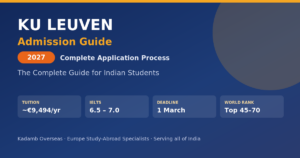
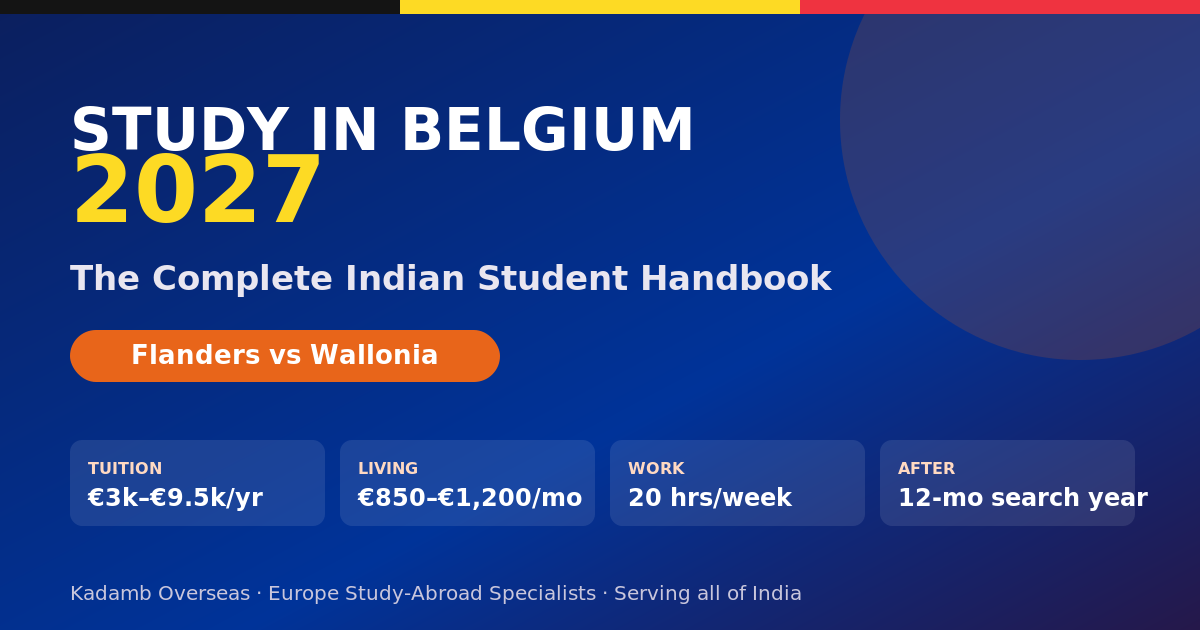
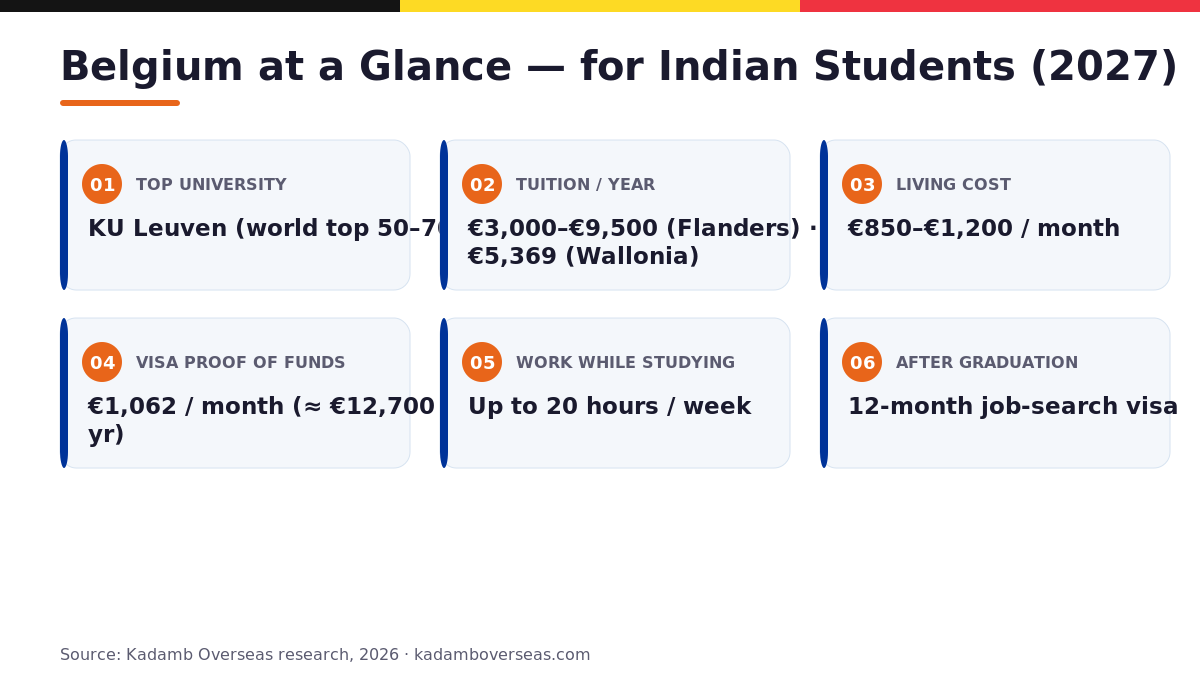
- Tuition 2026–27: Flanders roughly €3,000–€9,500/yr for non-EU (KU Leuven ~€9,494); French-speaking universities €5,369/yr (€1,194 registration + €4,175 contribution).
- Living cost: about €850–€1,200/month (≈ ₹8–11 lakh/year).
- Visa proof of funds: €1,062/month — about €12,700 for the year.
- Work: up to 20 hours/week during term; 12-month job-search visa after graduation.
- Best for: engineering, computer science, business, biotech and public-health students who want a globally ranked EU degree at a fraction of UK/US cost.
Is Belgium a good choice for Indian students in 2027?
Quick answer: Yes — if you value a highly ranked, English-taught master’s in the middle of Europe at a moderate cost. Belgium’s KU Leuven sits among the world’s top 50–70 universities, Ghent and UCLouvain are globally respected, and Brussels is the capital of the European Union, packed with institutions, NATO, multinationals and internships. Belgium is genuinely multicultural, safe, and central — you can reach Paris, Amsterdam, London, Cologne or Luxembourg in a couple of hours by train.
It is not the cheapest country in Europe — Germany’s public universities are tuition-free, and that remains the budget king. Belgium sits in the sensible middle: more affordable than the UK, the US, the Netherlands or Ireland, with degrees that carry serious weight. For the right student, that trade-off is excellent value.
6 reasons Indian students choose Belgium
- World-class universities at moderate cost. KU Leuven, Ghent and UCLouvain rank among Europe’s best, yet cost a fraction of comparable UK or US degrees.
- English-taught master’s. Belgium runs hundreds of master’s programmes entirely in English, so you don’t need Dutch or French to earn a respected European degree.
- The heart of the EU. Brussels hosts the European Commission, Parliament, NATO and thousands of multinationals and NGOs — unmatched for internships in policy, law, business and international relations.
- Central location. Paris, Amsterdam, Cologne, London and Luxembourg are all one to two hours away by train — Belgium is the easiest base for exploring Europe.
- Strong graduate outcomes. A 12-month post-study search year, a high-wage economy and skilled-worker demand in tech, engineering and biotech make the transition to work realistic.
- Safe, multicultural and welcoming. Belgium is genuinely international, with established Indian communities in Brussels, Antwerp, Leuven and Ghent.
Flanders vs Wallonia: the decision that shapes everything
This is the single most important choice, and it’s the one most students get wrong because they treat “Belgium” as one place. It isn’t. Belgium is a federal country split into language regions, and where you study decides your language of daily life, your universities, and your fees.
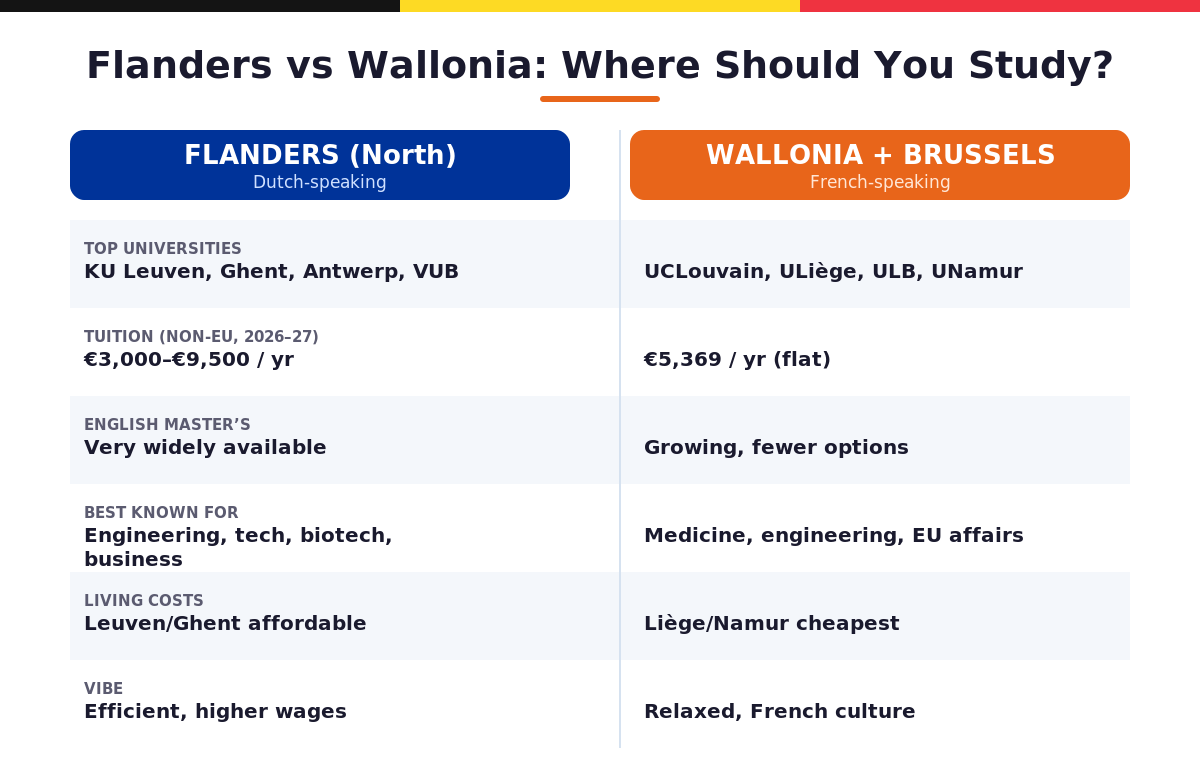
| Factor | Flanders (North) | Wallonia + Brussels (South) |
|---|---|---|
| Main language | Dutch (Flemish) | French |
| Top universities | KU Leuven, Ghent (UGent), Antwerp, VUB, Hasselt | UCLouvain, ULiège, ULB, UNamur, UMons |
| Non-EU tuition (2026–27) | ~€3,000–€9,500/yr | €5,369/yr (€1,194 + €4,175) |
| English master’s | Very widely available | Growing, but fewer than Flanders |
| Best known for | Engineering, tech, biotech, business | Medicine, engineering, humanities, EU affairs |
| Vibe | Efficient, business-like, higher wages | Relaxed, cheaper living, French culture |
The practical rule: if you want the widest choice of English-taught master’s and the strongest engineering/tech names, look at Flanders (led by KU Leuven and Ghent). If you want a lower, flat tuition fee and are comfortable in a French-speaking city — or you’re targeting medicine or EU-affairs careers in Brussels — Wallonia and Brussels make sense. Brussels itself is officially bilingual and hosts both Dutch-speaking (VUB) and French-speaking (ULB) universities.
The best universities in Belgium for Indian students
Flanders (Dutch-speaking)
- KU Leuven — Belgium’s flagship and one of Europe’s most research-intensive universities (founded 1425), consistently ranked in the world’s top 50–70. Outstanding for engineering, computer science, biomedical sciences and business. The widest English-taught master’s catalogue in the country.
- Ghent University (UGent) — a global top-100 university in a beautiful, affordable student city, strong in bioscience engineering, life sciences, veterinary medicine and psychology.
- University of Antwerp — strong in business, engineering and medicine, in Belgium’s commercial and diamond-trade capital with a large port economy.
- Vrije Universiteit Brussel (VUB) — the Dutch-speaking university in Brussels, international and English-friendly, ideal if you want the capital plus Flemish tuition.
- Hasselt University — smaller and modern, good for business, engineering technology and life sciences.
Wallonia + Brussels (French-speaking)
- UCLouvain (Université catholique de Louvain) — the top French-speaking university in Belgium, strong across engineering, economics, medicine and the sciences, based in the purpose-built student town of Louvain-la-Neuve.
- University of Liège (ULiège) — a comprehensive research university strong in engineering, veterinary medicine, sciences and management, in a lively, affordable city.
- Université libre de Bruxelles (ULB) — the French-speaking university of Brussels, internationally oriented and well placed for EU-affairs, law and political-science careers.
- University of Namur (UNamur) and UMons — smaller universities with strong teaching in sciences, informatics and engineering.
Which Belgian city should you live in?
Your city shapes your budget and lifestyle as much as your university does.
- Leuven — a classic, compact student town built around KU Leuven; lively, safe and cheaper than Brussels. Ideal if KU Leuven is your target.
- Ghent — arguably Belgium’s best student city: beautiful canals, a huge student population, great nightlife and affordable rents, home to Ghent University.
- Brussels — the bilingual capital and EU hub; the most international city with the most internships, but also the most expensive for rent.
- Antwerp — Belgium’s stylish commercial capital with a major port and fashion scene; strong for business and design, mid-to-high living costs.
- Liège — a large, affordable French-speaking city on the Meuse, home to ULiège, with a warm, down-to-earth culture.
- Louvain-la-Neuve & Namur — smaller, budget-friendly French-speaking student towns (UCLouvain, UNamur) with a strong campus feel.
If keeping costs down matters most, favour Leuven, Ghent, Liège or Namur over Brussels and Antwerp — the rent difference alone can be €150–€250 a month.
Belgium tuition fees 2026–2027 for Indian students
Here’s where Flanders and Wallonia genuinely diverge, and where 2026–27 changed the maths.
Flanders (Dutch-speaking universities)
Flemish universities set their own non-EU tuition, and fees have risen. For 2026–27, expect roughly €3,000 to €9,500 per year depending on the university and programme. At KU Leuven, the standard non-EEA fee is around €9,494 per year (60 credits), with lab-heavy or specialised programmes at the higher end. This increase followed Flemish education budget cuts, which pushed universities to charge international students closer to the real cost of their programmes.
Wallonia and Brussels (French-speaking universities)
French-speaking universities use a flatter, more predictable structure. For 2026–27 the base registration fee is €1,194, and non-exempt non-EU students pay an additional annual contribution of €4,175, for a total of €5,369 per year. This applies at UCLouvain, ULiège, ULB and others (change your programme mid-stream and you may pay the full €5,369 rather than a reduced continuing rate). A handful of Brussels programmes charge more, so always confirm the exact figure for your specific course.
Cost of living in Belgium for Indian students
Belgium’s living costs are moderate by Western-European standards — higher than Central Europe, lower than the Netherlands, the UK or the Nordics. A realistic monthly budget is €850–€1,200, depending heavily on the city.
| Expense | Per month (€) | ≈ Per month (₹) |
|---|---|---|
| Accommodation (student room / shared) | €400–€650 | ₹36,000–58,500 |
| Food & groceries | €200–€300 | ₹18,000–27,000 |
| Transport (student pass) | €25–€50 | ₹2,250–4,500 |
| Insurance, phone, misc. | €100–€200 | ₹89,000–18,000 |
| Total | €850–€1,200 | ₹76,000–1,08,000 |
Cheaper cities: Leuven, Ghent, Liège, Namur and Hasselt are noticeably more affordable than Brussels and Antwerp, where rent runs higher. Choosing a student city over the capital can save you €150–€250 a month.
What does a year in Belgium really cost? (in rupees)
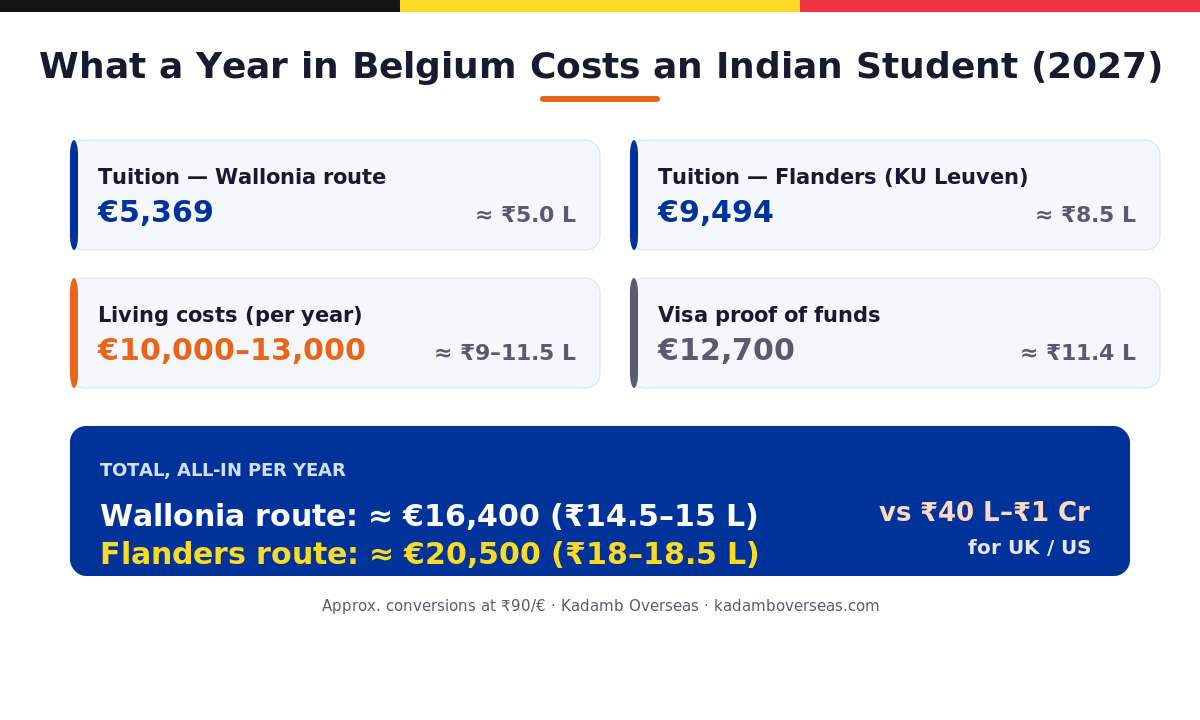
Adding tuition and living together, here’s the honest all-in figure for one year:
- Wallonia / French-speaking route: €5,369 tuition + ~€11,000 living ≈ €16,400/year ≈ ₹14.5–15 lakh.
- Flanders route (KU Leuven-level): ~€9,494 tuition + ~€11,000 living ≈ €20,500/year ≈ ₹18–18.5 lakh.
Compare that with ₹40 lakh–₹1 crore for a UK or US master’s, or ₹50 lakh+ for an Indian private professional college, and Belgium’s value is clear — especially with a scholarship. Most Belgian master’s are one or two years, so the total is very manageable.
Belgium vs Germany vs Netherlands for Indian students
These three are the destinations Indian students most often weigh against each other. Here’s the honest comparison.
| Factor | Belgium | Germany | Netherlands |
|---|---|---|---|
| Public tuition (non-EU) | €3,000–€9,500 | ≈ €0 (public) | €8,000–€20,000 |
| English master’s | Wide | Wide | Very wide |
| Post-study stay | 12 months | 18 months | 12 months (orientation year) |
| Edge | EU capital, balance of cost & prestige | Cheapest tuition, industrial jobs | Most English programmes, but pricier |
In short: Germany wins on tuition, the Netherlands on breadth of English programmes (at a higher price), and Belgium on the balance — respected universities, moderate cost, and the unique advantage of being the political capital of Europe. If budget is everything, compare Belgium with our Study in Germany guide too.
Scholarships and funding for Belgium
Funding can cut your cost dramatically. The routes worth pursuing:
- Master Mind Scholarships (Flanders) — a Flemish government scheme awarding scholarships to outstanding international master’s students at Flemish universities.
- ARES scholarships (Wallonia-Brussels) — development-cooperation scholarships for students from partner countries, including India, for specific master’s programmes.
- University scholarships — KU Leuven, Ghent, UCLouvain, ULiège and others offer their own merit and need-based awards and tuition waivers; KU Leuven, for example, offers limited waivers for students from lower-income countries.
- Erasmus Mundus Joint Master’s — fully-funded EU programmes, several coordinated by Belgian universities, covering tuition, a stipend and travel.
See our full scholarship assistance guide for how we identify and help you win these.
Language requirements: do you need Dutch or French?
For master’s degrees: usually no. Most international master’s programmes in Belgium — especially in Flanders — are taught entirely in English, and you’ll prove your English with IELTS (typically 6.5) or TOEFL. You do not need Dutch or French to study these.
For bachelor’s degrees: usually yes. Most undergraduate programmes are taught in the local language — Dutch in Flanders, French in Wallonia — so a bachelor’s generally requires proficiency in that language. This is why the large majority of Indian students come to Belgium for English-taught master’s programmes.
Either way, learning some basic Dutch or French makes daily life, part-time work and the post-study job search far easier — and employers value it.
Admission requirements and how to apply
A typical English-taught master’s application to a Belgian university needs:
- A recognised bachelor’s degree in a relevant field, with strong marks (competitive programmes look for a good academic record).
- English proof — usually IELTS 6.5 (or equivalent TOEFL), unless you qualify for a waiver.
- A motivation letter / statement of purpose and, often, letters of recommendation.
- A CV, transcripts, and degree certificates.
- Sometimes a relevant portfolio or entrance requirement, depending on the field.
Applications go directly to each university’s online portal. Deadlines for non-EU students are early — often between December and April for a September/autumn 2027 start — because you also need time for the visa afterwards. Apply to two or three well-matched universities rather than betting on one.
The Belgium student visa (Type D), step by step
Once you hold an admission letter, you apply for a Type D long-stay visa. The process is document-heavy but predictable.
- Secure admission and receive your official acceptance letter from a recognised Belgian university.
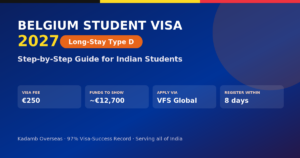
- Prove your funds. For 2026–27 you must show €1,062 per month — about €12,700 for the year — via a blocked account, a scholarship, or a formal financial guarantor (prise en charge / Annex 32).
- Gather documents: passport, admission letter, proof of funds, a medical certificate, a clean criminal-record (police clearance) certificate, insurance, and academic records — legalised/apostilled as required.
- Submit your application at the Belgian visa centre (VFS Global) covering your region — Delhi, Mumbai, Kolkata, Chennai, Bengaluru, Hyderabad or the appropriate centre — and give biometrics.
- Wait, travel and register. After approval, travel to Belgium and register at your local commune (town hall) within eight days of arrival to receive your residence permit.
Working while you study — and the post-study “search year”
International students in Belgium may work up to 20 hours per week during term time on a student work permit, and full-time during official university holidays. At around €13/hour, part-time work can bring in roughly €600–€800 a month — useful support for living costs, though not enough to fund tuition, so plan your finances as if you can’t work.
After you graduate, Belgium offers a 12-month post-study job-search visa (a “search year”), letting you stay to find skilled employment. Land a qualifying job and you can move onto a work permit or EU Blue Card — and, over time, toward long-term residence. With Brussels being the EU capital and Flanders a strong tech-and-industry economy, the graduate job market is genuinely good for skilled fields.
Best courses and fields to study in Belgium
- Engineering & technology — KU Leuven, Ghent, UCLouvain and ULiège are excellent, with strong industry and research links.
- Computer science, AI & data — high demand across Flanders’ tech economy and Brussels’ institutions.
- Biotechnology & life sciences — Belgium is a European biotech hub, and Ghent and KU Leuven are leaders.
- Business, economics & management — strong English-taught master’s, well placed for EU and multinational careers.
- Public health, international relations & EU affairs — uniquely strong because Brussels is the political heart of Europe.
Flanders or Wallonia — which should you pick?
A simple decision guide:
- Choose Flanders if: you want the widest English-taught master’s choice, the strongest global rankings (KU Leuven, Ghent), and a tech/business career — and you’re comfortable with higher tuition (up to ~€9,500).
- Choose Wallonia/Brussels if: you want a lower, flat €5,369 tuition, cheaper living (Liège, Namur), a French-speaking environment, or an EU-affairs/medicine focus in Brussels.
- Choose Brussels specifically if: you want the capital, EU institutions and internships, and access to both VUB (Dutch) and ULB (French).
Common mistakes Indian students make with Belgium
- Treating “Belgium” as one place. Flanders and Wallonia differ in language, fees and universities — choose deliberately.
- Assuming a bachelor’s is in English. Most bachelor’s are in Dutch or French; the English options are mainly at master’s level.
- Applying too late. Non-EU deadlines are early (Dec–Apr) and the visa adds months. Late starts cost strong students their place.
- A weak financial file. The €12,700 proof of funds must be clean and well-documented — the top reason for refusals.
- Ignoring the language for daily life and work. Basic Dutch or French makes part-time work and the search year far easier.
Your 12-month timeline for a 2027 intake
- 12–10 months before (mid-2026): shortlist universities and region, sit IELTS, and start scholarship research.
- 9–7 months before: prepare SOP, LORs and documents; apply to 2–3 universities before their deadlines; apply for Master Mind / ARES / Erasmus Mundus where eligible.
- 6–4 months before: receive admission, arrange proof of funds (blocked account / guarantor), and gather visa documents (medical, police clearance).
- 3–2 months before: submit the Type D visa at VFS, give biometrics.
- 1 month before: receive approval, book flights, arrange accommodation, prepare for departure.
- On arrival: register at your commune within 8 days, enrol, and begin.
Life as an Indian student in Belgium
Belgium is comfortable and easy to settle into. English is widely understood in universities and cities, public transport is excellent, and healthcare is high-quality (student insurance is mandatory and affordable). The weather is mild but grey and rainy for much of the year, so pack accordingly. Belgium is famous for its food — chocolate, waffles, fries and hundreds of beers — and Indian groceries, restaurants and communities are easy to find in Brussels, Antwerp, Leuven and Ghent, so home cooking is never far away. Cricket and community gatherings, Diwali and Holi celebrations, and active Indian student associations mean you’ll find your people quickly.
The one adjustment to plan for is language: while you can study and socialise in English, learning basic Dutch or French pays off enormously for part-time jobs, admin at the commune, and the post-study search year. Even an A2 level signals to employers that you intend to stay and integrate.
Intakes and deadlines for 2027
Most Belgian universities have a main September/autumn intake, and some offer a smaller February intake. For non-EU students the application deadlines are early — commonly between December 2026 and April 2027 for an autumn 2027 start — because you need time to secure admission, arrange proof of funds, and complete the Type D visa, which itself can take several weeks. The practical rule: aim to have your applications submitted by February–March 2027 at the latest, and start preparing (IELTS, documents, shortlist) in mid-2026. Students who begin late are the ones who miss out — not students with weak profiles.
How Kadamb Overseas helps — from anywhere in India
We are a Europe-focused consultancy working with students across all of India — Delhi, Mumbai, Kolkata, Chennai, Hyderabad, Bengaluru, Pune, Guwahati, Bhubaneswar, Kochi and beyond — online and from our Ahmedabad base. For Belgium specifically, we help you choose between Flanders and Wallonia based on your profile and budget, shortlist the right universities, build a strong application and SOP, target Master Mind, ARES and Erasmus Mundus funding, and prepare a clean visa and proof-of-funds file. With 500+ students placed across Europe and a 97% visa-success record, we do this every week.
Ready to plan your Belgium 2027 application? Book a free consultation, or read our full Study in Belgium guide and public universities in Europe overview.
Frequently asked questions
How much does it cost to study in Belgium for Indian students in 2027?
Budget roughly ₹14.5–18.5 lakh per year all-in. Tuition is about €5,369/year at French-speaking (Wallonia/Brussels) universities and €3,000–€9,500/year at Flemish universities (KU Leuven ~€9,494), plus living costs of €850–€1,200/month (≈ ₹8–11 lakh/year).
Is Belgium cheaper than the UK or Netherlands for studying?
Yes. Belgian tuition and living costs are meaningfully lower than the UK, the US, Ireland or the Netherlands for comparable degrees, while its top universities (KU Leuven, Ghent, UCLouvain) are globally respected. Germany’s public universities are cheaper still, but Belgium offers strong value in the middle.
Can I study in Belgium in English?
Yes, at master’s level — most international master’s programmes, especially in Flanders, are taught entirely in English (IELTS ~6.5). Bachelor’s programmes are mostly in Dutch (Flanders) or French (Wallonia), so most Indian students come for English-taught master’s.
What is the difference between Flanders and Wallonia for studying?
Flanders (north) is Dutch-speaking with universities like KU Leuven and Ghent and non-EU tuition of ~€3,000–€9,500/year. Wallonia and Brussels (south) are French-speaking with universities like UCLouvain, ULiège and ULB and a flat non-EU tuition of €5,369/year for 2026–27. Flanders has more English master’s; Wallonia often has lower, flatter fees.
How much money do I need for a Belgium student visa?
For 2026–27 you must prove €1,062 per month — about €12,700 for the year — through a blocked account, scholarship, or a financial guarantor (Annex 32). A clean, well-documented financial file is the single biggest factor in visa approval.
Can Indian students work while studying in Belgium?
Yes — up to 20 hours per week during term (full-time during holidays) on a student work permit, earning roughly €600–€800/month. Treat it as support for living costs, not tuition.
Is there a post-study work visa in Belgium?
Yes. Belgium offers a 12-month post-study job-search visa (“search year”) after graduation, letting you stay to find skilled work and then move onto a work permit or EU Blue Card.
Which Belgian universities are best for Indian students?
In Flanders: KU Leuven, Ghent University, University of Antwerp and VUB. In Wallonia/Brussels: UCLouvain, University of Liège and ULB. KU Leuven is the highest-ranked and has the widest English-taught catalogue.
Do I need IELTS to study in Belgium?
For most English-taught master’s programmes, yes — typically IELTS 6.5 (or an equivalent TOEFL score). Some universities grant a waiver if your previous degree was taught in English or accept a Medium-of-Instruction letter, so check each programme’s exact requirement.
When should I apply for a 2027 intake in Belgium?
Start preparing in mid-2026 and aim to submit applications between December 2026 and March 2027 for an autumn 2027 start. Non-EU deadlines are early, and you’ll need time afterward for proof of funds and the Type D visa.
Is Belgium safe for Indian students?
Yes. Belgium is a safe, stable and highly multicultural country with established Indian communities in Brussels, Antwerp, Leuven and Ghent, active student associations, and easy access to Indian food and groceries.
Can I settle in Belgium after studying?
There is a realistic path: use the 12-month post-study search year to find skilled work, move onto a work permit or EU Blue Card, and over several years of employment progress toward long-term residence. Learning Dutch or French strengthens your prospects significantly.
Kadamb Overseas · Europe study-abroad specialists · Serving students across India · +91 99131 42345 · support@kadamboverseas.com
Saumitra Rajput
Saumitra Rajput is the founder of Kadamb Overseas Pvt. Ltd., India's leading Europe-focused study abroad consultancy based in Ahmedabad. With 14+ years of expertise in European education, he has personally counselled 2,500+ Indian families and helped 500+ students secure admission to top European universities including TU Munich, ETH Zurich, EPFL, KU Leuven, HEC Paris, Sapienza Rome, TU Wien, and Warsaw University of Technology. He has visited 25+ European universities, partners with 250+ EU institutions, and maintains a 500+ students placed.
Planning to Study Abroad?
Get free expert guidance from our experienced counselors

Saumitra Rajput
Saumitra Rajput is the founder and lead counsellor at Kadamb Overseas, India's trusted Europe education consultancy based in Ahmedabad. With 14+ years of hands-on experience, he has personally guided 500+ students to universities across Germany, Switzerland, France, Italy, Austria, and Spain. Saumitra has visited partner universities across Europe, holds deep expertise in European visa processes, scholarships, and student life, and has achieved a 97% visa success rate for his clients. He is the host of the YouTube channel "Europe with Saumitra", where he shares first-hand insights on studying and living in Europe. His mission: make Europe accessible to every Indian student, with zero consultancy fees.