
AI answer summary
What is the living cost in Germany for Indian students?
Germany living cost depends on city, rent, insurance, food, transport and semester contribution. Munich and Frankfurt cost more, while smaller student cities can be more affordable.
Book a free Kadamb counselling call for profile-specific guidance.

Last Updated: April 20, 2026
💰 Europe Cost Calculator 2026 Updated
Country 1
Country 2
Table of Contents
- Complete Cost of Living Breakdown for Indian Students in Germany 2026
- Germany vs USA vs UK: Real Cost Comparison for Indian Students
- City-Wise Living Cost Comparison in Germany 2026
- Accommodation Options and Costs for Indian Students
- Germany Blocked Account 2026: What Indian Students Need to Know
- Food and Grocery Costs for Indian Students in Germany
- Health Insurance Costs for International Students
- Transportation Costs with Deutschlandticket
- Part-Time Work Income Potential in Germany
- Money-Saving Tips from Actual Students in Germany
- Frequently Asked Questions
- Conclusion
🕑 9 min read
⚡ Quick Facts: Germany Living Cost 2026
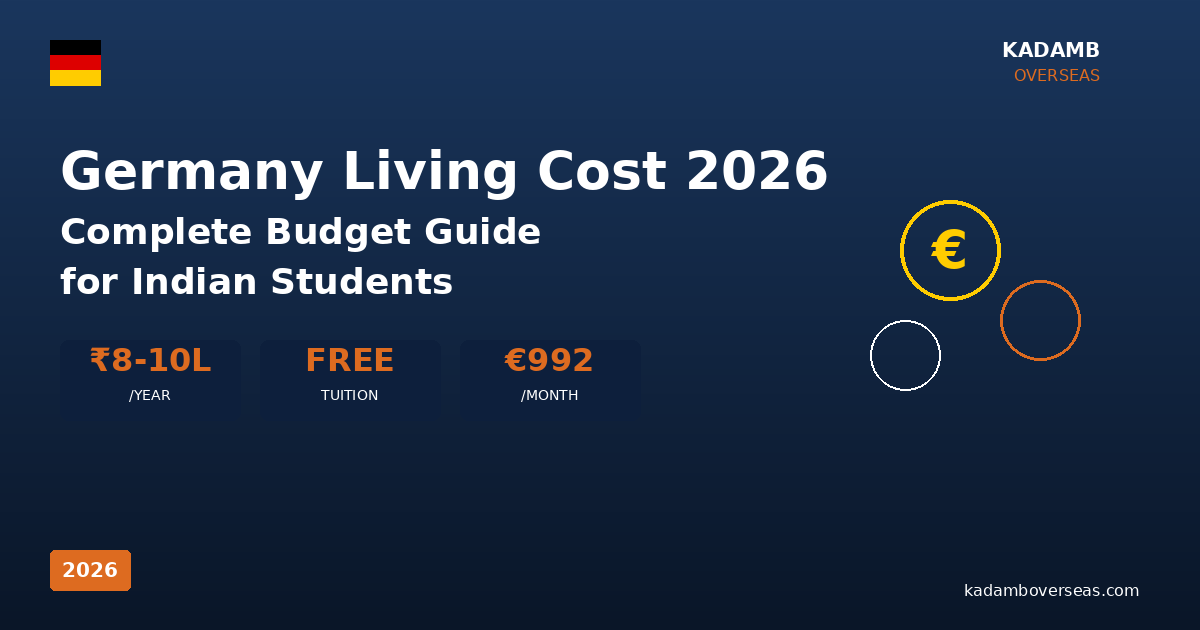
- Monthly Budget: €900-€1,200 (₹75,000-₹1,00,000)
- Annual Cost: ₹8-10 lakh (all expenses included)
- Blocked Account 2026: €11,904/year (₹10.5 lakh)
- Tuition Fees: €0 at public universities
- Part-Time Work: Up to 20 hours/week at €12.82/hour
- Cheapest Cities: Leipzig, Dresden, Chemnitz
Complete Cost of Living Breakdown for Indian Students in Germany 2026
Understanding exactly where your money goes helps you budget realistically. The German government mandates €11,904 annually in a blocked account because their research shows this is the minimum needed for comfortable student living. Let me break this down based on actual spending patterns from our students currently studying across Germany.
The biggest variable is your city choice. Munich students need €300-€400 more monthly than those in Leipzig simply because of rent differences. However, the education quality remains consistent across German public universities—a degree from Leipzig University carries the same weight as one from LMU Munich in the job market.
Monthly Expense Breakdown (Average German City):
| Expense Category | Monthly Cost (€) | Monthly Cost (₹) |
|---|---|---|
| Accommodation | €350-€500 | ₹30,000-₹43,000 |
| Food & Groceries | €200-€280 | ₹17,000-₹24,000 |
| Health Insurance | €120-€130 | ₹10,000-₹11,000 |
| Transportation | €29-€50 | ₹2,500-₹4,300 |
| Phone & Internet | €30-€50 | ₹2,500-₹4,300 |
| Study Materials | €30-€50 | ₹2,500-₹4,300 |
| Leisure & Personal | €100-€150 | ₹8,500-₹13,000 |
| TOTAL | €859-€1,210 | ₹73,000-₹1,04,000 |
The Deutschlandticket launched in 2024 transformed transportation costs. At €49/month (students get it for €29.40 from April 2025), you get unlimited travel on all local public transport across Germany—including regional trains. This single change saves students €200-€400 annually compared to previous semester ticket systems.
Germany vs USA vs UK: Real Cost Comparison for Indian Students
Numbers don’t lie, and this comparison explains why applications from India to Germany increased 15.1% in 2024, making Indians the largest international student group. When your family is deciding between destinations, this table shows the actual financial difference for a 2-year Master’s program.
| Cost Factor | Germany 🇩🇪 | USA 🇺🇸 | UK 🇬🇧 |
|---|---|---|---|
| Annual Tuition | ₹0 ✅ | ₹35-50 lakh ❌ | ₹20-35 lakh ❌ |
| Living Cost/Year | ₹8-10 lakh | ₹12-18 lakh | ₹12-15 lakh |
| Total 2-Year Cost | ₹16-20 lakh ✅ | ₹95 lakh-1.4 Cr ❌ | ₹65-1 Cr ❌ |
| Post-Study Work Visa | 18 months ✅ | Limited (OPT) ❌ | 2 years |
| You SAVE | ₹80+ lakh vs USA ✅ | — | — |
💡 Expert Insight
“The ₹80 lakh saved by choosing Germany over USA isn’t just about money—it’s about starting your career debt-free. I’ve seen students who chose USA spend their first 5-7 years post-graduation just repaying education loans, while our Germany graduates invested that money in homes, advanced certifications, and building savings. The financial freedom difference compounds dramatically over your career.”
— Saumitra Rajput, Founder, Kadamb Overseas (14+ Years Experience)
City-Wise Living Cost Comparison in Germany 2026
Your choice of city impacts your monthly budget by €200-€400. This isn’t about quality—German universities maintain consistent standards nationwide. It’s purely about local rental markets and cost of living variations between East and West Germany, and between major metropolitan areas versus smaller university towns.
Expensive Cities (Budget: €1,100-€1,500/month):
- Munich: Germany’s most expensive city. Average rent €800-€1,200/month for student housing. Home to TU Munich and LMU. Budget €1,300-€1,500/month.
- Frankfurt: Financial hub with high rents (€700-€1,000). Excellent for finance/business students. Budget €1,100-€1,400/month.
- Stuttgart: Engineering capital, strong job market. Rent €600-€900. Budget €1,100-€1,300/month.
Moderate Cities (Budget: €900-€1,100/month):
- Berlin: Surprisingly affordable for a capital city. Rent €500-€800. Budget €950-€1,200/month.
- Hamburg: Major port city with good university options. Rent €550-€850. Budget €1,000-€1,200/month.
- Cologne: Student-friendly atmosphere. Rent €500-€750. Budget €900-€1,100/month.
Affordable Cities (Budget: €700-€900/month):
- Leipzig: Fastest-growing student city. Rent €350-€500. Excellent tech scene. Budget €750-€900/month.
- Dresden: Historic city with strong engineering programs. Rent €350-€500. Budget €700-€900/month.
- Chemnitz: One of Germany’s cheapest cities. Rent €250-€400. Budget €650-€800/month.
- Halle: Affordable with excellent university. Rent €300-€450. Budget €700-€850/month.
🎓 Student Success Story
Rahul K. from Vadodara, Gujarat
“I chose TU Dresden over TU Munich specifically because of costs. My monthly expenses in Dresden are €820—rent €380, food €200, insurance €120, transport €30 (semester ticket), and €90 for everything else. My cousin in Munich spends €1,400 monthly. Same German degree, but I’ll graduate with ₹12+ lakh saved. That’s my emergency fund sorted for years.”
- University: TU Dresden
- Program: M.Sc. Computer Science
- Savings vs Munich: ₹5+ lakh over 2 years
Accommodation Options and Costs for Indian Students
Housing will consume 35-45% of your budget, making it the most critical cost decision. Germany offers three primary options, each with distinct advantages. The key is applying early—student dormitories have 6-12 month waiting lists in popular cities.
1. Student Dormitories (Studentenwerk) — €250-€450/month
The cheapest and most hassle-free option. Studentenwerk (student services organization) manages dormitories in every university city. These include utilities, internet, and sometimes basic furniture. Apply immediately after receiving your admission—waiting lists fill fast. In cities like Munich, the wait can exceed 12 months.
2. Shared Apartments (WG – Wohngemeinschaft) — €350-€550/month
The most common choice among international students. You rent a room in a shared flat with 2-4 other students, sharing kitchen and bathroom. Websites like WG-Gesucht.de and Studenten-WG.de list thousands of options. This option offers better location flexibility and faster availability than dormitories. For more details on German student visa requirements, understanding accommodation proof is essential.
3. Private Apartments — €600-€1,200/month
Studio or one-bedroom apartments offer complete privacy but at premium prices. Consider this only if your budget allows €1,200+ monthly expenses or you’re in affordable cities like Leipzig or Chemnitz. Private rentals require German-level paperwork including SCHUFA (credit check), proof of income, and often a German guarantor.
💡 Expert Tip
“Apply to Studentenwerk housing the same day you receive university admission—not after visa approval. The waiting lists are managed by application date, not arrival date. I’ve seen students miss out on €300/month dormitories because they waited until reaching Germany, then paying €600+ for private housing. Early application is non-negotiable.”
— Saumitra Rajput, Founder, Kadamb Overseas (14+ Years Experience)
🎯 Ready to Plan Your Germany Budget?
Get personalized cost estimates based on your city choice and lifestyle. Our experts have helped 500+ students budget accurately for German education.
✅ 14+ Years Experience | ✅ 97% Visa Success Rate | ✅ 500+ Students Placed
Germany Blocked Account 2026: What Indian Students Need to Know
The blocked account is Germany’s financial proof requirement—you deposit €11,904 (₹10.5 lakh approximately) before visa application, then withdraw €992 monthly after arriving. This isn’t lost money; it’s your living expenses fund with mandatory savings built in.
Key Blocked Account Details for 2026:
- Required Amount: €11,904 per year (increased from €11,208 in 2024)
- Monthly Withdrawal Limit: €992
- Providers: Expatrio, Fintiba, Deutsche Bank, and Coracle
- Processing Time: 3-7 business days for most providers
- Fees: €0-€89 opening fee depending on provider
The €992 monthly withdrawal covers your essential expenses with careful budgeting. Students in affordable cities like Leipzig or Dresden can live comfortably within this amount. Those in Munich will need part-time work income to supplement. Understanding your study in Germany complete guide helps plan these finances effectively.
Food and Grocery Costs for Indian Students in Germany
Food expenses range from €150-€300 monthly depending entirely on your cooking habits. Students who cook regularly spend €150-€200; those who eat out frequently hit €300+. The good news: Germany has excellent affordable supermarket chains and Indian grocery stores in most university cities.
Budget Supermarket Options:
- Aldi, Lidl, Penny: Cheapest options. Weekly groceries €25-€35.
- Rewe, Edeka: Better variety, slightly higher prices. Weekly groceries €35-€50.
- Asia/Indian Shops: Available in all major cities. Rice, spices, dal cost more than India but accessible.
Typical Monthly Food Budget Breakdown:
| Item | Monthly Cost |
|---|---|
| Groceries (cooking at home) | €100-€150 |
| University Mensa (canteen) | €40-€60 (€3-4/meal) |
| Occasional eating out | €30-€60 |
| Total | €170-€270 |
Health Insurance Costs for International Students
Health insurance is mandatory in Germany—you cannot enroll at university without proof of coverage. For students under 30, public health insurance costs €120-€132 monthly (including nursing care insurance). This covers doctor visits, hospital stays, prescriptions, and mental health services.
Public vs Private Health Insurance:
- Public (Statutory) Insurance: TK, AOK, Barmer, DAK. €120-€132/month. Covers everything. Mandatory for students under 30 in degree programs.
- Private Insurance: €40-€100/month. Limited coverage. Only for students over 30 or in non-degree programs. Not recommended for most students.
Transportation Costs with Deutschlandticket
The Deutschlandticket revolution changed student budgets significantly. For €49/month (€29.40 for students from April 2025), you get unlimited travel on all local public transport across Germany—buses, trams, U-Bahn, S-Bahn, and regional trains. This single ticket replaced the complex semester ticket systems.
Many universities now include a reduced Deutschlandticket in semester fees, costing students effectively €0-€30 additional monthly for unlimited travel. Check with your specific university about their arrangement. If you’re exploring the DAAD scholarship options, transportation costs are typically covered within the living stipend.
Part-Time Work Income Potential in Germany
German student visas allow significant work hours: 140 full days or 280 half days per year (equivalent to approximately 20 hours weekly during semesters, full-time during breaks). With minimum wage at €12.82/hour (2025), part-time work can cover 50-80% of your living costs.
Realistic Monthly Earnings:
- Student Jobs (HiWi positions): €450-€600/month (campus research assistant roles)
- Retail/Service Jobs: €500-€800/month (supermarkets, restaurants)
- Tutoring/Teaching: €600-€1,000/month (English tutoring, academic subjects)
- IT/Tech Working Students: €800-€1,500/month (for CS/Engineering students)
Many students fund their entire living expenses through part-time work while keeping blocked account funds as savings. However, balance work with studies—your degree is the primary goal. German employers value working student experience during recruitment, making this work experience valuable beyond the income.
Money-Saving Tips from Actual Students in Germany
Our students have developed specific strategies that consistently work for managing costs effectively. These aren’t theoretical suggestions—they’re proven methods from hundreds of Indian students currently living across German cities.
Smart Budgeting Strategies:
- Cook at home 80% of the time: University canteens for lunch (€3-4), home cooking for dinner. Saves €150/month vs eating out.
- Buy used textbooks: Facebook groups, eBay Kleinanzeigen. New textbooks cost €50-100 each; used versions €10-20.
- Student discounts everywhere: Museums, cinemas, software (Microsoft, Adobe), phone plans—always ask for student prices.
- Bulk shopping with flatmates: Split Costco-style bulk purchases for rice, cleaning supplies, toiletries.
- Free entertainment: University sports, library resources, student organization events. Germany has rich free cultural offerings.
Frequently Asked Questions
What is the cost of living in Germany for Indian students in 2026?
The cost of living in Germany for Indian students in 2026 ranges from €900-€1,200 per month (₹8-10 lakh annually). This includes accommodation (€350-€500), food (€200-€280), health insurance (€120-€130), transportation (€30-€50), and personal expenses (€100-€150). Cities like Munich cost €1,200-€1,500/month while Leipzig and Dresden are cheaper at €700-€900/month.
How much blocked account amount is required for Germany student visa in 2026?
For 2026, the blocked account requirement is €11,904 per year (approximately ₹10.5 lakh). This amount allows monthly withdrawals of €992 to cover your living expenses. The blocked account serves as proof of financial capability for your student visa application and ensures you have funds throughout your studies.
Which are the cheapest cities to live in Germany for Indian students?
The cheapest German cities for students include Leipzig (€750-€850/month), Dresden (€700-€800/month), Chemnitz (€650-€750/month), Halle (€700-€800/month), and Jena (€700-€850/month). These eastern German cities offer excellent universities with significantly lower rent compared to Munich, Frankfurt, or Stuttgart.
Can Indian students work part-time in Germany to cover living costs?
Yes, Indian students can work up to 140 full days or 280 half days annually (approximately 20 hours/week during semesters). With minimum wage at €12.82/hour, students typically earn €600-€1,000 monthly from part-time work. Many students cover 50-80% of living costs through work while maintaining strong academics.
What is the monthly rent for student accommodation in Germany?
Student accommodation costs range from €250-€450/month for dormitories (Studentenwerk), €350-€550/month for shared apartments (WG), and €600-€1,200/month for private studios. Dormitories are cheapest but have 6-12 month waiting lists. Apply immediately after receiving admission for best chances.
Is Germany cheaper than USA for Indian students?
Yes, significantly cheaper. Total 2-year Master’s cost in Germany is ₹16-20 lakh (with FREE tuition at public universities) compared to ₹95 lakh-1.4 crore in USA. German public universities charge zero tuition while US universities charge $30,000-$60,000 annually. You save ₹80+ lakh choosing Germany over USA.
🚀 Start Your Affordable Germany Journey Today
Join 500+ Indian students who chose smart, affordable European education. Get personalized budget planning and application support from our 14+ years experienced team.
Book Free Consultation
Ask a Question
📍 Visit us: Ahmedabad Office | 📞 WhatsApp: +91-9913333239
Conclusion
Germany offers what no other major study destination can: world-class education at ₹8-10 lakh per year total cost, with zero tuition fees. The €11,904 blocked account requirement is your living expenses fund, not a payment to universities. By choosing affordable cities like Leipzig or Dresden, cooking at home, and working part-time, our students consistently live comfortably while building careers in Europe’s strongest economy. The 18-month post-study work visa then converts your investment into salaries starting at ₹40-60 lakh annually.
About the Author
Saumitra Rajput is the Founder of Kadamb Overseas Pvt Ltd, Ahmedabad’s trusted study abroad consultancy with 14+ years of experience. He has personally guided 500+ Indian students to top European universities with a 97% visa success rate.
📚 Related Articles
Saumitra Rajput
Saumitra Rajput is the founder of Kadamb Overseas Pvt. Ltd., India's leading Europe-focused study abroad consultancy based in Ahmedabad. With 14+ years of expertise in European education, he has personally counselled 2,500+ Indian families and helped 500+ students secure admission to top European universities including TU Munich, ETH Zurich, EPFL, KU Leuven, HEC Paris, Sapienza Rome, TU Wien, and Warsaw University of Technology. He has visited 25+ European universities, partners with 250+ EU institutions, and maintains a 97% visa success rate.
Planning to Study Abroad?
Get free expert guidance from our experienced counselors

Saumitra Rajput
Saumitra Rajput is the founder and lead counsellor at Kadamb Overseas, India's trusted Europe education consultancy based in Ahmedabad. With 14+ years of hands-on experience, he has personally guided 500+ students to universities across Germany, Switzerland, France, Italy, Austria, and Spain. Saumitra has visited partner universities across Europe, holds deep expertise in European visa processes, scholarships, and student life, and has achieved a 97% visa success rate for his clients. He is the host of the YouTube channel "Europe with Saumitra", where he shares first-hand insights on studying and living in Europe. His mission: make Europe accessible to every Indian student, with zero consultancy fees.
Related Articles
- Blocked Account Germany 2026: Complete Guide for Indian Students | Expatrio vs Fintiba
- Is Germany Safe for Indian Students in 2026? Complete Safety Guide With Statistics and Tips
- University of Hamburg 2026: Complete Guide for Indian Students
- Goethe University Frankfurt 2026: Complete Guide for Indian Students
- University of Bonn 2026: Complete Guide for Indian Students