


Last Updated: April 19, 2026
💰 Europe Cost Calculator 2026 Updated
Country 1
Country 2
Table of Contents
- 🎓 Why is Education Free in Germany?
- 💰 Real Cost Breakdown: Germany vs USA vs UK
- 🏛️ Top Tuition-Free German Universities for Indian Students
- 📋 Eligibility Requirements for Indian Students
- 📝 Application Process & Timeline for September 2026
- 📄 Documents Required for Application
- 🛂 German Student Visa Process from India
- 💼 Working While Studying in Germany
- 🎯 Post-Study Work Visa: 18 Months to Find a Job
- 🏠 Living Costs Breakdown (Monthly)
- 🎓 Popular English-Taught Programs in Germany
- 🔖 APS Certificate for Indian Students — Mandatory for German Visa
- 💶 Semester Contribution (Semesterbeitrag) — The Hidden Cost of "Free" Education
- 🏙️ Cheapest Cities in Germany for Indian Students (2026)
- ❓ Frequently Asked Questions
🕑 10 min read
Yes, you can study in Germany completely tuition-free in 2026—this is not a scholarship, not a discount, but a policy that applies to ALL students including Indians. German public universities charge ₹0 tuition fees, making a world-class Master’s degree possible for just ₹16-20 lakh total (including 2 years of living costs).
Compare this to USA where you’d spend ₹1-1.4 crore, or UK at ₹75 lakh-1.2 crore. Germany offers the same quality education—with universities like TU Munich (#37 world) and RWTH Aachen (#106 world)—at a fraction of the cost.
In this comprehensive guide, we’ll cover everything you need to know about studying in Germany for free in 2026: eligibility, top universities, actual costs, application process, and how to get your student visa.
🇩🇪 Germany Free Education: Quick Facts 2026
- Tuition Fee: ₹0 at all public universities (except Baden-Württemberg)
- Semester Fee: €150-350 (₹14,000-32,000) per semester
- Living Cost: ₹8-10 lakh per year
- Total 2-Year Cost: ₹16-22 lakh (vs ₹1+ crore USA)
- English Programs: 1,800+ Master’s programs
- Post-Study Work Visa: 18 months
- Work While Studying: 20 hours/week allowed
🎓 Why is Education Free in Germany?
Unlike most countries, Germany believes education is a public good, not a commodity. In 2014, all German states abolished tuition fees for both domestic and international students at public universities.
This isn’t charity—it’s policy. The German government funds universities directly through taxes, so they don’t need to charge students. The only exception is Baden-Württemberg, which reintroduced fees of €1,500/semester (₹1.4 lakh) for non-EU students in 2017.
✅ What “Free” Actually Means:
- Tuition: ₹0 (no fees for teaching)
- Semester Contribution: €150-350 required (covers admin, student union, transport)
- Living Expenses: You pay for housing, food, insurance (₹8-10L/year)
💰 Real Cost Breakdown: Germany vs USA vs UK
Let’s look at the actual numbers for a 2-year Master’s degree:
Bottom line: You save ₹80 lakh to ₹1.2 crore by choosing Germany over USA. That’s enough to buy a house in most Indian cities!
🏛️ Top Tuition-Free German Universities for Indian Students
Germany has over 300 public universities offering free education. Here are the top-ranked ones:
*Universities in Baden-Württemberg charge additional €1,500/semester for non-EU students
For detailed admission guides, check our posts on TU Munich and Heidelberg University.
🎯 Not Sure Which German University Fits Your Profile?
With 300+ tuition-free options, choosing the right university is crucial. Get personalized recommendations based on your academic background, budget, and career goals.
✓ 500+ students guided to German universities
📋 Eligibility Requirements for Indian Students
To study in Germany for free, you need to meet these requirements:
📚 Academic Requirements
- Bachelor’s Degree: Minimum 60-70% (varies by university)
- Relevant Background: Degree should match Master’s program
- GRE/GMAT: NOT required for most programs
- Work Experience: NOT required for most programs
🗣️ Language Requirements
- English Programs: IELTS 6.0-6.5 or TOEFL 80-90
- German Programs: TestDaF 4×4 or DSH-2
- Some universities accept: PTE, Duolingo, Cambridge
Need English test preparation? Check our IELTS Coaching program.
💰 Financial Requirements (For Visa)
- Blocked Account: €11,904 (₹11 lakh) – mandatory
- Monthly Withdrawal: €992/month allowed
- Health Insurance: €110/month (~₹10,200)
- Providers: Expatrio, Fintiba, Coracle
📝 Application Process & Timeline for September 2026
Here’s your month-by-month roadmap for September 2026 intake:
📅 NOW – February 2026
Research universities, take IELTS, prepare documents (transcripts, SOP, LORs)
📅 January – April 2026
Submit applications via uni-assist or directly to universities
📅 April – June 2026
Receive admission letters, open blocked account
📅 May – July 2026
Apply for German student visa at VFS/Embassy
📅 September 2026
Arrive in Germany, start your studies! 🎉
📄 Documents Required for Application
Start gathering these documents early:
Need help with SOP? Check our SOP Assistance service.
💡 EXPERT INSIGHT
“The biggest mistake Indian students make is applying to only 1-2 universities. I always recommend applying to 5-7 programs across different ranking tiers. With free applications to most German universities, there’s no reason to limit your options.”
— Saumitra Rajput, Founder, Kadamb Overseas (15+ years experience)
🛂 German Student Visa Process from India
After receiving your admission letter, here’s how to get your German student visa:
Step 1: Open Blocked Account
Deposit €11,904 (₹11 lakh) in Expatrio, Fintiba, or Deutsche Bank blocked account. This proves you can support yourself financially.
Step 2: Buy Health Insurance
Get travel health insurance for initial entry, then switch to German public insurance (TK, AOK) after arrival. Cost: ~€110/month.
Step 3: Book VFS Appointment
Schedule appointment at VFS Global (Delhi, Mumbai, Bangalore, Chennai, Kolkata, Hyderabad, Pune). Book 6-8 weeks before planned travel.
Step 4: Attend Visa Interview
Submit documents, answer questions about your study plans and finances. Processing takes 4-8 weeks.
✅ Visa Success Rate with Kadamb: 97%
Our interview preparation ensures you’re ready for every question.
💼 Working While Studying in Germany
One of the best parts of studying in Germany—you can legally work to support yourself:
✅ Work Rights for Indian Students
- During Semester: 20 hours/week
- During Semester Breaks: Full-time allowed
- Minimum Wage: €12.41/hour (₹1,150/hour)
- Monthly Earnings: ₹80,000-1,00,000 possible
- Popular Jobs: Research assistant (HiWi), tutoring, restaurant, retail
Learn more about living costs in Germany and how part-time work can offset expenses.
🎯 Post-Study Work Visa: 18 Months to Find a Job
After graduation, Germany offers one of the best post-study work policies:
🛂 18-Month Job Seeker Visa
- Stay 18 months after graduation to find work
- Work any job during this period (no restrictions)
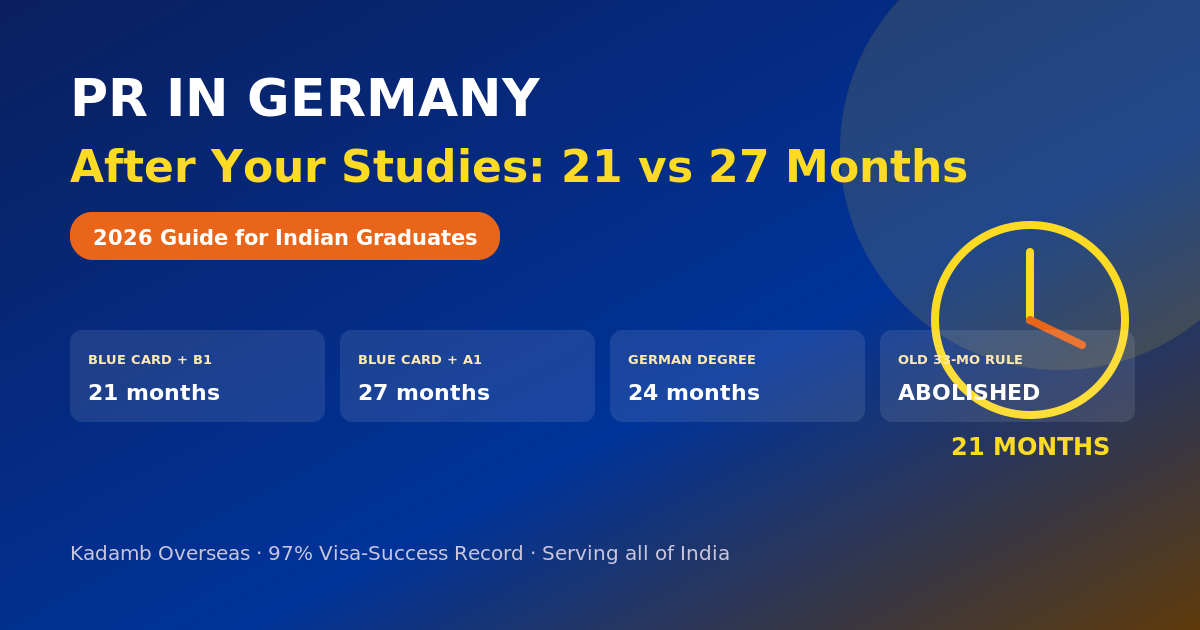
- Once you find a job matching your qualification → EU Blue Card
- Blue Card holders can apply for PR after 21-33 months
💰 Average Starting Salaries in Germany
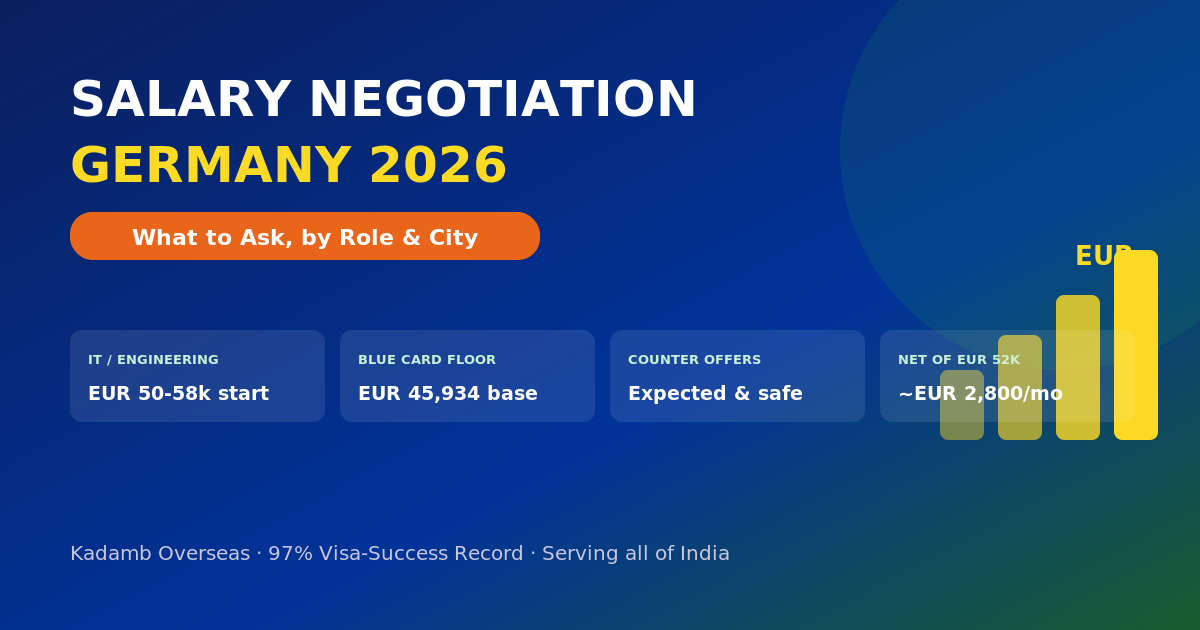
- Engineering: €50,000-65,000/year (₹46-60 lakh)
- Computer Science/IT: €55,000-75,000/year (₹51-70 lakh)
- Business/Finance: €45,000-60,000/year (₹42-56 lakh)
- Data Science/AI: €60,000-80,000/year (₹56-74 lakh)
🎓 STUDENT SUCCESS STORY
Sandip from Gujarat completed his Master’s in Mechanical Engineering at TU Munich in 2023. “I spent just ₹18 lakh total for 2 years—my friends in USA spent ₹1.2 crore! Now I’m earning €58,000/year at BMW Munich. Germany was the smartest financial decision I ever made.”
Now working at BMW with EU Blue Card, applying for PR in 2025 💼
🏠 Living Costs Breakdown (Monthly)
Here’s what you’ll actually spend each month in Germany:
🎓 Popular English-Taught Programs in Germany
Germany offers 1,800+ Master’s programs in English. Most popular for Indian students:
- Computer Science & Data Science – TU Munich, RWTH Aachen, TU Berlin
- Mechanical Engineering – RWTH Aachen, TU Munich, KIT
- Electrical Engineering – TU Munich, TU Dresden, RWTH Aachen
- Business Administration – Mannheim, LMU Munich, Cologne
- Automotive Engineering – TU Munich, Stuttgart, Aachen
- Renewable Energy – TU Berlin, Freiburg, Oldenburg
Search all English programs on DAAD database.
🔖 APS Certificate for Indian Students — Mandatory for German Visa
If you’re an Indian student applying to a German university, you must obtain an APS Certificate (Akademische Prüfstelle) before applying for a student visa. This is non-negotiable — without it, the German consulate will reject your visa application.
What Is the APS Certificate?
The APS (Academic Evaluation Centre) verifies the authenticity of your Indian academic documents. Germany introduced this requirement specifically for Indian students due to high rates of fraudulent certificates in earlier years. The APS office in India is located in New Delhi and Chennai.
APS Certificate Types
| Type | Who Needs It | Process | Time |
|---|---|---|---|
| APS Certificate (Standard) | Bachelor’s/Master’s applicants with Indian degrees | Document submission + interview at New Delhi or Chennai | 6–8 weeks |
| APS for School Leavers | Students applying after Class 12 (direct Bachelor’s) | Document check only, no interview | 4–6 weeks |
| APS Fast Track | Any applicant needing urgent processing | Same as standard, priority queue | 2–3 weeks |
APS Application — Step by Step
- Register online at aps-india.de
- Upload documents: all mark sheets, degree certificates, transcripts, ID proof
- Pay fee: ₹18,000 (standard) or ₹27,000 (fast track)
- Attend interview at New Delhi (C-9 Qutab Institutional Area) or Chennai (Goethe-Institut)
- Receive certificate by post or collect in person
💶 Semester Contribution (Semesterbeitrag) — The Hidden Cost of “Free” Education
German public universities don’t charge tuition, but every student pays a Semesterbeitrag (semester contribution) — an administrative fee covering student union services, public transport passes, and campus facilities. This fee is not optional.
| State | Top University | Semester Fee (€) | Includes Transport? | In ₹ (approx) |
|---|---|---|---|---|
| Bavaria | TU Munich / LMU Munich | €144–€150 | No (buy separate) | ~₹13,000 |
| Baden-Württemberg | Heidelberg / KIT Karlsruhe | €165–€175 | No | ~₹15,000 |
| Berlin | TU Berlin / FU Berlin / HU Berlin | €307–€314 | ✅ Yes (AB zones) | ~₹28,000 |
| Hamburg | University of Hamburg / TUHH | €340–€365 | ✅ Yes (HVV) | ~₹32,000 |
| North Rhine-Westphalia | RWTH Aachen / TU Dortmund | €290–€310 | ✅ Yes (NRW) | ~₹27,000 |
| Saxony | TU Dresden / Leipzig | €245–€260 | ✅ Yes (regional) | ~₹23,000 |
| Lower Saxony | Leibniz Hannover / Göttingen | €380–€400 | ✅ Yes (VRB) | ~₹35,000 |
Key insight: Universities in Berlin or Hamburg charge higher semester fees (~€300–400) but include a public transport pass worth €400–600/semester. Munich charges lower fees (~€150) but you pay transport separately (~€200–250/semester). Net cost is often similar — factor this when comparing cities.
🏙️ Cheapest Cities in Germany for Indian Students (2026)
Your monthly living cost varies dramatically by city. Here’s a realistic comparison for a student sharing a flat:
| City | Rent (shared flat) | Food | Transport | Total/Month | Total/Year (₹) |
|---|---|---|---|---|---|
| Leipzig 🥇 | €280–€350 | €150–€180 | €60–€80 | €490–€610 | ₹5.3–6.6L |
| Dresden | €300–€380 | €150–€200 | €65–€85 | €515–€665 | ₹5.5–7.2L |
| Dortmund / Bochum | €320–€420 | €160–€200 | €60–€90 | €540–€710 | ₹5.8–7.7L |
| Hannover | €350–€450 | €160–€200 | Included in fee | €510–€650 | ₹5.5–7.0L |
| Berlin | €500–€700 | €180–€220 | Included in fee | €680–€920 | ₹7.3–9.9L |
| Frankfurt | €550–€750 | €200–€250 | €80–€100 | €830–€1,100 | ₹8.9–11.9L |
| Munich | €650–€900 | €220–€280 | €200–€250 | €1,070–€1,430 | ₹11.6–15.5L |
💡 Student tip: Leipzig and Dresden (Saxony state) have Germany’s lowest living costs, strong engineering programs (TU Dresden ranks among Germany’s best), and excellent quality of life. For Indian students on a budget, Leipzig or Dresden saves ₹4–8 lakh per year compared to Munich — with no compromise in degree quality.
Tuition: ₹0 | Semester fee: ₹13,000–35,000/semester | Living (budget city): ₹5–7L/year | Living (expensive city): ₹89–15L/year
Total range: ₹5.5L–15.5L/year — vs ₹35–55L/year in the UK or USA.
❓ Frequently Asked Questions
Yes! Public universities in Germany charge ₹0 tuition for all students, regardless of nationality. You only pay a semester contribution of €150-350 (₹14,000-32,500) which covers admin fees, student union, and public transport. The only exception is Baden-Württemberg state, which charges €1,500/semester for non-EU students.
For a 2-year Master’s degree, expect to spend ₹16-22 lakh total, including semester fees (₹56K-1.3L), living costs (₹16-20L), and health insurance (₹2.2L). This is about 85% cheaper than USA. Check our detailed Germany cost breakdown.
Not necessarily. Germany offers 1,800+ Master’s programs taught entirely in English. For these, you need IELTS 6.0-6.5. However, learning basic German (A1-B1) is helpful for daily life, part-time jobs, and career opportunities after graduation.
A blocked account (Sperrkonto) is mandatory for your German student visa. You must deposit €11,904 (₹11 lakh) in a special account. You can withdraw €992/month for living expenses. Providers include Expatrio, Fintiba, and Coracle. This proves you can financially support yourself.
Yes! International students can work 20 hours/week during semesters and full-time during breaks. With minimum wage at €12.41/hour, you can earn ₹80,000-1,00,000/month. Popular student jobs include research assistant (HiWi), tutoring, and restaurant work.
Germany offers an 18-month post-study work visa to find employment. Once you get a job matching your qualification, you can apply for the EU Blue Card. Blue Card holders can apply for permanent residency after 21-33 months. Average starting salaries are €50,000-70,000/year (₹46-65 lakh).
Start NOW! Most German universities have application deadlines between January-April 2026. You should: Take IELTS by January 2026, prepare documents by February 2026, submit applications by March-April 2026, and apply for visa by May-June 2026. Book a consultation to create your personalized timeline.
Ready to Study in Germany for ₹16-20 Lakh?
September 2026 applications are now open. Get expert guidance from university selection to visa approval.
📋 In Your Session:
- University shortlist (5-7 options for your profile)
- Exact cost estimate & funding options
- Application timeline & document checklist
- Blocked account & visa guidance
- Scholarship eligibility assessment
📞 +91-9913333239 |
💬 WhatsApp Us
📍 Kadamb Overseas, Shahabad, Ahmedabad | ⏰ Mon-Sat: 10AM – 7PM IST
Saumitra Rajput
Founder & European Education Expert
With 15+ years experience, Saumitra has helped 500+ Indian students from Gujarat study at top German universities including TU Munich, RWTH Aachen, TU Berlin, and Heidelberg.
📚 Related Germany Guides
Saumitra Rajput
Saumitra Rajput is the founder of Kadamb Overseas Pvt. Ltd., India's leading Europe-focused study abroad consultancy based in Ahmedabad. With 14+ years of expertise in European education, he has personally counselled 2,500+ Indian families and helped 500+ students secure admission to top European universities including TU Munich, ETH Zurich, EPFL, KU Leuven, HEC Paris, Sapienza Rome, TU Wien, and Warsaw University of Technology. He has visited 25+ European universities, partners with 250+ EU institutions, and maintains a 500+ students placed.
Planning to Study Abroad?
Get free expert guidance from our experienced counselors

Saumitra Rajput
Saumitra Rajput is the founder and lead counsellor at Kadamb Overseas, India's trusted Europe education consultancy based in Ahmedabad. With 14+ years of hands-on experience, he has personally guided 500+ students to universities across Germany, Switzerland, France, Italy, Austria, and Spain. Saumitra has visited partner universities across Europe, holds deep expertise in European visa processes, scholarships, and student life, and has achieved a 97% visa success rate for his clients. He is the host of the YouTube channel "Europe with Saumitra", where he shares first-hand insights on studying and living in Europe. His mission: make Europe accessible to every Indian student, with zero consultancy fees.