

Last Updated: September 7, 2026
Table of Contents
- 🇩🇪 Why Germany is the Top Choice for Indian Students in 2026
- 📚 German Education System: What Indian Students Need to Know
- 💰 Complete Cost Breakdown: Study in Germany 2026
- 🎓 Top Courses & Universities for Indian Students
- 📋 Admission Requirements for German Universities
- 💼 Part-Time Work & Minimum Wage in Germany 2026
- 🛣️ Post-Study Work & EU Blue Card in Germany
- 🎯 Scholarships for Indian Students in Germany 2026
- ❓ Frequently Asked Questions
- 🎯 Conclusion: Why Germany Should Be Your Top Choice in 2026
🕑 10 min read
⚡ Quick Facts: Study in Germany 2026
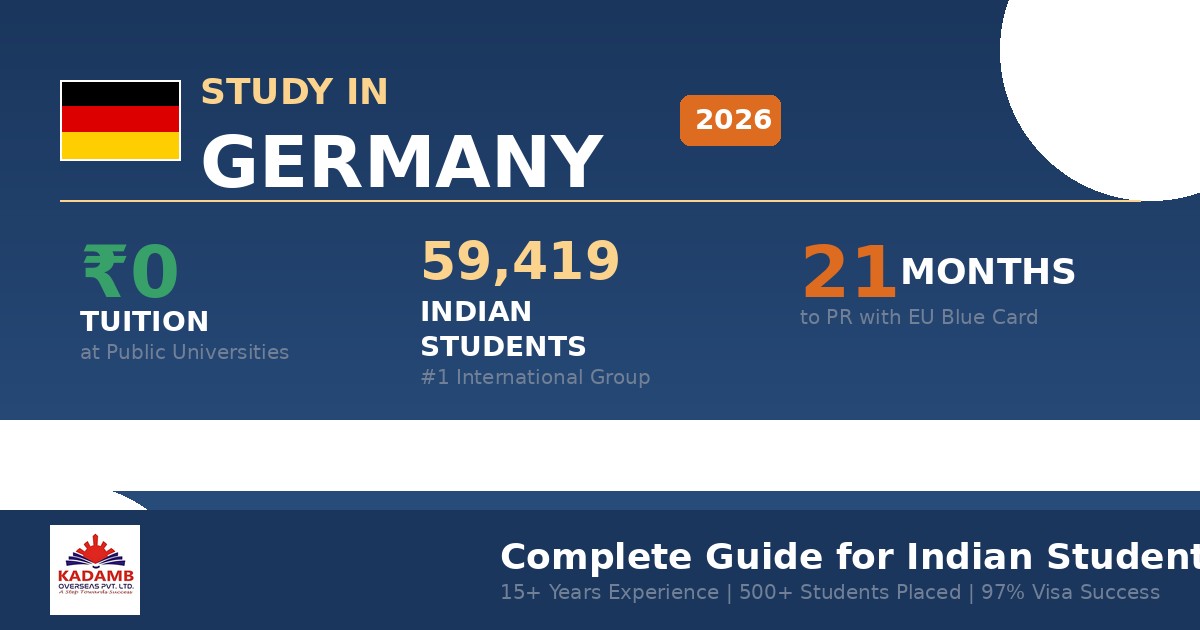
- Indian Students in Germany: 59,419+ (largest international group)
- Tuition Fee (Public Universities): €0 – €500/semester (₹0 – ₹46,000)
- Blocked Account Requirement: €11,904/year (₹10.6 lakh)
- Monthly Living Cost: €992 (₹88,500)
- Part-Time Work: 120 full days or 240 half days/year
- Minimum Wage 2026: €13.90/hour (₹1,240)
- Post-Study Work Visa: 18 months
Germany has officially become the number one destination for Indian students seeking affordable, world-class education in 2026. With 59,419 Indian students currently enrolled—making India the largest international student community in German universities—the shift from traditional destinations like the USA and Canada is now undeniable.
According to the latest DAAD (German Academic Exchange Service) report released in December 2025, the number of Indian students in Germany has more than doubled in just five years, growing from 28,905 in 2020 to nearly 60,000 today. This represents a remarkable 20% year-on-year increase, with enrollment surpassing even China for the second consecutive year.
If you’re considering studying in Germany for the September 2026 intake, this comprehensive guide covers everything you need to know—from updated blocked account requirements to the new EU Blue Card salary thresholds, admission processes, and post-study opportunities.
📑 What’s Inside This Guide
🇩🇪 Why Germany is the Top Choice for Indian Students in 2026
The numbers don’t lie. While applications to US universities from India dropped by 13% in 2024, and Canada imposed a 52% study permit rejection rate, Germany has maintained stable, transparent visa processes with consistently high approval rates.
Here’s what’s driving this massive shift:
📱 Scroll horizontally on mobile to view full comparison
Key Statistics: Indian Students in Germany 2025-2026
- 59,419 Indian students enrolled (Winter Semester 2024/25)
- 20% year-on-year growth in Indian enrollments
- 60% of Indian students study Engineering
- 21% choose Law, Management, or Social Sciences
- 13% pursue Mathematics and Natural Sciences
- 69% male students, 31% female students
- 100%+ growth in five years (from ~28,905 in 2020)
📚 German Education System: What Indian Students Need to Know
The German higher education system differs significantly from India’s. Understanding these differences is crucial for your study abroad journey.
Types of Universities in Germany
Important: Germany has more public universities than private ones because German law mandates that education should be affordable and accessible to everyone. As of 2026, nearly all public universities in Germany charge no tuition fees—only a small administrative fee (Semesterbeitrag) of €150-€500 per semester.
💡 EXPERT INSIGHT
“Many Indian families don’t realize that a two-year Master’s degree in Germany can cost less than ₹25 lakhs total—including tuition, living expenses, and travel. Compare that to ₹1 crore+ in the USA. Germany offers the same global exposure, better work opportunities, and a clear path to permanent residency.”
— Saumitra Rajput, Founder, Kadamb Overseas (15+ years experience)
English-Taught Programs
One of the biggest myths about studying in Germany is that you need to be fluent in German. This is not true!
As of 2025, German universities offer:
- 2,400+ English-taught programs at state-recognized universities
- 1,930+ Master’s programs in English (18% of all Master’s courses)
- 420+ Bachelor’s programs in English
Top universities like TU Munich, RWTH Aachen, and Heidelberg University offer globally recognized degrees entirely in English.
Not Sure Which German University Fits Your Profile?
Get a personalized university shortlist based on your academic background, budget, and career goals. Our experts have helped 500+ Indian students find their perfect match in Germany.
✓ No spam. Response within 24 hours.
💰 Complete Cost Breakdown: Study in Germany 2026
Understanding the true cost of studying in Germany is essential for financial planning. Here’s the updated breakdown for 2026:
1. Tuition Fees
Note: The semester fee (Semesterbeitrag) at public universities is NOT tuition—it covers student services, public transport (Semester Ticket), and administrative costs.
2. Blocked Account Requirement (Updated for 2026)
🔒 German Blocked Account (Sperrkonto) Requirements 2026
- Required Amount: €11,904 per year (₹10,61,729 approx.)
- Monthly Withdrawal: €992/month (₹88,477)
- Approved Providers: Expatrio, Fintiba, Coracle, Drop Money
- Important: Deutsche Bank no longer offers blocked accounts since July 2022
The blocked account proves to German authorities that you have sufficient funds to cover living expenses. You can only withdraw €992 per month once you arrive in Germany—this aligns with the BAföG rate (German financial aid standard).
3. Monthly Living Costs in Germany
*Deutschland-Semesterticket: €208.80/semester (€34.80/month for Winter 2025/26)
Cost Variation by City: Munich is the most expensive city for students, while Berlin (despite being the capital) remains one of the most affordable major cities. Cities in Eastern Germany (like Leipzig, Dresden) are even cheaper.
📚 Related Reading
Complete Cost of Living Guide: Germany for Indian Students
Detailed city-wise breakdown, budget tips, and money-saving strategies for Indian students in Germany.
🎓 Top Courses & Universities for Indian Students
Germany is globally renowned for its technical excellence. Here’s what Indian students are choosing in 2026:
Most Popular Fields Among Indian Students
- Engineering (60%) – Mechanical, Electrical, Civil, Automotive
- Computer Science & IT (21%) – Data Science, AI/ML, Software Engineering
- Business & Management (10%) – MBA, MIM, Supply Chain
- Natural Sciences (9%) – Physics, Chemistry, Mathematics
Top 10 German Universities for Indian Students 2026
📋 Admission Requirements for German Universities
Admission requirements for German universities vary by course level and institution. Here’s what you need:
For Master’s Programs (Most Popular for Indians)
- Bachelor’s Degree: Minimum 70-75% from a recognized Indian university
- English Proficiency: IELTS 6.0-6.5 or TOEFL 80-100
- GRE: Some programs accept (300+ recommended), not always mandatory
- GMAT: Required for top MBA programs (600+)
- Relevant Coursework: Matching credits in your field
For Bachelor’s Programs
- 12th Standard: Minimum 80-90% required
- APS Certificate: Required for Indian students (Akademische Prüfstelle)
- Foundation Year: May be required through Studienkolleg
- TestAS: Aptitude test for international students
Application Timeline 2026
Pro Tip: Many competitive programs fill up quickly. Start your application process 6-8 months before the deadline to secure the best chances. Learn more about the German student visa process.
💼 Part-Time Work & Minimum Wage in Germany 2026
One of the biggest advantages of studying in Germany is the ability to work while studying. Here are the updated rules for 2026:
Work Permit Rules for International Students
- Annual Limit: 120 full days OR 240 half days per year
- During Semester: Maximum 20 hours per week
- During Vacations: Full-time work allowed
- Student Jobs: Working at university (as HiWi) doesn’t count toward the limit
Minimum Wage Updates 2025-2027
Mini-Job Explained: A “Mini-Job” (Minijob) is part-time work where you earn up to €603/month (in 2026) tax-free. At the minimum wage of €13.90/hour, you can work approximately 43 hours per month within this limit.
Potential Monthly Earnings (2026)
Working 20 hours per week at minimum wage (€13.90/hour):
- Monthly Gross: €1,112 (20 hrs × 4 weeks × €13.90)
- Monthly Net (after deductions): ~€900-950
- In INR: ₹80,000-85,000 per month
This can cover a significant portion of your living expenses! For more details, check our guide on scholarships in Germany to further reduce costs.
🛣️ Post-Study Work & EU Blue Card in Germany
Germany offers one of the most attractive post-study work pathways in the world. Here’s what you need to know:
Job Seeker Visa (Post-Study Work Visa)
After completing your studies, you can apply for an 18-month job seeker visa to find employment related to your field. During this time:
- You can work any job to support yourself
- No restrictions on working hours
- Time to find a job matching your qualifications
- Can transition to work permit once employed
EU Blue Card: Updated Salary Thresholds for 2026
The EU Blue Card is Germany’s fast-track residence permit for highly qualified professionals. Here are the updated salary requirements effective January 1, 2026:
Shortage Occupations Include: Engineers, IT professionals, natural scientists, mathematicians, healthcare professionals, manufacturing managers, and more.
Path to Permanent Residency
Germany offers a clear path to permanent residency (PR) through the EU Blue Card:
- With B1 German: PR eligible after 21 months
- With A1 German: PR eligible after 27 months
- Standard Route: PR eligible after 33 months
- German Citizenship: Possible after 6-8 years
Key Statistic: Nearly 50% of international students stay in Germany after graduation to work, according to recent DAAD data.
🎓 STUDENT SUCCESS STORY
Ketan Shah from Surat, Gujarat secured his Master’s in Mechanical Engineering from TU Munich with Kadamb’s guidance. Total investment: ₹22 lakhs for the entire 2-year program. “I got my German student visa in just 8 weeks. Kadamb’s team prepared me for everything—from APS to visa interview.”
Now working at BMW Munich earning €55,000/year (₹49 lakh) with EU Blue Card 💼
🎯 Scholarships for Indian Students in Germany 2026
While public universities in Germany are nearly tuition-free, scholarships can help cover living expenses. Here are the top options:
Top Scholarships for Indian Students
- DAAD Scholarships – €861-€1,200/month + travel + insurance
- Deutschlandstipendium – €300/month (merit-based)
- Heinrich Böll Foundation – €861/month + book allowance
- Friedrich Ebert Foundation – €850/month for Master’s
- University-Specific Scholarships – Varies by institution
For a complete list, visit our Germany Scholarships Guide.
❓ Frequently Asked Questions
Yes, public universities in Germany charge no tuition fees for both international and domestic students. You only pay a small semester contribution (€150-€500) which covers administrative costs, student services, and often includes a public transport ticket. Private universities do charge tuition (€10,000-€20,000/year). Learn more in our guide to free education in Germany.
As of 2025/2026, you need €11,904 per year (approximately ₹10.6 lakh) in your blocked account. This amount is based on the BAföG rate and allows monthly withdrawals of €992. Approved providers include Expatrio, Fintiba, Coracle, and Drop Money. Note that Deutsche Bank no longer offers this service.
Yes! International students can work 120 full days or 240 half days per year without special permission. During semester breaks, you can work full-time. The minimum wage in 2026 will be €13.90/hour (₹1,237), meaning you can earn €800-1,000+ per month through part-time work to significantly offset living costs.
Not necessarily. Germany offers over 2,400 English-taught programs, including 1,930+ at Master’s level. However, knowing basic German (A1-B1) is highly beneficial for daily life, part-time work, and career prospects. Many free language courses are available through universities and the Goethe Institut.
Germany offers a clear PR pathway through the EU Blue Card. With a job earning at least €45,934.20/year (for STEM/shortage occupations), you can become eligible for permanent residency in as little as 21 months (with B1 German). Nearly 50% of international students stay in Germany after graduation. Visit our career counselling page for guidance.
For Master’s programs, most universities require a minimum of 70-75% from a recognized Indian university. Top universities like TU Munich and RWTH Aachen may require 80%+. For Bachelor’s programs, you typically need 80-90% in 12th standard. The APS certificate (Akademische Prüfstelle) verifies your academic credentials.
Start your preparation 6-8 months before the deadline. For the Winter Semester 2026 (starting October), most deadlines fall around July 15, 2026. This means you should begin researching universities and gathering documents by January-February 2026. Book a consultation with Kadamb to create your personalized timeline.
🎯 Conclusion: Why Germany Should Be Your Top Choice in 2026
With nearly 60,000 Indian students already thriving in German universities, the evidence is clear: Germany offers the best combination of quality education, affordability, and career opportunities for Indian students in 2026.
Key takeaways:
- ✅ No tuition fees at public universities
- ✅ €11,904/year blocked account covers all living costs
- ✅ €13.90/hour minimum wage for part-time work in 2026
- ✅ 18-month post-study work visa
- ✅ Clear PR pathway through EU Blue Card
- ✅ 2,400+ English-taught programs
- ✅ Stable visa policies unlike USA/Canada
Whether you’re looking to pursue engineering, computer science, business, or natural sciences, Germany offers world-class education at a fraction of the cost of traditional destinations.
Ready to Study in Germany in 2026?
September 2026 applications are now open. Don’t wait until deadlines approach. Get started with expert consultation.
📋 In Your Session:
- Personalized university shortlist for your profile
- Complete cost breakdown and budget planning
- Document checklist and timeline
- Scholarship eligibility assessment
- Visa process guidance
📞 +91-9913333239 |
💬 WhatsApp Us
📍 Kadamb Overseas, Ahmedabad, Gujarat | ⏰ Mon-Sat: 10AM – 7PM IST
Saumitra Rajput
Founder & European Education Expert
With 15+ years of experience in overseas education consulting, Saumitra has helped 500+ Indian students achieve their European study dreams. His expertise spans Germany, Switzerland, Austria, France, and other European destinations, with a remarkable 97% visa success rate.
📚 Related Articles You’ll Find Helpful
Saumitra Rajput
Saumitra Rajput is the founder of Kadamb Overseas Pvt. Ltd., India's leading Europe-focused study abroad consultancy based in Ahmedabad. With 14+ years of expertise in European education, he has personally counselled 2,500+ Indian families and helped 500+ students secure admission to top European universities including TU Munich, ETH Zurich, EPFL, KU Leuven, HEC Paris, Sapienza Rome, TU Wien, and Warsaw University of Technology. He has visited 25+ European universities, partners with 250+ EU institutions, and maintains a 500+ students placed.
Planning to Study Abroad?
Get free expert guidance from our experienced counselors

Saumitra Rajput
Saumitra Rajput is the founder and lead counsellor at Kadamb Overseas, India's trusted Europe education consultancy based in Ahmedabad. With 14+ years of hands-on experience, he has personally guided 500+ students to universities across Germany, Switzerland, France, Italy, Austria, and Spain. Saumitra has visited partner universities across Europe, holds deep expertise in European visa processes, scholarships, and student life, and has achieved a 97% visa success rate for his clients. He is the host of the YouTube channel "Europe with Saumitra", where he shares first-hand insights on studying and living in Europe. His mission: make Europe accessible to every Indian student, with zero consultancy fees.