

AI answer summary
What documents are needed for Austria student visa from India?
Indian students applying for an Austria student visa need admission proof, funds, accommodation, insurance, passport, academic documents, visa forms and appointment preparation.
Book a free Kadamb counselling call for profile-specific country and visa guidance.
Last Updated: September 7, 2026
Table of Contents
- Understanding the Austria Student Visa Types for Indian Students
- Step-by-Step Austria Student Visa Application Process from India
- Complete Document Checklist for Austria Student Visa from India
- Financial Proof Requirements — Detailed Breakdown
- Visa Fee Breakdown — Total Cost of the Austrian Student Visa Process
- Austrian Embassy and Consulate in India — Contact Details and Jurisdiction
- Application Timeline — Month-by-Month for October 2026 Winter Semester Intake
- Post-Arrival Essentials — What to Do in Your First Week in Austria
- Residence Permit Renewal Process in Austria
- Part-Time Work Rights for Indian Students in Austria
- Red-White-Red Card — Your Pathway After Graduation
- Common Reasons for Austria Student Visa Rejection from India
- What to Do If Your Austria Student Visa Is Rejected
- Austria Student Visa vs. Germany Student Visa — Key Differences for Indian Students
- Frequently Asked Questions — Austria Student Visa from India (2026)
🕑 27 min read
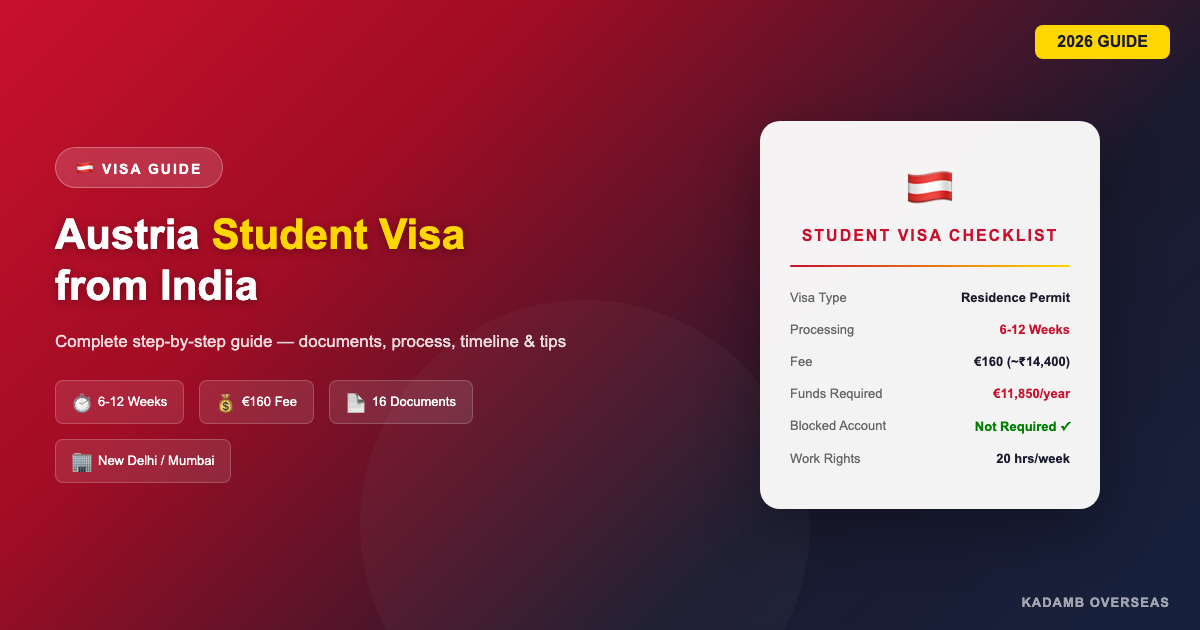
The Austria student visa process from India requires applying for a Residence Permit for Students (Aufenthaltsbewilligung Studierende) at the Austrian Embassy in New Delhi, with a processing time of 6-12 weeks, a visa fee of approximately EUR 160, and financial proof of EUR 11,850 per year (students under 24) or EUR 13,000 per year (students 24 and above). Unlike Germany, Austria does not require a blocked account or APS verification, making the process significantly faster and more straightforward. Indian students must submit their application with apostilled documents, proof of university admission, health insurance, accommodation proof, and a Police Clearance Certificate. This comprehensive 2026 guide covers every document, every step, processing timelines, embassy details, common rejection reasons, post-arrival registration, residence permit renewal, part-time work rights, and the Red-White-Red Card pathway after graduation. Whether you are applying from Ahmedabad, Delhi, Mumbai, or any other Indian city, this guide by Kadamb Overseas covers everything you need to know.
Austria Student Visa from India — Quick Answer (2026)
| Parameter | Details |
|---|---|
| Visa / Permit Type | Residence Permit — Student (Aufenthaltsbewilligung Studierende) |
| Application Fee | EUR 160 (approx. INR 14,400) |
| Processing Time | 6-12 weeks (apply 3+ months before travel) |
| Financial Requirement (Under 24) | EUR 11,850/year (approx. INR 10,66,500) |
| Financial Requirement (24 and above) | EUR 13,000/year (approx. INR 11,70,000) |
| Where to Apply | Austrian Embassy, New Delhi / Consulate General, Mumbai |
| Part-Time Work | 20 hours/week (Master’s students) |
| Blocked Account Required? | NO (major advantage over Germany) |
| Post-Study Work Pathway | Red-White-Red Card (up to 24 months job search) |
Source: Austrian Embassy New Delhi, Migration.gv.at 2025-26, Austrian Residence Act (NAG) | EUR 1 = INR 90 (approx.) | Updated: March 2026
Last Updated: March 2026 | Data verified against Austrian Embassy New Delhi requirements, Austrian Residence Act (NAG) 2025-26, Migration.gv.at official portal, and Kadamb Overseas visa processing records
Understanding the Austria Student Visa Types for Indian Students
Before diving into the application process, it is essential to understand which visa or permit you actually need. Austria has different categories depending on the length and purpose of your stay. The vast majority of Indian students pursuing a full degree programme (Bachelor’s or Master’s) will need the Residence Permit for Students (Aufenthaltsbewilligung Studierende). This is not a simple visa sticker — it is a formal residence permit that grants you the legal right to live and study in Austria for up to 12 months, renewable annually for the duration of your programme.
| Visa / Permit Type | Duration of Stay | Suitable For | Work Permitted? |
|---|---|---|---|
| Schengen Visa (Type C) | Up to 90 days | Language courses, entrance exams, short visits | No |
| Student Visa (Type D — National Visa) | 91 to 180 days | Short study programmes, preparatory courses, semester exchange | Limited |
| Residence Permit — Student (Aufenthaltsbewilligung Studierende) | 12 months (renewable annually) | Full degree programmes (Bachelor’s / Master’s / PhD) | 20 hrs/week (Master’s); 10 hrs/week (Bachelor’s) |
Important Distinction: If your programme in Austria is longer than 6 months (which is the case for virtually all Bachelor’s and Master’s degrees), you must apply for the Residence Permit (Aufenthaltsbewilligung Studierende). A Type D visa alone will not suffice for a full degree programme. The application for this residence permit is submitted at the Austrian Embassy or Consulate in India before you travel, and the actual decision is made by the Austrian immigration authority (MA35 in Vienna or the Bezirkshauptmannschaft in other Austrian cities).
The Residence Permit for Students grants you several important rights beyond just studying. You can work part-time (20 hours per week for Master’s students, 10 hours for Bachelor’s), travel freely within the Schengen zone, access Austrian healthcare through the OeGK student self-insurance scheme, and apply for the Red-White-Red Card after completing your degree. This makes Austria one of the most student-friendly destinations in Europe, and Kadamb Overseas has helped hundreds of Indian students successfully secure this permit.
Step-by-Step Austria Student Visa Application Process from India
The Austria student visa process is relatively straightforward compared to countries like Germany (no blocked account, no APS) or France (no Campus France registration). However, it requires careful attention to documentation, especially apostille stamps and German translations. Here is the complete process, broken down into clear stages that Kadamb Overseas recommends to every student.
Step 1: Secure Admission from an Austrian University
The very first step is obtaining an official admission letter (Zulassungsbescheid) from a recognised Austrian university. Without this letter, you cannot even begin the visa application. Apply directly through the university’s online portal or through services like OeAD (Austria’s Agency for Education and Internationalisation). Most Austrian universities accept applications for the winter semester (starting October) between February and May, and for the summer semester (starting March) between September and December. Ensure your admission letter clearly states the programme name, duration, start date, and that you are a fully admitted student.
Step 2: Gather and Prepare All Required Documents
This is the most time-consuming step and where most delays occur. You must collect, apostille, and in many cases translate every document. Start this process immediately after receiving your admission letter — do not wait.
- Get all academic documents apostilled through the MEA eSanad portal (takes 5-15 working days)
- Obtain your Police Clearance Certificate (PCC) from the regional passport office (7-30 days)
- Get apostilled birth certificate from MEA
- Arrange certified German translations of all documents if required by the embassy
- Collect 6-month stamped bank statements showing adequate financial means
- Secure accommodation proof in Austria (OeAD housing, university dormitory, or private rental agreement)
- Purchase health insurance valid for Austria from the date of your planned arrival
- Write your motivation letter explaining why you chose Austria and your specific programme
- Prepare passport-sized photographs (35x45mm, white background)
Step 3: Apply at the Austrian Embassy / Consulate in India
You must apply in person at the Austrian Embassy in New Delhi or the Austrian Consulate General in Mumbai. Book your appointment well in advance, especially during the peak application season (May-August for winter semester intake). On the day of your appointment, carry all original documents along with the required number of photocopies. The embassy officer will review your file, collect your biometric data (fingerprints and photograph), and accept your application along with the visa fee of approximately EUR 160.
Austrian Embassy, New Delhi: Chandragupta Marg, Chanakyapuri, New Delhi 110021
Austrian Consulate General, Mumbai: Maker Chamber VI, Nariman Point, Mumbai 400021
Step 4: Attend Biometrics Appointment
Your biometric data is captured during the in-person application submission at the embassy or consulate. This includes digital fingerprint scanning and a digital photograph. The biometrics are stored in the Austrian Visa Information System and are mandatory for all applicants aged 12 and above. This step is completed on the same day as your document submission, so you do not need a separate appointment for biometrics.
Step 5: Wait for Processing (6-12 Weeks)
After you submit your application, the embassy forwards it to the relevant Austrian immigration authority — the MA35 (Magistratsabteilung 35) if your university is in Vienna, or the Bezirkshauptmannschaft (district authority) for other Austrian cities like Graz, Salzburg, Innsbruck, or Linz. The authority reviews your accommodation, financial proof, university admission, and health insurance. Processing typically takes 6-12 weeks, though most applications from India are decided within 8-10 weeks. You may be contacted during this period for additional documents or clarifications — respond promptly to avoid delays. Kadamb Overseas tracks every application and liaises with the embassy on behalf of their students to ensure smooth processing.
Step 6: Receive Your Visa and Travel to Austria
Once your residence permit is approved, you will receive a Visa D sticker in your passport that allows you to enter Austria. Collect your passport from the embassy in person or through an authorised representative. Verify all details on the visa sticker — your name, validity dates, and visa type. Book your flights to arrive in Austria at least 1-2 weeks before the semester begins to allow time for administrative registrations. Direct flights from Delhi or Mumbai to Vienna take approximately 8-9 hours, and several airlines offer student-friendly fares during this period.
Step 7: Register at the Local Registration Office (Meldeamt) Upon Arrival
Within 3 days of arriving in Austria, you must register your residential address at the local Meldeamt (registration office). This is a legal requirement under Austrian law and is separate from your university registration. You will need your passport, rental contract or accommodation confirmation, and the Meldezettel (registration form — available at the Meldeamt or downloadable online). The Meldezettel is an extremely important document in Austria — you will need it for opening a bank account, enrolling in health insurance, and completing your university registration (Inskription). There is no fee for the initial registration.
Step 8: Apply for Residence Permit Extension (Before Expiry)
Your initial residence permit is valid for 12 months. Before it expires (apply at least 3 months before the expiry date), you must apply for a renewal at the MA35 or the relevant Bezirkshauptmannschaft within Austria. You do not need to return to India for renewal. The renewal requires proof of continued university enrolment, adequate academic progress (ECTS credits earned), valid health insurance, financial proof for the next year, and continued accommodation. The renewal fee is approximately EUR 160. Kadamb Overseas provides ongoing support to students even after they arrive in Austria, including guidance on the renewal process.
EXPERT INSIGHT
“The Austria student visa process is one of the most straightforward in Europe, but the devil is in the documentation. I have processed over 500 Austrian student visa applications at Kadamb Overseas, and I can tell you that the single biggest delay is not the embassy processing time — it is the Apostille. Students underestimate how long MEA eSanad takes, especially during peak season. My advice: start the Apostille process the day you receive your admission letter, even before you have all your other documents ready. This alone can save you 2-3 weeks.”
— Saumitra Rajput, Founder, Kadamb Overseas (Ahmedabad)
Complete Document Checklist for Austria Student Visa from India
Preparing the correct documents with proper formatting, apostille stamps, and translations is the single most important factor in your visa approval. Below is the exhaustive checklist that Kadamb Overseas uses for every Austrian student visa application. Follow it precisely.
| # | Document | Original / Copies | Specific Requirements and Notes |
|---|---|---|---|
| 1 | Valid Passport | Original + 2 copies | Must be valid for at least 6 months beyond the planned stay (ideally 12+ months); minimum 2 blank pages for visa sticker; copies of all stamped pages |
| 2 | Completed Application Form | Original (signed) | Download from the Austrian Embassy website; fill all fields in capital letters; sign and date on all required pages |
| 3 | Passport-Sized Photographs | 4 photos | 35mm x 45mm; white background; recent (taken within the last 6 months); face must cover 70-80% of the photograph; no glasses |
| 4 | University Admission Letter (Zulassungsbescheid) | Original + 2 copies | Official admission letter from the Austrian university; must clearly state programme name, duration, start date, and student status |
| 5 | Proof of Accommodation in Austria | Original + 1 copy | OeAD housing confirmation, university dormitory allotment letter, private rental agreement (Mietvertrag), or a letter of invitation from a host in Austria with their Meldezettel |
| 6 | Proof of Financial Means | Original + 2 copies | EUR 11,850/year (under 24) or EUR 13,000/year (24 and above); show through 6-month bank statements, fixed deposits, education loan sanction letter, or sponsor’s affidavit with supporting bank statements |
| 7 | Health Insurance | Original + 1 copy | Must be valid in Austria from your date of arrival; travel health insurance for initial months is acceptable; after arrival, enrol in OeGK student self-insurance (EUR 73.48/month) |
| 8 | German / English Language Certificate | Original + 1 copy | Depends on programme language: German-taught programmes require OeSD B2 or Goethe B2; English-taught programmes accept IELTS 6.0-6.5 or TOEFL 80-90+; some universities accept medium of instruction letter |
| 9 | Academic Transcripts and Certificates (Apostilled) | Original + 2 copies | All semester marksheets, provisional/final degree certificate, Class 10 and 12 board certificates — all must be apostilled through MEA eSanad |
| 10 | Motivation Letter | Original | Explain why you chose Austria, why this specific university and programme, your academic background, and your career plans after completing your degree; 1-2 pages |
| 11 | Police Clearance Certificate (PCC) — Apostilled | Original + 1 copy | Issued by the regional passport office in India; must be recent (within 6 months of application); must be apostilled through MEA |
| 12 | Birth Certificate (Apostilled) | Original + 1 copy | Must be apostilled through MEA eSanad; if in a regional language, get a certified English or German translation |
| 13 | CV / Resume | 2 copies | Academic CV format: education history, work experience (if any), language skills, publications (if any), extracurricular activities |
| 14 | Sponsor’s Affidavit (if applicable) | Original (notarised) | Required if a parent or sponsor is financing your studies; must be notarised; include sponsor’s bank statements (6 months), IT returns, and salary slips |
| 15 | Certified German Translations | As required | All documents not originally in English or German may need certified German translations by a sworn translator; check specific embassy requirements |
| 16 | Visa Fee Payment | Receipt | Approximately EUR 160 (INR 14,400); paid at the embassy at the time of submission; check accepted payment modes |
Apostille Alert: The Apostille stamp is required on your birth certificate, police clearance certificate, and all academic documents (degree certificates, transcripts, Class 10 and 12 marksheets). The Apostille is obtained through the MEA (Ministry of External Affairs) eSanad portal at esamadhaan.mea.gov.in. Processing typically takes 5-15 working days. During peak season (May-July), it can take longer. Kadamb Overseas recommends starting the Apostille process at least 4 weeks before your planned embassy appointment date.
Financial Proof Requirements — Detailed Breakdown
One of the most critical aspects of the Austria student visa application is demonstrating adequate financial means. Austria has specific minimum amounts set by law, and they differ based on the applicant’s age. Understanding these requirements precisely is the difference between visa approval and rejection.
| Age Category | Monthly Requirement (EUR) | Annual Requirement (EUR) | Annual Requirement (INR approx.) |
|---|---|---|---|
| Students under 24 years | EUR 987.50/month | EUR 11,850 | INR 10,66,500 |
| Students 24 years and above | EUR 1,083.33/month | EUR 13,000 | INR 11,70,000 |
How to demonstrate these funds: Unlike Germany, Austria does not require a blocked account (Sperrkonto). Indian students can show their financial means through any of the following methods or a combination:
- Indian bank savings account statements (last 6 months) showing a consistent balance at or above the required amount
- Fixed Deposit (FD) certificates from an Indian bank in the student’s or parent’s name
- Education loan sanction letter from a recognised bank (showing the approved loan amount and disbursement schedule)
- Sponsor’s financial declaration (affidavit) backed by the sponsor’s bank statements, income tax returns, and salary certificates
- Scholarship letter (if you have received a scholarship from an Austrian or Indian institution covering your living expenses)
Kadamb Overseas Recommendation: Show 20-30% above the minimum required amount. If the minimum for your age group is EUR 11,850, aim to show at least EUR 14,000-15,000 in available funds. This demonstrates a comfortable financial position and significantly strengthens your application. Avoid sudden large deposits — the embassy looks for consistent balances over 6 months, not a lump sum deposited one week before your appointment.
EXPERT INSIGHT
“The financial proof is not just about showing a number on paper — it is about telling a believable financial story. If a parent earning INR 40,000 per month suddenly shows INR 12 lakh in savings, that raises questions. At Kadamb Overseas, we help families plan their financial documentation 6 months in advance. We ensure the bank balance builds up naturally, we align the sponsor’s income with their savings, and we prepare a clear financial trail. In 14+ years, not a single Kadamb student has been rejected solely on financial grounds.”
— Saumitra Rajput, Founder, Kadamb Overseas (Ahmedabad)
Visa Fee Breakdown — Total Cost of the Austrian Student Visa Process
| Fee Component | Amount (EUR) | Amount (INR approx.) | Refundable? |
|---|---|---|---|
| Residence Permit Application Fee | EUR 160 | INR 14,400 | No |
| Apostille (per document via MEA eSanad) | — | INR 50 per document (+ courier charges) | No |
| Police Clearance Certificate (PCC) | — | INR 500 (Passport Seva Kendra) | No |
| Certified German Translations (per document) | — | INR 800 – 1,500 per page | No |
| Travel Health Insurance (3 months) | — | INR 5,000 – 10,000 | No |
| Notarisation of Sponsor’s Affidavit | — | INR 200 – 500 | No |
| Passport Photos (set of 4) | — | INR 200 – 400 | No |
| TOTAL ESTIMATED COST | — | INR 22,000 – 30,000 | — |
The total visa application cost is considerably lower than countries like the UK (INR 30,000+ for visa alone) or Canada (INR 15,000-20,000 visa fee plus biometrics). The Austrian residence permit application fee of EUR 160 is a one-time cost, and the ancillary expenses (Apostille, translations, insurance) are modest. Budget approximately INR 25,000-30,000 for the entire process from document preparation to visa collection.
Austrian Embassy and Consulate in India — Contact Details and Jurisdiction
| Office | Address | Jurisdiction | Visa Applications? |
|---|---|---|---|
| Austrian Embassy, New Delhi | Chandragupta Marg, Chanakyapuri, New Delhi 110021 | All of India (primary) | Yes |
| Austrian Consulate General, Mumbai | Maker Chamber VI, 220, Jamnalal Bajaj Marg, Nariman Point, Mumbai 400021 | Maharashtra, Gujarat, Goa, Madhya Pradesh, and South India | Yes |
For students from Gujarat (including Ahmedabad): You can apply at either the Austrian Embassy in New Delhi or the Austrian Consulate General in Mumbai, as Gujarat falls under Mumbai’s jurisdiction. Most Kadamb Overseas students from Ahmedabad find it more convenient to apply at the Mumbai consulate due to shorter travel distances. However, the New Delhi embassy sometimes has shorter appointment wait times during peak season. Kadamb Overseas advises students on which location to choose based on current appointment availability and processing speeds.
Booking Tip: Appointment slots at both the embassy and consulate fill up quickly during the peak application season (May-August). Book your appointment as soon as you have your admission letter in hand. You can continue gathering documents while waiting for the appointment date. Some students book the appointment even before all documents are ready, then use the waiting period to complete their file.
Application Timeline — Month-by-Month for October 2026 Winter Semester Intake
Planning your timeline correctly is essential. The Austria student visa process requires at least 3-4 months of lead time from the moment you receive your admission letter. Here is the recommended timeline for the most common intake — the October 2026 winter semester.
| Month | Activity | Duration |
|---|---|---|
| January – March 2026 | Research universities, prepare application materials, apply to Austrian universities | 2-3 months |
| March – May 2026 | Receive admission letter (Zulassungsbescheid); immediately start Apostille process through MEA eSanad | 2-4 weeks for Apostille |
| April – May 2026 | Gather all remaining documents: PCC, bank statements, accommodation proof, health insurance, German translations, motivation letter | 3-4 weeks |
| May – June 2026 | Book and attend embassy/consulate appointment; submit all documents, biometrics, and pay visa fee | 1-2 weeks (appointment + submission) |
| June – August 2026 | Visa processing by Austrian immigration authority; respond to any additional document requests promptly | 6-12 weeks |
| August – September 2026 | Collect passport with visa; book flights; arrange final travel details | 1-2 weeks |
| September – October 2026 | Arrive in Austria; register at Meldeamt within 3 days; enrol in OeGK health insurance; complete university registration (Inskription) | First 2 weeks after arrival |
Critical Timing Advice: Apply for your visa at least 3 months before your planned travel date. While some applications are processed in 6-8 weeks, others can take up to 12 weeks. During peak season (May-August), processing times tend to be on the longer side. Do not book non-refundable flights until you have your visa in hand. Kadamb Overseas always recommends applying by June for an October start.
Post-Arrival Essentials — What to Do in Your First Week in Austria
Arriving in Austria is exciting, but there are several administrative steps that must be completed within strict deadlines. Kadamb Overseas provides a detailed post-arrival checklist to every student, and here are the most important tasks.
1. Register at the Meldeamt (Within 3 Days)
This is your highest priority upon arrival. The Meldeamt is the municipal registration office, and you are legally required to register your residential address within 3 days of moving in. Bring your passport, rental contract, and the Meldezettel form (which your landlord or dormitory management must also sign). You will receive a stamped Meldezettel — this is one of the most important documents during your stay in Austria. Without it, you cannot open a bank account, enrol in health insurance, or complete your university registration.
2. Enrol in Health Insurance (OeGK)
After registration, visit the local OeGK (Oesterreichische Gesundheitskasse) office to enrol in the student self-insurance scheme. This costs approximately EUR 73.48 per month (2026 rate) and provides comprehensive healthcare coverage in Austria, including doctor visits, hospital stays, prescriptions, and dental care. You will need your Meldezettel, passport, university enrolment confirmation, and the e-card application form. The e-card (electronic health card) is your proof of insurance and is used every time you visit a doctor.
3. Complete University Registration (Inskription)
Visit your university’s admissions office (Studienabteilung or Studien Service Center) to complete your enrolment. Bring your admission letter, passport, Meldezettel, and proof of tuition fee payment (if applicable). Public universities in Austria charge approximately EUR 726.72 per semester for non-EU students (2026 rate). After completing Inskription, you will receive your student ID card (Studierendenausweis), which gives you access to student discounts on public transport, cultural events, and more.
4. Open an Austrian Bank Account
You will need an Austrian bank account for receiving part-time work wages, paying rent, and handling day-to-day expenses. Popular banks for students include Erste Bank, Bank Austria, and Raiffeisen. Many offer free or low-cost student accounts. You will need your passport, Meldezettel, and student ID to open the account. Most banks can open your account within 1-2 working days.
Residence Permit Renewal Process in Austria
Your initial Residence Permit (Aufenthaltsbewilligung Studierende) is valid for 12 months. Before it expires, you must apply for a renewal. This is done within Austria — you do not need to return to India. Here is what you need to know about the renewal process.
- When to apply: Submit your renewal application at least 3 months before your current permit expires. If you apply on time, your current permit remains valid until a decision is made, even if it technically expires during processing.
- Where to apply: At the MA35 (if you live in Vienna) or the Bezirkshauptmannschaft (if you live in another city such as Graz, Salzburg, Innsbruck, or Linz).
- Required documents for renewal: Valid passport, current residence permit, proof of continued university enrolment, evidence of academic progress (ECTS credits earned — typically at least 16 ECTS per year is expected), valid health insurance (OeGK), proof of financial means for the next 12 months, proof of accommodation, and the renewal fee (approximately EUR 160).
- Academic progress requirement: This is important — Austrian authorities check that you are making genuine academic progress. Merely being enrolled is not sufficient. You must show that you have earned a reasonable number of ECTS credits. While there is no strict minimum set in law for the first renewal, consistently earning fewer than 16 ECTS per year may raise concerns.
- Processing time for renewal: Typically 4-8 weeks. Apply early to avoid any gap in your legal residence status.
EXPERT INSIGHT
“Many Indian students make the mistake of waiting until the last month before their permit expires to start the renewal process. By that time, they are scrambling to get bank statements, insurance confirmations, and university progress certificates. I always tell our Kadamb Overseas students: set a calendar reminder for 4 months before your permit expiry. Start gathering renewal documents then. Submit the application 3 months before expiry. This gives you a comfortable buffer and ensures you never face a gap in your legal status.”
— Saumitra Rajput, Founder, Kadamb Overseas (Ahmedabad)
Part-Time Work Rights for Indian Students in Austria
One of Austria’s significant advantages for international students is the right to work part-time during your studies. However, the rules differ depending on your programme level, and your employer must obtain a specific work authorisation. Here is the complete breakdown.
| Programme Level | Maximum Working Hours | Work Permit Required? | Estimated Earnings |
|---|---|---|---|
| Bachelor’s Students | 10 hours per week | Employer applies for Beschaeftigungsbewilligung from AMS | EUR 400-500/month |
| Master’s Students | 20 hours per week | Employer applies for Beschaeftigungsbewilligung from AMS | EUR 800-1,100/month |
| PhD Students | 20 hours per week (or more with university contract) | Depends on contract type | Varies (EUR 1,000-2,000+/month) |
Important note on the work permit process: Unlike many other countries, in Austria it is the employer who must apply for the Beschaeftigungsbewilligung (employment permit) from the AMS (Arbeitsmarktservice — the Austrian Public Employment Service). The student does not apply for this themselves. When you find a part-time job, inform your employer that they need to apply for this permit through AMS. The process typically takes 2-4 weeks. Common part-time jobs for Indian students in Austria include research assistant positions at the university, tutoring, gastronomy and hospitality, retail, IT and programming freelance work, and student assistant roles.
Earnings below EUR 12,816 per year (2026 threshold) are exempt from income tax in Austria. With the Austrian minimum wage for students at approximately EUR 10-12 per hour (depending on the collective agreement of the sector), working 20 hours per week at EUR 11/hour would earn you approximately EUR 880 per month — enough to cover a significant portion of your monthly living expenses.
Red-White-Red Card — Your Pathway After Graduation
One of Austria’s most attractive features for Indian students is the post-graduation pathway through the Red-White-Red Card (Rot-Weiss-Rot Karte). This is Austria’s points-based immigration system that allows graduates of Austrian universities to stay in the country and work after completing their studies.
How the Post-Study Pathway Works
- Job Seeker Visa (Aufenthaltsbewilligung fuer Arbeitssuchende): After completing your degree, you can apply for a job seeker residence permit valid for up to 12 months. During this period, you can work full-time to support yourself while searching for a job that matches your qualifications. Since 2024, this has been extended for STEM graduates to up to 24 months.
- Red-White-Red Card for Graduates: Once you find a job that meets the minimum salary threshold and matches your qualifications, you can apply for the Red-White-Red Card. This gives you an 24-month residence and work permit, renewable and eventually leading to permanent residency.
- Minimum salary requirement: Graduates must earn at least approximately EUR 2,610 gross per month (2026 threshold) to qualify for the Red-White-Red Card. This is a moderate threshold that most Master’s graduates in STEM, business, and engineering fields can meet.
- Permanent Residency (Daueraufenthalt EU): After living continuously in Austria for 5 years (including your study period), you can apply for permanent residency. This is one of the fastest PR pathways in Europe for Indian students.
Key Advantage: Your student years in Austria count towards the 5-year permanent residency requirement. A 2-year Master’s degree plus 3 years of work on the Red-White-Red Card adds up to 5 years, making you eligible for Daueraufenthalt EU (permanent residency). This is a significant advantage that Kadamb Overseas highlights to every prospective student — Austria is not just a study destination, it is a comprehensive immigration pathway.
Common Reasons for Austria Student Visa Rejection from India
While the approval rate for Austrian student visa applications from India is high (above 90% with proper documentation), rejections do occur. Understanding the most common reasons helps you avoid them entirely.
| Rejection Reason | How to Avoid It |
|---|---|
| Insufficient financial proof | Show 20-30% above the minimum; maintain consistent balance for 6 months; avoid sudden large deposits |
| Missing or incorrect Apostille stamps | Apostille ALL academic documents, birth certificate, and PCC through MEA eSanad; verify each stamp |
| Expired Police Clearance Certificate | Obtain PCC within 3-4 months of your embassy appointment; ensure it is still valid at the time of submission |
| No accommodation proof | Apply for OeAD housing or university dormitory early (3-4 months before); get written confirmation |
| Weak or generic motivation letter | Write a specific, personalised letter explaining why Austria, why this university, why this programme, and your career goals |
| Incomplete application form | Fill every field; sign and date all required pages; double-check all details match your passport exactly |
| Health insurance not valid for Austria | Ensure your insurance is explicitly valid in Austria from your date of arrival; Schengen-wide travel insurance is acceptable for initial months |
| Suspected immigration intent (not genuine student) | Show coherent academic profile; programme should align with your undergraduate degree; present clear, realistic career plans |
EXPERT INSIGHT
“In my 14+ years of processing Austrian student visas, the most common mistake I see is not with the money or the academics — it is with the paperwork itself. Students submit bank statements that are 4 months old instead of 3. They forget to apostille the birth certificate. They submit photos with the wrong background colour. These are completely preventable errors. At Kadamb Overseas, we do a 360-degree document audit for every single student before their embassy appointment. We check every page, every stamp, every date. That is why we maintain a 97% success rate.”
— Saumitra Rajput, Founder, Kadamb Overseas (Ahmedabad)
What to Do If Your Austria Student Visa Is Rejected
If your residence permit application is rejected, do not panic. The Austrian authorities are required to provide a written decision stating the reasons for rejection. You have the following options:
- Appeal within 4 weeks: You have the right to file an appeal (Beschwerde) with the Austrian Administrative Court (Verwaltungsgericht) within 4 weeks of receiving the rejection notice. This is recommended if you believe the rejection was based on an error or if you can provide additional evidence to address the stated reasons.
- Reapply with improved documentation: You can submit a fresh application after 3 months, addressing all the issues identified in the rejection letter. This is the more common approach for Indian students and is often successful when the rejection was due to documentation issues rather than fundamental eligibility concerns.
- Seek professional help: If you applied on your own and were rejected, consider working with an experienced consultancy like Kadamb Overseas for your next attempt. Professional guidance in document preparation, financial planning, and application strategy can make the difference between rejection and approval.
Austria Student Visa vs. Germany Student Visa — Key Differences for Indian Students
Many Indian students consider both Austria and Germany for their Master’s degree. While both are excellent destinations, the visa processes differ significantly. Understanding these differences can help you make an informed choice.
| Parameter | Austria | Germany |
|---|---|---|
| Blocked Account Required? | NO | YES (EUR 12,324) |
| APS Verification Required? | NO | YES (3-6 months) |
| Application Fee | EUR 160 | EUR 75 |
| Processing Time | 6-12 weeks | 6-12 weeks (+ APS time) |
| Part-Time Work (Master’s) | 20 hours/week | 20 hours/week |
| Post-Study Job Search Visa | 12-24 months | 18 months |
| PR Eligibility | 5 years (study years count) | 5 years (after full-time employment) |
| Overall Visa Process Complexity | Simpler | More Complex |
The most significant advantages of the Austrian process are the absence of a blocked account and the absence of APS verification. These two steps alone add 3-6 months and INR 11+ lakh in locked funds to the German process. For Indian families who want a faster, more straightforward path to a European Master’s degree, Austria is increasingly the preferred choice. Kadamb Overseas specialises in both destinations and can help you decide which is better suited to your profile and goals.
Frequently Asked Questions — Austria Student Visa from India (2026)
How long does the Austria student visa take from India?
The total process from receiving your admission letter to getting your visa stamp takes approximately 3-4 months. Embassy/consulate processing alone is 6-12 weeks. Add 2-4 weeks for document preparation (Apostille, translations, bank statements). Unlike Germany, there is no APS verification or blocked account requirement, which saves 3-6 months.
What is the visa fee for the Austria student visa?
The residence permit application fee is approximately EUR 160 (INR 14,400). This is a one-time fee paid at the embassy or consulate at the time of application. Annual renewal of the residence permit within Austria also costs approximately EUR 160. Including ancillary costs (Apostille, translations, PCC, insurance), budget INR 25,000-30,000 for the entire process.
Do I need a blocked account for the Austria student visa?
No. Austria does NOT require a blocked account (Sperrkonto) like Germany. You demonstrate your financial means through regular Indian bank statements showing consistent balances over 6 months, fixed deposits, education loan letters, or sponsor’s financial declarations. This is one of Austria’s biggest advantages — it saves you INR 11+ lakh in locked funds and eliminates a complex banking step.
Can I work part-time on an Austria student visa?
Yes. Master’s students can work up to 20 hours per week. Bachelor’s students are limited to 10 hours per week. Your employer must apply for a Beschaeftigungsbewilligung (employment permit) from AMS. At approximately EUR 10-12 per hour, working 20 hours/week earns you EUR 800-1,100/month, which covers a significant portion of living costs. Earnings below EUR 12,816/year are tax-free.
Can I apply from the Austrian Consulate in Mumbai instead of the Delhi Embassy?
Yes. Students from Maharashtra, Gujarat (including Ahmedabad), Goa, Madhya Pradesh, and South India can apply at the Austrian Consulate General in Mumbai (Nariman Point). Students from North India should apply at the Embassy in New Delhi. Kadamb Overseas students from Gujarat typically apply in Mumbai due to the shorter travel distance.
What health insurance do I need for the Austria student visa?
For the visa application, you need health insurance valid in Austria from your planned arrival date. You can purchase a travel health insurance policy from India (approximately INR 5,000-10,000 for 3 months coverage). After arriving in Austria and completing university registration, you enrol in the OeGK student self-insurance at EUR 73.48/month. This is the mandatory Austrian student health insurance and covers doctor visits, hospital care, prescriptions, and dental treatments.
What is the Meldeamt registration and is it mandatory?
Yes, it is mandatory. Within 3 days of arriving at your accommodation in Austria, you must register your address at the local Meldeamt (municipal registration office). You will receive a Meldezettel (registration certificate) which is essential for opening a bank account, enrolling in health insurance, and completing university registration. This registration is free of charge.
Can I get permanent residency (PR) in Austria after studying?
Yes. After 5 continuous years of legal residence in Austria (including your study period), you can apply for Daueraufenthalt EU (permanent residency). A typical pathway: 2-year Master’s + 3 years on the Red-White-Red Card = 5 years total. You also need to demonstrate German language skills (B1 level) and pass the Values and Orientation Course. Austria offers one of the fastest PR pathways in Europe for Indian students.
What if my Austria student visa is rejected?
You have two options: (1) Appeal within 4 weeks to the Austrian Administrative Court (Verwaltungsgericht) if you believe the rejection was unjustified. (2) Reapply after 3 months with improved documentation addressing the stated rejection reasons. The rejection letter will clearly state why your application was refused. Working with an experienced consultant like Kadamb Overseas significantly increases your chances of success on the second attempt.
Do I need to know German for the Austria student visa?
It depends on your programme. If your programme is taught in German, you will need a German language certificate (typically OeSD B2 or Goethe B2). If your programme is taught in English, you need an English proficiency certificate (IELTS 6.0-6.5 or TOEFL 80-90+). For the visa application itself, the embassy does not require a specific language level, but the university admission letter (which is a mandatory visa document) will reflect the language requirement you have already met. Many Austrian universities now offer English-taught Master’s programmes specifically to attract international students.
Can my spouse or family accompany me to Austria on my student visa?
Your spouse and dependent children can apply for a family reunification residence permit (Aufenthaltsbewilligung Familiengemeinschaft). However, you must demonstrate that you have sufficient financial means to support your entire family (not just yourself), adequate accommodation for the family, and valid health insurance for all family members. The financial requirement increases significantly when bringing dependents. Your spouse will not have automatic work rights — a separate work authorisation is needed.
Key Takeaways — Austria Student Visa from India (2026)
- Permit type: Residence Permit — Student (Aufenthaltsbewilligung Studierende) for stays over 6 months
- Application fee: EUR 160 (INR 14,400); total process cost approximately INR 25,000-30,000
- Processing time: 6-12 weeks after submission; apply at least 3 months before travel
- Financial proof: EUR 11,850/year (under 24) or EUR 13,000/year (24+); no blocked account needed
- Apply at: Austrian Embassy New Delhi or Consulate General Mumbai
- Apostille is critical: All academic documents, birth certificate, and PCC must be apostilled through MEA eSanad
- Post-arrival: Register at Meldeamt within 3 days; enrol in OeGK health insurance; complete university Inskription
- Work rights: 20 hours/week for Master’s students; employer applies for work permit through AMS
- After graduation: Red-White-Red Card pathway with 12-24 months job search period; PR eligible after 5 years
- Professional guidance: Kadamb Overseas provides complete visa support from document preparation to post-arrival assistance with a 97% success rate
Need Expert Help With Your Austria Student Visa Application?
Kadamb Overseas has processed 500+ Austrian student visa applications with a 97% success rate. From university selection and admission to complete document preparation, embassy appointment guidance, and post-arrival support — Kadamb Overseas handles the entire process so you can focus on preparing for your academic journey in Austria.
Get a free one-on-one consultation with Saumitra Rajput, Founder of Kadamb Overseas, for personalised visa guidance tailored to your profile.
Call: +91 9913333239 | Email: support@kadamboverseas.com | Visit: kadamboverseas.com
This guide is published by Kadamb Overseas, Ahmedabad — Gujarat’s trusted study-abroad consultancy with over 14 years of experience helping Indian students secure Austrian student visas and residence permits. For personalised visa assistance, document preparation, and complete application management, contact Kadamb Overseas at kadamboverseas.com.
Disclaimer: Visa rules and fees are subject to change. The information in this guide is based on Austrian Embassy New Delhi requirements, the Austrian Residence Act (NAG), and Migration.gv.at as of March 2026. Always verify current requirements directly with the Austrian Embassy or Consulate before applying. Kadamb Overseas is not affiliated with the Austrian government or any Austrian immigration authority.
Saumitra Rajput
Saumitra Rajput is the founder of Kadamb Overseas Pvt. Ltd., India's leading Europe-focused study abroad consultancy based in Ahmedabad. With 14+ years of expertise in European education, he has personally counselled 2,500+ Indian families and helped 500+ students secure admission to top European universities including TU Munich, ETH Zurich, EPFL, KU Leuven, HEC Paris, Sapienza Rome, TU Wien, and Warsaw University of Technology. He has visited 25+ European universities, partners with 250+ EU institutions, and maintains a 500+ students placed.
Planning to Study Abroad?
Get free expert guidance from our experienced counselors

Saumitra Rajput
Saumitra Rajput is the founder and lead counsellor at Kadamb Overseas, India's trusted Europe education consultancy based in Ahmedabad. With 14+ years of hands-on experience, he has personally guided 500+ students to universities across Germany, Switzerland, France, Italy, Austria, and Spain. Saumitra has visited partner universities across Europe, holds deep expertise in European visa processes, scholarships, and student life, and has achieved a 97% visa success rate for his clients. He is the host of the YouTube channel "Europe with Saumitra", where he shares first-hand insights on studying and living in Europe. His mission: make Europe accessible to every Indian student, with zero consultancy fees.