
Last Updated: September 7, 2026
Table of Contents
- Why Do a PhD in Germany?
- Types of PhD Programs in Germany
- Top Universities for PhD in Germany (Indian Students)
- PhD Eligibility for Indian Students
- PhD Scholarships in Germany for Indian Students
- Step-by-Step: How to Apply for PhD in Germany
- PhD in Germany vs USA vs UK
- Frequently Asked Questions — PhD in Germany
🕑 4 min read
Why Do a PhD in Germany?
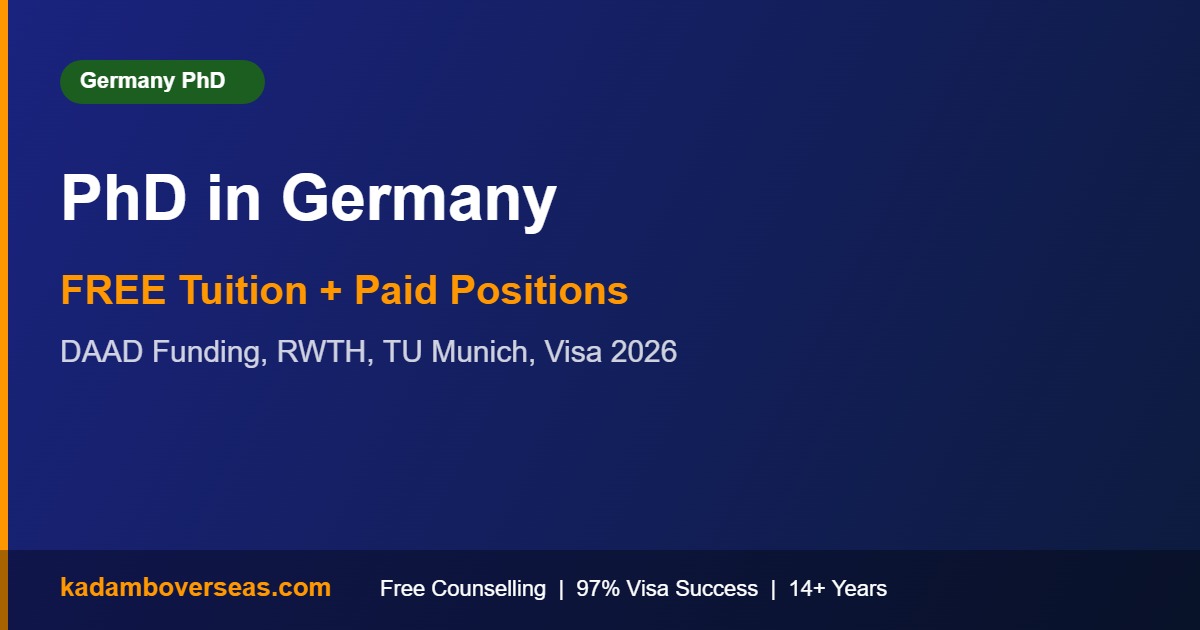
- Free tuition — Public universities charge only €150–350/semester administrative fee
- Paid PhD positions — Many PhD roles are employment contracts (50–75% of TV-L E13 scale) paying €1,500–2,200/month
- World-class research — TU Munich, LMU, RWTH Aachen, Heidelberg — all global top 100
- DAAD full funding — Covers tuition, living, and health insurance for Indian students
- EU residency pathway — PhD graduates can apply for Blue Card or Permanent Residence
- English-medium research — Most PhD programs conducted in English even at German universities
Types of PhD Programs in Germany
| Type | Duration | Funding | Best For |
|---|---|---|---|
| Individual Doctorate (Betreuermodell) | 3–5 years | Self-funded or DAAD | All fields |
| Structured PhD (Graduate School) | 3–4 years | Fully funded stipend | Sciences, Engineering |
| Industrial/Corporate PhD | 3 years | Company salary | Engineering, CS, Chemistry |
| Cotutelle (Joint Degree) | 3–4 years | Shared funding | Bilateral research projects |
Top Universities for PhD in Germany (Indian Students)
| University | QS 2025 | Research Strengths | City |
|---|---|---|---|
| TU Munich (TUM) | #37 | Engineering, CS, Life Sciences | Munich |
| LMU Munich | #59 | Medicine, Natural Sciences, Humanities | Munich |
| Heidelberg University | #87 | Medicine, Biology, Chemistry | Heidelberg |
| RWTH Aachen | #106 | Mechanical, Electrical, Industrial Engineering | Aachen |
| KIT Karlsruhe | #119 | Physics, Engineering, CS, Mathematics | Karlsruhe |
| Freie Universität Berlin | #120 | Social Sciences, Political Science, History | Berlin |
| Max Planck Institutes (82 institutes) | Unranked | Basic research — world-leading in all sciences | Various |
PhD Eligibility for Indian Students
| Requirement | Details |
|---|---|
| Academic Qualification | Master’s degree (M.Tech, ME, MSc, MBA) with minimum 60% or 7.0 CGPA. 4-year B.Tech with distinction may be accepted at some universities. |
| APS Certificate | Mandatory for all Indian students. Verifies academic credentials. Takes 6–8 weeks. Apply via APS India in New Delhi or Chennai. |
| Language | IELTS 6.5–7.0 or TOEFL 90 for English-medium research. German B2/C1 for German-taught programs. Many supervisors accept email contact in English. |
| Research Proposal | 2–4 page research proposal outlining your intended research question, methodology, and connection to supervisor’s work. Critical for individual doctorate. |
| Supervisor Agreement | For individual doctorate: you must find a professor (Doktorvater/Doktormutter) who agrees to supervise your thesis before formally applying. |
PhD Scholarships in Germany for Indian Students
1. DAAD Research Grants
Best for: All PhD fields | Amount: €934/month + health insurance + travel allowance
DAAD (German Academic Exchange Service) offers several PhD scholarships specifically for Indian students. Applications typically open in July–October for the following academic year. Apply via DAAD portal at daad.de.
2. Helmholtz Association PhD Fellowships
Best for: Natural sciences, engineering, medicine | Amount: TV-L E13 salary (€1,800–2,400/month)
Germany’s largest research organization with 19 research centers. Most PhD positions are employment contracts with full German employee benefits.
3. Max Planck Society Fellowships
Best for: Basic research across all sciences | Amount: €1,500–2,000/month stipend
IMPRS (International Max Planck Research Schools) programs are fully funded and highly competitive. 82 institutes across Germany.
4. Erasmus Mundus Joint Doctorates
Amount: €3,600/month (highest EU PhD funding)
Joint PhD degree involving 2–3 European universities. Must apply when program call opens — very competitive but extremely rewarding.
Step-by-Step: How to Apply for PhD in Germany
- Identify research area — Define your research topic clearly (3–4 sentences)
- Find a supervisor — Search university faculty pages, ResearchGate, Google Scholar. Email professors directly with your research proposal and CV
- Get APS Certificate — Apply to APS India office (takes 6–8 weeks)
- Apply for scholarship — DAAD, Helmholtz, or Max Planck programs (apply 12–18 months in advance)
- Get admission letter — Once supervisor agrees, apply formally to the university
- Apply for student visa — German National Visa (Type D) at German embassy in India
- Open blocked account — Required for visa: €11,208/year (or show scholarship letter instead)
- Depart and enroll — Register at university, obtain residence permit
PhD in Germany vs USA vs UK
| Factor | Germany | USA | UK |
|---|---|---|---|
| Tuition | FREE | $20–50K/yr | £15–25K/yr |
| Stipend | €1,500–2,200/mo | $1,500–2,500/mo | £1,200–1,500/mo |
| Duration | 3–4 years | 4–6 years | 3–4 years |
| Post-PhD Visa | 18-month job seeker | 3-yr OPT (STEM) | 2-yr Graduate visa |
| PR Pathway | Blue Card → PR | H-1B lottery | Tier 2 → ILR |
Frequently Asked Questions — PhD in Germany
Can Indian students do PhD in Germany in English?
Yes. Most PhD research at German universities is conducted in English, especially in STEM fields. You will need IELTS 6.5–7.0 or TOEFL 90+ for the visa and enrollment. German language is helpful for daily life but not required for the research itself.
Is PhD in Germany fully funded?
Many PhD positions in Germany come with employment contracts (Wissenschaftlicher Mitarbeiter) paying 50–75% of TV-L E13 salary (€1,500–2,200/month). DAAD, Max Planck, and Helmholtz also offer full scholarships. Unfunded PhDs (with no salary) are rare in STEM but more common in humanities.
How long is a PhD in Germany?
A PhD in Germany typically takes 3–5 years. Structured graduate school programs are usually 3–4 years. Individual doctorates can take longer (4–5 years). The official minimum is typically 3 years from enrollment.
What is the salary after PhD in Germany?
Post-doctoral researchers in Germany earn €3,500–5,500/month (TV-L E13 full scale). Industry positions (engineering, pharma, CS) offer €55,000–90,000/year. Germany’s 18-month job seeker visa allows PhD graduates to stay and find employment without needing a job offer beforehand.
Related Germany Resources
Saumitra Rajput
Saumitra Rajput is the founder of Kadamb Overseas Pvt. Ltd., India's leading Europe-focused study abroad consultancy based in Ahmedabad. With 14+ years of expertise in European education, he has personally counselled 2,500+ Indian families and helped 500+ students secure admission to top European universities including TU Munich, ETH Zurich, EPFL, KU Leuven, HEC Paris, Sapienza Rome, TU Wien, and Warsaw University of Technology. He has visited 25+ European universities, partners with 250+ EU institutions, and maintains a 500+ students placed.
Planning to Study Abroad?
Get free expert guidance from our experienced counselors

Saumitra Rajput
Saumitra Rajput is the founder and lead counsellor at Kadamb Overseas, India's trusted Europe education consultancy based in Ahmedabad. With 14+ years of hands-on experience, he has personally guided 500+ students to universities across Germany, Switzerland, France, Italy, Austria, and Spain. Saumitra has visited partner universities across Europe, holds deep expertise in European visa processes, scholarships, and student life, and has achieved a 97% visa success rate for his clients. He is the host of the YouTube channel "Europe with Saumitra", where he shares first-hand insights on studying and living in Europe. His mission: make Europe accessible to every Indian student, with zero consultancy fees.