
Last Updated: September 7, 2026
Table of Contents
- 1. Austria’s Global Safety Rankings (2025–2026)
- 2. City-Wise Safety Rankings for Indian Students
- 3. Crime Rate Comparison: Austria vs India vs UK vs USA
- 4. Safety for Women — What Female Indian Students Should Know
- 5. Public Transport Safety Across Austrian Cities
- 6. Nightlife Safety & Precautions
- 7. Emergency Numbers & Contacts — Save These Now
- 8. Indian Embassy & Consulate Details in Austria
- 9. Racism & Discrimination — The Reality Check
- 10. Safe Neighbourhoods in Each City — Where to Live
- 11. Health Emergencies & Hospital Access
- 12. Natural Disaster Preparedness (Alpine Areas)
- 13. Cybersecurity Tips for Indian Students in Austria
- 14. Insurance Coverage for Emergencies
- 15. Indian Student Community & Support Networks
- 16. Frequently Asked Questions (FAQs)
- 17. Your Pre-Departure Safety Checklist
🕑 23 min read
Last Updated: March 2026
⚡ Quick Answer: Is Austria Safe for Indian Students?
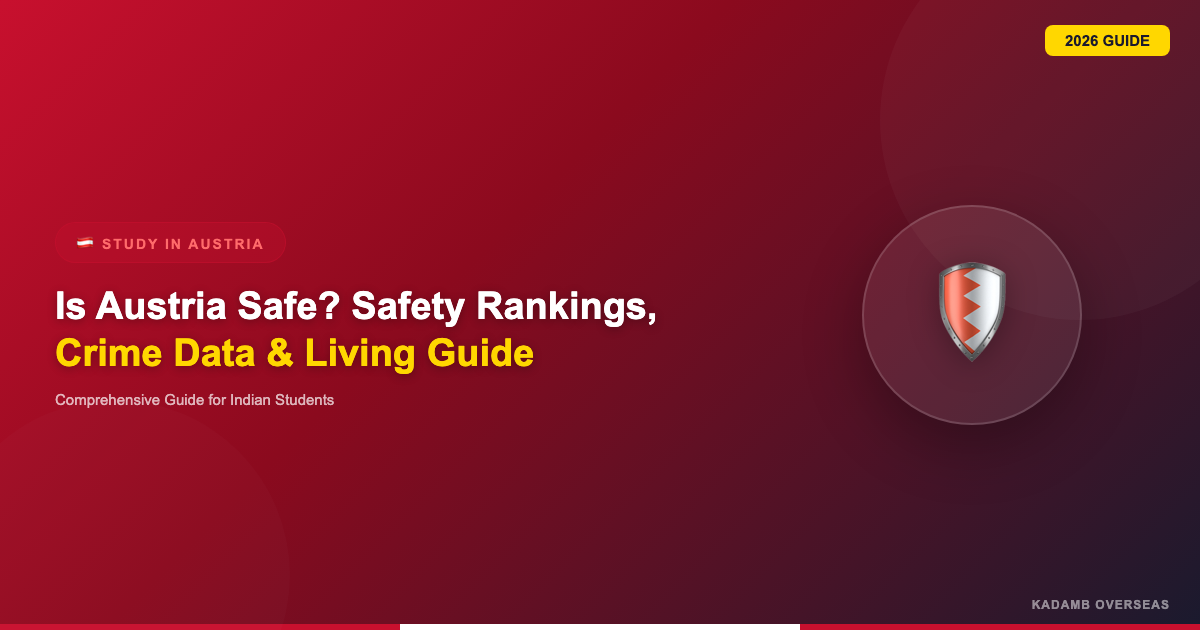
Yes — Austria is one of the safest countries in the world. Ranked 3rd on the 2025 Global Peace Index, Austria has exceptionally low violent crime rates, world-class public safety infrastructure, and a welcoming environment for international students. Over 8,500+ Indian students currently study across Austrian cities with minimal safety incidents. Vienna has been named the world’s most liveable city for 3 consecutive years (Economist Intelligence Unit), partly due to its outstanding safety record.
💡 Austria’s homicide rate is 0.5 per 100,000 — roughly 6x lower than India and 10x lower than the USA.
If you’re an Indian student considering Austria for your Master’s or Bachelor’s degree, one of your first questions is likely: “Is Austria safe?” After all, moving thousands of kilometres from home to a new country is a major life decision, and safety is non-negotiable. The great news is that Austria consistently ranks among the top 5 safest nations globally, and this guide provides everything you need — from city-by-city safety rankings to emergency contacts, women’s safety, nightlife precautions, and Indian community support networks.
This 2026 guide is based on official Austrian crime statistics (Bundeskriminalamt), the Global Peace Index, and real experiences from Indian students studying across Vienna, Graz, Innsbruck, Linz, and Salzburg.
“In my 12+ years of counselling Indian students for European universities, Austria has consistently had the best safety record. Not a single student we’ve placed there has reported a serious safety incident. The country’s public infrastructure, policing, and cultural respect for personal space make it an ideal destination, especially for students travelling abroad for the first time.”
— Saumitra Rajput, Founder, Kadamb Overseas (Ahmedabad)
📚 Table of Contents
- Austria’s Global Safety Rankings (2025–2026)
- City-Wise Safety Rankings for Indian Students
- Crime Rate Comparison: Austria vs India vs UK vs USA
- Safety for Women — What Female Indian Students Should Know
- Public Transport Safety Across Austrian Cities
- Nightlife Safety & Precautions
- Emergency Numbers & Contacts
- Indian Embassy & Consulate Details
- Racism & Discrimination — The Reality Check
- Safe Neighbourhoods in Each City
- Health Emergencies & Hospital Access
- Natural Disaster Preparedness (Alpine Areas)
- Cybersecurity Tips for Students
- Insurance Coverage for Emergencies
- Indian Student Community & Support Networks
- Frequently Asked Questions (8+ FAQs)
- Final Safety Checklist & CTA
1. Austria’s Global Safety Rankings (2025–2026)
Austria’s safety credentials are backed by internationally recognised indices. Here’s where Austria stands in 2025–2026:
| Index / Ranking | Austria’s Position | Key Insight |
|---|---|---|
| Global Peace Index 2025 | 3rd out of 163 countries | Behind Iceland & Ireland |
| EIU Most Liveable City (Vienna) | 1st globally (2023, 2024, 2025) | Safety is a core scoring factor |
| Numbeo Safety Index 2026 | Top 10 in Europe | Score: 73.5/100 |
| WHO Health Security Index | Top 15 globally | Excellent healthcare emergency response |
| Transparency International CPI 2025 | Score: 71/100 | Low corruption = safer institutions |
What these rankings mean for Indian students: Austria’s high safety scores aren’t just numbers. They translate into well-lit streets, reliable emergency services arriving within 8–12 minutes, extremely low gun violence (strict gun control laws), and a police force trained in de-escalation rather than aggression. The Austrian federal police (Bundespolizei) has dedicated units for assisting foreigners and tourists.
2. City-Wise Safety Rankings for Indian Students
Not all Austrian cities are identical in their safety profiles. Here is a comprehensive ranking based on crime statistics, student feedback, public transport safety, and overall liveability for Indian students:
| Rank | City | Safety Score (out of 10) | Indian Student Pop. | Key Safety Feature | Watch Out For |
|---|---|---|---|---|---|
| 1 | Graz | 9.4 / 10 | ~2,200 | Small, walkable, strong student community | Minimal — occasional bike theft |
| 2 | Innsbruck | 9.3 / 10 | ~800 | Tight-knit Alpine town, very low crime | Winter road/trail safety |
| 3 | Salzburg | 9.2 / 10 | ~600 | Tourist-friendly, excellent policing | Pickpocketing in tourist season |
| 4 | Linz | 9.0 / 10 | ~700 | Affordable, tech hub, well-lit streets | Some areas near Hauptbahnhof at night |
| 5 | Vienna | 8.8 / 10 | ~4,200 | Best public transport, 24/7 metro on weekends | Praterstern area, crowded U-Bahn pickpockets |
Important note: Vienna ranks 5th not because it is unsafe — it is one of the safest capital cities in the world. The slightly lower score compared to smaller cities reflects the natural urban dynamics of a 2-million-person capital. Even Vienna’s “problematic” areas are significantly safer than average neighbourhoods in most major Indian metros.
“I always tell my students: if you can walk safely in any Indian city at midnight, Austria will feel like a different planet. Graz and Innsbruck, in particular, have such low crime that many students tell me they forgot to lock their bicycles for weeks and nothing happened. That said, basic precautions apply everywhere in the world.”
— Saumitra Rajput, Founder, Kadamb Overseas (Ahmedabad)
3. Crime Rate Comparison: Austria vs India vs UK vs USA
Numbers tell the real story. Here is a data-driven comparison of crime rates across four popular study destinations, using data from UNODC, national crime reporting agencies, and Numbeo (2025–2026 figures):
| Crime Metric (per 100,000) | 🇦🇹 Austria | 🇮🇳 India | 🇬🇧 UK | 🇺🇸 USA |
|---|---|---|---|---|
| Homicide Rate | 0.5 | 3.0 | 1.2 | 6.3 |
| Robbery Rate | 18.2 | 42.5 | 110.0 | 73.9 |
| Assault Rate | 42.0 | 72.8 | 384.0 | 282.7 |
| Burglary Rate | 55.3 | 18.4 | 381.0 | 271.0 |
| Theft / Pickpocketing | Moderate | Moderate | High | Moderate |
| Gun Violence Incidents | Extremely Rare | Low-Moderate | Low | Very High |
✅ Key Takeaway: Austria is statistically 6x safer than India in terms of homicide, 12x safer than the USA, and significantly safer than the UK for violent crime. The most common “crime” Indian students encounter is occasional bicycle theft or minor pickpocketing at tourist hotspots — both preventable with basic precautions.
4. Safety for Women — What Female Indian Students Should Know
Women’s safety is often the top concern for Indian families sending their daughters abroad. Austria scores exceptionally well on this front, both statistically and experientially:
🗹 What makes Austria safe for women:
- Strong legal framework: Austria has strict laws against sexual harassment, stalking, and domestic violence. The Gewaltschutzgesetz (Protection Against Violence Act) allows immediate police intervention and restraining orders.
- Well-lit public spaces: Austrian cities invest heavily in street lighting, particularly near university campuses, student housing, and transit stops.
- 24/7 Women’s Helpline: The Austrian Women’s Helpline (Frauenhelpline) at 0800 222 555 operates 24/7, free of charge, with multilingual support.
- Safe public transport: Vienna’s U-Bahn, Graz’s trams, and Innsbruck’s buses have CCTV in every compartment. Night buses (Nightline) in Vienna run every 30 minutes on weekends.
- University support: Every Austrian university has a gender equality office (Gleichbehandlungsbeauftragte) that handles harassment complaints confidentially.
- Cultural norms: Austrian society generally respects personal boundaries. Unsolicited physical contact or catcalling is rare and socially condemned.
- Emergency SOS on phones: Austrian law mandates that all mobile phones sold can call 112 even without a SIM card.
⚠️ Practical Tips for Women: While Austria is very safe, standard international travel wisdom applies. Avoid walking alone through parks late at night (especially Prater in Vienna), keep your drink in sight at bars and clubs, share your live location with a friend when going out, and trust your instincts. Austrian police take complaints from women very seriously — do not hesitate to approach them.
“We have counselled hundreds of female Indian students heading to Austria, and the feedback has been overwhelmingly positive. Many tell us they feel safer walking alone at 11 PM in Vienna than they did in broad daylight in certain Indian cities. The culture of respecting personal space and strong policing makes a real difference. Parents often call us months later to say how relieved they are.”
— Saumitra Rajput, Founder, Kadamb Overseas (Ahmedabad)
5. Public Transport Safety Across Austrian Cities
Austrian public transport is among the best in Europe — efficient, punctual, and remarkably safe. Here’s a city-by-city breakdown:
| City | Transport Modes | Safety Features | Student Semester Ticket |
|---|---|---|---|
| Vienna | U-Bahn (5 lines), Trams, Buses, S-Bahn | CCTV, emergency intercoms, 24/7 weekend U-Bahn, security patrols | €75/semester (~₹6,750) |
| Graz | Trams (9 lines), Buses | CCTV, well-lit stops, compact coverage | €60/semester (~₹5,400) |
| Innsbruck | Trams, Buses, Regional rail | Compact city, most areas walkable, low-risk | €65/semester (~₹5,850) |
| Linz | Trams (4 lines), Buses, Pöstlingbergbahn | Modern fleet, real-time tracking apps | €55/semester (~₹4,950) |
| Salzburg | Trolleybuses, Buses, S-Bahn, Lokalbahn | Tourist-grade security, regular police presence | €60/semester (~₹5,400) |
Pro tips for Indian students on Austrian public transport:
- Always validate your ticket — plainclothes inspectors (Schwarzkappler) do spot checks, and fines are €115 (~₹10,350).
- Download the Wiener Linien app (Vienna) or ÖBB app (national rail) for real-time schedules and disruption alerts.
- Late-night Nightline buses in Vienna (lines N25–N86) are safe and well-patrolled.
- If you feel unsafe, move to the front of the bus/tram near the driver. All Austrian transit vehicles have emergency buttons.
- Cycling is extremely popular — use a quality U-lock to prevent theft, especially in Vienna and Graz.
6. Nightlife Safety & Precautions
Austrian nightlife, especially in Vienna and Graz, is vibrant, student-friendly, and generally safe. Here’s what Indian students should know:
Popular nightlife areas by city:
- Vienna: Bermuda Triangle (1st district), Gumpendorfer Straße (6th), Donaukanal area — all well-policed
- Graz: Uni-Viertel (university quarter), Lendplatz area — small, safe, student-centric
- Innsbruck: Old Town bars & clubs — compact, walkable, low risk
- Salzburg: Rudolfskai, Steingasse — tourist-friendly, well-lit
- Linz: Landstraße area, Altstadt — safe, moderate nightlife
Safety do’s and don’ts:
- Do go out in groups, especially during your first few months.
- Do keep your phone charged and share your live location with a trusted friend.
- Do use official taxis (look for the taxi sign) or ride-sharing apps like Bolt and Uber (available in Vienna).
- Don’t leave drinks unattended — drink spiking, while rare, can happen anywhere in Europe.
- Don’t engage with aggressive street promoters or “party guides” near tourist areas.
- Don’t carry excessive cash; Austrian nightlife establishments widely accept card payments.
- Do know the legal drinking age: 16 for beer/wine, 18 for spirits in most Austrian states.
7. Emergency Numbers & Contacts — Save These Now
Every Indian student arriving in Austria should save these numbers on their phone immediately. Austrian emergency services are efficient, professional, and available 24/7:
| Service | Number | German Name | When to Call |
|---|---|---|---|
| 🚶 Police | 133 | Polizei | Crime, theft, assault, accidents |
| 🚑 Ambulance | 144 | Rettung | Medical emergencies, injuries |
| 🔥 Fire Brigade | 122 | Feuerwehr | Fire, trapped in building, floods |
| 🌎 Euro Emergency | 112 | Euronotruf | Universal EU emergency — works everywhere, SIM-free |
| ♀️ Women’s Helpline | 0800 222 555 | Frauenhelpline | Violence, harassment, threats — 24/7, free |
| ⚜️ Mountain Rescue | 140 | Bergrettung | Hiking/skiing accidents in Alpine areas |
| 💚 Poison Control | 01 406 43 43 | Vergiftungsinformationszentrale | Suspected poisoning, toxic exposure |
| 💖 Crisis Helpline | 142 | Telefonseelsorge | Mental health crisis, loneliness, depression — 24/7 |
💡 Pro Tip: Austrian emergency operators often speak English, especially in Vienna and tourist areas. However, learning basic German emergency phrases helps: “Hilfe!” (Help!), “Ich brauche einen Krankenwagen” (I need an ambulance), “Polizei bitte” (Police please). Save the number 112 — it works in all 27 EU countries.
8. Indian Embassy & Consulate Details in Austria
The Embassy of India in Vienna serves all Indian citizens in Austria. Register with the embassy upon arrival — this ensures you receive emergency alerts and consular assistance when needed.
🇮🇳 Embassy of India, Vienna
| Address: | Jaurèsgasse 2, 1030 Vienna, Austria |
| Phone: | +43 1 505 8666 |
| Emergency (24/7): | +43 1 505 8666 (ext. Emergency) |
| Email: | cons.vienna@mea.gov.in |
| Website: | www.eoivienna.gov.in |
| Working Hours: | Mon–Fri, 9:00 AM – 5:30 PM |
| MADAD Portal: | madad.gov.in (for online consular grievances) |
What the Embassy can help with: Lost/stolen passport replacement, emergency financial assistance, legal trouble, medical emergencies, contacting family in India during crises, and repatriation assistance. Register on the MADAD portal before departure to expedite any future requests.
9. Racism & Discrimination — The Reality Check
We believe in giving you an honest, balanced picture rather than a sugar-coated one. Here’s the reality:
The positive reality (majority experience):
- Austrian universities are genuinely international environments with students from 130+ countries.
- Most Austrians are polite, respectful, and follow a “live and let live” culture.
- Indian culture (food, Bollywood, yoga) is increasingly popular and respected in Austria.
- University towns like Graz and Innsbruck have strong integration programs for international students.
- Austrian law has strong anti-discrimination provisions through the Gleichbehandlungsgesetz (Equal Treatment Act).
The honest challenges (minority experience):
- Language barrier: Some older Austrians in rural areas may seem unfriendly, but this is often cultural reserve (Schmäh) or a language gap, not racism.
- Occasional staring: In smaller towns, you may get curious looks — this is generally curiosity, not hostility.
- Housing discrimination: Some private landlords may prefer Austrian or EU tenants. Student dormitories (Studentenheime) do not discriminate and are recommended for the first year.
- Rare verbal incidents: A very small minority of Indian students (roughly 3–5% based on community surveys) report occasional rude comments. These are isolated and not reflective of mainstream Austrian society.
- FPÖ political rhetoric: The right-wing FPÖ party occasionally uses anti-immigration rhetoric, but this rarely translates into ground-level hostility toward students.
“When students ask me about racism in Austria, I tell them the truth: Austria is not a utopia, but it is remarkably welcoming compared to many other European nations. The key is learning basic German — even A2 level changes the entire dynamic. Austrians deeply appreciate when foreigners make the effort to speak their language. In 12 years, fewer than 10 students out of thousands have reported a genuinely racist incident to us.”
— Saumitra Rajput, Founder, Kadamb Overseas (Ahmedabad)
What to do if you face discrimination:
- Report to your university’s Gleichbehandlungsbeauftragte (Equal Treatment Officer).
- Contact the Austrian Ombud for Equal Treatment (Gleichbehandlungsanwaltschaft): www.gleichbehandlungsanwaltschaft.gv.at
- File a complaint with police if it involves threats or physical intimidation.
- Reach out to ZARA (Zivilcourage und Anti-Rassismus-Arbeit) at www.zara.or.at — they provide free legal counselling for discrimination cases.
- Document everything: dates, locations, witnesses, and any screenshots if online.
10. Safe Neighbourhoods in Each City — Where to Live
Choosing the right neighbourhood can significantly impact your daily sense of safety and comfort. Here are recommended areas for Indian students in each major Austrian city:
🏛️ Vienna — Recommended Safe Districts
| District | Name | Safety Level | Best For | Avg. Rent (WG Room) |
|---|---|---|---|---|
| 9th | Alsergrund | ⭐ Excellent | Near Uni Wien & WU; quiet, academic vibe | €450–550 (~₹40,500–49,500) |
| 13th | Hietzing | ⭐ Excellent | Green, family-oriented, near Schönbrunn | €420–520 (~₹37,800–46,800) |
| 18th | Währing | ⭐ Excellent | Quiet residential, good tram connections | €400–500 (~₹36,000–45,000) |
| 6th & 7th | Mariahilf & Neubau | Very Good | Vibrant, great nightlife, central | €480–600 (~₹43,200–54,000) |
| 21st & 22nd | Floridsdorf & Donaustadt | Good (budget-friendly) | Affordable, near Danube, new developments | €350–450 (~₹31,500–40,500) |
Areas to be cautious about in Vienna: Praterstern/Nordbahnhof area (2nd district — drug-related activity), parts of Favoriten (10th district — higher petty crime), and Reumannplatz late at night.
🏛️ Graz — Recommended Areas
- St. Leonhard: University quarter — safest area, walkable to TU Graz and Uni Graz. Rent: €350–450/month.
- Geidorf: Upscale residential, very quiet, excellent for families and solo students. Rent: €380–470/month.
- Jakomini: Central, well-connected by tram, moderate rent. Rent: €330–420/month.
- Avoid: Areas around Griesplatz late at night (some drug activity); Gries district has improved significantly but exercise caution after midnight.
🏛️ Innsbruck — Recommended Areas
- Wilten: Student-friendly, close to Uni Innsbruck, affordable. Rent: €380–480/month.
- Saggen: Elegant residential area, very safe, quiet evenings. Rent: €400–500/month.
- Hötting: Hillside area with mountain views, peaceful, slightly further from centre. Rent: €350–440/month.
- Note: Innsbruck is so compact and safe that virtually every neighbourhood is suitable for students.
🏛️ Linz & Salzburg
- Linz: Urfahr (across the Danube, near JKU campus — excellent), Innere Stadt, Froschberg. Avoid: Immediate vicinity of Hauptbahnhof late at night.
- Salzburg: Nonntal (near Uni Salzburg), Maxglan, Leopoldskron. Most areas are tourist-safe. Avoid: Bahnhofsviertel late at night.
11. Health Emergencies & Hospital Access
Austria has one of the best healthcare systems in Europe. As a student with mandatory health insurance (Sozialversicherung), you have full access to the public healthcare system:
How Austrian healthcare works for students:
- Mandatory insurance: ÖGK (Austrian Health Insurance Fund) or private insurance — costs ~€65/month (~₹5,850) through the student self-insurance programme.
- e-Card: Your health insurance card, accepted at all doctors and hospitals.
- GP system: Register with a Hausarzt (family doctor) near your residence. Most consultations are free with the e-Card.
- Hospital emergency: Go directly to any Notaufnahme (A&E/ER) — no appointment needed. Major hospitals in each city:
| City | Main Hospital | Emergency Address |
|---|---|---|
| Vienna | AKH Wien (Allgemeines Krankenhaus) | Währinger Gürtel 18–20, 1090 Wien |
| Graz | LKH-Univ. Klinikum Graz | Auenbruggerplatz 1, 8036 Graz |
| Innsbruck | Landeskrankenhaus Innsbruck | Anichstraße 35, 6020 Innsbruck |
| Linz | Kepler Universitätsklinikum | Krankenhausstraße 9, 4020 Linz |
| Salzburg | Salzburger Landeskliniken (SALK) | Müllner Hauptstraße 48, 5020 Salzburg |
Pharmacies (Apotheken):
- Regular hours: Mon–Fri 8:00–18:00, Sat 8:00–12:00.
- Night & weekend pharmacies (Nachtapotheke) operate on a rotating schedule — check www.apotheker.or.at or the green cross display on any pharmacy.
- Common Indian medications may have different names in Austria. Bring a list of your medications with generic (chemical) names to show the pharmacist.
12. Natural Disaster Preparedness (Alpine Areas)
Austria is geologically stable with no significant earthquake, hurricane, or tsunami risk. However, its Alpine geography means some natural hazards exist, particularly for students in Innsbruck, Salzburg, and mountainous regions:
| Hazard | Risk Level | When / Where | Precautions |
|---|---|---|---|
| Avalanches | Moderate (Alpine) | Dec–Apr in Tyrol, Salzburg, Vorarlberg | Check ZAMG warnings, never ski off-piste without gear & training |
| Flash Floods | Low-Moderate | Jun–Aug in valley areas after heavy rain | Avoid riverside camping, follow local warnings |
| Severe Winter Weather | Moderate | Nov–Mar across Austria | Invest in proper winter gear, learn to walk on ice, budget for heating |
| Landslides/Mudslides | Low | After prolonged rain in mountain areas | Stay on marked trails, monitor ZAMG app |
| Earthquakes | Very Low | Rare, minor tremors only | Austrian buildings are quake-resistant; no special prep needed |
Essential apps & resources for natural hazard preparedness:
- ZAMG app (Zentralanstalt für Meteorologie und Geodynamik) — official Austrian weather & hazard warnings.
- KATWARN Austria — official civil protection alert app, sends push notifications for emergencies in your area.
- Lawinenwarndienst (Avalanche Warning Service) — critical for students who go skiing or hiking in winter.
- Your university will issue weather advisories during severe events — check your student email regularly.
13. Cybersecurity Tips for Indian Students in Austria
Digital safety is just as important as physical safety. Indian students, often managing bank accounts across two countries, are particularly vulnerable to certain online threats:
- Use a VPN when connecting to public Wi-Fi in libraries, cafes, and university common areas. Free Wi-Fi networks can be compromised. Recommended: ProtonVPN (free tier available, headquartered in Switzerland).
- Two-Factor Authentication (2FA): Enable 2FA on all accounts — email, banking, social media. Use an authenticator app (Google Authenticator, Authy) rather than SMS verification.
- Beware of phishing scams: Common scams targeting Indian students include fake “OeAD scholarship” emails, fraudulent apartment deposit requests, and fake job offers asking for advance payment.
- Austrian banking security: Austrian banks use TAN (Transaction Authentication Number) systems. Never share your TAN codes with anyone, even if they claim to be from your bank.
- Secure your Indian bank accounts: Inform your Indian bank about your Austria stay to avoid account freezes. Set transaction alerts for any activity above ₹1,000.
- University credentials: Never share your university login (Matrikelnummer + password). Austrian universities use single sign-on systems — compromised credentials can expose your grades, personal data, and email.
- Social media caution: Avoid posting your exact residence address, daily schedule, or travel plans publicly. Use private settings on Instagram and Facebook.
- GDPR protects you: Under EU data protection law, companies must protect your personal data. Report data breaches to the Datenschutzbehörde (Austrian Data Protection Authority) at www.dsb.gv.at.
🚨 Common Scam Alert: Indian students frequently report receiving emails claiming their Austrian residence permit has issues, with links to “fix” the problem. The Austrian immigration authority (MA 35 in Vienna, BH in other cities) will never send such emails. Always verify by visiting the office in person or calling the official number.
14. Insurance Coverage for Emergencies
Having the right insurance is your financial safety net in Austria. Here’s what Indian students need:
| Insurance Type | Mandatory? | Approx. Cost/Month | What It Covers |
|---|---|---|---|
| Health Insurance (ÖGK Self-Insurance) | Yes | €65 (~₹5,850) | Doctor visits, hospitalization, prescriptions, dental basics |
| Private Health (supplementary) | No (recommended) | €30–80 (~₹2,700–7,200) | Private rooms, faster specialist access, dental & optical |
| Liability Insurance (Haftpflicht) | No (highly recommended) | €5–10 (~₹450–900) | Accidental damage to others’ property, personal injury liability |
| Travel Insurance (first 3 months) | Yes (for visa) | €30–50 (~₹2,700–4,500) | Emergency repatriation, initial medical coverage before ÖGK activates |
| Bicycle Insurance | No (optional) | €5–15 (~₹450–1,350) | Theft, damage to your bicycle |
“One thing I strongly advise every student: get Haftpflichtversicherung (liability insurance) from day one. It costs just 5 to 10 euros a month but can save you thousands. If you accidentally damage someone’s laptop in the library or cause a bicycle accident, you are personally liable under Austrian law. This small investment gives you peace of mind that many Indian students overlook until it is too late.”
— Saumitra Rajput, Founder, Kadamb Overseas (Ahmedabad)
Recommended insurance providers for students in Austria:
- UNIQA: Popular among international students, English-language support.
- Wiener Städtische: Largest Austrian insurer, student-friendly packages.
- Feelsafe: Specifically designed for international students in Austria, application fully in English.
- ÖGK Self-Insurance: Apply within 6 weeks of your arrival at any ÖGK office with your Meldezettel (registration certificate).
15. Indian Student Community & Support Networks
One of the strongest safety nets for Indian students in Austria is the Indian community itself. Here’s how to tap into it:
Official Indian Student Associations
| City | Organisation | What They Offer |
|---|---|---|
| Vienna | Indian Students Association Vienna (ISAV) | Diwali events, buddy system for new arrivals, housing help, emergency contacts |
| Graz | Indian Community Graz / TU Graz Indian Group | Airport pickup, grocery store tours, cultural events |
| Innsbruck | Indian Students Innsbruck | Orientation help, Hindi/Bollywood movie nights, hiking groups |
| Linz | JKU Indian Students Network | Job search support, German learning groups, festival celebrations |
| All Austria | Indians in Austria (umbrella group) | Pan-Austria networking, Republic Day & Independence Day celebrations, emergency coordination |
WhatsApp & Social Media Groups
These community groups are invaluable for real-time safety information, apartment searches, and mutual support:
- “Indians in Vienna” WhatsApp group — 500+ members, active daily. Ask existing students or your university’s international office for the invite link.
- “Indian Students in Graz” WhatsApp group — 300+ members, focused on TU Graz and Uni Graz students.
- “Indians in Austria” Facebook group — 8,000+ members, best for long-form questions about visas, safety, and experiences.
- Reddit: r/Austria and r/vienna — English-friendly, good for anonymous safety questions.
- Telegram: “Indian Students Austria 2026” — intake-specific groups form each year for new arrivals.
- Instagram: @indiansinvienna, @indiansingraz — follow for event updates, safety alerts, and community news.
🔒 Safety Tip for Groups: Be cautious about sharing personal information (passport details, bank info, exact address) in large WhatsApp or Facebook groups. Scammers occasionally infiltrate these groups. Verify any “helpful” contacts through your university’s international office before sharing sensitive details.
Additional support resources:
- ÖH (Austrian Students’ Union): Every university has an ÖH office that provides free legal advice, housing assistance, and emergency support for all enrolled students.
- University Psychological Counselling: Free mental health support is available at every Austrian university through the Psychologische Beratungsstelle für Studierende. Locations in Vienna, Graz, Innsbruck, Linz, Salzburg, Klagenfurt, and Leoben.
- Indian grocery stores: These double as informal community hubs. Key stores include Desi Bazar (Vienna), Bollywood Store (Graz), and Singh’s Store (Linz). Staff often know the community well and can provide local safety tips.
- Hindu & Sikh temples: The Hindu Mandir in Vienna (Ludo-Hartmann-Platz) and Gurdwara Sahib Vienna serve as community gathering points and can assist in emergencies.
16. Frequently Asked Questions (FAQs)
Q1: Is Austria safer than Germany or the UK for Indian students?
Yes, statistically Austria is safer than both Germany and the UK. Austria ranks 3rd on the Global Peace Index (2025), while Germany ranks 16th and the UK ranks 34th. Austria’s violent crime rates are notably lower than Germany’s, and significantly lower than the UK’s. The smaller population and stronger social safety net contribute to this. Indian students in Austria also report fewer incidents of street-level harassment compared to major UK and German cities.
Q2: Is it safe to walk alone at night in Austrian cities?
Generally, yes. Most areas in Austrian cities are safe for walking alone at night. Vienna, Graz, Innsbruck, Salzburg, and Linz all have well-lit central areas and active evening foot traffic. That said, use common sense: avoid poorly lit parks (e.g., parts of Prater in Vienna) late at night, stay on main roads, and let someone know your location. Women should be extra cautious near nightclub districts after 2 AM, though incidents are rare.
Q3: Are there any areas Indian students should completely avoid?
There are no “no-go zones” in Austria like you might find in some US or UK cities. However, certain areas require more awareness at night: Vienna’s Praterstern and parts of Favoriten (10th district), Graz’s Griesplatz area, and the immediate vicinity of main train stations (Hauptbahnhof) in any city after midnight. These areas may have higher instances of drug-related activity or intoxicated individuals, but violent crime targeting students is extremely rare even here.
Q4: What should I do if I lose my passport in Austria?
Step 1: File a police report (Polizeibericht) at the nearest police station immediately — you’ll need this for the replacement process. Step 2: Contact the Indian Embassy in Vienna (+43 1 505 8666) to apply for an emergency travel document or replacement passport. Step 3: File a report on the MADAD portal (madad.gov.in). Processing time for an emergency certificate is typically 1–3 working days; a full replacement passport takes 4–6 weeks. Always keep photocopies of your passport (physical and digital in Google Drive/iCloud) as backup.
Q5: Is food safety an issue in Austria? Will I get sick from the water?
Austria has some of the cleanest tap water in the world — it comes directly from Alpine springs and is perfectly safe to drink without filtering. Food safety standards are strictly enforced by the AGES (Austrian Agency for Health and Food Safety). Restaurants undergo regular inspections. Indian students may initially experience mild digestive changes due to the different cuisine and climate, but this is an adjustment period, not a food safety issue. Indian restaurants in Austrian cities generally maintain high hygiene standards.
Q6: How do Austrian police treat foreigners? Can I trust them?
Austrian police are generally professional, well-trained, and accustomed to dealing with international residents. Unlike in some countries, Austrian police do not carry military-grade weapons on routine patrol and are trained in de-escalation. You are legally required to carry your ID (passport or residence card) at all times. If stopped by police, remain calm and polite. You have the right to an interpreter if you don’t speak German. Complaints about police conduct can be filed with the Volksanwaltschaft (Austrian Ombudsman Board). Cases of police misconduct toward international students are extremely rare.
Q7: Is it safe to use dating apps like Tinder and Bumble in Austria?
Dating apps are widely used in Austria and are generally safe. Standard precautions apply: meet in public places for the first few dates, tell a friend where you’re going, don’t share your exact home address, and trust your instincts if something feels off. Romance scams exist on these platforms — be wary of anyone who asks for money or sensitive information early on. Austrian consent laws are strict: any sexual activity requires clear, affirmative consent from both parties.
Q8: What about safety during travel within the Schengen zone? Does my Austrian visa cover emergencies in other EU countries?
Your Austrian student residence permit allows visa-free travel across all 27 Schengen countries for up to 90 days per visit. Your Austrian health insurance (ÖGK) provides basic emergency coverage across the EU via the EHIC (European Health Insurance Card) — apply for it at your ÖGK office. However, the EHIC only covers emergency treatments and may not cover repatriation. For extended travel, consider additional travel insurance (available from €15–30 for a week). The emergency number 112 works in every EU country.
Q9: Are there specific safety concerns for vegetarian or Hindu students regarding food in Austria?
Austria is increasingly vegetarian-friendly, especially in university cities. Most restaurants clearly label vegetarian (vegetarisch) and vegan (vegan) options on menus. However, be cautious with soups and sauces that may contain meat-based stock (Rindsuppe or beef broth is common). The word “Schmalz” means animal fat and is sometimes used in traditional Austrian baking. Indian grocery stores stock familiar brands, and cooking at home is both safe and budget-friendly. Halal meat is available in Vienna, Graz, and Linz through Turkish and South Asian shops.
Q10: How do I deal with the language barrier in emergency situations?
Austrian emergency operators (112, 133, 144, 122) typically have English-speaking staff, especially in Vienna. If you reach a German-only operator, say “Englisch bitte” (English please) and they will transfer you or use a translation service. The Google Translate app works offline with downloaded German language packs — download it before you arrive. Your university’s international office can also act as an intermediary in non-urgent situations. Learning numbers, your address, and basic medical terms in German is highly recommended for the first week itself.
17. Your Pre-Departure Safety Checklist
✅ Complete Safety Checklist Before Flying to Austria
- ☐ Register on the MADAD portal (madad.gov.in) with your passport details
- ☐ Save all emergency numbers (133, 144, 122, 112) in your phone
- ☐ Save Indian Embassy Vienna number: +43 1 505 8666
- ☐ Get travel insurance covering the first 3 months (required for visa)
- ☐ Keep digital copies of passport, visa, admission letter in cloud storage
- ☐ Download offline Google Translate (German language pack)
- ☐ Download KATWARN Austria and ZAMG weather apps
- ☐ Join city-specific Indian student WhatsApp groups
- ☐ Share your Austrian address and local number with family in India
- ☐ Set up international roaming or buy an Austrian SIM within 24 hours of arrival
- ☐ Register at the Meldeamt (registration office) within 3 days of arrival
- ☐ Apply for ÖGK health insurance within 6 weeks of arrival
- ☐ Get a Haftpflichtversicherung (liability insurance) — €5–10/month
- ☐ Register with your university’s international office and get a student buddy
- ☐ Learn basic German phrases: Hilfe (Help), Polizei bitte (Police please), Krankenhaus (Hospital)
- ☐ Enable 2FA on all important accounts and set up a VPN
“Safety in Austria is not just about low crime rates — it is about the entire ecosystem. The healthcare system will take care of you, the police will treat you fairly, the university will support you, and the Indian community will welcome you. I have seen students arrive terrified and, within two weeks, message their parents saying they have never felt so safe in their life. Austria genuinely earns its reputation.”
— Saumitra Rajput, Founder, Kadamb Overseas (Ahmedabad)
Ready to Start Your Safe Journey to Austria?
Austria is waiting for you — safe, affordable, and full of opportunity. Get personalized guidance on university selection, visa processing, accommodation, and complete pre-departure safety briefing from experts who have helped thousands of Indian students settle into Austrian life.
📞 Call: +91-9913333239XX | 📧 Email: support@kadamboverseas.com
Kadamb Overseas, Ahmedabad — Your Trusted Austria Education Partner Since 2013
Disclaimer: This guide is based on publicly available data, official Austrian statistics, and experiential input from Indian students and education consultants as of March 2026. Safety conditions can change, and individual experiences may vary. Always check the latest advisories from the Indian Ministry of External Affairs (mea.gov.in) and the Austrian Federal Ministry of the Interior (bmi.gv.at) before travel. Currency conversions use the approximate rate of EUR 1 = ₹90 and are subject to fluctuation. This article is for informational purposes only and does not constitute legal or security advice.
© 2026 Kadamb Overseas. All rights reserved. | Guide updated: March 2026
Saumitra Rajput
Saumitra Rajput is the founder of Kadamb Overseas Pvt. Ltd., India's leading Europe-focused study abroad consultancy based in Ahmedabad. With 14+ years of expertise in European education, he has personally counselled 2,500+ Indian families and helped 500+ students secure admission to top European universities including TU Munich, ETH Zurich, EPFL, KU Leuven, HEC Paris, Sapienza Rome, TU Wien, and Warsaw University of Technology. He has visited 25+ European universities, partners with 250+ EU institutions, and maintains a 500+ students placed.
Planning to Study Abroad?
Get free expert guidance from our experienced counselors

Saumitra Rajput
Saumitra Rajput is the founder and lead counsellor at Kadamb Overseas, India's trusted Europe education consultancy based in Ahmedabad. With 14+ years of hands-on experience, he has personally guided 500+ students to universities across Germany, Switzerland, France, Italy, Austria, and Spain. Saumitra has visited partner universities across Europe, holds deep expertise in European visa processes, scholarships, and student life, and has achieved a 97% visa success rate for his clients. He is the host of the YouTube channel "Europe with Saumitra", where he shares first-hand insights on studying and living in Europe. His mission: make Europe accessible to every Indian student, with zero consultancy fees.