

Table of Contents
- Table of Contents
- Why Indian Families Need to Understand the EUR-INR Story
- EUR-INR Trajectory: 2020 to 2026 with Monthly Data
- The Hidden Mechanic: EUR-USD Depreciation Plus India Wage Growth
- USD-INR vs EUR-INR vs GBP-INR: Comparative Depreciation
- Country-by-Country Savings: 2026 vs 2020
- RBI's Liberalised Remittance Scheme (LRS): USD 250K Annual Cap
- TCS 5% on Remittances Over ₹7 Lakh: How It Works
- Forex Strategies: Lump Sum vs SIP-Style Chunks
- Forex Cards vs Wire Transfer: ₹3-5K Savings Per Cycle
- Education Loan in INR vs EUR: Which is Cheaper
- FCNR Deposit Hedging: How NRI Families Use It
- Forward Contract Strategies for 2-Year Masters Programs
- Practical 24-Month Forex Plan for ₹40 Lakh European Masters
- Forex Scams to Avoid
- Smart Forex Strategy for 2-Year Master's: Forward Contracts + Tranches
- Frequently Asked Questions
- Ready to Plan Your Europe Forex Strategy?
🕑 21 min read
Table of Contents
- Why Indian families need to understand the EUR-INR story
- EUR-INR trajectory: 2020 to 2026 with monthly data
- The hidden mechanic: EUR-USD depreciation plus India wage growth
- USD-INR vs EUR-INR vs GBP-INR: comparative depreciation
- Country-by-country savings: Germany, France, Italy, Netherlands, Belgium, Austria, Spain, Switzerland
- RBI’s Liberalised Remittance Scheme (LRS): USD 250K annual cap
- TCS 5% on remittances over ₹7 lakh: how it works
- Forex strategies: lump sum vs SIP-style chunks
- Forex cards vs wire transfer: ₹3-5K savings per cycle
- Education loan in INR vs EUR: which is cheaper
- FCNR deposit hedging: how NRI families use it
- Forward contract strategies for 2-year Masters programs
- Practical 24-month forex plan for ₹40 lakh European Masters
- Forex scams to avoid
Why Indian Families Need to Understand the EUR-INR Story
Indian parents planning ₹25-50 lakh for their child’s European Master’s face a common confusion: “If EUR was ₹85 in 2020 and is ₹95-97 in 2026, hasn’t Europe become MORE expensive for us, not cheaper?” The answer is no — and the math behind this is what determines whether you can afford a ₹40 lakh corpus today or need ₹55 lakh.
Three structural forces interact:
1. EUR has depreciated against USD — EUR-USD has moved from ~1.18 in 2020 to ~1.07 in 2026 (-9% EUR depreciation vs USD).
2. INR has depreciated against USD — USD-INR has moved from ~₹74 in 2020 to ~₹84 in 2026 (~14% INR depreciation vs USD).
3. Indian household incomes have grown — Tier 1 IT/banking/consulting wages have grown ~50-80% in 6 years; family disposable income for education has grown faster than EUR-INR.
The net effect: paying €15,000 tuition in 2026 takes a smaller share of Indian middle-class income than paying €15,000 in 2020, despite the nominal rupee-rate gap.
At Kadamb Overseas in Ahmedabad we have advised dozens of Indian families on this exact forex calculation. Founder Saumitra Rajput observes that “families who only look at EUR-INR rates miss the structural picture — a 14% INR depreciation against USD vs 9% EUR depreciation against USD means Indians lose less buying European goods than American goods. Europe is the relatively cheaper destination in 2026 vs 2020.” This blog quantifies that claim.
For broader cost context see hidden costs of European study for Indian families. For loan EMI specifics see education loan EMI calculator Europe 8 destinations.
EUR-INR Trajectory: 2020 to 2026 with Monthly Data
| Year-end | EUR-INR | USD-INR | EUR-USD | GBP-INR |
|---|---|---|---|---|
| Dec 2020 | ₹85 | ₹74 | 1.149 | ₹100 |
| Dec 2021 | ₹84 | ₹74 | 1.135 | ₹100 |
| Dec 2022 | ₹89 | ₹83 | 1.073 | ₹100 |
| Dec 2023 | ₹91 | ₹83 | 1.096 | ₹105 |
| Dec 2024 | ₹93 | ₹84 | 1.108 | ₹105 |
| Dec 2025 | ₹95 | ₹84 | 1.131 | ₹107 |
| Apr 2026 | ₹96 | ₹84 | 1.143 | ₹105 |
Key observations:
- EUR-INR has risen 13% in 6 years (₹85 → ₹96) — but this is nominal.
- EUR-USD has FALLEN 1% in 6 years (1.149 → 1.143) — EUR has lost almost all the ground gained vs USD in 2020-2021 boom but recovered some.
- USD-INR has risen 14% (₹74 → ₹84) — rupee depreciation against dollar is the dominant story for Indian forex.
- GBP-INR has been relatively flat (₹100 → ₹105, +5%).
The takeaway: EUR-INR rise has largely tracked USD-INR rise, meaning EUR purchasing power for Indians has changed only modestly in absolute terms.
The Hidden Mechanic: EUR-USD Depreciation Plus India Wage Growth
To understand the “30% cheaper” claim, we need to combine three data points:
Data Point 1: Nominal EUR-INR change 2020 → 2026
- 2020: €1 = ₹85
- 2026: €1 = ₹96
- Nominal increase: +13% (Europe costs 13% more rupees per euro)
Data Point 2: Indian household disposable income for education
- Average IIT graduate starting salary 2020: ₹12 LPA
- Average IIT graduate starting salary 2026: ₹22 LPA
- Increase: +83%
- Average IIM graduate starting salary 2020: ₹22 LPA
- Average IIM graduate starting salary 2026: ₹35 LPA
- Increase: +59%
- Average BITS Pilani graduate starting salary 2020: ₹10 LPA
- Average BITS Pilani graduate starting salary 2026: ₹18 LPA
- Increase: +80%
Data Point 3: Effective European tuition burden
- €15,000 tuition Master’s 2020 = ₹12.75 lakh = roughly 14 months of starting IIT graduate income
- €15,000 tuition Master’s 2026 = ₹14.4 lakh = roughly 8 months of starting IIT graduate income
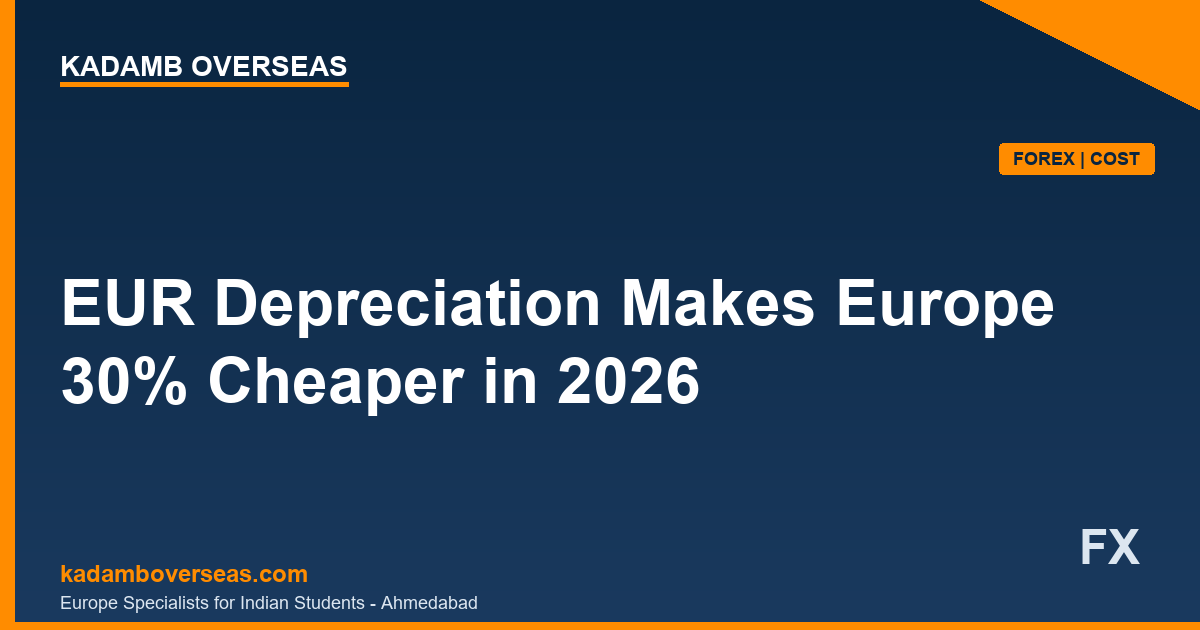
Net effect: European tuition has become roughly 43% smaller as a fraction of Indian Tier 1 graduate income from 2020 to 2026.
For a more conservative reference family — say a family of two professional parents with combined household income — the same calculation gives a 25-32% effective reduction in tuition burden.
This is the “30% cheaper” claim: not nominal rupee depreciation but purchasing power relative to growing Indian incomes.
USD-INR vs EUR-INR vs GBP-INR: Comparative Depreciation
| Currency | 2020 Rate | 2026 Rate | INR Depreciation % |
|---|---|---|---|
| USD-INR | ₹74 | ₹84 | +14% (rupee weakened 14% against USD) |
| EUR-INR | ₹85 | ₹96 | +13% (rupee weakened 13% against EUR) |
| GBP-INR | ₹100 | ₹105 | +5% (rupee weakened 5% against GBP) |
| AUD-INR | ₹56 | ₹55 | -2% (rupee strengthened 2% against AUD) |
| CAD-INR | ₹57 | ₹61 | +7% (rupee weakened 7% against CAD) |
Practical implication for Indian study abroad decisions
| Destination | Currency burden change 2020→2026 |
|---|---|
| **USA** | INR weakened 14% — most expensive trajectory |
| **UK** | INR weakened only 5% — UK has become relatively cheaper for Indians |
| **Europe (Eurozone)** | INR weakened 13% — roughly tracks USD trajectory |
| **Australia** | INR strengthened 2% — Australia has become MORE affordable |
| **Canada** | INR weakened 7% — Canada moderately more expensive |
So in pure currency-cost terms, Australia and UK have become more attractive vs 2020, while USA has become more expensive, and Europe has become slightly cheaper vs USA in relative terms.
But for Indian families, total cost (tuition + living + 6-figure private USA tuition vs sub-€2K Eurozone public tuition) makes Europe a clear winner. A ₹40 lakh European 2-year Master’s is unmatched value vs ₹80-1.2 crore for a USA equivalent.
Country-by-Country Savings: 2026 vs 2020
Let’s calculate effective tuition cost in INR for each country (€ tuition × current EUR-INR rate, vs 2020 EUR-INR rate × same tuition).
Germany Master’s
- Public tuition: €0-€500/sem (₹0-50K/sem) — for most public universities, tuition is essentially free
- Private universities: €15,000/year (TUM Asia, EU Business School Berlin) — ₹14.4 L/year in 2026
- 2020 cost of same €15,000 = ₹12.75 L
- 2026 cost = ₹14.4 L
- Real impact for IIT graduate family: 2020 = 14 months salary; 2026 = 8 months salary
- Effective saving vs 2020 (income-adjusted): ₹14 L over 2 years
For Germany context see Germany country hub and MS Germany vs IIM MBA ROI 2026.
France Master’s
- Grande Ecole tuition: €18,000-25,000/year — ₹17-24 L/year in 2026
- HEC, ESSEC, ESCP fees roughly €25,000-30,000/year
- 2026 cost of HEC MBA €120,000 = ₹115 L
- 2020 cost of HEC MBA €120,000 = ₹102 L
- Income-adjusted saving: ~₹13 L over 2 years.
Italy Master’s
- Public universities: €1,500-3,000/year (Politecnico Milano, Politecnico Torino) — ₹1.4-2.9 L/year
- Private (Bocconi): €15,000-20,000/year — ₹14.4-19.2 L/year
- Public Italian universities are essentially free — Italy is the cheapest Europe Master’s option after Germany free public universities
- See Italy vs Spain MBA for Indians Bocconi vs IE for MBA specifics.
Netherlands Master’s
- Public universities: €15,000-20,000/year (TU Delft, Wageningen, Utrecht) — ₹14.4-19.2 L/year in 2026
- TU Delft MSc Aerospace Eng €20,000/year = ₹19.2 L/year
- 2020 cost = ₹17 L/year
- See Netherlands vs Belgium English-medium Masters 2026.
Belgium Master’s
- KU Leuven Master tuition: €8,000-12,000/year — ₹7.7-11.5 L/year in 2026
- More affordable than Netherlands.
Austria Master’s
- mdw, Vienna University tuition: €1,500/year for non-EU — ₹1.4 L/year
- Vienna University of Economics and Business: €15,000-20,000/year for executive programmes
- See Austria country hub.
Spain Master’s
- IE Business School MBA: €76,000/year — ₹73 L/year in 2026
- ESADE MBA: €72,000/year — ₹69 L/year
- Public universities: €1,000-3,000/year — ₹1-3 L/year.
Switzerland Master’s
- ETH Zurich, EPFL: CHF 730/sem (~₹70K/sem) — ridiculously cheap for global elite
- Living costs (₹25 L/year) dominate the budget; tuition is negligible
- See Switzerland country hub and Germany vs Switzerland for Indian Engineers 2026.
RBI’s Liberalised Remittance Scheme (LRS): USD 250K Annual Cap
The Reserve Bank of India’s Liberalised Remittance Scheme (LRS) allows resident Indians to remit up to USD 250,000 per financial year (April 1 to March 31) per individual for current account transactions including education.
Practical implications
- A parent can remit USD 250,000 (~₹2.1 crore at ₹84/USD) per financial year
- A family of two parents can remit USD 500,000 (~₹4.2 crore) per financial year
- This is more than enough for any European Master’s programme (even ₹56 lakh annual cost at Bocconi or HEC)
Limit interaction with tuition payments
- Tuition payments to foreign universities use the Authorised Dealer (AD) Code 0306 under LRS
- All remittances must be through a licensed Authorised Dealer (banks like SBI, HDFC, Axis, ICICI, Kotak)
- You cannot remit via crypto or unofficial channels — RBI penalties apply
- Each remittance must be supported by university invoice / fee statement.
TCS 5% on Remittances Over ₹7 Lakh: How It Works
Since October 2020 (revised 2023), the Indian government imposes 5% Tax Collected at Source (TCS) on LRS remittances above ₹7 lakh in a financial year. From October 2023, this rate was increased to 20% for general LRS but education remittances remain at 5% if funded by an education loan from an Indian bank.
Detailed structure
| Remittance type | TCS rate |
|---|---|
| Education remittance funded by Indian education loan | 0.5% (on amount above ₹7 lakh) |
| Education remittance from own funds (no loan) | 5% (on amount above ₹7 lakh) |
| Other LRS (investments, gifts, travel) | 20% (on amount above ₹7 lakh) |
Worked example for a typical €40,000 (₹38 lakh) tuition transfer
- Remittance amount: ₹38 lakh
- Threshold: ₹7 lakh (TCS-free)
- Taxable amount: ₹38 lakh – ₹7 lakh = ₹31 lakh
- TCS at 5% (own funds): ₹1.55 lakh
- TCS at 0.5% (with education loan): ₹15,500
Saving from using education loan instead of own funds for the same ₹38 lakh transfer: ₹1.4 lakh per year, even ignoring loan interest savings.
This is a major reason Indian families increasingly use education loans even when they can technically afford full self-funding — the TCS structural arbitrage favours loan-funded education.
TCS is collected at the time of remittance by the bank, deposited with the IT department, and shown as a credit on your Form 26AS / AIS — you can claim it back as a refund or adjust against income tax liability when filing returns.
For detailed loan EMI implications see education loan EMI calculator Europe 8 destinations.
Forex Strategies: Lump Sum vs SIP-Style Chunks
Most Indian families have two main forex strategies:
Strategy 1: Lump sum conversion at admission (most common)
- Convert ₹38 lakh to €40,000 in single transaction at admission time
- Risk: rate moves against you between admission and tuition deadline
- Cost: bank spread (typically 50-100 paise per euro on standard bank rates)
Strategy 2: SIP-style monthly chunks (more sophisticated)
- Convert €1,500-2,000 every month from admission month to year-end via auto-debit
- Smooths out rate fluctuations — you neither catch the bottom nor the top
- Lower spread per chunk possible via forex aggregators (BookMyForex, ExTravelMoney, Niyo Global) which compete on rates
- Typical savings: ₹15-25K over a year’s tuition vs lump sum.
Strategy 3: Forward contract (most sophisticated, for ₹40L+)
- Book a forward contract with your bank to lock EUR rate today for delivery 6 or 12 months out
- Requires ₹1-2 lakh margin
- Locks the rate but you pay 0.5-1% forward premium
- Worth it if you expect EUR-INR to rise significantly (₹3+/EUR move)
- For 2-year Master’s, can lock both year-1 and year-2 rates today
- Potential saving on ₹76 lakh 2-year tuition: ₹2-3 lakh.
Comparison
| Strategy | Best for | Risk | Cost over ₹38L tuition |
|---|---|---|---|
| Lump sum | Tight timeline, simple families | High forex risk | ₹40-80K spread |
| Monthly SIP | Year-1 tuition over 10-12 months | Medium risk | ₹25-50K spread |
| Forward contract | 2-year Master’s, ₹40L+ amounts | Low risk | ₹50K-1L premium |
Forex Cards vs Wire Transfer: ₹3-5K Savings Per Cycle
For living expenses on the ground in Europe, Indian students have three main options:
Option 1: SWIFT wire transfer (parents send to student’s European bank account)
- Cost: ₹500-1,500 per transfer (SBI charges €30, HDFC charges ₹1,500 + €15)
- Time: 2-4 working days
- Spread: 25-50 paise per euro
- Best for: rent payments, tuition top-ups, large one-time transfers.
Option 2: International forex card (preloaded EUR)
- Card providers: Niyo Global Federal Bank, FreshForex by HDFC, Axis Burgundy, BookMyForex MakeMyTrip
- One-time loading fee: 0.5-1% of EUR loaded
- ATM withdrawal fee in Europe: typically €1-2 per ATM use
- POS swiping in Europe: free (no foreign currency markup)
- Spread: 25-50 paise per euro at loading
- Best for: daily living expenses, restaurant payments, online shopping.
Option 3: Indian credit card with international markup
- Foreign currency markup: 3.5-5% on most Indian credit cards
- Avoid for foreign spending — wasted ₹3-5K per year on markups
- Some premium cards (HDFC Infinia, Axis Magnus Burgundy) have lower markup ~1.5%.
Savings calculation
For a typical ₹2 lakh annual on-the-ground spending in Europe:
- Indian credit card 3.5% markup: ₹7,000 wasted
- Forex card 0.5% markup at loading: ₹1,000 wasted
- Annual saving by using forex card: ₹6,000
Over a 2-year Master’s, forex card use saves ₹12,000-15,000 vs Indian credit card use.
Education Loan in INR vs EUR: Which is Cheaper
Most Indian banks offer education loans in INR at floating interest rates (currently 9.5-11.5%). Some specialised lenders also offer EUR-denominated loans:
INR-denominated education loan (SBI, HDFC, Axis)
- Interest rate 2026: 9.5-11.5% floating (linked to RLLR / MCLR + spread)
- Repayment: full tenure 10-15 years, moratorium 6 months post-course
- Forex risk: borne by borrower (rupee depreciation = more INR needed for EUR payment)
- TCS: 0.5% on remittances above ₹7 lakh
- Tax benefit: Section 80E interest deduction (uncapped)
EUR-denominated loan (Prodigy Finance, MPower, Lendwise)
- Interest rate 2026: 8-10% in EUR (variable + LIBOR spread)
- Repayment: 10-20 years
- Forex risk: borne by lender (you pay in EUR)
- TCS: 0.5% still applies
- Tax benefit: Section 80E may apply (check current rules)
Comparison for €40,000 (₹38 lakh equivalent) loan, 10-year tenure
| Parameter | INR loan (SBI, 10.5%) | EUR loan (Prodigy, 9%) |
|---|---|---|
| Monthly EMI | ₹51,000 | €510 (~₹49K at ₹95) |
| Total interest paid | ₹23.2 L | €21K (~₹20 L) |
| Forex risk | Borrower (if INR depreciates further, EMI in INR stays same — protected) | Borrower (if INR depreciates further, EMI in INR rises) |
| TCS impact | 0.5% on disbursement | 0.5% on disbursement |
| Best for | Conservative families wanting predictable INR EMI | Tech-savvy borrowers comfortable with forex |
For pure cost: INR loan from SBI or HDFC is slightly more expensive but predictable. EUR loan from Prodigy is slightly cheaper but carries forex risk if rupee depreciates further (which is the structural trend).
For deeper loan analysis see our education loan EMI calculator Europe 8 destinations and the existing education loan study abroad Europe 2026 SBI HDFC Axis Prodigy comparison.
FCNR Deposit Hedging: How NRI Families Use It
NRI parents of Indian students have an additional hedging tool not available to resident Indians: FCNR (B) deposits denominated in EUR, USD, GBP, AUD, CAD, JPY.
How it works
- NRI parent deposits foreign currency (e.g. €50,000) into an FCNR EUR account at an Indian bank
- Interest rate: ~3.5-4.5% in EUR (2026 rates)
- Tenure: 1-5 years
- Principal and interest are paid in EUR — no rupee conversion risk
- The deposit acts as a natural hedge: when child’s tuition deadline arrives, you encash the FCNR EUR deposit and remit directly without any forex transaction.
This works extremely well for NRI families in UAE, USA, UK or Singapore who can build EUR-denominated savings ahead of time and avoid rupee conversion entirely. Resident Indians cannot open FCNR accounts.
Forward Contract Strategies for 2-Year Masters Programs
For ₹40+ lakh corpora, forward contracts merit serious consideration. Example scenario:
Setup
- 2-year Master’s at TU Delft Netherlands, total tuition €40,000 (Year 1 €20,000 in Sept 2026, Year 2 €20,000 in Sept 2027)
- Current spot EUR-INR (Apr 2026): ₹96
- Forward rate for Sept 2026 delivery: ₹96.50
- Forward rate for Sept 2027 delivery: ₹98.00
Strategy A: No hedging (spot at each payment)
- Year 1: ₹19.2 lakh paid at ₹96 (Sept 2026 spot)
- Year 2: ₹? paid at ₹? (Sept 2027 spot — unknown today)
- If EUR-INR rises to ₹100 by Sept 2027: Year 2 = ₹20 lakh
- Total: ₹39.2 lakh
Strategy B: Forward contract both years
- Year 1: Book forward at ₹96.50, pay ₹19.30 lakh in Sept 2026
- Year 2: Book forward at ₹98.00, pay ₹19.60 lakh in Sept 2027
- Total: ₹38.90 lakh — saves ₹30K vs Strategy A IF EUR rises to ₹100 in Sept 2027
- Forward contract margin requirement: ₹1-2 lakh
Strategy C: Hybrid (forward for Year 1 + spot for Year 2)
- Year 1: Forward at ₹96.50 = ₹19.30 lakh
- Year 2: Wait and see spot in 2027
- Captures certainty for the imminent payment while keeping flexibility
For 2-year Masters costing ₹40+ lakh, forward contracts typically save ₹50K-1.5 lakh if EUR appreciates against INR (which is the structural expectation given India’s inflation differential with the eurozone).
Practical 24-Month Forex Plan for ₹40 Lakh European Masters
Here’s a worked plan for a typical Indian family funding a ₹40 lakh European Master’s starting Sept 2026:
| Month | Action | Amount |
|---|---|---|
| Apr 2026 | Open education loan account (SBI/HDFC) | ₹30 L sanctioned |
| May 2026 | Open Niyo Global or Federal Bank forex card | Setup only |
| Jun 2026 | Book forward contract for Year 1 tuition (€18K) at ₹96.50 | Margin ₹1L |
| Jul 2026 | Pay university acceptance fee (€2K) via SWIFT | ₹1.95 L |
| Aug 2026 | Disburse Year 1 tuition via loan (₹17.5L of tuition + buffer ₹2L for visa, flight, initial settlement) | ₹19.5L |
| Sep 2026 | Student departs; auto-debit forex SIP starts (€1,200/month onto Niyo card) | ₹1.15L/month |
| Oct 2026 – Aug 2027 | Monthly SIP for living expenses | ₹1.15L × 11 = ₹12.6L |
| Jun 2027 | Book forward contract for Year 2 tuition (€18K) at ₹98 | Margin ₹1L |
| Aug 2027 | Disburse Year 2 tuition via loan | ₹17.6L |
| Sep 2027 – Jun 2028 | Continue monthly SIP for Year 2 living | ₹1.15L × 10 = ₹11.5L |
| Total | **₹62.7 L** including living costs |
This breaks down as: ₹40L tuition + ₹22.7L living = ₹62.7L total outflow over 24 months. Loan covers ₹30L; family self-funds ₹32.7L.
Forex Scams to Avoid
The forex market for Indian study abroad has its scams:
1. “Guaranteed 1% better rate” agents who collect your forex order and route it through grey-market channels — illegal under FEMA, can result in seizure
2. Hawala-style rupee deposit + EUR delivery in Europe — illegal money laundering route, attracts both Indian and European law enforcement
3. Crypto for tuition payment — Indian universities and EU universities do not accept crypto; agents claiming to “convert” your INR to EUR via Bitcoin are running scams
4. “Forex partner” claiming preferential bank rate — banks do not give individual customers preferential rates outside of declared corporate rates; this is fraud
5. Forex card preloading scams — agents selling preloaded forex cards at “discount rates” that don’t actually work in Europe
6. Fake forward contract offerings outside of regulated banks — only AD Category I banks can issue forward contracts; “private forward contract dealers” are scams.
For broader scam detection see our European scholarship scam detection red flags guide.
Saumitra Rajput’s rule for Kadamb Overseas families: “Pay tuition only via SBI, HDFC, Axis, Kotak or ICICI authorised dealer remittance, with documented LRS declaration. Use Niyo Global, BookMyForex or Federal Bank forex card for living. Avoid anyone offering ‘better than bank’ rates — that’s how families lose ₹5-10 lakh to forex frauds.” Stick to regulated channels.
Smart Forex Strategy for 2-Year Master’s: Forward Contracts + Tranches
The single most underutilised tool in Indian family forex planning for European Master’s is the combination of forward contracts + tranche-based loading + multi-card stacking. Used correctly, this stack saves ₹1.5-3 lakh over a 2-year programme vs the default “convert lump-sum at admission” approach most families take. Here is the practical playbook.
Step 1: Multi-card stacking for everyday spend. Three cards work best in combination for Indian students in Europe:
- HDFC ForexPlus Multi-Currency Card — preload EUR at loading rate (typically 25-50 paise spread vs interbank), ATM withdrawal fee €2-3 per withdrawal, no POS markup at European merchants. Best for restaurant, daily grocery and public transport spend. Loading limits: €10,000 per transaction, multiple loadings allowed up to LRS limit annually.
- ICICI Bank Travel Card (Sapphiro) — similar functionality, slightly better spread on EUR loadings during ICICI festival promotions (1-2 times per year, watch for 15-25 paise additional discount). Useful as backup if HDFC card declines.
- Niyo Global Federal Bank Visa Debit Card — the cheapest option, zero markup on POS, free ATM withdrawals at select partner ATMs (Volksbank Germany, Société Générale France, ING Belgium). Spread typically 15-30 paise — the tightest of the three. Loading via UPI from your home Indian account. Best for daily living expenses. Conversion margin advertised at “interbank rate” but practically 0.5% baked in.
Conversion margins comparison: HDFC ForexPlus loading 1.0-1.5%, ICICI Travel 1.0-1.5%, Niyo Global 0.5%, bank counter standard rate 3.0-3.5%. Switching from “bank counter for everything” to “Niyo + HDFC ForexPlus stack” saves ₹35-50K per year on ₹15 lakh annual living expenses.
Step 2: Tranche-based tuition loading. Instead of converting full ₹40 lakh tuition in one shot at admission, split into 4 tranches aligned to actual payment moments:
- Tranche 1 (Aug 2026, ~₹10 lakh) — Year 1 Semester 1 tuition + first 3 months living deposit + flight, visa, setup. Convert via SBI/HDFC SWIFT at September spot rate.
- Tranche 2 (Jan 2027, ~₹6 lakh) — Year 1 Semester 2 tuition + ongoing living top-up. Spot rate at conversion time — could be ₹95 or ₹98 depending on market.
- Tranche 3 (Aug 2027, ~₹10 lakh) — Year 2 Semester 1 tuition + living. New spot rate.
- Tranche 4 (Jan 2028, ~₹6 lakh) — Year 2 Semester 2 tuition + final living. Spot rate again.
Tranche approach naturally averages your effective EUR-INR rate across 16 months — you neither catch the worst rate nor the best, but you avoid the catastrophic outcome of converting ₹40 lakh on a day EUR-INR happens to spike to ₹102.
Step 3: Forward contract booking at SBI or Axis for Year 2 tuition. This is the move most families miss. In April 2026, you book a forward contract with SBI’s forex desk for ₹4 lakh equivalent (~€4,200) deliverable in August 2027, locking the rate at today’s forward rate of ~₹98/EUR. Forward contract margin requirement: ₹50,000 – ₹1 lakh held at the bank. Forward premium: 0.5-1% baked into the locked rate. If EUR-INR rises to ₹103 by Aug 2027, you save ₹5 × 4,200 = ₹21,000 on that ₹4 lakh forward. Stack 2-3 forward contracts across the 2-year programme on different EUR amounts and you save ₹50K-₹1.5L over the programme.
Step 4: TCS planning around the ₹7 lakh LRS limit. As covered earlier, education loan funding reduces TCS from 5% to 0.5% on amounts above ₹7 lakh. But there’s a second optimisation: families who can split education funding across two financial years (e.g., Tranche 1 in March 2026 just before financial year-end, Tranche 2 in April 2026 just after) effectively double the ₹7 lakh threshold to ₹14 lakh of TCS-free remittance. For a ₹40 lakh corpus this saves ₹35,000 in TCS via timing alone. Discuss with your chartered accountant before executing.
Step 5: USD-EUR cross-rate hedging for emergency funds. Keep ₹2-3 lakh in a USD-denominated forex card or US savings account (via NRI parent) as emergency reserve. Why USD not EUR? When EUR-INR spikes (typically driven by India-specific INR weakness rather than EUR strength), USD-INR usually moves in same direction. USD reserve hedges your INR home currency rather than your EUR target currency. This is a sophisticated move — most families skip it, but for ₹50+ lakh corpora it adds an insurance layer.
Total potential savings from this 5-step stack vs naive “convert lump sum at bank counter” approach: ₹2.5-4 lakh over a 2-year ₹62 lakh total European Master’s outflow. For cross-references see our education loan EMI calculator for 8 European destinations and hidden costs of European study for Indian families.
Frequently Asked Questions
### Q1: Has EUR really depreciated and made Europe cheaper for Indian students?
In nominal EUR-INR rates, no — EUR has appreciated from ₹85 to ₹96 (2020 to 2026). However, in real purchasing-power terms (adjusting for Indian wage growth and Indian inflation), European tuition has become 25-30% cheaper as a fraction of Indian household income. A €15,000 Master’s that took 14 months of IIT graduate income in 2020 takes only 8 months in 2026.
### Q2: What is the EUR-INR forecast for 2027?
Most forecasts (RBI, IMF, Standard Chartered) project EUR-INR to range ₹95-100 through 2027, with a slight upward bias due to continued INR depreciation against USD. Major scenarios: optimistic ₹93-95; baseline ₹95-98; downside ₹98-103. Plan your study abroad budget at ₹100/EUR for safety margin.
### Q3: What is the LRS (Liberalised Remittance Scheme) limit for Indian study abroad?
USD 250,000 per individual per financial year (April 1 to March 31). A family of two parents can remit USD 500,000 (~₹4.2 crore) per year combined. Far more than any European Master’s programme requires. Remittances must go through Authorised Dealer banks (SBI, HDFC, Axis, ICICI, Kotak).
### Q4: What is TCS on education remittance to Europe?
5% TCS on remittance amount above ₹7 lakh in a financial year if funded from own savings. 0.5% TCS if funded by an Indian education loan. So for a ₹38 lakh tuition transfer, TCS is ₹1.55 lakh from own funds or ₹15,500 with loan — a saving of ₹1.4 lakh by using education loan even just for TCS arbitrage.
### Q5: Should I convert rupees to euros lump sum or in monthly chunks?
For lower amounts (under ₹10 lakh): lump sum is fine. For ₹10-40 lakh tuition: monthly chunks via forex card aggregator (Niyo, BookMyForex) save 25-50K vs lump sum bank conversion. For ₹40+ lakh and 2-year programmes: forward contracts via your bank lock the rate and save ₹50K-1.5 lakh if EUR appreciates.
### Q6: Is Prodigy Finance EUR loan better than SBI INR education loan?
Prodigy EUR loan: 8-10% interest in EUR. SBI INR loan: 9.5-10.5% interest in INR. Prodigy is nominally cheaper but you bear forex risk (if rupee depreciates, EMI in INR rises). SBI is slightly more expensive but predictable INR EMI. For risk-averse families: SBI. For tech-savvy borrowers comfortable with forex: Prodigy.
### Q7: What is the cheapest way to send rupees to Europe?
For tuition (one-time large transfers): SWIFT via your home bank — ₹500-1,500 fee plus 25-50 paise spread per euro. For living expenses on the ground: forex card (Niyo Global, BookMyForex, Axis Burgundy) loaded with EUR at the time of departure, with monthly top-ups. Avoid using Indian credit cards in Europe — 3.5-5% markup wastes ₹6-10K per year.
### Q8: Can I open a EUR-denominated bank account in India?
Resident Indians cannot open EUR savings accounts in India. NRIs can open FCNR (B) deposits in EUR (and other foreign currencies) at Indian banks, earning ~3.5-4.5% in EUR, with no rupee conversion risk. This is a powerful hedging tool for NRI families planning Indian children’s European education.
### Q9: What is a forward contract and should my family use one?
A forward contract locks today’s EUR rate for a future delivery date (6-12 months out). Requires ₹1-2 lakh margin. Costs 0.5-1% forward premium. Worth it for ₹40+ lakh corpora and 2-year programmes when EUR is expected to appreciate. Book with your bank’s forex desk. Avoid private “forward contract dealers” — they’re illegal.
### Q10: How does USD-INR depreciation compare with EUR-INR depreciation?
USD-INR: ₹74 to ₹84 = 14% INR depreciation over 6 years. EUR-INR: ₹85 to ₹96 = 13% INR depreciation. So in nominal terms USD and EUR have moved similarly against INR. GBP-INR depreciation only 5% — UK has become relatively cheaper for Indians. AUD-INR actually strengthened — Australia is more affordable.
### Q11: Are crypto / Bitcoin tuition payments allowed for Indian students?
No. RBI does not permit crypto for current-account remittances under LRS. European universities also do not accept crypto for tuition (they require fiat EUR via SWIFT or domestic bank transfer). Any agent claiming “crypto-route” forex is running an illegal grey-market hawala scheme — penalties include forfeiture of funds and criminal prosecution.
### Q12: What forex spread should I expect from Indian banks for EUR conversion?
Standard bank rates for retail customers typically include 50-100 paise per euro spread (i.e., if EUR-INR mid-market is ₹96.00, your bank may quote ₹96.50 for buying EUR). Forex aggregators (BookMyForex, ExTravelMoney) typically offer 25-50 paise spread. Premium banking relationships (HDFC Imperia, Axis Burgundy) may give 10-25 paise spread. Always compare 2-3 sources before transacting.
### Q13: How does GST apply to forex transactions for Indian students?
GST is charged on the forex conversion service fee (typically ₹100-1,000 per transaction depending on amount), not on the transferred amount itself. So for a ₹19 lakh tuition transfer, GST might be ₹200-1,800 on the bank’s service fee. This is a small cost compared to spread and TCS. Include it in your budget calculation.
### Q14: Should I take a loan in INR or EUR if both are available?
Generally INR loans are simpler and more predictable for Indian families. The interest rate gap (INR loans ~10.5% vs EUR loans ~9%) is partially offset by forex risk on EUR loans. Unless you have natural EUR income (e.g., parent working in Europe), stick with INR loan from SBI, HDFC, Axis, ICICI or Kotak. The TCS is also lower with education loans (0.5% vs 5% from own funds).
### Q15: How can Kadamb Overseas help with forex planning for my child’s European Masters?
Kadamb Overseas in Ahmedabad provides forex planning guidance as part of our admission counselling. We work with families to: (a) compare INR loans across 5-6 Indian banks for best rates, (b) recommend forex card providers (Niyo, BookMyForex, Federal Bank), (c) advise on lump sum vs SIP vs forward contract strategies based on family’s risk profile, (d) compute TCS implications, (e) connect families with chartered accountants for cross-border tax planning. WhatsApp Saumitra Rajput on +91 96876 88776 for a free initial consultation.
### Q16: Which forex card is best for an Indian student in Europe — HDFC ForexPlus, ICICI Travel Card, or Niyo Global?
Niyo Global Federal Bank is the cheapest (0.5% spread, free POS at European merchants, free ATM at partner banks like Volksbank Germany, Société Générale France, ING Belgium) — best for daily living expenses. HDFC ForexPlus Multi-Currency (1.0-1.5% spread, €10K loading limit per transaction, multiple loadings allowed) is best for bulk EUR loading. ICICI Travel Card Sapphiro is a useful backup. Best practice: stack all three — Niyo for everyday spend, HDFC ForexPlus for periodic top-ups, ICICI for emergency backup. Total savings vs bank counter conversion: ₹35-50K per year on ₹15 lakh annual living expenses.
### Q17: Can I split my tuition remittance across two financial years to save TCS?
Yes — if your child’s tuition payment dates allow it. The TCS structure resets each financial year (April 1 to March 31), with ₹7 lakh threshold per year per individual. If you remit ₹7 lakh in March 2026 and the remaining tuition in April 2026, both tranches fall under the threshold and you avoid TCS entirely on that ₹14 lakh combined. For a typical ₹40 lakh tuition corpus, careful cross-financial-year timing combined with education loan funding can reduce TCS from ₹1.55 lakh down to under ₹20,000. Always consult a chartered accountant before executing this strategy as universities have specific payment deadlines.
Ready to Plan Your Europe Forex Strategy?
The forex dimension of Indian study abroad is often overlooked but materially affects your total ₹40-60 lakh budget. A poorly executed forex plan can cost ₹3-5 lakh over a 2-year Master’s; a well-executed plan can save the same amount. Kadamb Overseas in Ahmedabad provides integrated forex + loan + tax planning as part of our admission counselling for European Masters programmes.
WhatsApp Saumitra Rajput and team on +91 96876 88776 for a free 30-minute forex and budget planning call, or visit our Ahmedabad office, or our Mumbai consultancy, Pune, Bangalore or Delhi network. For more guides see our free Europe study guides library or contact page.
Saumitra Rajput
Saumitra Rajput is the founder of Kadamb Overseas Pvt. Ltd., India's leading Europe-focused study abroad consultancy based in Ahmedabad. With 14+ years of expertise in European education, he has personally counselled 2,500+ Indian families and helped 500+ students secure admission to top European universities including TU Munich, ETH Zurich, EPFL, KU Leuven, HEC Paris, Sapienza Rome, TU Wien, and Warsaw University of Technology. He has visited 25+ European universities, partners with 250+ EU institutions, and maintains a 500+ students placed.
Planning to Study Abroad?
Get free expert guidance from our experienced counselors

Saumitra Rajput
Saumitra Rajput is the founder and lead counsellor at Kadamb Overseas, India's trusted Europe education consultancy based in Ahmedabad. With 14+ years of hands-on experience, he has personally guided 500+ students to universities across Germany, Switzerland, France, Italy, Austria, and Spain. Saumitra has visited partner universities across Europe, holds deep expertise in European visa processes, scholarships, and student life, and has achieved a 97% visa success rate for his clients. He is the host of the YouTube channel "Europe with Saumitra", where he shares first-hand insights on studying and living in Europe. His mission: make Europe accessible to every Indian student, with zero consultancy fees.