


Last Updated: January 9, 2026
Table of Contents
- 🎯 Understanding PTE Speaking: How AI Scoring Actually Works
- 📋 All 7 PTE Speaking Task Types: Complete Breakdown
- 🎤 Mastering Pronunciation: What the AI Really Listens For
- 🌊 Mastering Oral Fluency: The Art of Smooth Delivery
- 📊 Task-Specific Strategies for Maximum Scores
- ⚠️ Common Mistakes That Kill Your Score
- 📱 Practice Tools & Resources
- 🗓️ Your 30-Day PTE Speaking Improvement Plan
- ❓ Frequently Asked Questions
- 🎯 Conclusion: Your Path to PTE Speaking Success
🕑 11 min read
⚡ PTE Speaking 2026: Quick Facts
- Section Duration: 54-67 minutes (Speaking & Writing combined)
- Task Types: 5 main types + 2 new additions (2024 update)
- Scoring Range: 10-90 points (Pronunciation & Fluency: 0-5 scale each)
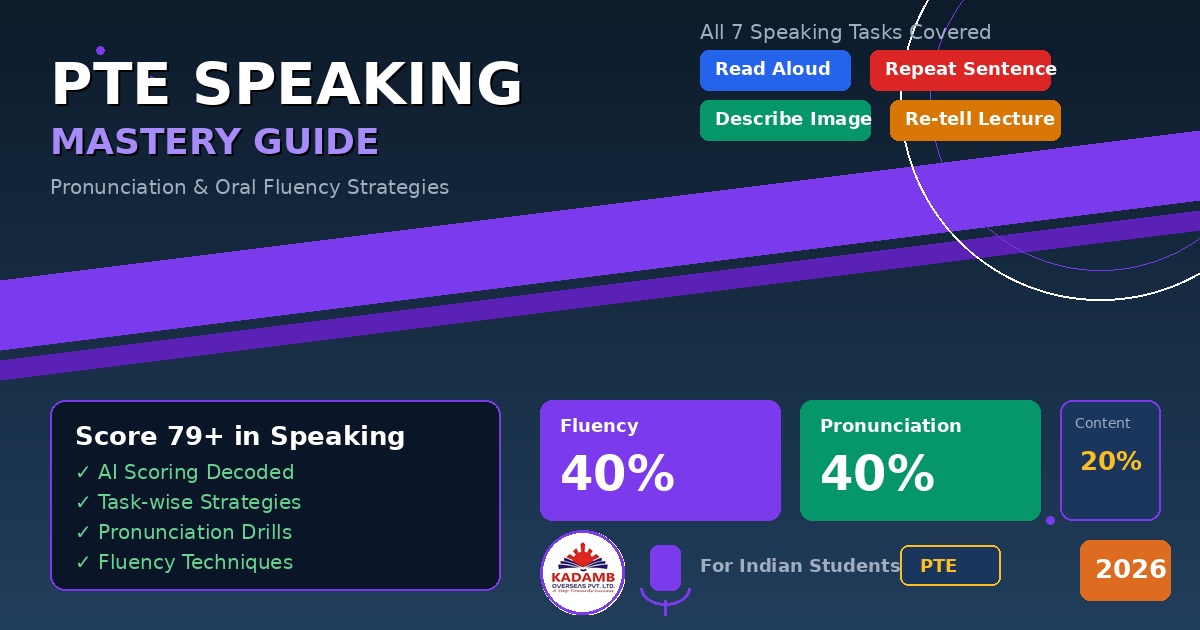
- Key Skills: Pronunciation (40%) + Oral Fluency (40%) + Content (20%)
- Results: Available within 48 hours
- Validity: 2 years from test date
Struggling to score above 79 in PTE Speaking despite being fluent in English? You’re not alone. Over 60% of Indian test-takers lose crucial points in Pronunciation and Oral Fluency—not because their English is weak, but because they don’t understand how the AI scoring system works.
The PTE Academic Speaking section is fundamentally different from IELTS or TOEFL. There’s no human examiner making subjective judgments. Instead, Pearson’s AI-powered Versant technology analyzes your speech patterns, stress placement, rhythm, and clarity in milliseconds. Understanding this technology is your key to unlocking a high score.
In this comprehensive guide, we’ll decode exactly what the PTE AI listens for, reveal task-specific strategies for all 7 question types, and share proven techniques that have helped our students at Kadamb Overseas PTE Coaching achieve 79+ scores consistently. Whether you’re targeting September 2026 intake for European universities or need quick score improvement, these strategies will transform your speaking performance.
🎯 Understanding PTE Speaking: How AI Scoring Actually Works
Before diving into strategies, let’s understand the scoring mechanics. Unlike human examiners who might be influenced by accent or nervousness, PTE’s AI scoring is completely objective—but it follows specific patterns you can optimize for.
The Three Pillars of PTE Speaking Scores
Key Insight: Notice that HOW you speak (Fluency + Pronunciation = 80%) matters more than WHAT you say (Content = 20%). This is why many fluent speakers still struggle—they focus on perfect grammar instead of smooth delivery.
The 0-5 Scoring Scale Explained
📋 All 7 PTE Speaking Task Types: Complete Breakdown
The PTE Speaking & Writing section includes 7 distinct task types (including 2 additions from the 2024 update). Understanding each task’s specific requirements is crucial for targeted preparation.
Struggling with PTE Speaking Score Below 79?
Get personalized feedback on your pronunciation and fluency from our PTE experts. Our AI-assisted coaching has helped 500+ students achieve 79+ scores.
✓ Identify your weak areas. Response within 24 hours.
🎤 Mastering Pronunciation: What the AI Really Listens For
Here’s a fact that surprises many test-takers: Your accent is NOT your pronunciation score. The PTE AI is trained on hundreds of global English accents—Indian, Chinese, Nigerian, British, American. It doesn’t penalize accents; it evaluates clarity and correctness within your accent.
The 4 Elements of Pronunciation Scoring
1. Vowel Sounds — Can listeners clearly distinguish between similar vowels?
- ship vs sheep (short /ɪ/ vs long /iː/)
- bed vs bad (/e/ vs /æ/)
- full vs fool (/ʊ/ vs /uː/)
2. Consonant Sounds — Are challenging consonants produced clearly?
- /θ/ (think, three) — tongue between teeth
- /ð/ (this, that) — voiced version
- /v/ vs /w/ (very vs wary)
- /r/ vs /l/ (right vs light)
3. Word Stress — Is the correct syllable emphasized?
- pro-nun-ci-A-tion (stress on 4th syllable)
- DE-sert (noun: dry land) vs de-SERT (verb: abandon)
- PHO-to-graph vs pho-TOG-ra-phy
4. Sentence Stress & Intonation — Does the voice rise and fall naturally?
- Questions: Rising intonation ↗
- Statements: Falling intonation ↘
- Lists: Rise, rise, rise, fall (A↗, B↗, C↗, and D↘)
💡 EXPERT INSIGHT
“The biggest mistake Indian students make is trying to sound ‘American’ or ‘British.’ The AI doesn’t care about your accent—it cares about clarity. Speak in your natural voice, but focus on producing each sound distinctly. Use your phone’s voice-to-text feature: if Google can’t understand you, neither will PTE’s AI.”
— Saumitra Rajput, Founder, Kadamb Overseas (15+ years experience)
🔧 Practical Pronunciation Drills
Tongue Twisters for Indian Speakers:
- /θ/ sound: “The thirty-three thieves thought they thrilled the throne”
- /v/ vs /w/: “Very well, William went west with Victor”
- /r/ vs /l/: “Really reliable railway regulations rarely relax”
- Consonant clusters: “Strict strength training strengthens strategic skills”
🌊 Mastering Oral Fluency: The Art of Smooth Delivery
Fluency isn’t about speaking fast—it’s about speaking smoothly without unnecessary breaks. The AI detects:
- Hesitations: Unnatural pauses mid-sentence
- Repetitions: “I think… I think that…”
- False starts: “The graph shows… Actually, the chart displays…”
- Filler words: “Um,” “uh,” “like,” “you know”
The 5-Point Fluency Scale in Detail
💪 Fluency Building Techniques
1. The Shadowing Method
Listen to native English speakers (podcasts, TED Talks, news) and speak along with them in real-time. This synchronizes your speech patterns with natural English rhythm.
2. The Chunking Technique
Instead of reading word-by-word, group words into meaningful phrases:
❌ “The / report / shows / that / sales / increased / significantly”
✅ “The report shows / that sales increased / significantly”
3. Silent Pause vs Filler Words
If you need to think, pause silently. A brief silent pause is much better than “um” or “uh.” The AI is less sensitive to short silent pauses than to filler sounds.
📚 Related Reading
IELTS vs PTE: Which Test Should Indian Students Choose in 2026?
Compare scoring systems, acceptance rates, and preparation strategies for both tests.
📊 Task-Specific Strategies for Maximum Scores
1. Read Aloud (Highest Scoring Task!)
This is your biggest scoring opportunity—it contributes to both Speaking AND Reading scores.
✅ DO:
- Use all prep time to silently read and identify difficult words
- Mark natural pause points (commas, periods) mentally
- Maintain steady pace—don’t rush or drag
- Complete the entire text (partial responses lose content points)
❌ DON’T:
- Start speaking before the recording tone
- Go back to correct mistakes (keep moving forward)
- Speak in a monotone—use natural intonation
- Skip difficult words—attempt everything
2. Repeat Sentence (Hardest Task for Many!)
This tests both listening and speaking simultaneously. The key is chunking and instant recall.
Strategy:
- Focus on meaning, not individual words — Understanding helps recall
- Start speaking immediately — Don’t wait to remember everything
- Say what you remember — Partial credit is given; silence scores zero
- Maintain fluency over accuracy — A fluent close approximation scores better than hesitant perfection
3. Describe Image (Use Templates!)
Templates provide structure and ensure you don’t freeze. Here’s a proven template:
📋 Describe Image Template:
- Introduction: “This [image type] illustrates/shows/presents [topic].”
- Key feature 1: “The most significant/striking feature is [highest/lowest/main point].”
- Key feature 2: “Additionally, we can observe that [another important detail].”
- Comparison (if applicable): “Comparing [X] and [Y], we see that [relationship].”
- Conclusion: “In conclusion, this [image type] clearly demonstrates [main takeaway].”
4. Re-tell Lecture
Take notes during the audio using keywords and abbreviations. Focus on:
- Main topic (usually stated in first 20 seconds)
- Key points (2-3 main ideas)
- Examples or data mentioned
- Conclusion/speaker’s opinion
5. Answer Short Question
These test vocabulary, not speaking skills directly. Tips:
- Answer in 1-3 words only (don’t elaborate)
- Practice general knowledge questions
- If unsure, give your best guess (no negative marking)
⚠️ Common Mistakes That Kill Your Score
🎓 STUDENT SUCCESS STORY
Priya Sharma from Ahmedabad improved her PTE Speaking score from 62 to 84 in just 6 weeks. “The biggest change was understanding that fluency matters more than perfect grammar. Once I stopped correcting myself mid-sentence and learned to use templates for Describe Image, my scores jumped dramatically. Kadamb’s mock tests with AI feedback helped me identify exactly where I was losing points.”
Now pursuing her Master’s in Data Science at TU Munich, Germany 🇩🇪
📱 Practice Tools & Resources
Here are proven tools to improve your pronunciation and fluency:
🗓️ Your 30-Day PTE Speaking Improvement Plan
Week 1-2: Foundation Building
- Practice 5 Read Aloud passages daily
- Record and listen to yourself—identify pronunciation errors
- Work on 3 problem sounds (e.g., /θ/, /v/, /r/) with tongue twisters
- Shadow 10 minutes of TED Talks daily
Week 3: Template Mastery
- Learn and practice Describe Image template until automatic
- Practice Re-tell Lecture with note-taking
- Work on Repeat Sentence with chunking technique
- Eliminate filler words consciously
Week 4: Mock Tests & Refinement
- Take 2-3 full scored mock tests
- Analyze score report—identify weak areas
- Focus practice on lowest-scoring task types
- Final week: maintain consistency, avoid new techniques
❓ Frequently Asked Questions
No, PTE’s AI is trained on hundreds of global accents including Indian English. Your accent won’t penalize you. What matters is clarity—producing distinct vowel and consonant sounds, correct word stress, and natural intonation. Speak in your natural voice; don’t try to fake a British or American accent, as this often makes pronunciation worse.
With focused daily practice, most students can achieve significant improvement in 4-6 weeks. If your current level is around 65, expect 4-6 weeks of dedicated preparation. If you’re below 50, allow 8-12 weeks. The key is consistent daily practice (minimum 1-2 hours) rather than cramming. Join our PTE Coaching program for structured preparation with expert guidance.
Both are equally weighted at approximately 40% each (with content at 20%). However, fluency is often easier to improve quickly through practice and technique. Pronunciation requires more time to develop muscle memory. For immediate score improvement, focus on eliminating hesitations and filler words (fluency), while working on pronunciation as a longer-term goal.
No! Fluency means smooth, uninterrupted speech—not fast speech. Speaking too quickly often leads to mumbled pronunciation and incomplete words, which hurts both fluency AND pronunciation scores. Aim for a moderate, steady pace where each word is clearly articulated. Natural pauses at punctuation marks are expected and don’t hurt your score.
Keep going! Self-corrections hurt your fluency score more than the original mistake would hurt your content score. The AI detects repetitions and false starts as fluency problems. Unless you’ve said something completely wrong (like the opposite meaning), continue without correcting. A small error delivered fluently scores better than a perfect word with hesitation.
Read Aloud is the most valuable task because it contributes to BOTH Speaking and Reading scores (cross-scoring). With 6-7 questions and maximum points per task, excelling here significantly boosts your overall score. Repeat Sentence is also crucial as it affects Speaking and Listening scores. Prioritize these two tasks in your preparation.
Many Indian students find PTE Speaking more predictable because it’s computer-based with AI scoring—no examiner bias or bad days. Tasks are shorter, templates work well, and you know exactly what to expect. However, PTE requires technical skills (knowing when to start/stop recording) and comfort with computers. If you’re someone who gets nervous with human examiners, PTE may suit you better. Compare both tests at our IELTS Coaching page.
🎯 Conclusion: Your Path to PTE Speaking Success
Mastering PTE Speaking isn’t about having a perfect accent or extensive vocabulary—it’s about understanding how AI scoring works and optimizing your delivery accordingly. Remember the key principles:
- Fluency + Pronunciation = 80% of your score. Focus on smooth delivery over perfect content.
- Never self-correct. Keep moving forward even if you make mistakes.
- Use templates for Describe Image and Re-tell Lecture to ensure structure.
- Prioritize Read Aloud and Repeat Sentence—they contribute to multiple scores.
- Practice with AI feedback tools to identify your specific weak points.
Whether you need PTE scores for studying in Germany, France, or Austria for the September 2026 intake, consistent practice with the right strategies will get you there. Start today, and you’ll see results within weeks.
Ready to Ace PTE Speaking?
Join our PTE Coaching Program with AI-powered feedback, expert trainers, and proven strategies that have helped 500+ students achieve 79+ scores.
📋 Our PTE Coaching Includes:
- Task-wise strategies for all 7 speaking tasks
- AI-powered pronunciation analysis
- Unlimited mock tests with detailed feedback
- 1-on-1 doubt clearing sessions
- Score improvement guarantee
📞 +91-9913333239 |
💬 WhatsApp Us
📍 Kadamb Overseas, Ahmedabad, Gujarat | ⏰ Mon-Sat: 10AM – 7PM IST
Saumitra Rajput
Founder & European Education Expert
With 15+ years of experience in overseas education consulting, Saumitra has helped 500+ Indian students achieve their European study dreams. Kadamb Overseas offers comprehensive PTE, IELTS, and TOEFL coaching alongside study abroad consulting with a 97% visa success rate.
📚 Related Articles You’ll Find Helpful
Saumitra Rajput
Saumitra Rajput is the founder of Kadamb Overseas Pvt. Ltd., India's leading Europe-focused study abroad consultancy based in Ahmedabad. With 14+ years of expertise in European education, he has personally counselled 2,500+ Indian families and helped 500+ students secure admission to top European universities including TU Munich, ETH Zurich, EPFL, KU Leuven, HEC Paris, Sapienza Rome, TU Wien, and Warsaw University of Technology. He has visited 25+ European universities, partners with 250+ EU institutions, and maintains a 97% visa success rate.
Planning to Study Abroad?
Get free expert guidance from our experienced counselors

Saumitra Rajput
Saumitra Rajput is the founder and lead counsellor at Kadamb Overseas, India's trusted Europe education consultancy based in Ahmedabad. With 14+ years of hands-on experience, he has personally guided 500+ students to universities across Germany, Switzerland, France, Italy, Austria, and Spain. Saumitra has visited partner universities across Europe, holds deep expertise in European visa processes, scholarships, and student life, and has achieved a 97% visa success rate for his clients. He is the host of the YouTube channel "Europe with Saumitra", where he shares first-hand insights on studying and living in Europe. His mission: make Europe accessible to every Indian student, with zero consultancy fees.
Related Articles
- Eiffel Scholarship Program of Excellence Requirements, Application Process, Universities List
- PhD in Austria 2026 (Indians): Fully Funded Positions, Stipend, Top Universities
- Master in English at University of Basel
- University College Birmingham Tuition Fees, Scholarships Eligibility, Admission
- Post-Study Work in Switzerland 2026: Complete Guide for Indian Students